

Your rank tracker shows position one for your top keywords. Green arrows across the dashboard. Then you pull the traffic report, and the line is sloping down anyway. Nothing in your tooling explains it, because the tool was built to answer one question: where does my page sit on the results page? That question matters less every quarter. More buyers now get their answer before a single blue link loads, and the best rank checker on your stack has no way to see whether your brand made it into that answer or got left out.
Stable Rankings Don’t Mean Your Brand Is Safe
For two decades, SERP position worked as a clean proxy for traffic. Rank well, get clicks, win business. That chain has broken.
In the first four months of 2026, 68% of US Google searches ended without a click to anywhere, up from 60% in 2024. Less than a third of searches now send a visit to the open web.
The pages that still rank are losing value too. Ahrefs found that the presence of an AI Overview cuts click-through rate by 58% for the top organic result, nearly double the drop it measured eight months earlier.
So your ranking can hold steady while the traffic behind it quietly drains. That’s the gap most rank checkers still can’t see.
Why Your Rank Checker Goes Quiet on AI Search
A rank checker crawls the results page and logs where your URL sits. That model assumes the answer is a list of links a user scrolls through. AI search doesn’t work that way.
When someone asks ChatGPT or Perplexity for a recommendation, the engine writes one answer and names a handful of brands. There’s no position three, no page two, no link list to scrape in the old sense. Either your brand is in the answer or it isn’t.
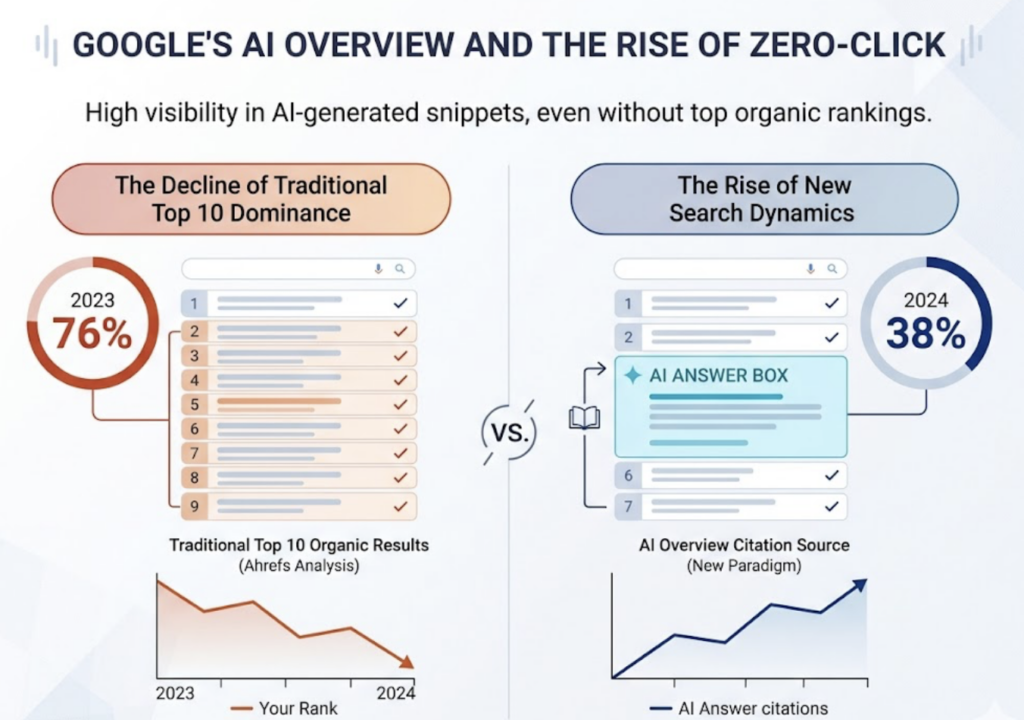
And ranking on Google no longer guarantees you make the cut. An Ahrefs analysis of 4 million AI Overview citations found that only 38% of cited pages also rank in the top 10 organic results, down from 76% a year earlier. AI engines weigh answer-readiness and source trust, not just the signals your rank tracker was built around.
Here’s the practical problem: the place your buyers increasingly ask is the one place your current tooling reports nothing.
What the Best Rank Checker Actually Tracks Now
If the job of a rank checker is to tell you where you stand when a buyer goes looking, then the job has expanded. A tool that only reads Google’s results page now covers a shrinking slice of that question.
The best rank checker for 2026 has to measure four things traditional trackers skip:
- Presence across engines. Whether your brand shows up in ChatGPT, Gemini, Perplexity, and Google AI Overviews, not just one of them.
- Position inside the answer. Where you land relative to competitors when the AI lists options.
- Citation and source share. Which domains the AI pulls from, and whether yours is one of them.
- Recommendation sentiment. How the model frames you. Premium or budget, leader or alternative.
Measuring this reliably is harder than running a SERP scan. AI answers shift with the model version, the user’s region, and even the time of day, since real-time retrieval keeps pulling in fresh content through the day. A single manual check tells you almost nothing. You need a fixed prompt set, run on a schedule, the same way you’ve always tracked keyword positions over time.
Checking Your Position Inside AI Answers
This is where a purpose-built AI search tracker earns its place next to your SERP tools. Topify treats the problem as rank tracking for the answer layer: define the prompts your buyers actually ask, then watch where your brand lands across the major AI engines over time.
Its Position Tracking shows where you sit relative to competitors inside AI responses, while Visibility Tracking records how often you get mentioned at all. Both run on a recurring schedule, so a drop registers as a trend rather than a one-off fluke.
The part that ties back to old-school rank checking is the why. When your mention rate falls, Topify traces it to the source domains the AI stopped citing, so you can see which piece of content lost its grip on the answer. Track it. Trace it. Fix it.
Coverage spans ChatGPT, Gemini, Perplexity, and other major engines, which matters because presence on one platform rarely predicts presence on another.
Traditional Rank Checker vs AI Rank Checker
Neither tool replaces the other. SERP rank tracking still matters, especially since strong organic rankings remain one input AI engines consider. The point is coverage. Each tool answers a different question, and running only one leaves a blind spot.
| Dimension | Traditional Rank Checker | AI Rank Checker |
|---|---|---|
| What it measures | URL position on the results page | Brand presence and rank inside AI answers |
| Engines covered | Google, Bing | ChatGPT, Gemini, Perplexity, AI Overviews |
| Unit of value | The click | The mention, citation, or recommendation |
| Update cadence | Daily or weekly | Scheduled prompt sets that account for model and recency variance |
| Explains a drop? | Tells you the position changed | Tells you which source or competitor displaced you |
The teams least exposed in 2026 run both and read them together. A ranking that holds while AI mentions fall is a signal, not a contradiction.
How to Start Tracking the Rankings Google Can’t Show You
You don’t need to rebuild your stack to close the gap. Start small and let the data show you where you stand.
First, list 10 to 20 prompts a real buyer would type into an AI engine when researching your category. Use plain questions, not keywords. Second, run them across ChatGPT, Perplexity, and Google AI Overviews, and record whether your brand appears, where it ranks, and how it’s described. Third, do the same for your two closest competitors, so you have a benchmark instead of an isolated number.
That baseline is usually the wake-up call. Most brands find they show up far less often than their Google rankings would suggest. From there, you can get started with a tool that runs the set on a schedule and flags movement automatically.
Conclusion
Stable rankings used to mean a stable business. In 2026, they can hide a brand that’s quietly disappearing from the answers buyers actually read. The numbers behind your green dashboard, fewer clicks per ranking and a widening gap between organic position and AI citation, all point the same direction. The fix isn’t abandoning your rank checker. It’s adding one that can see the answer layer, then reading both side by side. Run a baseline across the AI engines your buyers use, compare it to your SERP data, and you’ll know within an afternoon whether your visibility is as solid as it looks.
FAQ
Q: Can a traditional rank checker track AI search visibility?
A: Not in any meaningful way. SERP rank trackers read the results page and record URL positions. They have no view into whether ChatGPT or Perplexity mentions your brand, where you rank inside an answer, or which sources the AI cited. For that you need an AI search rank checker built for the answer layer.
Q: How do I check my brand ranking in ChatGPT or Perplexity?
A: Define a set of prompts your buyers would actually ask, run them across each engine on a recurring schedule, and record presence, position, and sentiment. Because AI answers vary by model, region, and time of day, a single manual check isn’t reliable. A tracking tool automates the prompt set and reports movement over time.
Q: Do Google rankings still matter for AI search?
A: Yes, but less than they used to. Strong organic rankings remain one signal AI engines weigh, yet only 38% of AI Overview citations now come from top-10 pages. Ranking well is necessary groundwork, not a guarantee of being cited or recommended.
Q: What makes the best rank checker for AI search different?
A: It measures the mention, citation, and recommendation rather than the click, covers several AI engines instead of one, and runs prompt sets on a schedule to handle the variance baked into AI answers. The strongest setups also explain why your visibility moved, tracing changes back to specific source domains or competitors.

