

Being ranked #1 on Google used to be the finish line. In 2026, AI citations are where real brand authority gets built — and most marketers haven’t noticed yet.
You’ve done the work. You’ve earned the top spot. Your page ranks #1 for a high-value keyword, and it’s been sitting there for months.
Then you check the traffic. It’s down 40% year-over-year — and your ranking hasn’t moved.
This isn’t a fluke. It’s the structural consequence of a shift that’s been building for two years and hit critical mass in 2026: users no longer need to click your link. They get the answer before they ever see it.
The metric that actually matters now isn’t your position in the list. It’s whether the AI includes you in its answer.
Google #1 Used to Be the Finish Line. It Isn’t Anymore.
In June 2024, the top organic result for an informational query averaged a 1.76% click-through rate. By September 2025, that number had dropped to 0.61% — a 61% collapse — and only for queries where an AI Overview appeared. Even queries without AI Overviews saw CTRs fall to 1.62%.
That data comes from Seer Interactive, which tracked 3,119 informational terms across 42 organizations over 15 months. The conclusion is hard to argue with: Google is still processing between 9.1 and 13.6 billion queries per day, and search volume is growing. Clicks to websites are not.
The paradox of 2026 is that more people are searching — and fewer of them are arriving at your site.
Platforms like Perplexity (780 million queries in May 2025) and ChatGPT (800 million weekly active users) have trained users to expect synthesized answers, not lists of links. When AI handles the research, the information retrieval, and the comparison — all in a single response — the user only clicks when they’ve already decided. Your #1 ranking gets you into the pool of sources the AI draws from. That’s it. Whether you’re named, cited, or recommended is a completely separate question.
So What Exactly Is an AI Citation?
An AI citation is a visible reference to your brand or website within an AI-generated answer. It’s not a backlink. It’s not a ranking signal. It’s an explicit attribution that places your brand inside the answer itself — where users are actually paying attention.
The difference matters more than most marketers realize:
| Aspect | Traditional Backlink | AI Citation |
|---|---|---|
| Visibility | Hidden in source code | Visible in the AI response |
| Control | Editors and publishers | AI models via RAG logic |
| Permanence | Persistent | Transient, changes per prompt |
| Primary value | Builds ranking authority | Builds trust at decision moment |
AI citations appear in three forms. Source references show up as clickable cards or footnotes — think Perplexity’s “Sources” box. Brand mentions are when the AI names your brand directly in the response text, as a recommended solution. Content excerpts are when the AI pulls your phrasing or data into its answer, usually with a citation marker.
Of these, brand mentions carry the most weight. Research puts brand mentions at 3x more predictive of AI visibility than traditional backlinks. Being listed as a footnote source is useful. Being named as the answer is where conversion happens.
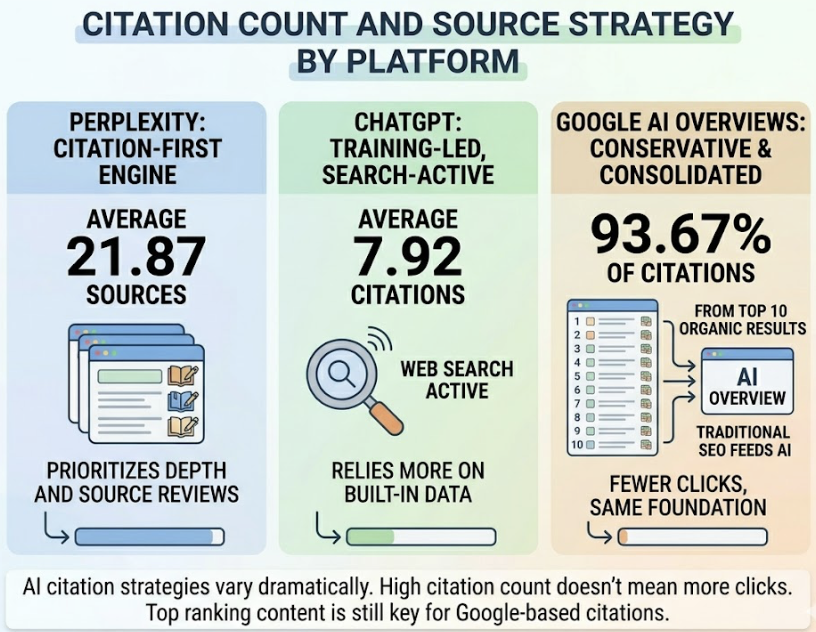
Each major platform handles citations differently. Perplexity was built as a “citation-first” engine and averages 21.87 sources per response. ChatGPT relies more heavily on training data and averages 7.92 citations when web search is active. Google AI Overviews are the most conservative — 93.67% of their citations come from the existing top 10 organic results — which means traditional SEO still feeds Google-based citations, just not the click itself.
Why an AI Citation Carries More Weight Than a Top Ranking
The quality gap between a click from a ranked result and a click from an AI citation is not marginal. It’s roughly 3x.
Data from Lebesgue, analyzing over 35,000 Shopify-based brands, found that AI referrals convert at 3.6% compared to 1.23% for traditional Google search. For B2B SaaS specifically, AI chatbot referrals delivered 6.69% CVR — on par with direct SEO traffic but arriving from a qualitatively different user.
The reason is what researchers call “funnel compression.” When a user finds your site via a Google ranking, they’re often still in research mode. When an AI recommends your brand by name, the AI has already handled the comparison, addressed the objections, and framed your product as the solution. The user’s click signals intent to act, not intent to browse.
That’s the difference between being found and being chosen.
There’s also a trust dynamic worth understanding. Users searching via AI treat the response like a recommendation from a knowledgeable advisor, not a list of options to evaluate. When an AI names your brand, it carries an implicit endorsement. That endorsement compresses the middle of the funnel before the user ever lands on your page.
The flip side of this is what analysts call the “Mention-Source Divide.” This is when an AI uses your content as invisible background data to inform its answer but explicitly names a competitor as the recommended solution. You provided the knowledge. They got the recommendation. It happens more often than most brands know.
3 Factors That Decide Whether AI Cites Your Brand
AI citation isn’t random. It’s driven by a logic that’s different from traditional SEO — and more manageable once you understand it.
Factor 1: Information gain, not keyword density. AI models favor sources that provide something genuinely unique: original data, specific statistics, proprietary research. According to findings from Princeton’s GEO research, adding statistics and credible references can increase AI visibility by up to 40%. Generic, summary-level content doesn’t get cited — it gets replaced by the AI’s own synthesis. The brands that earn citations are the ones that have data nobody else has.
Factor 2: Structural parsability. Because AI uses Retrieval-Augmented Generation to extract and reassemble information, the architecture of your content matters as much as the content itself. Pages that answer the core question within the first 200 words are 30% more likely to be cited by models like Claude. 68.7% of pages cited in ChatGPT follow logical heading hierarchies (H1 → H2 → H3). 81% of cited pages use Schema.org markup. Machine-readable structure isn’t a technical nicety — it’s a citation prerequisite.
Factor 3: Cross-platform mention frequency. AI citation operates on pattern recognition. If your brand is consistently referenced across Reddit threads, G2 reviews, industry forums, and news coverage, AI systems develop a “consensus” that you’re a category authority. Ahrefs’ study of 75,000 brands found that brand web mentions correlate with AI citations at r=0.664 — while total backlink count correlates at just r=0.10. Off-site brand signals are now 6x more predictive than backlink volume. One platform win tends to compound: a brand that earns consistent Perplexity citations often gains authority in ChatGPT’s more static index over time.
Your Competitors Are Already in the AI Answer. Are You?
Here’s the uncomfortable reality: most brands don’t know where they stand in AI recommendations. Traditional analytics can’t track zero-click impressions. GA4 doesn’t log “your brand appeared in a ChatGPT answer about project management software.” That visibility — or the absence of it — is completely invisible to standard tools.
Only 20% of brands remain consistently present across five consecutive runs of the same prompt. The rest appear occasionally, get displaced by competitors, or don’t show up at all. For competitive categories, this volatility is happening daily.
Topify was built specifically for this gap. Its Source Analysis feature reverse-engineers exactly which domains AI platforms are citing when users ask about your category — giving you a map of the “citation clusters” that feed AI perception of your space. Because 85% of brand mentions originate from third-party domains, knowing which platforms matter (Reddit, G2, Trustpilot, industry blogs) tells you precisely where your off-site efforts will move the needle.
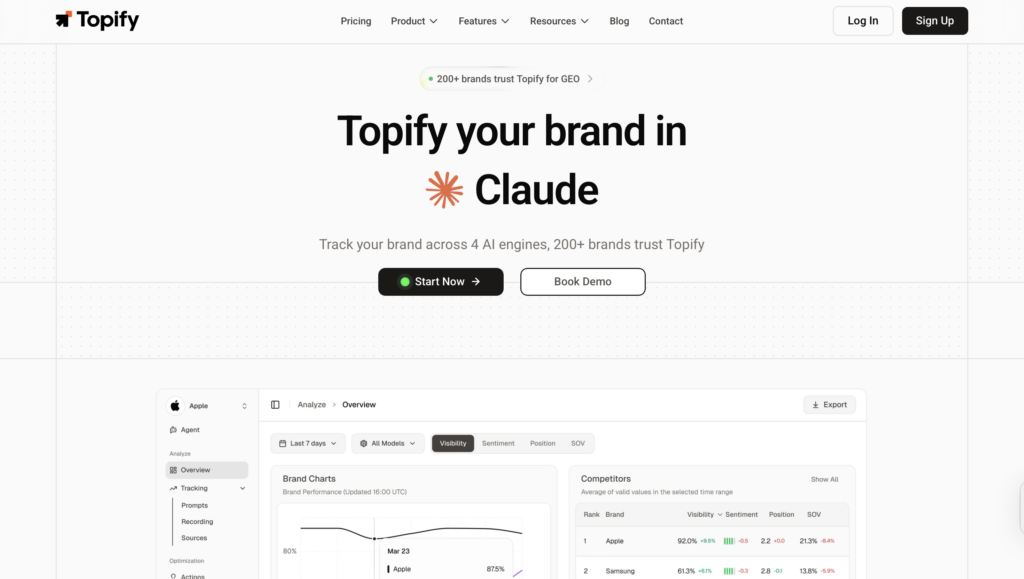
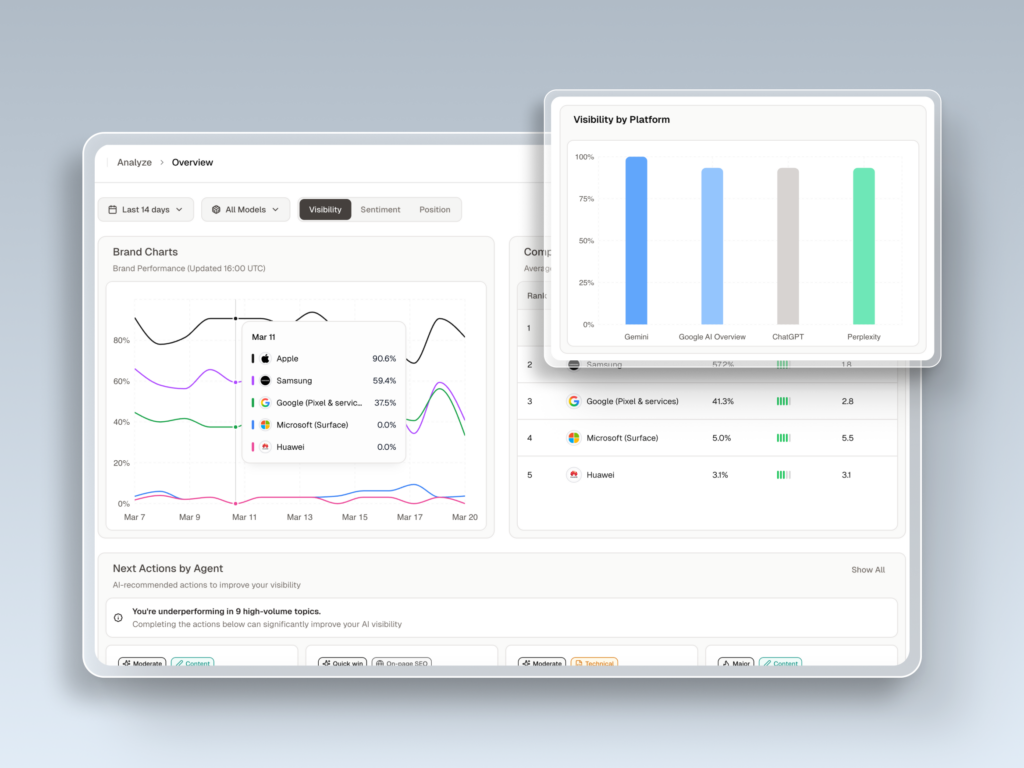
Topify’s Competitor Monitoring goes further — it tracks how often your competitors are cited relative to you, what sentiment the AI attaches to each brand, and where you sit in the response position index. If a competitor is earning first-position mentions in ChatGPT for your core category prompts, you’ll see it — and you’ll see the source domains driving it.
That’s the intelligence gap between brands operating in 2026 and those still optimizing for 2022.
How to Start Getting Cited by AI (Without Starting Over)
The good news is that transitioning to a citation-focused strategy doesn’t mean scrapping your existing content. It means restructuring it around extractability.
Prioritize answer-first structure. Every high-value page should open with a 2-3 sentence definitive statement — a clean, quotable definition or conclusion that an AI can pull directly. Save the context and nuance for the paragraphs that follow. Pages that bury the answer after three paragraphs of setup are losing citations to pages that don’t.
Replace adjectives with data. Phrases like “industry-leading performance” contribute nothing to AI citation probability. Specific numbers — load times, conversion rates, study sample sizes — are what AI models extract and attribute. If you have proprietary data, publish it. That’s your citation moat.
Treat content freshness as a citation retention strategy. Perplexity weights recency aggressively — content not updated in 90 days is 3x more likely to lose citation share to a competitor who published something newer. A rolling refresh model, where high-performing pages are updated with current statistics on a regular cadence, directly protects your citation position. Topify’s Visibility Tracking flags when your brand disappears from AI responses for specific prompts, so you can prioritize which pages need a refresh before you lose ground.
Start by auditing which of your pages are already being cited across ChatGPT, Perplexity, and Google AI Overviews — and which prompts in your category you’re absent from entirely. That gap is your roadmap.
Conclusion
The architecture of search has changed. Users aren’t navigating a list of ranked results — they’re accepting synthesized answers. And in that environment, a #1 ranking is the entry requirement, not the prize.
The prize is the citation. It’s where trust is built, where recommendations happen, and where the 3x conversion advantage lives. With organic CTRs down 61% on AI-present queries and zero-click behavior approaching 83% in AI-saturated searches, the brands that win will be those that AI systems recognize as authoritative, current, and structurally extractable.
Rankings get you into the room. Citations make you the recommendation.
If you don’t know where your brand stands in AI answers right now, Topify is where to start.
FAQ
Is an AI citation the same as a backlink?
No. A backlink is a persistent hyperlink used as a background signal for ranking algorithms — users don’t see it. An AI citation is a visible reference within an AI’s generated response, often temporary, that positions your brand as a trusted source in front of the user at the moment they’re making a decision.
Does being cited by AI improve my Google ranking too?
There’s a strong correlation, not direct causation. 93.67% of Google AI Overview citations come from the top 10 organic results, which means traditional SEO remains a prerequisite for Google-based citation eligibility. For ChatGPT and Perplexity, however, the drivers are entity authority and freshness — not Google rank. You can earn AI citations on those platforms without ranking highly, and you can rank #1 on Google while being absent from both.
How do I know if AI is already citing my brand?
Standard analytics can’t tell you. GA4 doesn’t capture zero-click AI appearances. You need tools that programmatically query LLM APIs and log brand appearances across platforms — like Topify, which tracks visibility, citation share, sentiment, and position across ChatGPT, Gemini, Perplexity, and others.
How often do AI citations change?
Frequently. Only 20% of brands appear consistently across five consecutive runs of the same prompt. In competitive categories, citation composition shifts daily — particularly on Perplexity, which re-crawls the live web for every query. Weekly tracking is the minimum; daily tracking is the standard for high-stakes categories.

