

Your keyword rankings are holding steady. Most of your dashboard is green. Then a prospect opens ChatGPT, asks for a recommendation in your category, and gets back five names. Yours isn’t one of them.
The rankings didn’t lie. They just stopped predicting what they used to, because by 2026 a top SERP position and a mention in an AI answer have become two separate things. Searching for the best rank checker is still worth doing. It’s just no longer the only number that tells you where your brand stands.
Why the Best Rank Checker Tells You Only Half the Story
Rank tracking was built on a simple assumption: a high SERP position predicts traffic. That assumption is breaking down fast.
By 2026, aggregate zero-click search rates have climbed to 64.82%, according to Digital Applied. When an AI Overview sits at the top of the page, organic click-through rates for the number-one Google result have dropped somewhere between 37.5% and 61%, based on Seer Interactive’s measurements. So you can hold position one and still watch the clicks evaporate.
It gets stranger. Ahrefs found that only about 38% of URLs cited in AI Overviews actually rank in the top 10 organic results. SERP authority and AI answer authority have decoupled.
That’s the gap most teams can’t see on a rank report.
The fix isn’t a better rank checker. It’s a second number that measures the layer your rank checker was never designed to watch.
What a Rank Checker Measures and What It Misses
A rank checker monitors where a specific URL sits, from position 1 to 100, on a Google or Bing results page. It’s a precise instrument for one job.
It does that job well. For navigational, transactional, and local queries, where people still scan a list and click, rank tracking remains the right tool. You’ll know when a product page slips from three to seven, and you’ll know which competitor moved up.
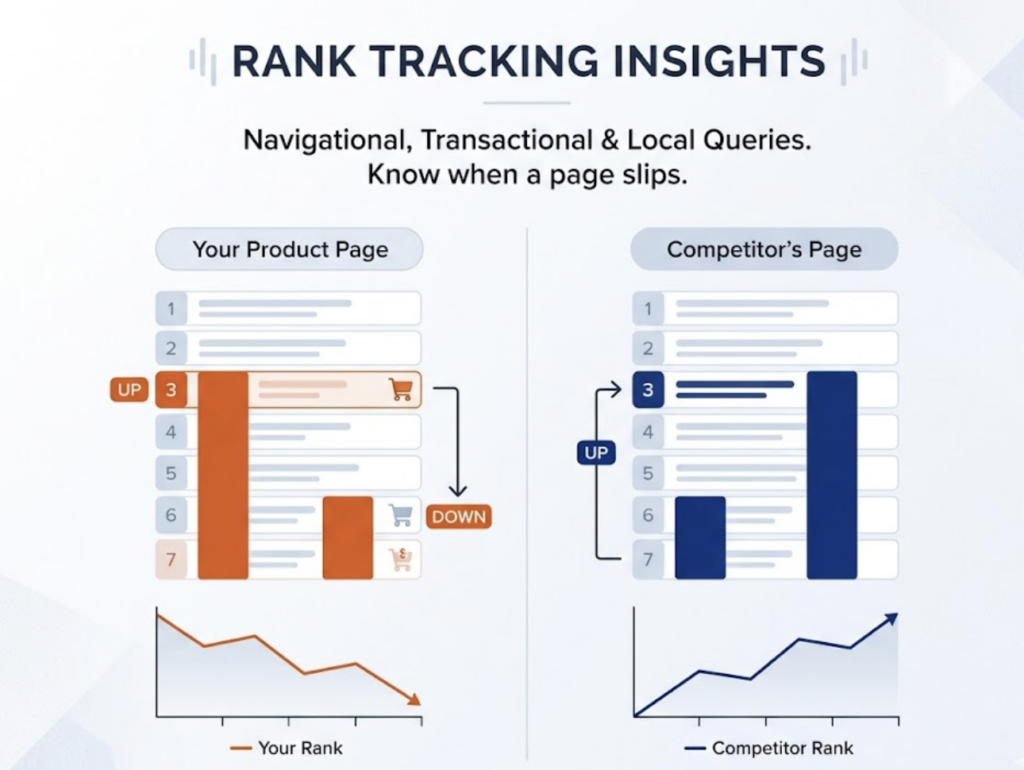
What it can’t see is the AI layer. A rank checker has no way to report whether your brand was mentioned, recommended, or quietly skipped inside a generated answer. The blue links it tracks are increasingly not where the high-intent research happens.
That blind spot is the whole problem. Your most-watched metric goes dark exactly where a growing share of buyers now start.
GEO Score: The Number That Tracks Whether AI Picks You
A GEO score quantifies your brand’s presence inside generative engines like ChatGPT, Perplexity, Gemini, and Claude. Instead of a SERP position, it measures citation frequency, recommendation order, and whether the model treats you as a source of truth.
Where a rank checker asks “are we on the page,” a GEO score asks “are we in the answer.” Generative engines reward what researchers call answer-readiness: logical structure, factual density, and semantic clarity. They care less about keyword density and backlink volume, the signals traditional rank tracking optimizes for.
The practical value is diagnostic. A GEO score doesn’t just tell you that AI is ignoring your brand. It points at why, by surfacing the citation gaps and structural issues keeping you out of the response.
The fastest way to see your own number is to run a baseline. Topify offers a free GEO Score Checker that audits a domain’s AI visibility with no signup, which is usually the cleanest first read on where you stand before you change anything.
Rank Checker vs. GEO Score: A Side-by-Side Look
The two numbers measure different domains of the same search behavior. Putting them next to each other makes the division of labor obvious.
| Dimension | Rank Checker | GEO Score |
|---|---|---|
| Tracking object | SERP link position | Citation frequency and recommendation rank |
| Primary platform | Google blue links | ChatGPT, Perplexity, Gemini, AI Overviews |
| Core metric | Keyword rank, 1 to 100 | Visibility index and citation authority |
| Blind spot | AI answer inclusion | Long-tail transactional SERP position |
| What you optimize | Crawlability and backlinks | Structure and fact-extractability |
Read the table as two halves of one picture, not a contest. A rank checker tells you how you compete for a click. A GEO score tells you how you compete for a citation. In 2026, most teams need both readings to explain what’s actually happening to their traffic.
When Each Number Matters More Than the Other
Neither metric wins outright. The smarter move is matching each number to the query type it explains best.
Rank checkers still lead for transactional and local intent. When someone searches “buy running shoes near me” or compares pricing pages, they want a list, and SERP position drives the click. Bottom-of-funnel work lives here.
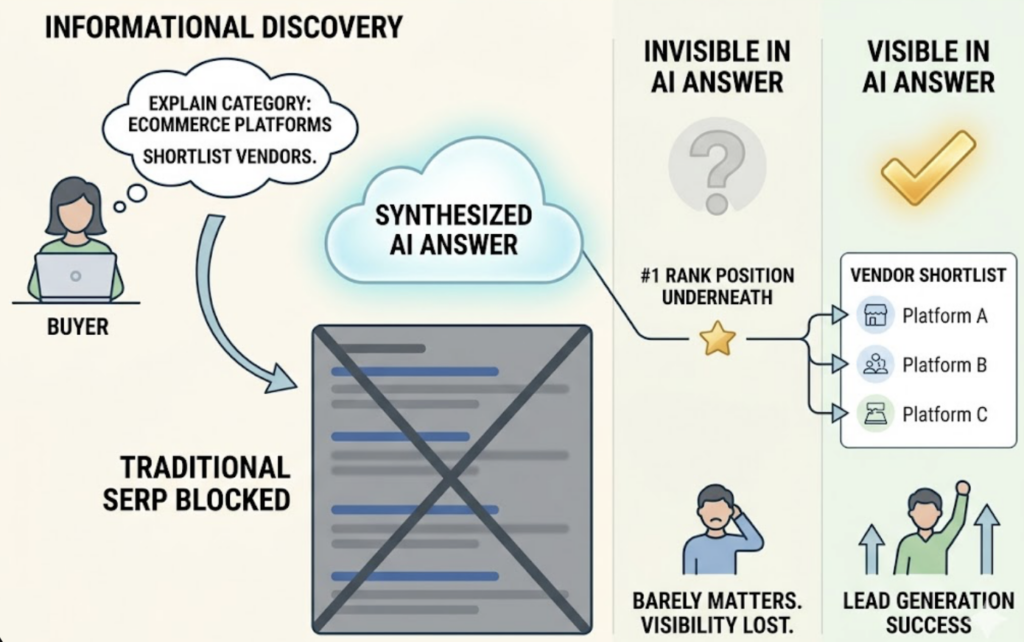
GEO scores lead for informational and research-stage discovery. When a buyer asks an AI assistant to explain a category or shortlist vendors, the synthesized answer often blocks the traditional SERP entirely. If you’re invisible in that answer, the rank you hold underneath barely matters.
There’s a cross-platform wrinkle worth flagging. AI models ground their answers differently, so a brand can perform well in Perplexity and stay invisible in ChatGPT. A single GEO score averaged across one platform hides that, which is why monitoring has to run model by model.
How to Track Both Numbers Without Doubling Your Stack
Here’s the trap most teams fall into. They keep their existing rank checker, bolt on a separate AI visibility tool, and end up with two dashboards that never reconcile. The data sits in silos, and nobody can answer “is our search visibility going up or down” without exporting two spreadsheets.
A consolidated approach solves that by treating both numbers as one workflow. With Topify, the GEO Score Checker gives you the free baseline, and the Comprehensive GEO Analytics engine extends it into ongoing monitoring across seven metrics, including visibility, sentiment, position, and mentions. In practice, that means you can watch an AI recommendation slip in real time, trace it to a competitor whose content structure the model now prefers, and line that up against your SERP rankings in the same view. The fragmented silos go away, and reporting stops being a reconciliation exercise.
Competitor benchmarking is where the two numbers compound. Topify maps why a rival is being cited, comparing their structure against the specific prompts your buyers use, so the GEO score becomes a list of fixes rather than a verdict. If you want to widen the audit further, Topify also maintains a free tools reference covering adjacent checks.
The point isn’t to replace your rank checker. It’s to stop treating SERP position as the only signal, when half your visibility now lives in answers the rank checker can’t read. You can get started with the baseline audit and add monitoring once the gaps are clear.
Conclusion
The visibility gap is simple to state and easy to miss. Your rank report can stay green while your brand disappears from the answers buyers actually read. One number tracks the click. The other tracks the citation. In 2026, watching only the first leaves you blind to where a growing share of discovery already happens.
Start with a baseline. Run a free GEO score against your domain, set it beside your current rankings, and look at the delta. If the two numbers disagree, that disagreement is the most useful thing your analytics will tell you all quarter.
FAQ
What’s the difference between a rank checker and a GEO score?
A rank checker tracks where your URL sits on a Google or Bing results page, from 1 to 100. A GEO score measures whether AI engines like ChatGPT and Perplexity mention, cite, or recommend your brand inside their answers. One watches the SERP, the other watches the synthesized response.
Do I still need a rank checker in 2026?
Yes, for transactional, navigational, and local queries where users still click a list of results. The change is that SERP position alone no longer predicts traffic, since zero-click rates and AI Overviews have absorbed much of the informational search behavior. Most teams now pair rank tracking with a GEO score.
How do I check my GEO score?
Run your domain through a free GEO Score Checker, such as the one Topify offers without a signup. It returns a baseline visibility read across AI platforms and flags the citation gaps keeping you out of generated answers.
Which metrics belong in a 2026 search monitoring system?
At minimum, keyword rankings for bottom-of-funnel queries plus AI visibility metrics like citation frequency, recommendation position, and sentiment across multiple models. Monitoring cross-platform matters, because a brand can rank well in Perplexity and stay invisible in ChatGPT.

