

Your client’s quarterly review is tomorrow. Every keyword in the white-label report is green: page one, top three, a few sitting at the very top. Then the client asks why a competitor keeps showing up when they type your category into ChatGPT, and the report has nothing to say. The rankings are real. The traffic just isn’t following them the way it used to. That gap, between a clean SERP report and what AI actually tells buyers, is where most agency rank checkers quietly stop measuring.
Why the Best Rank Checker in 2026 Tracks More Than Google
Traditional rank checkers do one thing well: they tell you where a URL sits on the Google results page. For a long time that was the whole game. In 2026, it’s a shrinking slice of it.
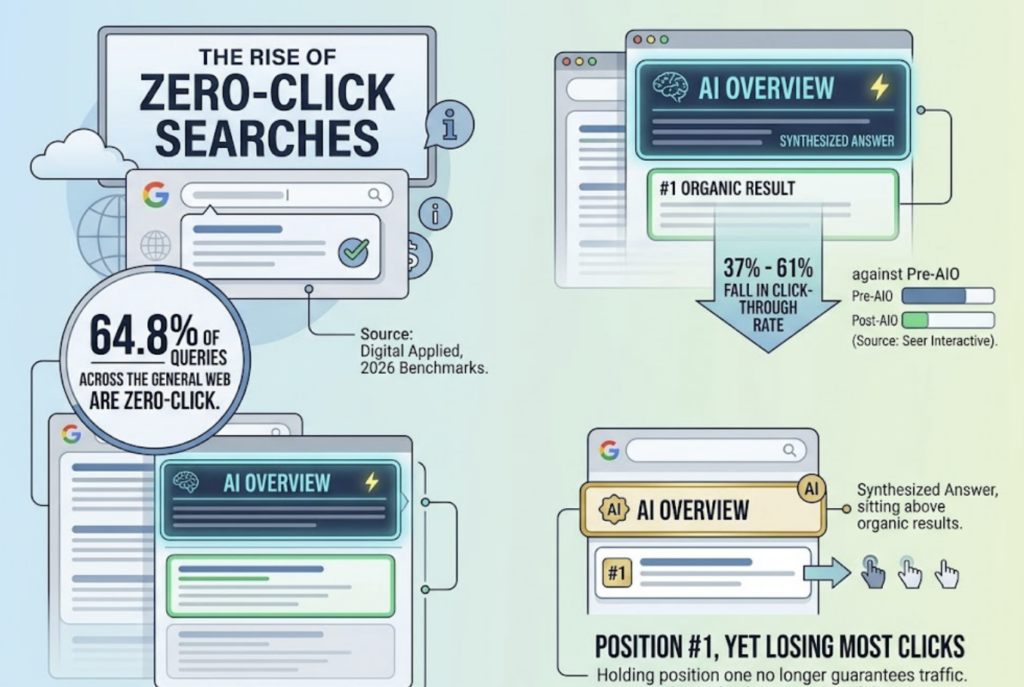
Zero-click searches now make up 64.8% of queries across the general web, per Digital Applied’s 2026 benchmarks. When an AI Overview appears, the top organic result’s click-through rate falls somewhere between 37% and 61%against pre-AIO baselines, according to Seer Interactive. So a keyword can hold position one and still lose most of its clicks to a synthesized answer sitting above it.
Here’s the part that breaks the white-label report.
Google SERP authority and AI answer authority are splitting into two separate variables. Ahrefs found that only around 38% of URLs cited in AI Overviews rank inside the top 10 organic results. Being #1 on Google no longer means you’re in the answer the buyer reads.
That’s the gap most agency reports still can’t see.
What an Agency Rank Tracker Should Actually Measure Now
The question clients ask has changed. It used to be “Where do I rank for X?” Now it’s closer to “Why does ChatGPT recommend my competitor for X when I’m #1 on Google?”
A rank checker built for 2026 has to answer both versions. SERP position still matters for transactional, bottom-of-funnel queries. But for the informational searches where buyers form opinions, the metric that counts is whether the brand shows up in the AI answer at all, and where it lands in that answer’s recommendation list. That second layer, the difference between AI search visibility and Google rankings, is exactly what legacy trackers were never built to see.
Use these dimensions to separate a legacy tracker from a 2026-ready one:
| Dimension | Legacy SERP Tracker | AI-Native Visibility Platform |
|---|---|---|
| Primary focus | URL position on Google SERPs | Citation presence and rank inside AI answers |
| AI coverage | Limited (SERP-feature tags) | Full (ChatGPT, Perplexity, Gemini, AI Overviews) |
| Reporting | Static white-label URLs | Dynamic answer-authority metrics |
| Actionability | Keyword and backlink suggestions | Content extractability and answer-readiness |
| Multi-client | Established multi-seat setup | Built for GEO-focused portfolio management |
Two of these rows decide most agency purchases. White-label reporting, because the data has to drop into a client deck without manual reformatting. And multi-client management, because an agency running 30 brands can’t juggle 30 separate logins.
The Best Rank Checker Tools for Agencies, Compared
Most agencies in 2026 run what amounts to a hybrid stack: a traditional tracker for transactional SEO, an AI-native platform for the answer layer. The two jobs are different enough that one tool rarely covers both well. Here’s how the main options line up.
| Tool | Google SERP tracking | AI answer rank | White-label reports | Multi-client | Starting price |
|---|---|---|---|---|---|
| Topify | Yes | Yes (ChatGPT, Perplexity, Gemini, AIO) | Yes | Yes (multi-project/seat) | $99/mo |
| AccuRanker | Yes (enterprise-grade) | No | Yes | Yes | Varies |
| SE Ranking | Yes | Limited | Yes (feature-rich) | Yes | Varies |
| Nightwatch | Yes (local + global) | No | Yes | Yes | Varies |
The pattern is hard to miss. The traditional trackers are strong on SERP depth and reporting, and nearly silent on AI answer rank. That single empty column is the one your client is now asking about.
#1 Topify: Adding the AI Rank Layer to Your White-Label Report
For agencies, the most useful question isn’t “which tool tracks Google best.” It’s “what fills the column my report is missing.” That’s where Topify tends to stand out.
Topify is built around the synthesis layer rather than the blue-link layer. Its Position Tracking monitors where a brand actually sits inside an AI’s response, not just whether it’s mentioned but whether it’s first, third, or buried under three competitors. Visibility Tracking runs the same check across ChatGPT, Gemini, Perplexity, and Google AI Overviews, so you can see a brand fade out of Perplexity while it holds steady in ChatGPT, instead of treating “AI search” as one undifferentiated number.
The piece agencies tend to underestimate is Source Analysis. It maps the specific pages AI engines cite when they recommend a brand or its competitors. In practice, that turns a vague client complaint (“we’re invisible in ChatGPT”) into a concrete action item: the competitor is being cited from three comparison pages and a Reddit thread, and the client has nothing comparable. That’s the kind of finding that justifies the next quarter’s content budget.
On the operational side, Topify was designed for portfolio management. Multi-project and multi-seat support starts at $99/month on the Basic plan, with four projects and four seats included, which maps cleanly onto how an agency assigns clients and team members. The white-label angle is the real unlock: you can inject AI visibility KPIs straight into the report framework you already send, so “AI Answer Authority” sits next to SERP position instead of living in a separate tool nobody opens.
The bottom line for agencies is leverage. Reporting a position number is table stakes. Explaining why a brand is or isn’t in an AI answer, and what to do about it, is the thing clients will pay a retainer for. You can get started with Topify on a single client before rolling it across the portfolio.
Traditional Rank Trackers Worth Keeping
None of this means tearing out the tools that already work. They just cover a different job.
AccuRanker and Nightwatch remain excellent for enterprise-scale, real-time Google SERP monitoring, with Nightwatch especially strong on local rank tracking across many locations. If a client’s growth still lives mostly in transactional, location-based search, these earn their place.
SE Ranking offers one of the more feature-rich white-label reporting suites for agencies, with solid SERP-feature monitoring. The trade-off is that it still runs on blue-link logic rather than LLM-based citation tracking, so the AI answer column stays empty.
The common thread across all three is the same: best-in-class for SERP, blind to the synthesis layer. That’s not a flaw so much as a boundary, and it’s the boundary your hybrid stack exists to cross.
How to Pick the Right Rank Checker for Your Client Mix
The right choice depends less on features and more on who your clients are.
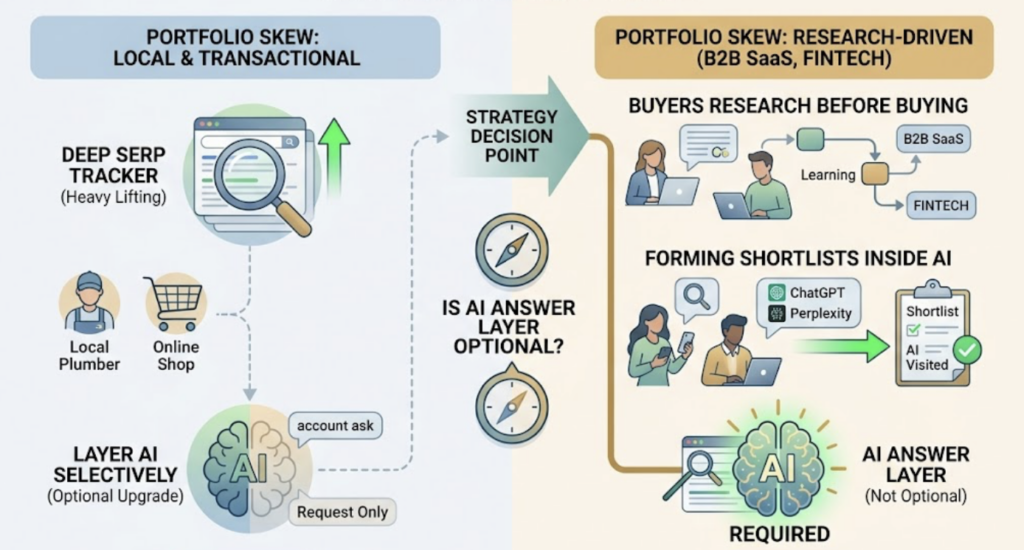
If your portfolio skews toward local services and transactional ecommerce, a deep SERP tracker still does most of the heavy lifting, and you can layer AI visibility selectively on the accounts that ask for it. If you serve B2B SaaS, fintech, or any category where buyers research before they buy, the AI answer layer isn’t optional. Those buyers are forming shortlists inside ChatGPT and Perplexity, and a report that ignores it is reporting on the wrong funnel stage.
A practical sequence: run a GEO-first audit on your highest-value informational keywords first. Where a client ranks #1 on Google but goes missing from the AI answer, the fix usually isn’t more backlinks. It’s extractability, clear headers, schema, and modular facts that AI engines can lift cleanly.
Start with the client most likely to ask the hard question. Prove the gap. Then standardize it.
Conclusion
The white-label report that wins client renewals in 2026 looks different from the one that won them in 2023. SERP position is still in it, but it’s no longer the headline. The agencies pulling ahead are the ones who can show a client exactly where they stand inside AI answers, name the competitor that’s outranking them there, and point to the source pages driving it.
The best rank checker for your agency, then, isn’t whichever tool tracks Google most precisely. It’s the one that closes the column your report has been leaving blank. Pick the stack that lets you walk into the next review with an answer to the AI question, before the client has to ask it.
FAQ
What’s the difference between a SERP rank checker and an AI rank tracker?
A SERP rank checker reports where your URL sits on the Google results page. An AI rank tracker reports whether and where your brand appears inside AI-generated answers from ChatGPT, Perplexity, Gemini, and AI Overviews. Since only about 38% of AI-cited URLs rank in Google’s top 10, the two measure increasingly different things, and an agency report needs both.
Can I add AI visibility data to a white-label rank tracking report?
Yes. Platforms like Topify are built to inject AI visibility KPIs into existing client report frameworks, so answer-authority metrics sit alongside traditional SERP positions instead of living in a separate dashboard your client never opens.
Do I still need a traditional rank tracker if I use an AI rank checker?
For most agencies, yes. Traditional trackers like AccuRanker, SE Ranking, and Nightwatch remain strong for transactional and local SEO. The AI rank checker covers the informational, top-of-funnel queries where buyers form opinions. Running both is the hybrid stack most agencies have settled on.
Is there a free way to check AI search rankings before committing to a tool?
You can start with a free GEO score check to see roughly how visible a brand is across AI engines, and there’s a public list of free rank and visibility toolsworth trying before you buy. They won’t replace continuous, multi-client tracking, but they’re a fast way to confirm the gap exists.

