

Your rank checker says you’re winning. Position 2 for your money keyword, top five across the board, rankings holding steady month over month. Then a prospect opens ChatGPT, types “best tool for [your category],” and reads back five recommendations. Yours isn’t one of them. Nothing in your dashboard explains it, because the dashboard was built to measure a page you control, not an answer a model generates. The position you’ve optimized for years is still real. It’s just no longer the only place buyers decide.
Why Most Rank Checkers Only See Half the Picture
A traditional rank checker runs on one assumption: that “ranking” means a position between 1 and 100 on a Google results page. That assumption held for two decades. In 2026 it covers a shrinking slice of how people actually find brands.
Search has split into two pathways. There’s the familiar SERP pathway, and there’s the synthesis pathway, where ChatGPT, Perplexity, and Google’s AI Overviews answer the question directly instead of handing back ten links. AI-assisted search traffic has jumped 527% year over year, and ChatGPT Search alone now handles somewhere between 250 and 500 million search-intent queries every week.
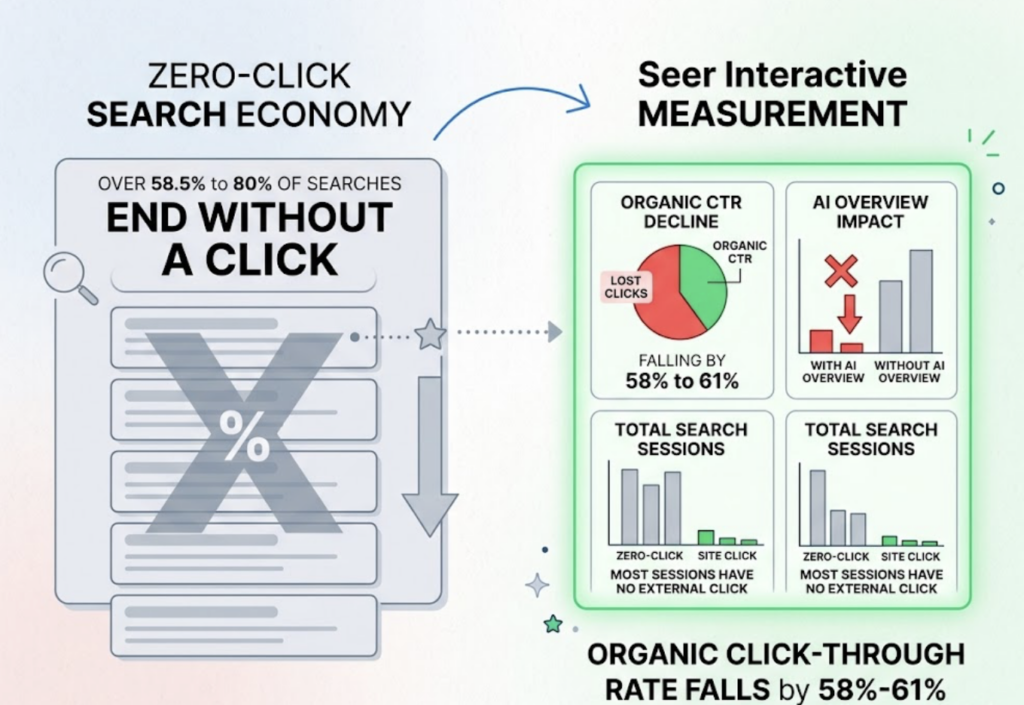
The click economy is eroding underneath the rankings. Depending on the dataset, between 58.5% and 80% of search sessions now end without a single click to a third-party site. When an AI Overview sits at the top of the page, Seer Interactive measured organic click-through rate for top-ranking results falling by 58% to 61%.
Here’s the part that should worry anyone optimizing for position alone.
Your rank can be perfect and your AI visibility can be zero. They’re measured by different systems, and a tool built for one is blind to the other. That’s the gap most teams don’t see until a competitor starts showing up in answers they never appear in. The distinction between AI search visibility and Google rankings is now the difference between two separate scoreboards.
The Three Types of Rank Checkers, and Who Each One Is For
“Rank checker” has quietly become three different categories of tool wearing the same name. Sorting them out is the first step to picking the right one.
| Tool type | What it tracks | What it misses | Best fit |
|---|---|---|---|
| Traditional SERP rank checker | Keyword positions 1–100 on Google | Whether AI engines mention or recommend you at all | Local, transactional, and navigational queries |
| SEO suite with rank tracking | SERP positions, backlinks, domain authority | AI answer position; citation behavior across platforms | Established SEO teams managing large keyword sets |
| AI rank checker / visibility tracker | Brand mentions and position inside AI-generated answers across platforms | Granular blue-link rank history (by design) | Brands whose buyers research through ChatGPT, Perplexity, or AI Overviews |
The split maps cleanly onto the two pathways. A traditional rank checker is keyword-to-URL matching scored by SERP position. An AI rank checker works on different logic entirely: it watches semantic intent and entity authority, and scores you on citation probability and brand mention rather than a numbered slot.
Both are legitimate. They answer different questions. The mistake is assuming the tool you already own answers both.
How to Tell Which Rank Checker You Actually Need
Skip the feature lists for a minute and answer three questions about your own funnel.
First, where do your buyers actually start their research? If they’re typing transactional and navigational queries into Google, a SERP tracker still maps your reality. If they’re asking ChatGPT or Perplexity open-ended “which tool should I use” questions, those sessions never touch a results page you can track.
Second, can your current rankings explain your traffic swings? When informational traffic drops while your positions hold steady, that’s a strong signal the synthesis pathway is rerouting demand around you.
Third, is one platform enough? Traditional tools watch Google. AI discovery is spread across ChatGPT, Gemini, Perplexity, AI Overviews, and others, each with its own citation behavior.
The data makes the case sharper than any feature comparison. Only about 38% of the URLs cited in AI Overviews rank in Google’s top ten, which means strong SERP authority is no longer a reliable proxy for AI visibility. Ranking and getting cited have become separate outcomes.
So the best rank checker isn’t the one with the longest feature list. It’s the one that measures the pathway your audience actually uses. For a growing number of brands, that pathway is no longer a page of links.
What a Rank Checker Built for AI Search Looks Like
When the thing you need to track is your position inside an AI answer, the tooling has to be built for that from the ground up. Topify approaches the problem as an AI-native rank checker: instead of scoring where your page sits on Google, it scores where your brand sits in what the models actually say.
That starts with coverage. Topify tracks brand presence across ChatGPT, Gemini, Perplexity, DeepSeek, Doubao, Qwen, and other major engines, so you’re not inferring cross-platform performance from a single source. Each platform cites and recommends differently, and watching only one tells you almost nothing about the rest.
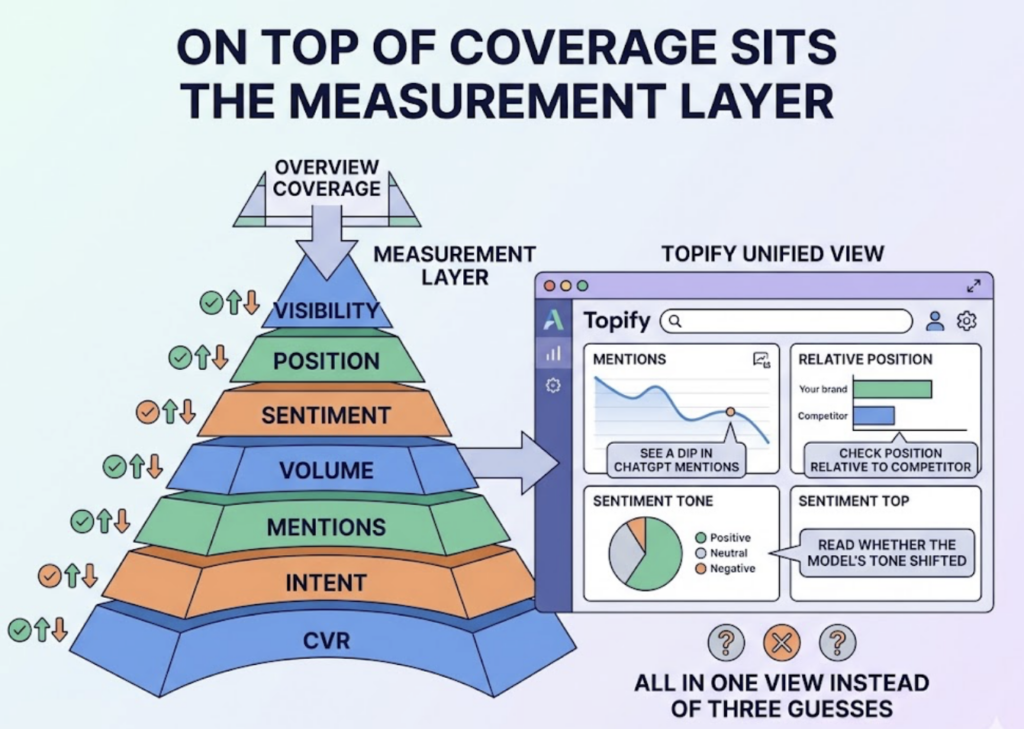
On top of coverage sits the measurement layer. Rather than a single number, Topify reports across seven metrics: visibility, position, sentiment, volume, mentions, intent, and CVR. In practice, that means you can see a dip in ChatGPT mentions, check whether your position relative to a competitor slipped, and read whether the model’s tone toward your brand shifted, all in one view instead of three guesses.
Two capabilities matter most for teams coming from a SERP background.
Position tracking inside AI answers tells you not just whether you’re mentioned but where you land relative to rivals when a model lists options. That’s the closest equivalent to a keyword ranking, except the “page” is a generated paragraph. And source analysis reverse-engineers the citations: it surfaces the exact domains and URLs the engines pull from, so you can see whether your content, or a competitor’s, is feeding the answers.
That’s the layer a traditional rank checker was never built to see.
For teams that want to test the idea before committing, a free GEO score check is a low-friction way to get a baseline, and this roundup of free GEO tools is a reasonable place to start. The point isn’t to replace your SEO stack on day one. It’s to stop flying blind on a pathway that now carries a large share of your buyers.
Where Traditional Rank Checkers Still Earn Their Place
None of this retires the SERP rank checker. It just relocates it.
Transactional and navigational searches still happen on Google, and for those, position and click-through remain the right things to measure. Local SEO, ecommerce category pages, and branded-query defense all live on the blue-link pathway, where tools like Ahrefs, Semrush, and SE Ranking continue to do exactly what they’re good at.
The 2026 reality is a dual-stack one. Traditional rank checkers monitor the SERP pathway. AI-native tools monitor the synthesis pathway. Treating either as optional leaves a hole in your reporting, and right now most teams only have the first half.
Matching the Best Rank Checker to Your Stack
The right setup depends on where your demand is moving, not on which tool has the flashiest dashboard.
If your traffic is still overwhelmingly Google-driven and transactional, keep your SERP tracker as the core and add a periodic AI visibility baseline so you’ll catch the shift early rather than late. If informational and research-stage traffic is softening while your rankings hold, that’s the signal to make an AI rank checker a standing part of your measurement, not an experiment. And if you’re an agency reporting to clients, you’ll eventually need both, because “how are we doing in AI search” is now a question that shows up in quarterly reviews with no slide to answer it.
The cost of skipping the second stack is measured in invisibility. By one estimate in the research, organizations that monitor only SERP position are effectively blind to 40% to 80% of the modern buyer journey. You can get started with Topify on the AI side without tearing out anything you already run.
Conclusion
The rank checker on your screen isn’t wrong. It’s just answering a question that used to be the whole game and is now half of it. Google position still matters for the searches that still happen on Google. Everything routed through an AI answer needs its own scoreboard, and a SERP tool can’t keep it.
The practical next step is small: run an AI visibility baseline this quarter, see where your brand actually lands when a model gets asked about your category, and compare that to your SERP rankings. If the two pictures don’t match, you’ve just found the part of your funnel you couldn’t see.
FAQ
Q: What’s the difference between an AI rank checker and an SEO rank checker?
A: An SEO rank checker measures your position on Google’s results page for specific keywords. An AI rank checker measures whether and where your brand appears inside answers generated by ChatGPT, Perplexity, and AI Overviews. One tracks links on a page; the other tracks mentions and position inside a generated response.
Q: Can’t I just check ChatGPT myself by asking it questions?
A: Manual spot-checks are unreliable. AI answers vary by phrasing, user history, region, and model updates, and they change week to week. A single prompt tells you almost nothing about your overall standing, which is why teams move to systematic tracking across platforms rather than ad hoc queries.
Q: Do I still need a traditional rank checker in 2026?
A: For transactional, navigational, and local searches, yes. Those queries still resolve on Google, and SERP position still predicts clicks. The shift isn’t replacement, it’s addition: most brands now need both a SERP tracker and an AI visibility tool to cover the full buyer journey.
Q: What’s the best rank checker for tracking ChatGPT visibility?
A: For ChatGPT specifically, you want a tool built to read AI answers, not Google pages. Look for cross-platform coverage, position tracking inside answers, and source analysis that shows which URLs the model cites. AI-native platforms like Topify are designed around exactly those signals.

