

You updated your content. Your rankings held. But your brand barely shows up in ChatGPT, and Perplexity is recommending your competitor instead. Traditional SEO did its job. The problem is that the job description changed.
AI SEO tools aren’t all the same animal anymore. Some optimize for Google’s AI Overviews. Some track brand mentions inside LLM responses. Some just slap “AI” on a keyword tool and call it a day.
This list cuts through that.
Here are the 10 AI SEO tools worth your attention in 2026, with an honest take on what each one actually does well.
What Changed in AI SEO in 2026 (and What Didn’t)
The tools that made “best of” lists in 2024 aren’t necessarily the right picks today. Zero-click searches now account for roughly 60% of traditional search queries, which means the game shifted from getting clicked to getting cited. That’s a different optimization problem entirely.
What didn’t change: backlinks still matter, content quality still matters, and technical health is still table stakes. What changed is the layer above all of that. Being indexed is no longer enough. You also need to be synthesized.
The tools below reflect that two-layer reality: traditional SEO depth on one side, generative visibility tracking on the other.
The 10 AI SEO Tools Worth Your Attention in 2026
1. Topify
Best for: Teams that need to track and improve AI search visibility across multiple platforms
Most AI SEO platforms tell you what’s happening on Google. Topify tells you what ChatGPT, Gemini, Perplexity, and seven other major AI platforms are actually saying about your brand.
That distinction matters. AI-driven traffic converts roughly 5x better than standard organic search traffic, and only 19% of users click through to sources cited in an AI overview. The ones who do are your highest-intent audience. Topify is built around the premise that being cited is the new ranking.
The platform tracks seven metrics simultaneously: visibility, sentiment, position, volume, mentions, intent, and CVR (Conversion Visibility Rate). For competitive intelligence, the Competitor Monitoring feature automatically detects which brands AI engines are recommending instead of yours, with real-time positioning data. Source Analysis goes a layer deeper, showing exactly which third-party domains AI platforms are citing, which helps identify content gaps before they widen.
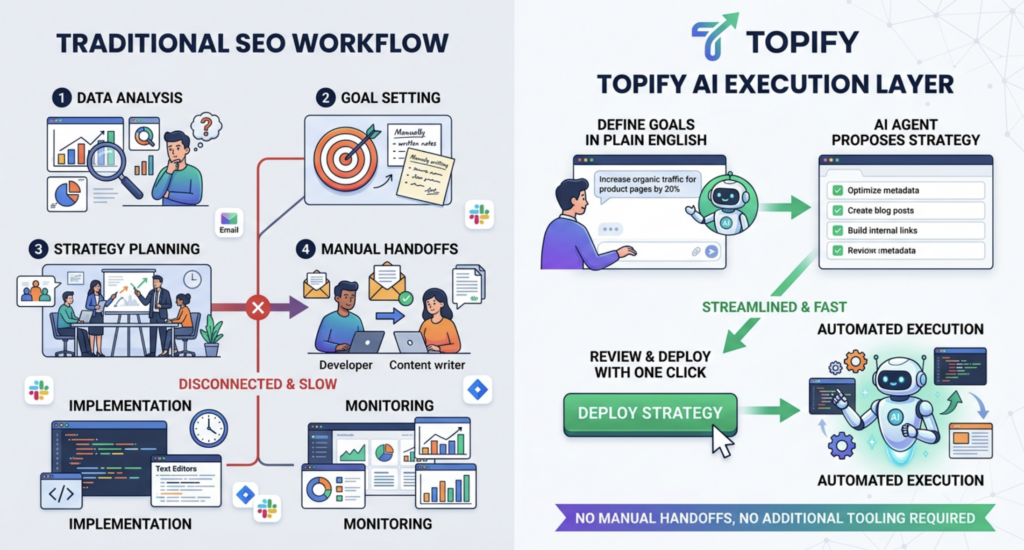
What sets Topify apart from generic SEO dashboards is the execution layer. Its AI agent doesn’t just surface data. You define your goals in plain English, review the proposed strategy, and deploy with a single click. No manual handoffs, no additional workflow tooling required.
Topify was built by a team that includes an LLM researcher with 2,000+ academic citations and a GEO strategy lead who scaled a site from zero to 1 million organic visitors. That background shows in how precisely the platform models AI citation behavior.
The coverage spans ChatGPT, Gemini, Perplexity, DeepSeek, and several other regional AI platforms, which matters if your audience is global. Most competitors track two or three engines and call it comprehensive.
Pricing: Starts at $99/month (Basic plan: 100 prompts, 4 platforms, 4 projects). Pro at $199/month covers 250 prompts and 8 projects. Enterprise from $499/month with a dedicated account manager.
2. Semrush One
Best for: Large teams that need predictive intelligence across both traditional and AI search
Semrush has evolved from a keyword database into something closer to a command center. Its AI Visibility Toolkit provides real-time brand mention tracking across ChatGPT, Gemini, and Perplexity. The Copilot dashboard assistant proactively flags schema errors and entity mapping issues before they affect citation frequency, which is a meaningful shift from reactive to predictive monitoring.
For scale, the Keyword Magic Tool clusters billions of terms by intent automatically. It’s a strong choice for enterprises already deep in the Semrush ecosystem, though the AI visibility features are gated behind higher-tier plans.
Pricing: Starts around $139/month.
3. SE Ranking
Best for: Challenger brands that need daily data and can’t afford weekly lag
Most platforms update their AI visibility data weekly. SE Ranking does it daily, which matters more than it sounds. AI responses can shift within hours after a major news cycle or a competitor’s content push.
The “No Cited” feature is particularly sharp: it identifies specific prompts where competitors receive citations but your brand doesn’t. That’s automated gap analysis that used to require manual prompt testing. Its AI Search Score synthesizes visibility across up to nine platforms into a single metric, useful for executive reporting.
Pricing: Starts at $65/month.
4. Ahrefs
Best for: Authority-first strategies and backlink intelligence
Ahrefs remains the benchmark for backlink data, and backlinks are still a training signal for LLMs in 2026. Its Brand Radar monitors visibility across 243 million monthly prompts derived from real “People Also Ask” data. The Link Intent score predicts how much generative traffic a new page will likely receive based on its existing authority profile.
The AI Content Helper identifies specific subtopics where a page is under-optimized compared to the top entities cited by Gemini and GPT-4, enabling surgical updates rather than full rewrites.
Pricing: Starts at $129/month.
5. Surfer SEO
Best for: Content teams producing at volume without losing entity coverage
Surfer’s Content Score was updated in 2026 to reflect semantic relationships and factual density, which are primary drivers of AI citations. Its Auto-Optimize feature has reduced content refresh labor by over 60% for mid-size content teams, according to the platform’s own data.
The Humanizer feature addresses what the industry calls the “Bland Tax”: AI-generated content that reads synthetically and gets filtered by both users and algorithms. Worth noting that Surfer is primarily a content optimization tool, not an AI visibility tracker.
Pricing: Starts at $89/month.
6. Clearscope
Best for: Media brands and editorial teams with strict content quality standards
Clearscope’s Query Fan-out Awareness analyzes how AI models expand a single query into related sub-queries. This helps writers build content that covers the full conversational journey, not just the primary question. Its grading system functions like an academic benchmark, calibrated to the quality thresholds required for inclusion in Google’s AI Overviews.
It’s the right tool if your primary bottleneck is editorial quality, not visibility tracking.
Pricing: Starts at $189/month.
7. Frase
Best for: Solo writers and small teams focused on AEO and structured content
Frase remains the most accessible entry point for Answer Engine Optimization (AEO). Its AI Agent generates a structured content brief from the top 20 SERP results in under 60 seconds, highlighting the questions AI engines are most likely to extract for summaries. The dual scoring system shows alignment with both traditional algorithms and generative synthesis patterns simultaneously.
For small teams building FAQ-heavy content strategies, it’s the most affordable option on this list that understands the AEO layer.
Pricing: Starts at $45/month.
8. MarketMuse
Best for: Content strategists building topical authority over 6- to 12-month horizons
MarketMuse’s Personalized Difficulty Scores are a standout feature: they show which topics your specific domain is most likely to win, based on its existing semantic footprint rather than generic competition metrics. The Automated Content Inventory surfaces topical gaps that prevent LLMs from recognizing a site as an authority in its space.
It’s a strategy tool, not an execution tool. You’ll want to pair it with something else for content production.
Pricing: Starts at $149/month.
9. Alli AI
Best for: Technical teams managing large sites with JavaScript architecture problems
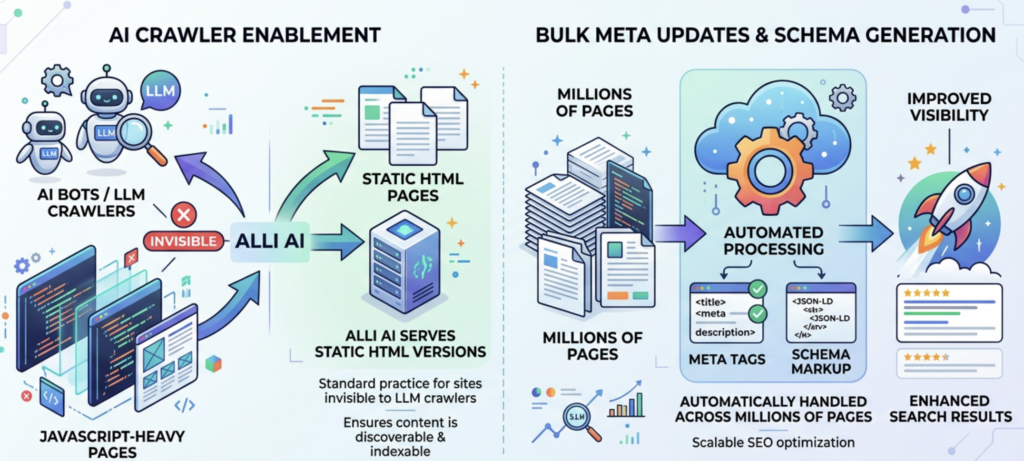
Alli AI’s strongest contribution is AI Crawler Enablement. It serves static HTML versions of JavaScript-heavy pages specifically to AI bots, which is standard practice for sites that would otherwise be invisible to LLM crawlers. Bulk meta updates and schema generation across millions of pages are handled automatically.
If your site architecture is clean, this tool is less relevant. If it’s not, it’s close to essential.
Pricing: Starts at $299/month.
10. LLMClicks.ai
Best for: Brands actively managing AI-generated misinformation about their products
Generative engines hallucinate. That’s not a future risk; it’s a current one.
LLMClicks monitors AI responses for incorrect product descriptions, outdated pricing, and competitive misrepresentation. It identifies the specific third-party sites being cited to form those errors, so you can target corrections at the source rather than chasing the symptoms.
For brands in regulated industries or with complex product lines, this kind of reputation monitoring is worth prioritizing before anything else.
Pricing: Contact for pricing.
How These 10 AI SEO Tools Stack Up Side by Side
| Tool | Keyword Research | Content Optimization | AI Visibility Tracking | Competitor Monitoring | Starts At |
|---|---|---|---|---|---|
| Topify | ✓✓ | ✓✓ | $99/mo | ||
| Semrush One | ✓✓ | ✓ | ✓✓ | ✓ | $139/mo |
| SE Ranking | ✓ | ✓ | ✓✓ | ✓ | $65/mo |
| Ahrefs | ✓✓ | ✓ | ✓ | ✓ | $129/mo |
| Surfer SEO | ✓✓ | $89/mo | |||
| Clearscope | ✓✓ | $189/mo | |||
| Frase | ✓ | ✓✓ | $45/mo | ||
| MarketMuse | ✓ | ✓✓ | $149/mo | ||
| Alli AI | $299/mo | ||||
| LLMClicks | ✓ | Custom |
✓✓ = core strength / ✓ = secondary capability
AI SEO Stops at Google. GEO Doesn’t.
Here’s the thing most AI SEO tools miss: they’re still optimizing for a Google-first world.
65% of enterprise marketing leaders are dedicating at least 25% of their 2026 marketing budgets to AI search optimization. The reason is straightforward: AI-driven traffic converts at roughly 10%, compared to under 2% for traditional organic. That performance gap is hard to ignore once you see it in your own analytics.
But if your tool doesn’t track what Perplexity says about you, or how Gemini frames your product against competitors, you’re only seeing half the picture.
Generative Engine Optimization (GEO) is the discipline built specifically for that blind spot. It’s less about keywords and more about entity consistency, citation velocity, and whether AI models trust your brand’s informational signals across the full digital landscape. If your brand’s LinkedIn, Reddit mentions, and website are telling slightly different stories, generative engines detect that inconsistency and it affects how often you get cited.
That’s the gap Topify was designed to close. While other platforms track rankings, Topify tracks whether AI is recommending you, and what it would take to change that.
5 Questions to Ask Before You Subscribe to Any AI SEO Tool
Not every tool on this list is the right fit for every team. These five filters help narrow it down fast.
1. Does your problem live in content creation or visibility tracking? Surfer, Clearscope, and Frase solve content problems. Topify and SE Ranking solve tracking problems. They serve different functions and aren’t interchangeable.
2. How often does your market move? If you’re in a competitive category where AI responses shift quickly, weekly refresh rates aren’t enough. Daily data from SE Ranking or real-time alerts from Topify matter here.
3. Are you optimizing for Google or for AI search platforms? These require different tools and different strategies. Most growth-stage teams need both layers covered, which typically means pairing a content tool with a GEO tracking platform.
4. What’s your technical architecture? If your site runs heavy JavaScript, AI crawlers may not be reading it correctly. That’s an Alli AI problem before it’s anything else.
5. Are there active hallucinations about your brand in AI responses? If competitors or outdated sources are creating false narratives inside LLM responses, reputation monitoring comes before visibility optimization.
Conclusion
The right AI SEO tool in 2026 depends entirely on which layer of the problem you’re solving. Traditional SEO platforms like Surfer and Ahrefs still have a place. But if you’re not tracking what AI engines say about your brand, you’re operating without half your data.
87% of enterprise leaders expect major AI platforms to complete closed-loop transactions within the next 12 months. The brands that get cited consistently now will have a structural advantage when those agent-driven workflows become mainstream. The window to build that citation authority isn’t open indefinitely.
If AI search visibility is the gap you’re trying to close, Topify covers tracking, competitive benchmarking, and execution in one platform. Get started here.
FAQ
Q: What’s the difference between AI SEO tools and traditional SEO tools?
A: Traditional SEO tools optimize for Google’s link-based ranking algorithm. AI SEO tools also track how your brand appears in generative AI responses from platforms like ChatGPT, Gemini, and Perplexity. In 2026, effective search optimization typically requires both layers, since a meaningful share of discovery now happens inside AI responses rather than on a search results page.
Q: Can AI SEO tools replace an SEO specialist?
A: Not fully. Automation now handles roughly 60-70% of routine tasks like audits, content scaling, and technical fixes. But human judgment is still needed for strategy, entity consistency management, and the editorial nuance that prevents AI-generated content from being filtered out for reading synthetically. The role has shifted from execution to orchestration.
Q: What is GEO, and how does it relate to AI SEO?
A: GEO (Generative Engine Optimization) is the practice of optimizing specifically for how AI systems synthesize, cite, and recommend your brand. It’s the layer of AI SEO that traditional platforms weren’t built for. Instead of keywords, GEO focuses on entity signals, citation velocity, and machine readability across the full digital landscape where LLMs gather training and retrieval data.
Q: Do these tools work for small websites or solo founders?
A: Yes, selectively. Frase ($45/month) and SE Ranking ($65/month) are the most accessible entry points. Topify’s Basic plan at $99/month is designed for smaller teams that want AI visibility tracking without enterprise pricing. For teams just starting out, the priority should be: content quality first, then visibility tracking once you have something worth tracking.

