

Search “best AEO tools” and you’ll find a dozen platforms claiming to track AI visibility. Most of them show a dashboard. What they don’t tell you is what they’re actually measuring, which AI platforms they cover, and whether the data leads to any action your team can take.
For SaaS brands, where software buyers are 3x more likely to use AI for vendor research than buyers in other sectors, picking the wrong tool isn’t a minor inconvenience. It’s a structural gap that your competitors will fill.
Here’s a ranked breakdown of the AEO tools worth considering in 2026, with a clear-eyed look at what each one actually does.
AEO in 2026 Isn’t What It Was 18 Months Ago
Featured Snippets used to be the goal. Now they’re almost irrelevant.
By 2026, the buying journey for B2B software has fundamentally shifted. 50% of B2B buyers now start their vendor research in an AI platform rather than Google. AI search traffic has grown 527% year-over-year. When a CTO queries Perplexity with something like “Which ERP handles cross-border compliance for fintech startups?” the answer they get isn’t a list of links. It’s a synthesized recommendation that names two or three vendors. If your brand isn’t one of them, that deal starts without you.
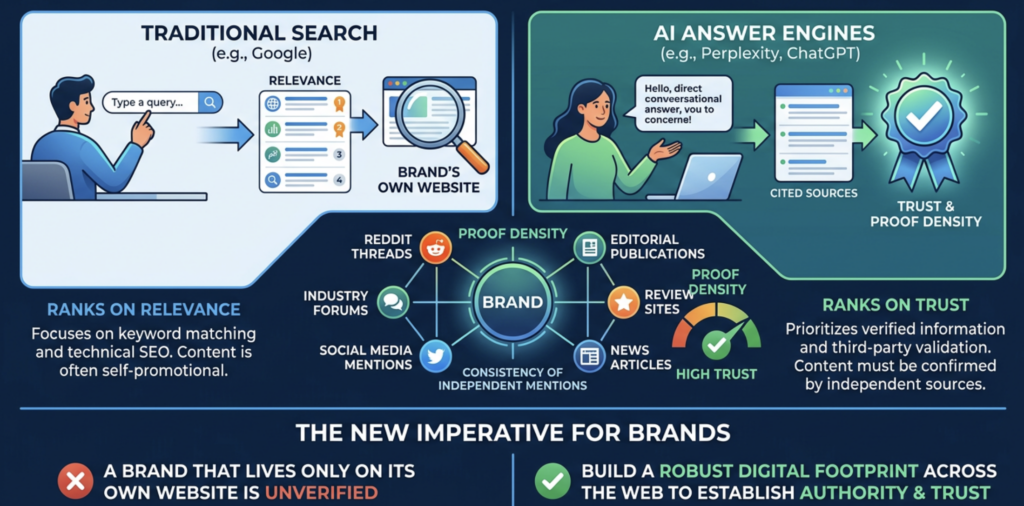
The underlying logic has also changed. Traditional search ranks on relevance. AI answer engines rank on trust — specifically what researchers call “proof density”: the consistency of independent mentions across Reddit threads, editorial publications, and industry forums. A brand that lives only on its own website is, from the model’s perspective, unverified.
That’s the gap AEO tools are designed to diagnose. The question is which tools actually help you close it.
7 Best AEO Tools for SaaS in 2026: Side by Side
| Tool | Core Capability | AI Platforms | Starting Price | Ideal For |
|---|---|---|---|---|
| Topify | Execution-first workflow | ChatGPT, Perplexity, Gemini, DeepSeek, Google AI Mode | $99/mo | Growth-stage SaaS & agencies |
| Profound | Enterprise visibility data | 10+ engines incl. GPT-5, Claude, Gemini | $499/mo | Fortune 500 & regulated sectors |
| AthenaHQ | High-velocity GEO | ChatGPT, Perplexity, Google AIO, Claude, Gemini | $295/mo | Performance teams |
| Peec AI | Competitor benchmarking | ChatGPT, Perplexity, Claude, Gemini, DeepSeek | €85/mo | SMBs & bootstrapped startups |
| Writesonic GEO | Content generation + AEO scoring | 10+ platforms incl. Llama, Grok | $199/mo | Content-heavy marketing depts. |
| Semrush AI | SEO-to-AEO integration | ChatGPT, Google AIO, Perplexity, Gemini | $99/mo (add-on) | Existing Semrush users |
| Zadoosh | Omnichannel managed service | Reddit, guest posts, multi-platform | $2,000–$5,000/mo | Done-for-you execution |
#1 Topify: The Best AEO Tool for SaaS Teams That Need to Act, Not Just Monitor
Most AEO tools stop at the report. Topify is built around what happens after it.
The platform’s core philosophy centers on what it calls the “Execution Loop”: identify the gap, prioritize the fix, deploy. Where most platforms show you that your brand is missing from a ChatGPT response, Topify tells you which specific prompts are driving traffic to your competitors, scores them by “Citability,” and surfaces “Dark Queries” — prompts with high AI research volume but near-zero traditional keyword search volume — that your team would never discover through conventional SEO tools.
That’s the gap most brands still can’t see.
Cross-Platform Visibility That Goes Beyond Mentions
Topify tracks real-time visibility across ChatGPT, Perplexity, Gemini, DeepSeek, and Google AI Mode. The distinction it draws between a “Mention” and a “Citation” matters more than it sounds. In 2026, a mention builds brand familiarity. A citation — where the AI provides a direct link to your source — is what drives high-intent trials and converts to sales-qualified leads.
The platform monitors seven metrics in parallel: visibility, sentiment, position, volume, mentions, intent, and CVR (Conversion Visibility Rate). For SaaS marketing teams reporting to a CMO, the CVR metric integrates with GA4 and CRM data to estimate the dollar value of AI visibility. Given that AI-referred visitors convert at 14.2% compared to 2.8% from traditional organic search, that number tends to change budget conversations quickly.
SaaS-Specific Prompt Intelligence
The “SaaS Scenario Engine” is where Topify earns its placement at the top of this list. It surfaces the exact prompts that send buyers to your competitors but not to you. A project management tool might rank well for “best project management software” but be completely absent for “best project management tool with SOC 2 compliance for healthcare teams.” That’s a sales conversation your competitor is winning by default.
Topify’s one-click agent execution lets teams deploy content fixes without building manual workflows. You define the goal; the platform handles the strategy and execution cycle.
Pricing:
| Plan | Price | Capacity |
|---|---|---|
| Basic | $99/mo | 50 prompts, 1 seat, ChatGPT + Perplexity |
| Pro | $199/mo | 100 prompts, 3 seats, 5 AI platforms |
| Advanced | $399/mo | 200 prompts, 10 seats, full engine coverage |
Best for: Growth-stage SaaS teams, marketing agencies managing multiple brands, and any team where AEO needs to produce pipeline, not just reports.
#2–#7: The Rest of the Field
#2 Profound is the choice for enterprise SaaS organizations where data security is non-negotiable. It’s currently the only AEO platform with SOC 2 Type II and HIPAA compliance, drawing on a proprietary database of over 400 million real user conversations to provide “Prompt Volume” data that functions like traditional search volume metrics. Starting at $499/mo, with meaningful enterprise features typically requiring $1,499+/mo. Best for: Fortune 500, Healthcare SaaS, FinTech.
#3 AthenaHQ is built for performance teams that prioritize speed. Its “Automated Content Velocity Pipeline” identifies gaps and pushes optimized content to your CMS in near real-time. In benchmark testing, AthenaHQ delivered a 45% gain in AI answer share within 30 days by capitalizing on low-density competitive prompts faster than manual teams could react. Starting at $295/mo. Best for: Growth-stage SaaS aiming for rapid market share capture.
#4 Peec AI offers a clean three-metric framework (Visibility, Position, Sentiment) across 9+ AI models including DeepSeek and Llama. Its polished competitor benchmarking quadrant views make it easy for small teams to assess relative standing without navigating an enterprise-grade interface. At €85/mo, it’s the most accessible entry point on this list. Best for: Bootstrapped startups and freelancers.
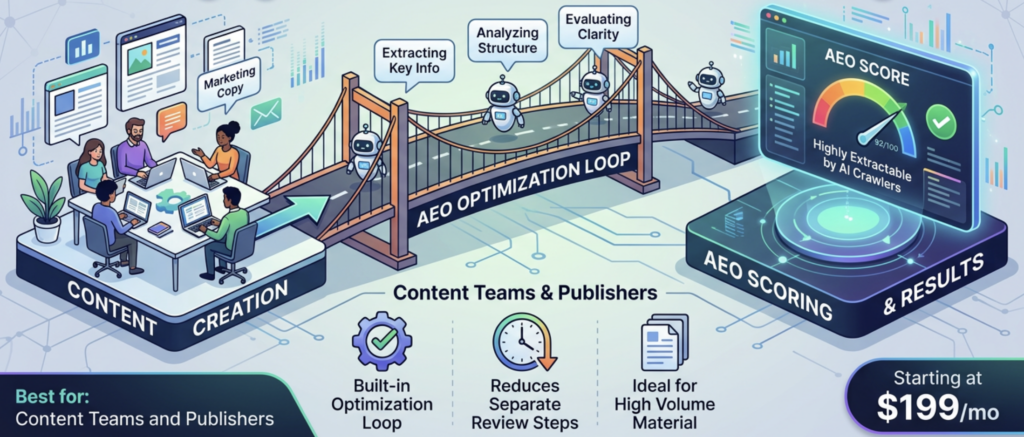
#5 Writesonic GEO bridges content creation and AEO scoring. Every piece of content produced through the platform receives an “AEO Score” that evaluates how extractable it is by AI crawlers. For content-heavy teams producing high volumes of material, the built-in optimization loop reduces the need for a separate review step. Starting at $199/mo. Best for: Content teams and publishers.
#6 Semrush AI is the path of least resistance for teams already running Semrush. The “AI Visibility Toolkit” lets marketers track AI Overview share alongside traditional keyword rankings in a single interface. It lacks the specialized Dark Query discovery that Topify offers, but the workflow integration is hard to replicate elsewhere. Starting at $99/mo as an add-on. Best for: Existing Semrush users and SEO-heavy teams.
#7 Zadoosh operates differently from every other tool on this list. It’s a productized service focused on building “Proof Density”: coordinated Reddit engagement, editorial guest posts, and unprompted brand mentions across independent platforms simultaneously. This builds the third-party credibility that causes AI models to treat a brand as a trusted entity. Starting at $2,000–$5,000/mo. Best for: SaaS brands at $1–$10M ARR in hyper-competitive categories.
Matching the Best AEO Tools to Your Growth Stage
Not every team needs the same stack. Here’s how to think about it based on where your company is.
Seed-stage and bootstrapped (under $1M ARR). Efficiency is the constraint. Topify Basic at $99/mo or Peec AI at €85/mo give you broad engine coverage at a manageable cost — enough to identify which subreddits and forums are driving AI citations in your category and where to focus early community-building efforts.
Growth-stage scaleup ($1M–$10M ARR). At this stage, “Time-to-Insight” is a competitive moat. Topify Pro at $199/mo or AthenaHQ at $295/mo both offer the automation layer that lets growth teams ship optimized content faster than competitors working manually. For teams where SQL generation from AI channels has become a board-level metric, Topify’s CVR integration makes the ROI case straightforward.
Enterprise and category leaders ($10M+ ARR). Compliance, multi-market tracking, and prompt volume data become the priorities. Profound’s enterprise tier handles SOC 2 and HIPAA requirements, and its 400 million conversation dataset gives large organizations the confidence to prioritize their AEO roadmap based on actual demand rather than estimated trends.
What These Best AEO Tools Can’t Do for You
Buying a tool solves the measurement problem. It doesn’t solve the content problem.
AI models in 2026 are increasingly sensitive to generic, automated content. They prioritize what researchers call “Substantive Value”: original research, unique case studies, and expert-authored insights that appear on independent high-authority domains. A tool can surface the gap. It can’t manufacture the credibility required to fill it.
Three things still require human judgment:
Original research gives AI models a reason to cite you specifically. LLMs are far more likely to reference a brand that publishes unique statistics or proprietary data than one that rephrases what’s already on the internet.
Entity consistency matters more than most teams realize. Your brand name, product terminology, and category positioning need to appear consistently across your website, G2, Reddit, and Wikipedia for models to “solidify” you as a recognized entity in their knowledge graph.
Source analysis is where tools like Topify provide disproportionate value post-purchase. If Perplexity is citing a specific niche technical blog to recommend your competitor, your content strategy needs to target that exact source. Understanding the “information diet” of AI models in your category is what separates teams that move the needle from teams that generate reports.
Increasing citation frequency from 5% to 30% in your category typically produces an ROI exceeding 700% on AEO tooling investment. The tools on this list give you the roadmap. The execution is still on you.
Conclusion
The “Winner-Takes-Most” dynamic in AI search is real. When a buyer queries an AI platform for software in your category, the model names two or three vendors. The gap between being first and being absent is worth tens of millions in pipeline at scale.
For most SaaS teams, Topify offers the most direct path from measurement to action — with broad platform coverage, SaaS-specific prompt intelligence, and a CVR framework that speaks the language CMOs need for budget justification. Profound and AthenaHQ are worth evaluating for enterprise compliance requirements and velocity-first use cases respectively, but neither closes the loop between data and execution as directly.
The question isn’t whether your brand has an AI visibility problem. At this point, most SaaS brands do. The question is how fast you’re moving to fix it.
FAQ
Q: What is the difference between AEO and GEO for SaaS brands?
A: AEO (Answer Engine Optimization) is a tactical discipline focused on structuring content for direct extraction by AI platforms — typically through FAQ schemas and answer-first formatting. GEO (Generative Engine Optimization) is a broader strategic framework designed to make a brand the default “Source of Truth” across synthesis platforms like ChatGPT and Perplexity. In practice, AEO is the execution layer; GEO is the overarching strategy that determines where and how you build authority.
Q: How do I know if my SaaS brand needs an AEO tool in 2026?
A: Query ChatGPT or Perplexity for your category with a specific use-case prompt — for example, “Best billing software for usage-based SaaS.” If your brand doesn’t appear in the top three recommendations despite strong traditional SEO, you have a visibility gap. Manual spot-checking works for initial diagnosis, but it can’t scale to cover the full range of prompts your buyers are actually using.
Q: Can I track AEO performance without a paid tool?
A: You can manually log prompts and track brand presence in ChatGPT and Perplexity on a weekly basis. The limitation is that manual tracking can’t surface Dark Queries (prompts with high AI volume but no traditional search data), run competitor benchmarking at scale, or map which sources AI models are citing in your category. For baseline awareness, manual tracking is a reasonable starting point. For systematic optimization, a dedicated tool is necessary.
Q: Which AI platforms matter most for B2B SaaS discovery?
A: ChatGPT remains the highest-volume platform for general vendor research. Perplexity is critical for deep-dive technical comparisons, where buyers evaluate integration specs, security certifications, and pricing structures. Google AI Overviews matter for capturing buyers still operating within traditional search workflows. Coverage across all three is the minimum viable baseline for a SaaS brand taking AEO seriously in 2026.

