

Your team spent the last year building domain authority, earning backlinks, and climbing keyword rankings. Then your CMO asked, “Are we showing up when people ask ChatGPT for recommendations in our category?” Nobody on the team had an answer. Not because they weren’t paying attention, but because the tools they rely on weren’t built to track that.
By 2026, over 58% of U.S. searches end without a single click. In AI search interfaces like ChatGPT and Perplexity, that zero-click rate exceeds 90%. The metric that matters now isn’t whether someone clicks your link. It’s whether AI mentions your brand at all.
That’s the gap an AI visibility platform is designed to close.
Your SEO Dashboard Can’t Track What AI Is Saying About You
Traditional SEO tools measure a world of indexed pages and deterministic rankings. You type a keyword, Google returns a ranked list of URLs, and tools like Ahrefs or Semrush tell you where your page sits. The system is predictable, stable, and well understood.
AI search engines work differently. ChatGPT, Perplexity, and Gemini don’t return a list of links. They synthesize conversational answers using Large Language Models and Retrieval-Augmented Generation. The output is probabilistic, not deterministic. The same prompt can produce different brand recommendations depending on timing, context, and model updates.
Here’s the thing: your existing SEO dashboard has no infrastructure to track this. It can’t tell you whether Perplexity mentioned your competitor three times last week while your brand appeared zero times. It can’t show you which sources the AI cited when it recommended someone else.
An AI visibility platform fills that gap. It’s a dedicated category of tools designed to monitor, analyze, and optimize how your brand appears inside generative AI responses.
What an AI Visibility Platform Actually Measures
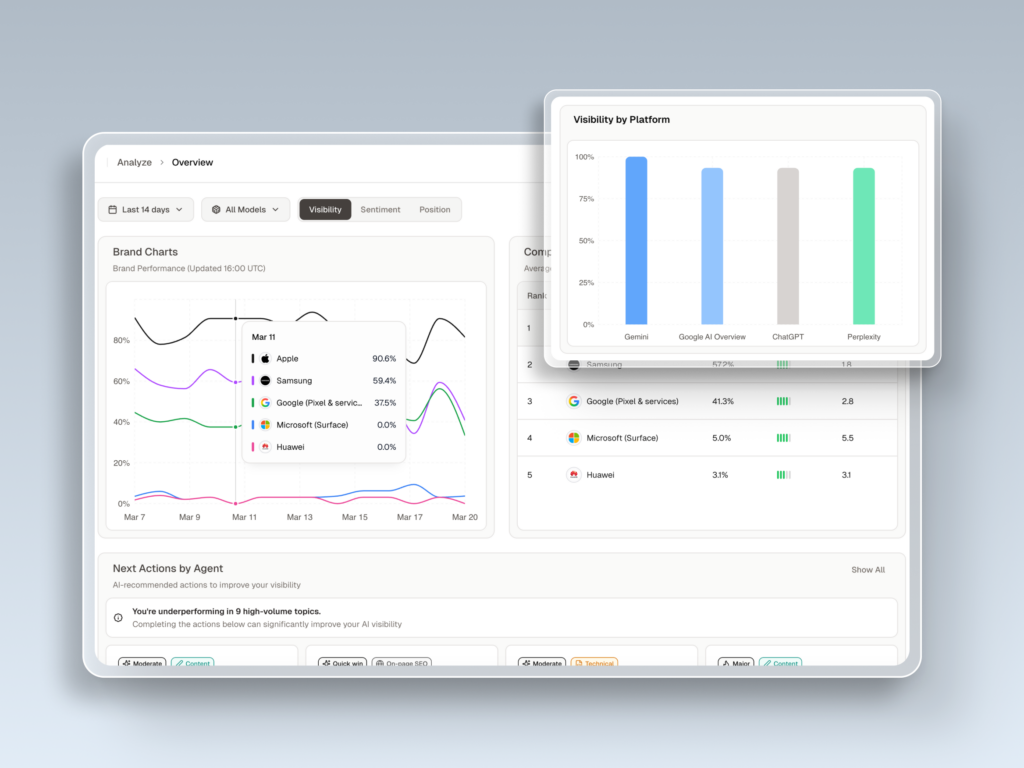
If traditional SEO tools track where your page ranks, an AI visibility platform tracks whether your brand gets recommended, how it gets described, and why.
The core metrics typically include:
| Metric | What It Tracks | Why It Matters |
|---|---|---|
| Visibility Score | How frequently your brand appears in AI answers for a specific prompt cluster | Your baseline measure of AI search presence |
| Sentiment Score | Whether AI describes your brand positively, neutrally, or negatively | Catches narrative drift before it becomes a PR problem |
| Position Rank | Where your brand appears relative to competitors in an AI answer | The AI equivalent of “page one” positioning |
| Citation/Source Analysis | Which domains AI platforms cite when recommending brands | Reveals the content and PR targets that drive AI recommendations |
| AI Volume | How often specific prompts are being asked across AI platforms | Identifies high-value AI search opportunities |
| CVR | Estimated likelihood that an AI mention drives a user toward your brand | Connects AI visibility to business outcomes |
One detail that separates useful platforms from superficial ones: prompt-level tracking. AI responses are probabilistic. Aggregated data hides the variance. You need to see what happens at the individual prompt level, across multiple AI engines, over time. That granularity is what makes the data actionable.
How AI Search Visibility Differs from Google Rankings
The confusion between AI search visibility and traditional Google rankings is understandable. Both involve “being found.” But the mechanics are fundamentally different.
| Dimension | Google SERP Rankings | AI Search Visibility |
|---|---|---|
| Foundation | Indexed database, keyword matching | LLM reasoning, RAG, embeddings |
| Output | Deterministic list of links | Probabilistic conversational narrative |
| Stability | Relatively stable across sessions | Highly volatile, changes per prompt and session |
| Optimization lever | Keyword density, link building | Semantic relevance, citation authority, entity structure |
Google ranks pages. AI platforms reason about brands.
When Perplexity answers “What’s the best project management tool for remote teams?”, it doesn’t pull a ranked list from an index. It synthesizes information from multiple sources, weighs citation authority, and generates a narrative that may or may not include your product. The same question asked a week later might produce a completely different set of recommendations.
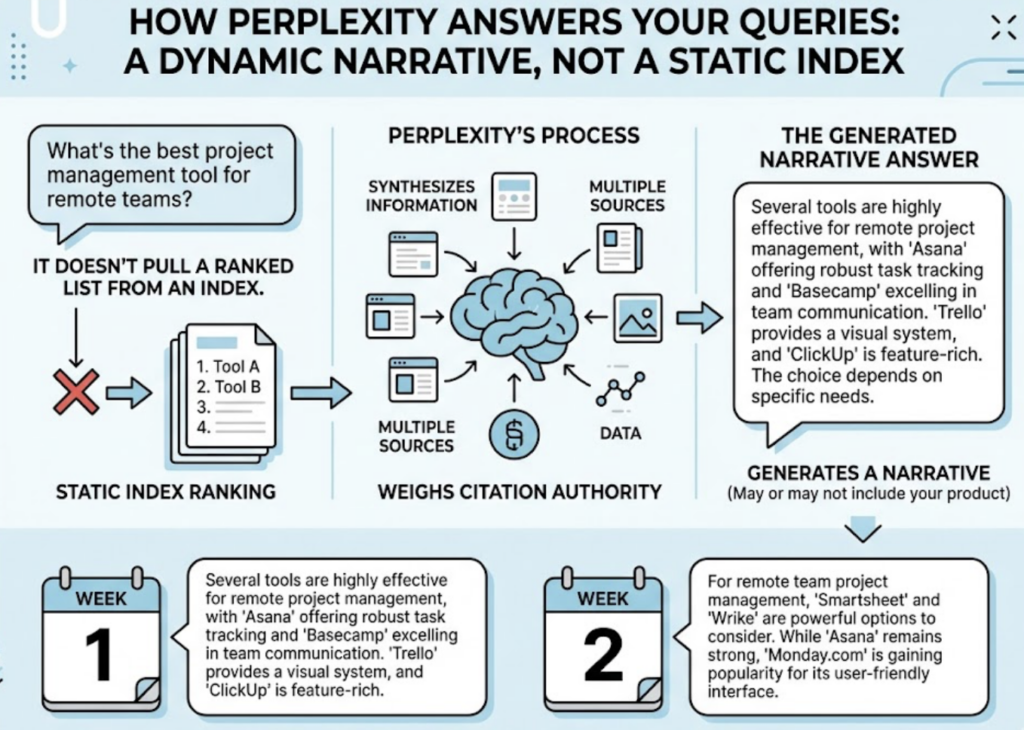
This volatility is exactly why you can’t rely on a one-time manual check. You need continuous, automated monitoring, which is the core function of an AI visibility platform.
5 Core Capabilities to Look for in Any AI Visibility Platform
As of late 2025, only 23% of marketers had invested in dedicated Generative Engine Optimization measurement. The market is still early, which means the tools vary widely in what they actually deliver.
Here’s what separates a platform that generates real insight from one that just produces dashboards:
1. Multi-platform coverage. Each AI engine has distinct retrieval behaviors. ChatGPT, Perplexity, Gemini, and DeepSeek don’t pull from the same sources or weight the same signals. A platform that only tracks ChatGPT gives you, at best, 25% of the picture.
2. Prompt-level granularity. You should be able to define specific “brand questions” (the prompts your customers actually ask) and monitor them repeatedly across time. Aggregate category data is useful for trends, but prompt-level data is where you find actionable patterns.
3. Citation and source analysis. The most valuable signal in AI visibility isn’t just whether you’re mentioned. It’s why. Citation analysis shows you which domains the AI relied on to build its recommendation. If a competitor’s brand keeps appearing because a specific industry publication cites them, that’s a targetable gap.
4. Sentiment and narrative integrity. AI can hallucinate. It can describe your premium product as “budget-friendly” or attribute features to you that don’t exist. Sentiment tracking catches these narrative drift problems before they compound.
5. Actionable optimization guidance. Data without direction is just noise. The platform should tell you what to change: restructure a FAQ page, secure a mention on a cited third-party source, or adjust your content for better extractability by RAG systems.
Topify covers all five. It tracks brand visibility across ChatGPT, Gemini, Perplexity, DeepSeek, and other major AI platforms at the prompt level, with built-in Source Analysis to reverse-engineer AI citations, Sentiment scoring on a 0-100 scale, and a one-click AI agent that turns insights into execution. For teams evaluating platforms, it’s a useful benchmark for what “full-stack AI visibility” looks like in practice.
Common Mistakes When Choosing an AI Visibility Platform
The category is new enough that most teams make avoidable errors during evaluation. Here are four that come up repeatedly:
Tracking only one AI platform. ChatGPT gets the headlines, but Perplexity, Gemini, and DeepSeek each have different retrieval pipelines. A brand that’s visible on ChatGPT might be completely absent on Perplexity. If your customers use multiple AI tools (and they do), single-platform data creates a false sense of security.
Equating “mentions” with “visibility.” Getting mentioned isn’t the same as getting recommended. A platform that counts brand name appearances without measuring sentiment, position, or context misses the point. Your brand could be mentioned five times in negative comparisons, and a basic mention tracker would call that a win.
Ignoring the citation layer. AI doesn’t generate recommendations from nothing. It pulls from specific sources, often a handful of high-authority domains per category. If you don’t know which sources the AI is citing, you can’t influence the inputs that drive your visibility. Topify’s Source Analysis, for example, surfaces the exact domains and URLs that AI engines reference, giving teams a concrete target list instead of guesswork.
Choosing a tool that stops at data. Dashboards are satisfying. But if the platform can’t tell you what to do with the numbers, your team will spend hours interpreting charts instead of optimizing content. Look for platforms that connect analytics to action, whether that’s content restructuring recommendations, citation gap alerts, or automated execution.
How to Get Started with an AI Visibility Platform
You don’t need to overhaul your marketing stack to begin. The most effective approach is a focused 30-day pilot. Here’s the framework:
Step 1: Identify your core prompts. Start with 5 to 25 high-intent questions that potential customers ask in your product category. These are the AI search queries where your brand should appear. Think “What’s the best [your category] for [your audience]?” or “How do I solve [problem your product addresses]?”
Step 2: Run a cross-platform baseline. Track those prompts across ChatGPT, Perplexity, Gemini, and at least one additional AI engine for 30 days. This establishes your visibility baseline: how often you appear, in what position, with what sentiment.
Step 3: Audit the cited sources. Look at which domains the AI is citing when it recommends brands in your space. If a competitor keeps getting recommended because a specific industry publication links to them, that’s your next content partnership or PR target.
Step 4: Optimize for extractability. AI systems favor content that’s easy to pull into a synthesis. Direct, concise answers near the top of your pages. Structured FAQs. Clear entity definitions. This isn’t about keyword density. It’s about making your content the path of least resistance for a RAG pipeline.
The ROI signal is already clear. During the 2025 holiday season, AI-referred traffic converted 31% better than non-AI organic traffic, with revenue per visit growing 254% year-over-year. The brands that started tracking early captured that upside. The ones that waited are still guessing.
Topify’s High-Value Prompt Discovery and Competitor Benchmarking tools make Steps 1 through 3 significantly faster. You define your brand category, and the platform surfaces the prompts that matter, tracks your position across AI engines, and identifies the citation gaps you need to close.
Conclusion
The question your CMO asked isn’t going away. “How are we doing in AI search?” will become as routine as “What’s our Google ranking?” within the next 12 months. The difference is that traditional SEO tools can’t answer it.
An AI visibility platform isn’t a replacement for your SEO stack. It’s the layer that tracks what your SEO stack was never designed to see: whether AI recommends your brand, how it describes you, and which sources it trusts. The teams that build this visibility baseline now won’t just have better data. They’ll have a structural advantage over competitors who are still relying on dashboards built for the ten-blue-links era.
Start by tracking. The optimization follows naturally once you can see the data.
FAQ
Q: What is an AI visibility platform?
A: An AI visibility platform is a tool that monitors how your brand appears in AI-generated answers across engines like ChatGPT, Perplexity, and Gemini. It tracks metrics like visibility score, sentiment, citation sources, and competitive positioning at the prompt level, giving you data that traditional SEO tools don’t capture.
Q: How does an AI visibility platform work?
A: It runs your target prompts across multiple AI search engines on a recurring basis, then analyzes the responses to determine whether your brand was mentioned, how it was described, what sources the AI cited, and where you rank relative to competitors. The data is tracked over time to identify trends and optimization opportunities.
Q: How much does an AI visibility platform cost?
A: Pricing varies by platform and scale. Topify, for example, starts at $99/month for 100 tracked prompts across ChatGPT, Perplexity, and AI Overviews, with plans scaling to $199/month for 250 prompts and enterprise options from $499/month. Most platforms offer trial periods so you can validate the data before committing.
Q: Can an AI visibility platform replace traditional SEO tools?
A: No. AI visibility platforms and SEO tools measure different things. SEO tools track Google SERP rankings, organic traffic, and backlinks. AI visibility platforms track brand presence in generative AI answers. Most marketing teams need both, since Google search and AI search coexist and serve different stages of the customer journey.

