

Your domain authority is 70. Your keyword rankings are solid. But none of that tells you whether Perplexity is recommending your competitor instead of you, or whether Claude just advised a prospect against your product in a 500-word evaluation they’ll never share with your sales team.
That’s the gap most SEO professionals hit when they start shopping for an AI rank tracker. The tools that show up first typically cover ChatGPT or Google AI Overviews, not both, and almost never the rest. Meanwhile, your audience is scattered across at least five generative platforms, each with its own retrieval logic, citation preferences, and recommendation hierarchy.
Most AI Rank Trackers Only Cover One Platform. That Costs You More Than You Think.
The most common purchasing mistake in 2026 isn’t picking the wrong AI rank tracker. It’s picking one that only watches a single platform and assuming you’ve got the full picture.
Here’s what the platform split actually looks like right now:
| AI Platform | Market Share | Active Users | Why It Matters |
|---|---|---|---|
| ChatGPT | 64.5–68% | 900M weekly | Dominant, but has shed ~20 percentage points of share since Jan 2025 |
| Google Gemini | 18.2–21.5% | 750M monthly | Fastest-growing platform, ~4x YoY growth, embedded in Google Workspace |
| Perplexity AI | 3–5% | 22–45M monthly | 80% college grads, 30% senior leadership, 780M queries/month |
| Claude | 2.9–4.2% | 300K+ enterprise customers | 40% of enterprise LLM API market, deep B2B reasoning |
| DeepSeek | Rapidly expanding | 96.88M monthly | Hit #1 in App Store across 156 countries, dominant in Asia |
If your tracker only covers ChatGPT, you’re blind to Perplexity’s citation-driven audience, Claude’s enterprise decision-makers, and the entire Mandarin-language AI ecosystem. That’s not a data gap. It’s a strategic failure.
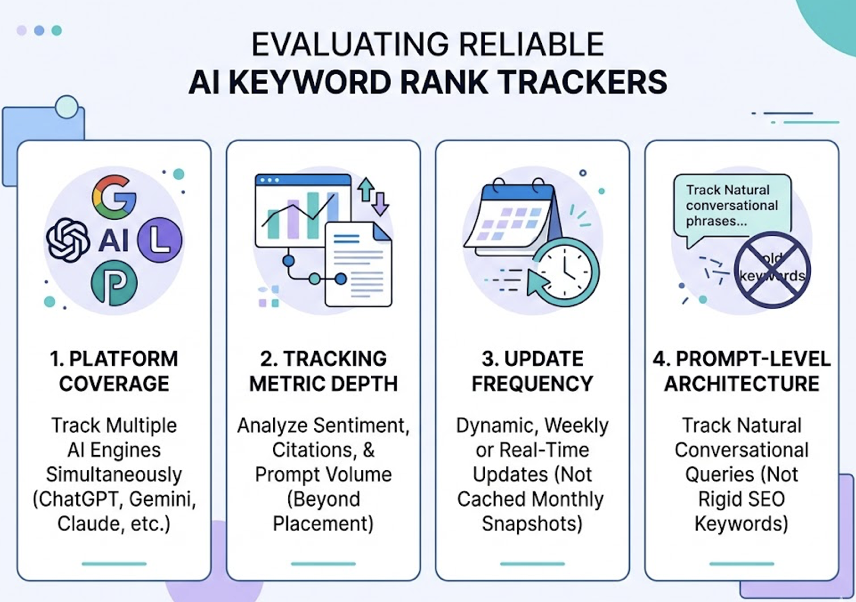
A reliable AI keyword rank tracker needs to clear four bars: platform coverage (how many AI engines it tracks simultaneously), tracking metric depth (beyond placement, does it evaluate sentiment, citation sources, and prompt volume), update frequency (cached monthly snapshots are useless when LLMs update weekly), and prompt-level architecture (tracking natural conversational queries, not rigid SEO keywords).
Here’s how the top five tools compare:
| Tracker | Best For | Platforms Covered | Key Metrics | Starting Price |
|---|---|---|---|---|
| Otterly AI | Entry-level tracking | ChatGPT, Perplexity, Gemini, Copilot, Google AIO | Prompt mentions, citations, basic URL auditing | $29/mo |
| SE Ranking | Traditional SEO hybrids | Google SERPs, Google AI Overviews, Bing | Organic positions, keyword tracking, AIO presence | $65/mo |
| Peec AI | Agency Looker Studio integration | Selected LLMs | Prompt volume estimations, mention/citation tracking | €85/mo |
| Profound | Enterprise compliance | ChatGPT, Perplexity, Gemini, Claude, Copilot | Prompt fan-out, custom scraping, SOC 2/HIPAA | $1,000+/mo |
| Topify | Full-spectrum tracking + execution | ChatGPT, Perplexity, Gemini, Claude, DeepSeek, Google AIO | Prompt-level tracking, 7 metrics, source reverse-engineering | $99/mo |
AI Search Intelligence Means Tracking Prompts, Not Just Keywords
Traditional keyword rank tracking measures fixed SERP positions. Type a query into Google, and the algorithm returns a mostly static list of indexed URLs. The same query tomorrow produces roughly the same results.
AI search doesn’t work that way.
Every time a user submits a prompt to ChatGPT or Perplexity, the generated response can differ based on temperature settings, real-time knowledge updates, and computational routing. There are no stable, fixed positions inside a generated answer. There’s only the probability of inclusion and relative prominence.
That’s why AI search intelligence demands prompt-level tracking. An advanced system locks a canonical set of conversational prompts and runs repeated sampling across multiple generative instances to build a statistically reliable baseline. The industry has converged on several metrics that matter:
Prompt-Level Tracking monitors brand visibility across entire conversational phrases and their semantic variations, not just single keywords. Position Rank measures whether your brand shows up as the primary recommendation or gets buried as a third-tier alternative. Share of Model calculates the percentage of times a brand gets cited or recommended relative to total relevant queries. And Citation Source Origin identifies the exact third-party URLs the AI relied on to generate its recommendation.
The shift from tracking organic blue links to tracking prompt-level Share of Model isn’t optional anymore. The question is which platform actually delivers it across every AI engine your audience uses.
Topify: Full-Spectrum AI Keyword Rank Tracking Across ChatGPT, Perplexity, Claude, and More
In the current market, Topify stands out as the only platform that’s natively built for Generative Engine Optimization rather than treating AI tracking as an add-on to a traditional SEO dashboard. It closes the loop between cross-platform monitoring and active content execution from a single interface.
Coverage that matches the real market. Topify tracks brand mentions and citations across ChatGPT, Perplexity, Google Gemini, Claude, Google AI Overviews, and Microsoft Copilot. It’s also the only platform with deep integration into the Mandarin-language AI ecosystem, covering DeepSeek, Qwen, and Doubao. For global SaaS companies and international brands, that coverage isn’t a bonus feature. It’s table stakes.
Seven tracking dimensions, not just “mentioned or not.” Topify quantifies AI visibility across seven indicators: Visibility Score (Share of Model), Sentiment Nuance (endorsement vs. neutral vs. critical), Position Placement, Prompt Volume, Mention vs. Citation distinction, Query Intent Classification, and Conversion Velocity (CVR) Modeling. Each metric operates at the prompt level, not the keyword level.
Discovery and reverse-engineering built in. Most trackers require you to manually input the keywords you want to monitor. Topify’s High-Value Prompt Discovery engine automatically surfaces the exact conversational questions your target audience is asking across AI platforms, continuously updating your tracking database before competitors identify the same trends. When a rival brand gets recommended over yours, Topify’s Causal Source Analysis reverse-engineers the AI’s output to identify the exact domains and publications the LLM used as its data source, revealing the off-page gaps you need to close.
Pricing that doesn’t require enterprise budget approval. The Basic plan starts at $99/month with 100 tracked prompts and 9,000 AI answer analyses. Pro scales to 250 prompts at $199/month. Enterprise configurations start at $499/month. That’s a fraction of the five-figure annual retainers that legacy enterprise tools demand.
What the Best ChatGPT Keyword Rank Tracker Actually Needs to Do
ChatGPT still commands roughly 68% of AI chatbot web traffic and 900 million weekly active users. Optimizing for OpenAI’s models is the foundational step of any GEO strategy, and the demand for a reliable best ChatGPT keyword rank tracker has surged.
But ChatGPT’s retrieval logic is distinct. It doesn’t return a ranked list of links. It synthesizes reviews, technical documentation, and brand sentiment from across the web to build a single narrative answer. Since the integration of SearchGPT mechanics, it increasingly provides inline citations to publishers.
A specialized ChatGPT tracker needs prompt coverage with semantic fan-out (users query in natural language, not rigid keywords), high-frequency refresh rates (monthly snapshots are functionally useless), citation source tracking (correlating your brand’s mention with the specific URLs the model referenced), and dynamic competitor benchmarking (tracking which alternatives ChatGPT recommends alongside or instead of you).
The trap to avoid: purchasing a best ChatGPT keyword rank tracker software that locks you into OpenAI’s ecosystem alone. If your tool can’t simultaneously show what’s happening on Perplexity, Claude, and AI Overviews, you’re buying a fraction of the intelligence you need.
Perplexity and Claude Rank Tracking: The Blind Spot That Costs High-Value Leads
Most trackers prioritize ChatGPT and Google AI Overviews. That leaves Perplexity and Claude systematically ignored, which is a problem because these two platforms reach the audiences with the highest purchase intent and decision-making authority.
Perplexity is a citation engine, not a chatbot. It processes 780 million queries monthly for an audience that’s 80% college graduates and 30% senior leadership. Visibility on Perplexity is almost entirely determined by source quality. If your content lacks verifiable statistics, expert quotations, and dense, structured passages (the optimal range is 134–167 words per information chunk), Perplexity’s retrieval system will skip it. The best Perplexity keyword rank tracker software needs to monitor not just whether your brand was mentioned, but whether your proprietary domain was used as the primary citation source or if Perplexity pulled from a secondary news outlet instead. Topify’s source reverse-engineering is built specifically for this kind of citation chain analysis.
Claude evaluates, not just recommends. Anthropic’s Claude holds 40% of the enterprise LLM API market and serves over 300,000 businesses. It rarely generates simplistic ranked lists. Instead, it produces nuanced evaluations that weigh trade-offs. Critically, Claude’s Constitutional AI alignment means it will downgrade brands that rely on hyperbolic marketing claims or aggressive sales language. Most legacy trackers register a “mention” as a success without detecting that Claude actually advised against the purchase. The best Claude keyword rank tracker software needs deep sentiment parsing across Claude’s model family (Haiku, Sonnet, Opus) to distinguish an endorsement from a warning.
AI Overviews and AI Mode: The Google Layer That Reshapes CTR Math
Google AI Overviews now appear in approximately 48% of all search queries. For informational and how-to queries, that penetration exceeds 70%. On comparison queries (“X vs Y”), the trigger rate hits 95.4%.
The impact on organic traffic is severe. On queries where AI Overviews appear, the organic Position 1 CTR has dropped by up to 61%. Only 38% of pages cited within AI Overviews also rank in the traditional top 10. That means the correlation between high organic rankings and AI visibility has fractured.
Google’s AI Mode, the dedicated conversational interface, has already amassed 75 million daily active users, adding another layer where brands need to appear.
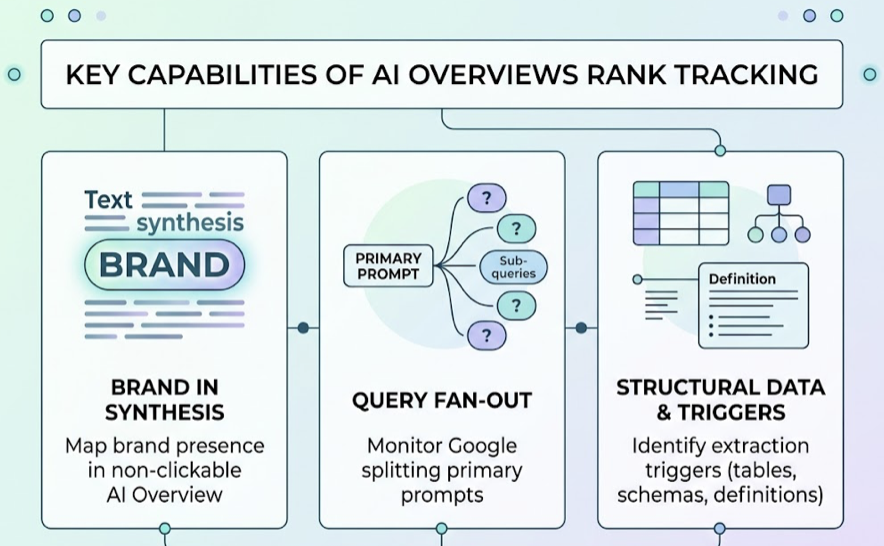
Traditional SEO tools that track standard organic rankings are measuring a metric that no longer drives visibility on these queries. A dedicated best AI Overviews keyword rank tracker needs to map brand presence within the non-clickable synthesis portions of the AI Overview, monitor Google’s query fan-out behavior (how it splits a primary prompt into sub-queries), and identify the structural data components (tables, schemas, definitional blocks) that trigger extraction. Topify covers both the best AI Overviews keyword rank tracker software and best AI Mode keyword rank tracker use cases by tracking brand position across Google’s entire generative layer.
What AI Search Intelligence Looks Like When It’s Actually Working
Tracking is only half the equation. The other half is what happens after you spot a problem.
Most AI rank trackers stop at the dashboard. They’ll show you a drop in Share of Model, but the diagnosis, strategy, and execution remain a manual, multi-week process. True AI search intelligence closes that loop.
Here’s what the full cycle looks like in practice. A B2B SaaS brand discovers via Topify’s continuous monitoring that its Share of Model dropped 15% across ChatGPT and Perplexity for a high-value prompt cluster. Topify’s Causal Source Analysis automatically identifies the cause: a competitor published a highly structured statistical report that both platforms now cite, boosting the rival’s position while demoting the SaaS brand.
Instead of weeks of manual content planning, the marketing director inputs a plain-English goal into Topify’s One-Click Agent. The system identifies content gaps, drafts answer-first content optimized for machine extraction (FAQ schema, 150-word definitional passages, structured HTML tables), and deploys directly to the brand’s CMS via REST API.
Detection to deployment in minutes. Within 30 days, as generative crawlers re-index the updated content, the brand reclaims its position across all tracked AI engines. That’s the difference between a tracking tool and an AI search intelligence platform.
To start tracking your brand’s AI search visibility across every major platform, get started with Topify.
Conclusion
The choice of an AI keyword rank tracker in 2026 comes down to one question: does it show you the complete picture, or just one corner of it?
Single-platform trackers create an illusion of visibility. Your brand might rank well in ChatGPT while being entirely absent from Perplexity’s citation-driven results, negatively framed in Claude’s enterprise evaluations, or missing from the AI Overviews that now suppress 61% of organic clicks. The only way to know is to track all of them simultaneously, at the prompt level, with sentiment and citation source analysis baked in.
For SEO professionals and marketing teams ready to move beyond fragmented data, Topify provides the full-spectrum coverage, the diagnostic intelligence, and the execution layer that turns tracking into action. Start your AI search optimization strategy today.
FAQ
Q: What’s the best LLM keyword rank tracker software in 2026?
A: The most comprehensive option is Topify. It provides unified, prompt-level tracking across ChatGPT, Perplexity, Claude, Google Gemini, Google AI Overviews, and DeepSeek, with seven distinct metrics including Share of Model, sentiment analysis, and citation source reverse-engineering. It also includes one-click optimization execution, which most LLM keyword rank tracker software tools lack entirely.
Q: Can I track my brand’s rank in ChatGPT, Perplexity, and Claude with one tool?
A: Yes. Full-spectrum GEO platforms like Topify are built to solve the fragmentation problem. You can monitor brand mentions, citation sources, and recommendation positions across ChatGPT, Perplexity, Claude, and several other AI engines from a single dashboard.
Q: What’s the difference between AI keyword rank tracking and traditional SEO rank tracking?
A: Traditional SEO rank tracking measures fixed URL positions on a SERP based on exact-match keywords. AI keyword rank tracking measures probabilistic visibility within dynamically generated text. It requires prompt-level tracking to simulate conversational queries and relies on Share of Model to quantify how frequently a brand gets cited or recommended across multiple AI responses.
Q: How often should I check my AI search rankings?
A: LLM knowledge bases, retrieval behaviors, and competitor content update continuously. Monthly checks aren’t enough. Enterprise brands should use platforms that run high-frequency programmatic sampling across core prompt clusters multiple times per week to detect drops in Share of Model or shifts in citation preferences as they happen.

