

A logistics manager typed into ChatGPT: “Best cold chain logistics providers in the Midwest with real-time tracking.” Five brands came back. Yours wasn’t one of them. Not because your fleet is smaller or your coverage is worse. Because AI doesn’t know you well enough to recommend you.
73% of B2B buyers now use AI tools like ChatGPT and Perplexity during their procurement research. For supply chain companies, that means your next RFP might start inside an AI chatbot, not a Google search bar.
There’s a free way to see where you stand. Topify‘s AI Visibility Report shows how often your brand gets mentioned across major AI platforms, where you rank, and which providers surface you most. ✅ Free ⚡ Results in 60 seconds
div data-topify-widget=”visibility-report”>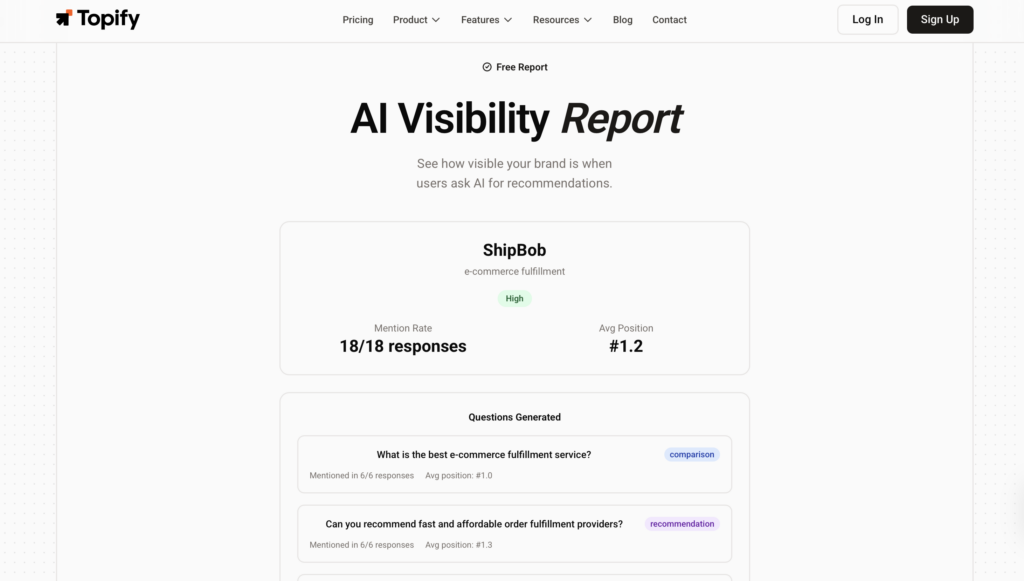
Five Brands Own 80% of AI Recommendations in Your Supply Chain Category
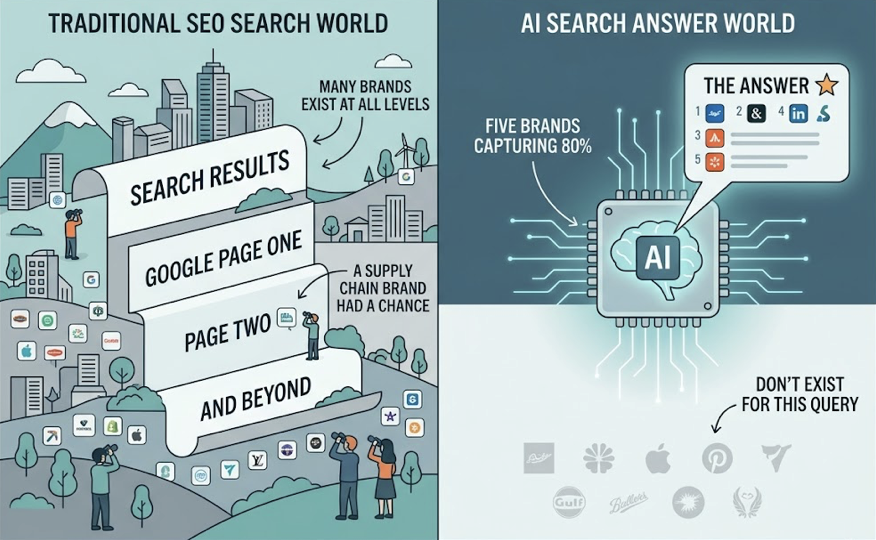
Here’s what most supply chain marketers don’t realize: AI doesn’t return a list of 50 results the way Google does. It returns a short, confident answer with five to seven names. Research from Magenta Associates found that just five brands capture 80% of top AI-generated responses for any given B2B category. If you’re a 3PL, freight forwarder, or WMS provider not in that top five, you’re invisible to a growing share of your market.
The AI Visibility Report breaks this problem into measurable signals. Instead of guessing whether AI knows your brand, you get a cross-platform snapshot with specific metrics.
What Each Metric Tells You About Your Supply Chain Brand
| Metric | What It Measures | Supply Chain Translation | Red Flag |
|---|---|---|---|
| Mention Rate | How often AI includes your brand in responses | Frequency of appearing in procurement-related AI answers | Below 10% in your category |
| Ranking Position | Where you appear in AI’s recommendation order | Whether you’re first-choice or afterthought for logistics buyers | Consistently ranked 4th or lower |
| Provider Breakdown | Which AI platforms mention you | Gaps between ChatGPT, Perplexity, Gemini, and AI Overviews | Missing entirely from one or more platforms |
| Category Relevance | How accurately AI associates you with your niche | Whether AI knows you’re a cold chain specialist vs. a general 3PL | Misclassified or described with outdated capabilities |
A freight brokerage might discover it ranks well on Perplexity but doesn’t appear in ChatGPT at all. A warehouse automation vendor might find that AI describes its product line from three years ago. A 3PL with strong regional coverage might learn that AI only mentions it for national shipments. Each of these gaps points to a different fix.
Where Supply Chain Brands Typically Find Problems
Scenario 1: The “ghost brand” problem. You’ve been in business for 15 years, but AI treats you like a startup. Your mention rate is near zero because your digital footprint is concentrated in trade directories and PDF whitepapers that AI models can’t easily parse.
Scenario 2: The misclassification gap. AI recommends you for general freight, but your actual specialty is hazmat or temperature-controlled logistics. Your revenue-generating service lines are invisible in the prompts that matter most.
Scenario 3: The platform blind spot. You appear consistently in Google AI Overviews because of strong SEO, but ChatGPT and Perplexity don’t mention you. Procurement teams using those platforms never see your name.
Run Your Brand Through the Report in Three Steps
- Go to the AI Visibility Report and enter your brand name plus your primary supply chain category (e.g., “Acme Logistics, cold chain”).
- Review the cross-platform breakdown. Note which AI providers mention you and which don’t.
- Check your ranking position against the top five names AI recommends. If you’re not in that group, you’ve identified the gap.
The whole process takes under a minute, costs nothing, and requires no account creation.
The Prompts Your Procurement Buyers Are Typing Into AI Right Now
Supply chain procurement has specific language patterns. Buyers don’t type vague queries. They ask detailed, decision-ready questions that AI answers with confident recommendations.
| AI Prompt Example | Buyer Intent | What It Reveals About Your Visibility |
|---|---|---|
| “Best 3PL for e-commerce fulfillment in the Southeast” | Vendor shortlisting by region + vertical | Whether AI associates you with the right geography and specialty |
| “Compare TMS platforms for mid-size shippers 2026” | Head-to-head evaluation | Where you rank against category alternatives |
| “Most reliable cold chain logistics provider for pharma” | Trust and compliance verification | How AI rates your reliability and industry certifications |
| “Warehouse automation vendors with same-day integration” | Technical capability matching | Whether AI understands your tech stack and implementation speed |
| “Affordable freight audit software for companies under 500 employees” | Budget-conscious procurement | If AI positions you correctly on pricing and company size fit |
| “Which supply chain visibility platforms have real-time tracking” | Feature-specific search | Whether your product features are accurately represented in AI answers |
Each of these prompts represents a real procurement decision where AI is shaping the shortlist. If your brand doesn’t appear for the prompts most relevant to your business, you’re losing deals before your sales team even knows the opportunity existed.
That matters more than it used to. Forrester’s 2025 research found that 61% of the B2B buying journey completes before a buyer contacts any vendor. When AI fills that pre-contact research window, the brands it recommends get a structural advantage.
The Supply Chain AI Visibility Gap No One Is Tracking
Two forces are colliding in supply chain procurement, and most suppliers are caught in the middle.
Force 1: AI recommendations are becoming the new shortlist. G2’s March 2026 survey of 1,076 B2B buyers found that 69% chose a different vendor than originally planned based on AI chatbot guidance. One-third purchased from a vendor they’d never heard of before. In supply chain, where switching costs are high and relationships run deep, that’s a disruptive shift. A procurement manager who discovers a new WMS through Perplexity’s recommendation might bypass the incumbent entirely.
Five brands capturing 80% of AI recommendations isn’t just a statistic. It’s the new competitive structure. In traditional search, a supply chain brand on page two of Google still had a chance. In AI search, if you’re not in the answer, you don’t exist for that query. The concentration is more extreme than anything SEO ever produced.
Force 2: AI search converts at 5.1x the rate of traditional organic, but almost nobody in supply chain is measuring it. AI search traffic converts at 14.2% compared to Google organic’s 2.8%. Yet only 22% of B2B marketers currently track AI visibility. In supply chain specifically, where marketing teams tend to be lean and focused on trade shows and direct outreach, the tracking gap is likely even wider.
This is the first-mover window. The supply chain brands that start measuring and optimizing their AI visibility now will build compounding advantages. AI models learn from the signals available today. Brands that strengthen their digital footprint, structured data, and content authority in 2026 will be harder to displace in 2027 and beyond. Those that wait will face steeper barriers as the top five positions in each category become more entrenched.
85% of buyers aged 25-34 already use AI for supplier research. As these younger procurement professionals advance into senior decision-making roles, AI visibility won’t be a marketing experiment. It’ll be a prerequisite for staying in the consideration set.
From a One-Time Snapshot to Continuous Visibility Monitoring
The AI Visibility Report gives you a clear picture of where you stand today. But AI search results aren’t static. Models update, competitor content shifts, and your ranking position can change from one month to the next. A strong mention rate in May doesn’t guarantee the same result in July.
That’s the gap between a one-time check and ongoing visibility management. Topify’s AI Visibility Checker turns that snapshot into continuous monitoring. It tracks your brand’s mention rate, ranking position, and competitor movements across ChatGPT, Perplexity, Gemini, and Google AI Overviews on a daily and weekly basis. When your visibility drops or a competitor overtakes you, you get alerted before the impact reaches your pipeline.
| Capability | Free AI Visibility Report | Topify Platform |
|---|---|---|
| Check frequency | One-time snapshot | Continuous daily/weekly monitoring |
| AI platforms covered | Single check | ChatGPT + Perplexity + Gemini + AI Overviews |
| Historical trends | Not available | Full trend history with change alerts |
| Competitor tracking | Not available | Real-time competitor benchmarking |
| Actionable recommendations | Manual interpretation | Data-driven GEO optimization suggestions |
| Team collaboration | Not available | Multi-user access with shared dashboards |
Plans start at $99/month with a 7-day free trial, no credit card required. For supply chain companies managing multiple brands or divisions, the Pro plan supports multi-brand tracking. You can start a free trial and connect your brand in under five minutes.
Conclusion
Supply chain procurement is moving into AI. The brands that get recommended win the first look. The brands that don’t get recommended are fighting an uphill battle they may not even know about.
Start with the data. Run your brand through the AI Visibility Report and see where you actually stand across the AI platforms your buyers are using. It’s free, takes 60 seconds, and gives you a concrete baseline to act on.
Beyond visibility tracking, a few other Topify free tools can round out your diagnostic:
- Brand Authority Checker: See how AI rates your brand’s authority and trust signals, critical for supply chain where reliability is everything.
- Prompts Researcher: Discover the exact procurement prompts buyers are asking AI in your supply chain category.
- Competitor Analysis: Find out which supply chain brands AI considers your competitors and how you compare.
FAQ
Is the AI Visibility Report really free? Do I need to create an account?
Yes, it’s completely free and requires no registration. Enter your brand name and category, and you’ll get a cross-platform visibility report in about 60 seconds.
What’s the difference between the free report and the Topify paid platform?
The free report gives you a one-time snapshot of your current AI visibility. The paid platform adds continuous monitoring, historical trend tracking, competitor benchmarking, and actionable optimization recommendations. Think of the free report as a health check and the platform as ongoing care.
How often should a supply chain brand check its AI visibility?
At minimum, monthly. AI models update frequently, and competitor content changes can shift your ranking position. If you’re actively running content campaigns or launching new service lines, weekly checks give you faster feedback.
Does AI visibility actually affect supply chain procurement outcomes?
The data says yes. 73% of B2B buyers use AI during procurement research, and 69% end up choosing a different vendor than planned based on AI recommendations. For supply chain companies, where contracts are large and switching costs are high, being in or out of AI’s top recommendations has direct revenue implications.

