

A DeFi protocol with $200 million in total value locked asked Perplexity: “Best DeFi lending platforms for institutional borrowers.” Five protocols appeared in the answer. Theirs wasn’t one of them. They rank on Google’s first page for that exact query. AI search doesn’t care.
The gap is measurable, and the check takes 60 seconds. Topify‘s AI Visibility Report scans how often your brand gets mentioned across ChatGPT, Perplexity, Gemini, and Google AI Overviews, then breaks down your mention rate, ranking position, and provider-by-provider performance.
✅ Free ⚡ Results in 60 seconds 🔒 No signup required
AI Visibility Report
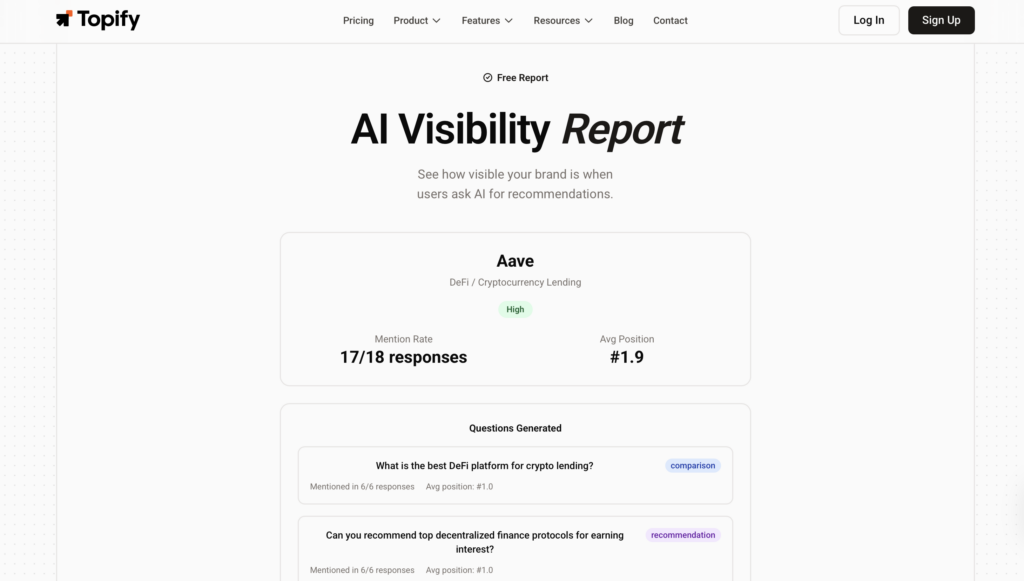
What the AI Visibility Report Actually Tells You About Your Web3 Brand
The report doesn’t give you a single vanity score. It breaks your AI presence into dimensions that map directly to how Web3 brands win or lose in AI-generated recommendations.
Three Metrics, Decoded for Web3
| Metric | What It Measures | What It Means for Web3 Brands |
|---|---|---|
| Mention Rate | How frequently AI names your brand in category queries | Below 10%: AI doesn’t associate your protocol with your core vertical (DeFi, L2, wallets, etc.) |
| Ranking Position | Where your brand appears in AI’s ranked recommendations | Position 4+: You’re behind protocols that may have lower TVL but stronger content signals |
| Provider Breakdown | Which AI platforms mention you and which don’t | Gaps reveal platform-specific blind spots, like being visible on Perplexity but absent from ChatGPT |
A Web3 project with a strong mention rate on Perplexity but zero presence on ChatGPT has a distribution problem, not a product problem. That’s the kind of insight the report surfaces immediately.
Where Web3 Brands Typically Discover Problems
Scenario 1: The “invisible protocol” problem. A Layer 2 chain has shipped 15 ecosystem partnerships and processes 2M daily transactions. AI search doesn’t mention it when users ask “fastest L2 for gaming.” The Visibility Report shows a mention rate of 3% and a ranking position outside the top 10 across all platforms.
Scenario 2: Platform-specific gaps. A non-custodial wallet brand shows up consistently in Perplexity answers (which heavily index Reddit discussions) but is completely absent from ChatGPT and Gemini. The provider breakdown reveals the brand’s visibility relies entirely on community chatter, not structured, citable content.
Scenario 3: Misrepresentation over invisibility. A DeFi protocol appears in AI answers, but the description references a deprecated version of their product. The report flags the mention, and the brand realizes that being mentioned incorrectly might be worse than not being mentioned at all.
How to Run Your Web3 Brand Through the Report
Step 1: Go to the AI Visibility Report and enter your brand name or protocol name.
Step 2: Review your mention rate, ranking position, and provider breakdown. Note which AI platforms include you and which don’t.
Step 3: Compare your results against your Google search rankings. The gap between traditional SEO performance and AI visibility is where the problem lives.
The entire process takes under a minute. No account, no API key, no token gating.
Web3 Buyers Ask AI Before They Ask Your Community
Crypto research behavior has shifted. Investors, developers, and enterprise buyers increasingly type questions into AI assistants before visiting protocol documentation, Discord servers, or Twitter threads.
Here’s what those queries look like, and what they reveal about your brand’s AI presence:
| AI Prompt Example | Platform | Search Intent | What It Reveals About Your Brand |
|---|---|---|---|
| “Best Layer 2 for gaming dApps” | ChatGPT | Protocol selection | Whether AI considers you a credible option in your vertical |
| “Is [protocol] safe to stake on?” | Perplexity | Trust verification | How AI describes your security track record and audit history |
| “Most secure DeFi lending platforms 2026” | Gemini | Purchase/allocation decision | Your ranking against competitors in AI’s recommendation list |
| “Cheapest blockchain for NFT minting” | ChatGPT | Cost comparison | Whether AI has accurate, current data on your fee structure |
| “Web3 wallet comparison for beginners” | Google AI Overview | Onboarding decision | If your product appears in the entry-level recommendation set |
73% of B2B buyers now use AI tools in their research process. In Web3, where due diligence is non-negotiable and trust thresholds are higher than in most industries, AI-generated answers carry even more weight.
The problem compounds: AI search traffic converts at 14.2%, roughly five times the rate of traditional Google organic traffic. If your Web3 brand isn’t in the AI answer, you’re not just losing impressions. You’re losing the highest-converting traffic channel available.
Google Rankings and AI Search Visibility Are Two Different Games
Web3 brands assume that strong Google rankings translate into AI search presence. They don’t.
A blockchain company can rank on page one for competitive keywords while remaining invisible inside ChatGPT, Perplexity, and Gemini. Research on AI-generated search experiences confirms that AI models retrieve and prioritize sources differently from traditional search rankings. In some cases, cited sources don’t even appear among the top classic search results.
Here’s the thing: traditional search rewards pages optimized around keywords and backlinks. LLMs synthesize information from multiple sources at once. They prioritize corroborated claims, structured explanations, trusted publications, fresh reporting, and repeated brand mentions across the web.
For Web3 brands, this creates a specific vulnerability. Most crypto projects still rely on short-lived marketing cycles: airdrops to generate wallet activity, KOL partnerships for Twitter reach, Discord campaigns for community engagement. These tactics generate temporary traffic, but they fail to create the kind of durable, multi-source content signals that AI models use to build their recommendation lists.
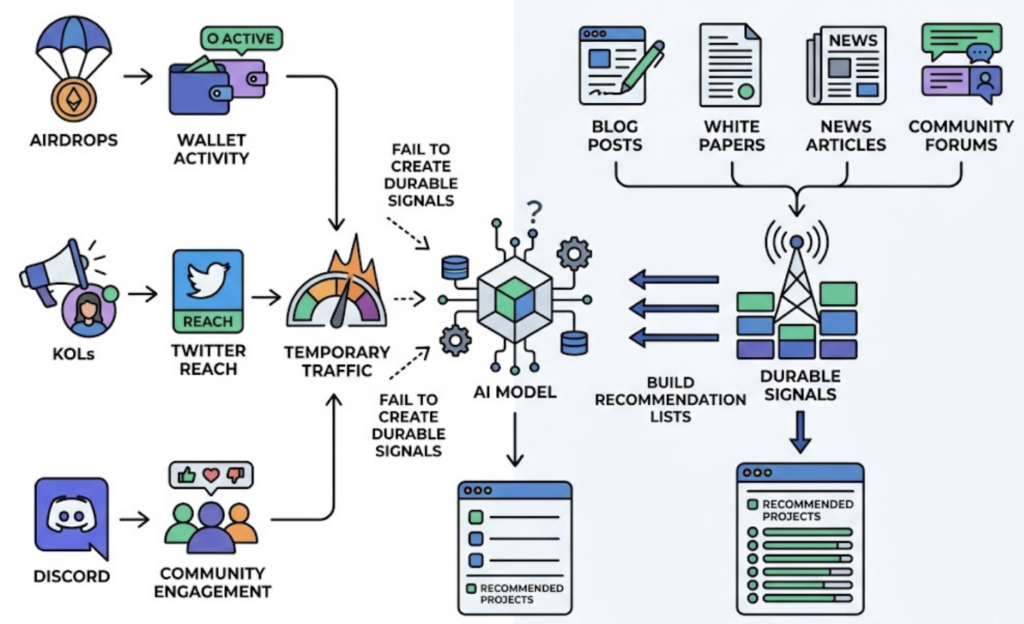
The AI Visibility Report makes this gap visible. Run your brand through it, and you’ll see exactly where Google performance and AI presence diverge. That divergence is your starting point.
AI Applies Stricter Trust Filters to Crypto and Web3 Brands
Not every industry faces the same bar for AI recommendations. Web3 faces a higher one.
AI models have been trained on a web that includes years of crypto scams, rug pulls, Ponzi schemes, and regulatory enforcement actions. That history shapes how LLMs evaluate new queries about blockchain projects. When a user asks “Is [protocol] safe?”, AI doesn’t just check your website. It looks for audit reports cited by independent sources, media coverage from trusted publications, community sentiment across Reddit and forums, and consistency between what your brand claims and what third parties verify.
A Web3 project with solid technology but thin external validation gets filtered out. In practice, this means that a newer DeFi protocol with a $50M TVL and two completed audits can still be invisible to AI if those audits aren’t cited in publications that LLMs trust, if Reddit discussions about the protocol are sparse, and if no independent comparison articles include it.
The path forward isn’t more marketing spend. It’s building what AI models consider trustworthy signals: entity-level consistency across sources, structured content that LLMs can extract and cite, third-party validation from publications and review platforms, and a content footprint that persists beyond campaign cycles.
This is where the shift from “event-driven marketing” to “entity building” becomes critical for Web3 brands. Airdrops don’t build entities. Consistent, structured, multi-source content does.
One Snapshot Tells You Where You Stand. Continuous Tracking Tells You Where You’re Heading.
The AI Visibility Report gives you a clear picture of your current AI search presence. But AI models update their training data, adjust recommendation signals, and shift rankings on a rolling basis. A protocol that shows up in ChatGPT’s DeFi recommendations today could disappear next month after a model update, with no change on the brand’s end.
Web3 moves fast. Narratives shift from RWA tokenization to modular chains to AI agents in weeks. Your AI visibility score is tied to those shifts.
Topify‘s AI Visibility Checker picks up where the free report leaves off. It tracks your mention rate, ranking position, and provider breakdown continuously across ChatGPT, Perplexity, Gemini, and Google AI Overviews. You’ll see trend lines, get alerts when visibility shifts, and benchmark your performance against competing protocols in real time.
| Capability | Free AI Visibility Report | Topify Platform |
|---|---|---|
| Check frequency | One-time snapshot | Continuous daily/weekly monitoring |
| AI platforms covered | Aggregated overview | Per-platform breakdown with trends |
| Historical data | None | Full visibility history with alerts |
| Competitor tracking | Not included | Real-time protocol benchmarking |
| Action recommendations | Manual interpretation | Specific optimization suggestions |
| Team collaboration | Single user | Unlimited team seats |
Every plan starts with a 7-day free trial, no credit card required. The Starter plan begins at $99/month.
Conclusion
Web3 brands are competing for attention in AI search whether they’ve optimized for it or not. The question isn’t whether your protocol should be visible in ChatGPT and Perplexity. It’s whether you even know your current status.
Start with the free AI Visibility Report to see where your brand stands across AI platforms. Use the results to identify platform-specific gaps, trust signal weaknesses, and ranking positions that don’t match your product’s actual strengths. Then decide whether a one-time check is enough, or whether continuous monitoring through Topify’s platform fits your growth stage.
While you’re checking your AI visibility, a few other free tools can round out the picture. Topify‘s GEO Score Checkerevaluates whether AI crawlers can actually access and parse your site’s content. The AI Trends Tracker surfaces which Web3 topics are trending across AI platforms right now. And the Brand Authority Checker scores how AI models perceive your brand’s expertise and trustworthiness in your category.
FAQ
Is the AI Visibility Report free? Do I need to sign up?
Yes, it’s completely free and requires no account, no email, and no credit card. Enter your brand name, get your report in under 60 seconds.
What’s the difference between the free report and Topify’s paid platform?
The free report gives you a one-time snapshot of your AI visibility across platforms. The paid platform adds continuous monitoring, historical trend tracking, competitor benchmarking, optimization recommendations, and team collaboration. Plans start at $99/month with a 7-day free trial.
How often should Web3 brands check their AI visibility?
At minimum, after every major product launch, narrative shift, or AI model update. In practice, weekly monitoring is ideal for Web3 because the space moves faster than most industries, and AI recommendation lists can change without warning.
Why is my Web3 brand invisible in AI search if I rank well on Google?
Google rankings depend on keywords and backlinks. AI models prioritize corroborated claims, trusted publications, structured content, and multi-source brand mentions. Most Web3 brands optimize for the first set of signals but not the second, which is why Google performance and AI visibility often diverge.

