

An ML engineer typed into Perplexity: “Best experiment tracking platform for production ML at scale.” Five tools came back. Yours wasn’t one of them. Your platform handles 10,000+ experiments daily, ships with SOC 2 compliance, and has a Kubernetes-native deployment pipeline. None of that mattered, because AI didn’t know it existed.
The gap is measurable, and the check takes 60 seconds. Topify‘s GEO Score Checker evaluates whether AI crawlers can access your site, how well your content is structured for AI comprehension, and how visible your brand actually is across AI platforms.
✅ Free ⚡ Results in 60 seconds 🔒 No signup required
GEO Score Checker
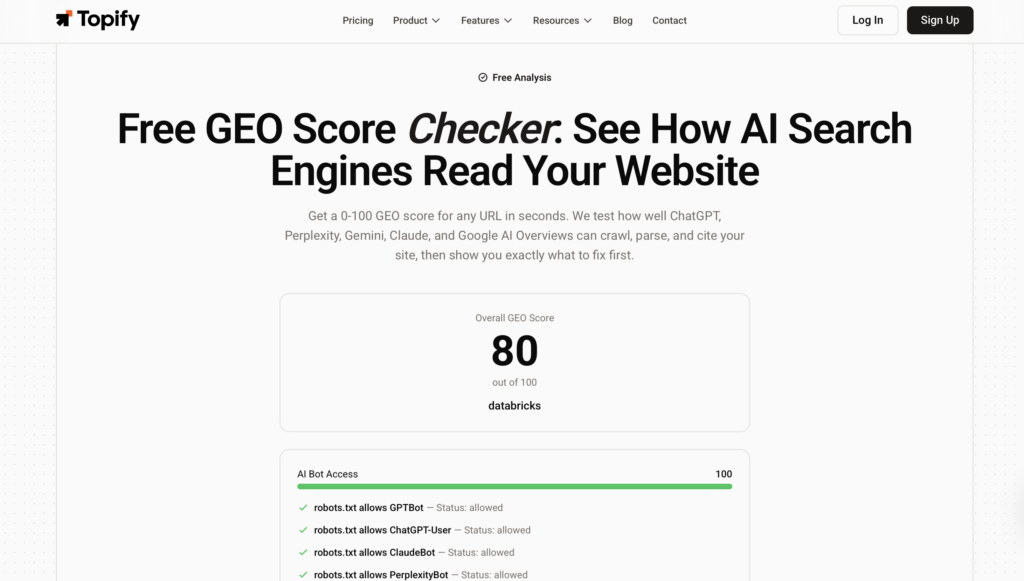
What the GEO Score Checker Reveals About Your MLOps Platform
Four Signals That Determine If AI Recommends Your MLOps Brand
The GEO Score Checker returns a 0-100 composite score built from four dimensions. Each one maps to a specific problem MLOps brands face in AI search.
| Signal | What It Measures | What It Means for MLOps Brands |
|---|---|---|
| Bot Access (0-100) | Whether AI crawlers (GPTBot, ClaudeBot, PerplexityBot) can reach your content | Below 50: your docs, tutorials, and changelogs are invisible to AI models |
| Structured Data (0-100) | Schema markup, metadata, and content organization | Below 40: AI can’t parse your feature set or differentiate you from similar platforms |
| Content Signals (0-100) | Depth, authority indicators, and topical relevance of your pages | Below 50: AI treats your platform as a minor player, even if your user base says otherwise |
| Visibility Score (0-100) | How often and prominently AI surfaces your brand in relevant queries | Below 30: you’re not in the AI answer at all for your core category |
An MLOps platform with strong Content Signals but a Bot Access score of 25 has a clear diagnosis: the content is good, but AI literally can’t read it. That’s often a robots.txt misconfiguration blocking GPTBot or ClaudeBot. It’s fixable in minutes once you know it’s the problem.
Three Issues MLOps Brands Typically Discover
Your documentation is gated behind authentication. Many MLOps platforms require login to access API docs, SDK references, and integration guides. AI crawlers can’t authenticate. The result: AI models describe your product based on your marketing pages, not your actual capabilities.
Your product positioning is ambiguous to AI. If your site talks about “data pipelines,” “model serving,” and “workflow orchestration” without clear MLOps framing, AI may classify you as a data engineering tool or a generic DevOps platform. You’ll show up in the wrong category or not at all.
Your changelog and release notes aren’t crawlable. MLOps buyers care about recent updates. If AI can’t access your latest release notes, it’ll describe the version you shipped 18 months ago. Your new LLM deployment features, fine-tuning pipelines, or GPU optimization tools won’t exist in AI’s understanding.
Run Your First Check in 60 Seconds
Go to the GEO Score Checker, enter your domain, and get your four-dimensional breakdown. No account, no credit card, no sales call. The score tells you exactly which layer needs attention first, so you’re not guessing where to start.
The AI Prompts Deciding Which MLOps Platforms Get Recommended
ML engineers and data scientists don’t search for MLOps tools the way marketing teams expect. They ask AI specific, scenario-driven questions. The table below shows what those prompts look like and what they reveal about your visibility.
| AI Prompt Example | Platform | Search Intent | What It Reveals |
|---|---|---|---|
| “Best MLOps platform for LLM fine-tuning and deployment” | ChatGPT | Purchase evaluation | Whether AI associates your brand with LLM-era capabilities |
| “MLflow vs [your brand] for experiment tracking” | Perplexity | Head-to-head comparison | Whether AI has enough data to represent your platform accurately |
| “Open-source MLOps tools for Kubernetes 2026” | Gemini | Stack planning | Whether AI categorizes you correctly (open-source vs. commercial, cloud vs. self-hosted) |
| “MLOps platform with HIPAA compliance for healthcare” | ChatGPT | Compliance-driven selection | Whether AI knows about your security certifications and vertical capabilities |
| “Which experiment tracking tool scales to 100K runs” | Perplexity | Performance benchmarking | Whether AI can cite specific performance claims from your documentation |
Here’s the thing. If your GEO Score Checker results show low Bot Access or weak Structured Data, AI doesn’t have enough information to answer any of these prompts in your favor. The model defaults to the brands whose content it can actually read and parse.
Gartner has projected that traditional search engine volume will drop 25% by 2026 due to AI platform adoption. For MLOps brands, the shift is already happening. Your buyers are the exact people building and using these AI systems. They’re not going to Google first.
Three Visibility Gaps That Cost MLOps Brands Pipeline
Open-Source Tools Dominate AI Recommendations. Commercial Platforms Get Left Out.
Ask any major AI model to recommend MLOps tools, and you’ll get a predictable list: MLflow, Kubeflow, SageMaker, maybe Weights & Biases. The pattern isn’t random. Open-source projects generate massive volumes of crawlable content: GitHub repos, community forums, Stack Overflow threads, conference talks, academic papers. AI models train on all of it.
Commercial MLOps platforms, by contrast, often keep their most valuable content behind login walls, gated demos, and sales-qualified funnels. The content that could differentiate them in AI search never makes it into the training data.
A low GEO Score Checker result in Content Signals or Bot Access often points directly to this structural disadvantage. The fix isn’t to open-source your product. It’s to make your technical depth visible to AI in the same way open-source projects naturally are: public documentation, ungated tutorials, structured comparison pages, and crawlable API references.
Category Misclassification Is the Silent Killer of MLOps Visibility
AI models don’t have a fixed taxonomy for the MLOps market. They infer category placement from the signals your site sends. If your homepage leads with “accelerate your data pipeline” or “streamline infrastructure management,” AI may slot you into data engineering or DevOps, not MLOps.
This matters because prompt-level visibility is category-specific. When someone asks “best MLOps platform for production ML,” AI pulls from its internal model of what belongs in the MLOps category. If your brand isn’t firmly in that bucket, you won’t surface, regardless of how strong your product is.
The GEO Score Checker’s Content Signals dimension can flag this issue. A score that’s strong on general authority but weak on topical relevance suggests your site communicates expertise without specifying the right category.
“Answer Inclusion” Is Replacing SERP Rankings as the MLOps Visibility KPI
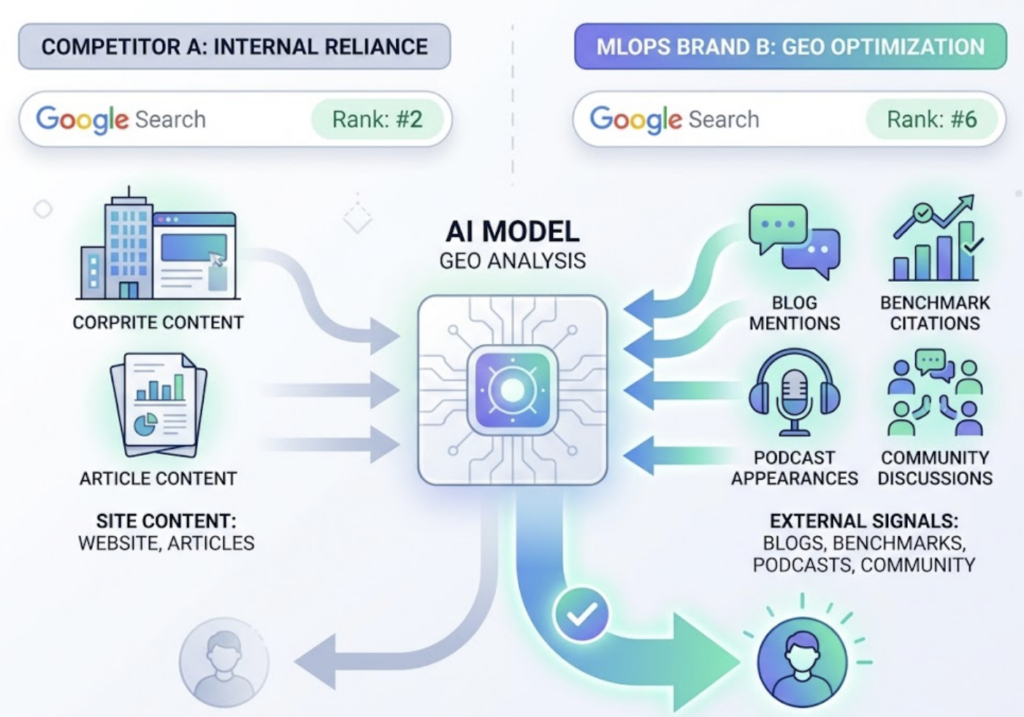
Research from Edelman shows that up to 90% of citations driving brand visibility in LLMs come from earned media, not traditional SEO signals. For MLOps brands, this means ranking #3 on Google for “experiment tracking tools” doesn’t guarantee you’ll appear in the AI-generated answer.
Answer Inclusion, whether your brand is named in the AI response at all, is the new metric. And it operates on different rules. AI models weigh semantic relevance, structural clarity, and third-party validation more heavily than domain authority alone.
In practice, an MLOps brand with a moderate Google ranking but strong third-party coverage (blog mentions, benchmark citations, podcast appearances, community discussions) can outperform a higher-ranked competitor that relies primarily on its own site content. The GEO Score Checker gives you the baseline. From there, the optimization strategy shifts toward building the kind of external signals AI models actually trust.
From a One-Time Score to Continuous AI Visibility
Your GEO Score Checker result is a snapshot. It tells you where you stand today. But AI models update their training data, adjust their ranking signals, and reshuffle recommendations on a rolling basis. A score of 72 today could drop to 55 next quarter without any change on your end, simply because a competitor improved their structured data or published a wave of new technical content.
Topify‘s Comprehensive GEO Analytics dashboard tracks your GEO score, visibility, and content signals continuously across ChatGPT, Perplexity, Gemini, and Google AI Overviews. You’ll see trend lines, get alerts when scores shift, and receive specific recommendations for what to fix next.
Here’s how the free check compares to the full platform:
| Capability | Free GEO Score Checker | Topify Platform |
|---|---|---|
| Check frequency | One-time snapshot | Continuous daily/weekly monitoring |
| AI platforms covered | Aggregated single score | Per-platform breakdown (ChatGPT, Perplexity, Gemini, AI Overviews) |
| Historical trends | None | Full trend history with automated alerts |
| Competitor tracking | Not included | Real-time competitor benchmarking |
| Action recommendations | General score breakdown | Specific, prioritized optimization steps |
| Team collaboration | Single user | Unlimited team member seats |
Every plan starts with a 7-day free trial, no credit card required. The Starter plan begins at $99/month.
Conclusion
MLOps buyers are already asking AI which platforms to evaluate. If your brand isn’t in those answers, you’re losing pipeline before your sales team even gets a chance to talk.
Start with the GEO Score Checker. Get your four-dimensional score. Fix the crawlability and content structure issues it surfaces. Then build a continuous monitoring practice so you’re not blindsided when AI models shift their recommendations.
While you’re assessing your GEO score, a few other free checks can round out the picture. Topify‘s AI Robots Checkershows exactly which AI crawlers your robots.txt currently blocks, a critical first step for MLOps platforms that may have inadvertently locked out GPTBot or ClaudeBot. The Competitor Analysis tool reveals how AI positions your brand against alternatives in your category. And the AI Visibility Report gives you a cross-platform snapshot of how often your brand gets mentioned in AI-generated responses.
FAQ
Is the GEO Score Checker really free? Do I need to create an account?
Yes, it’s completely free with no signup required. Enter your domain and get your score in under 60 seconds. No credit card, no email, no strings attached.
What’s the difference between the free GEO Score Checker and Topify’s paid platform?
The free tool gives you a one-time snapshot of your GEO readiness across four dimensions. The paid platform provides continuous monitoring, per-platform breakdowns, historical trend tracking, competitor benchmarking, and actionable optimization recommendations. Plans start at $99/month with a 7-day free trial.
How often should MLOps brands check their AI visibility?
At minimum, after every major product release, documentation update, or website restructure. AI models re-index content on rolling schedules, so changes can take weeks to propagate. Continuous monitoring through the Topify platform catches shifts you’d otherwise miss.
Why does my MLOps platform rank well on Google but not appear in AI answers?
AI models weight different signals than traditional search engines. They prioritize structured data, crawlability by AI-specific bots (GPTBot, ClaudeBot), semantic clarity, and third-party validation. A strong Google ranking doesn’t automatically translate to AI visibility, which is exactly what the GEO Score Checker helps you diagnose.

