

A VP of Engineering opens Perplexity and types: “Best GPU cloud provider for large-scale inference workloads in 2026.” Four brands show up. Yours isn’t one of them. That query just bypassed your sales team, your landing pages, and your entire demand gen funnel. The buyer moved on before you ever had a chance to pitch.
Here’s the thing: you can check whether AI search engines can actually see your infrastructure brand right now. Topify’sGEO Score Checker runs a free audit on any URL and returns a 0-100 score across four dimensions: bot access, structured data, content signals, and visibility. ✅ Free, ⚡ results in 60 seconds, 🔒 no signup required.
GEO Score Checker
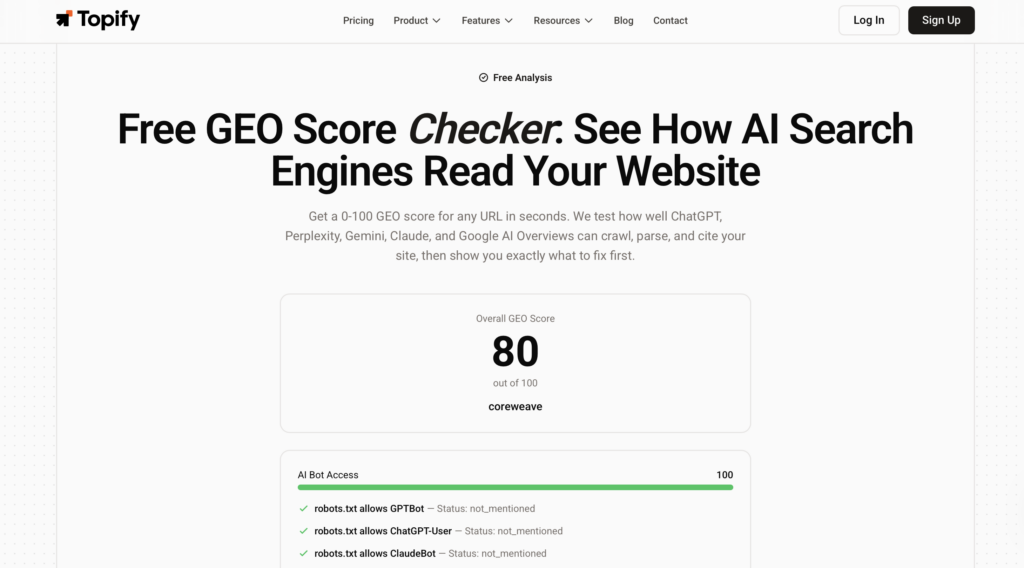
What the GEO Score Tells You About Your AI Infrastructure Website
The Four Dimensions That Determine If AI Can Read Your Site
Most AI infrastructure companies invest heavily in product documentation, benchmark reports, and technical whitepapers. But if AI crawlers can’t access, parse, and cite that content, none of it contributes to your AI search visibility.
The GEO Score Checker evaluates your site across four dimensions. Each one maps directly to how AI models decide whether to include your brand in a recommendation.
| Dimension | What It Measures | What It Means for AI Infrastructure |
|---|---|---|
| Bot Access | Whether AI crawlers (GPTBot, ClaudeBot, PerplexityBot) can reach your pages | Many infra sites block bots via robots.txt or serve content behind JavaScript rendering walls |
| Structured Data | Schema markup, JSON-LD, and machine-readable metadata | AI models rely on structured data to understand product specs, pricing tiers, and deployment options |
| Content Signals | Citability, clarity, and depth of on-page content | Dense technical docs score well here, but only if they’re organized with clear headings and concise claims |
| Visibility | How often your brand appears in AI-generated responses | Low visibility means your competitors are getting the recommendations your content should earn |
A score of 70+ generally means AI models can find and reference your content. Below 50, and you’re likely invisible in most AI-generated answers about GPU clouds, networking hardware, or data center solutions.
Three Scenarios Where AI Infrastructure Brands Fail the GEO Test
Scenario 1: Your benchmark data lives in PDFs. You published a detailed MLPerf comparison showing your GPU cluster outperforms alternatives by 40%. But it’s locked in a downloadable PDF that AI crawlers can’t index. The GEO Score Checker flags this as a content signal gap.
Scenario 2: Your robots.txt blocks AI bots. Your engineering team configured robots.txt to limit crawl load, and in the process blocked GPTBot and ClaudeBot entirely. Your bot access score drops to near zero, and AI platforms literally can’t see your site.
Scenario 3: Your product pages lack structured data. You offer three GPU cloud tiers with different specs, pricing, and SLAs. But without schema markup, AI models can’t distinguish your offerings from a competitor’s. When a buyer asks “cheapest GPU cloud for fine-tuning,” AI has no structured way to recommend your starter tier.
Run Your First GEO Audit in 60 Seconds
The process is straightforward:
- Go to the GEO Score Checker and enter your homepage URL.
- Review your composite score and the breakdown across all four dimensions.
- Prioritize fixes based on which dimension scores lowest. Bot access issues typically have the fastest fix cycle. Content signal improvements take longer but compound over time.
You don’t need a marketing agency to interpret the results. The score is designed to be readable by technical teams, which is exactly who runs the show at most AI infrastructure companies.
The Prompts AI Infrastructure Buyers Are Typing Into ChatGPT
Understanding what your buyers ask AI is the first step to showing up in those answers. Here are the prompt patterns that drive vendor discovery in this category.
| AI Prompt Example | Platform | Search Intent | What It Reveals |
|---|---|---|---|
| “Best GPU cloud for LLM training at scale” | ChatGPT | Vendor shortlisting | Whether AI recommends your platform for high-compute workloads |
| “CoreWeave vs Lambda for inference” | Perplexity | Competitive comparison | How AI positions your brand against named alternatives |
| “Most cost-effective AI infrastructure for startups” | Gemini | Budget-constrained purchase | Whether your pricing or starter tiers get cited |
| “Best liquid cooling for high-density GPU racks” | ChatGPT | Component research | Whether your cooling or hardware specs are visible to AI |
| “What networking equipment do I need for a 1,000-GPU cluster” | Perplexity | Technical planning | Whether AI references your product documentation |
| “AI data center providers near Virginia” | Google AI Overview | Location-based evaluation | Whether your facilities appear in geo-specific AI results |
37% of product discovery queries now start in AI interfaces. In the AI infrastructure space, these queries tend to be highly specific and technical. That’s good news if your content is well-structured. It’s a problem if AI can’t parse your specs.
The GEO Gaps Most AI Infrastructure Companies Don’t Know They Have
AI Models Describe Your Product Using Information From Six Months Ago
GPU architectures evolve on 6-to-12-month cycles. New cooling systems hit the market every quarter. Pricing changes constantly as supply and demand shift across regions.
But AI models don’t update in real time.
If your website content isn’t structured for AI citability, models will keep using whatever information they absorbed during their last training window. That means a buyer asking about your latest GPU cluster might get a description based on your previous-generation specs. In a market where global AI infrastructure spending is projected to exceed $900 billion by 2029, outdated AI descriptions don’t just cost you visibility. They cost you pipeline.
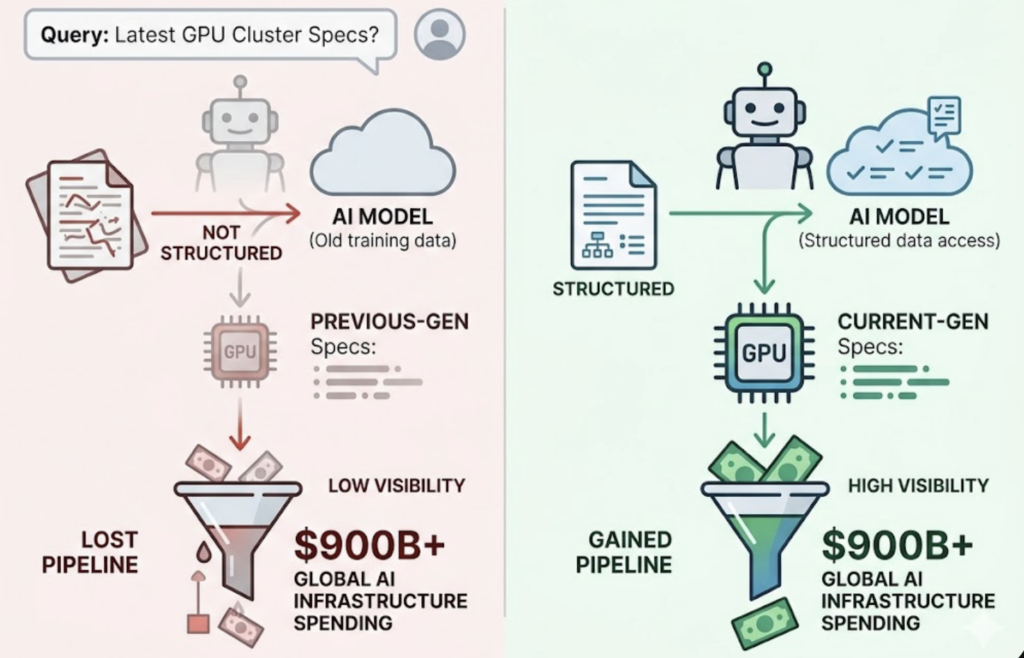
The fix isn’t just publishing a blog post about your new product. It’s making sure your content architecture, schema markup, and entity signals are clear enough that AI models can absorb and re-surface updated information quickly.
Your Competitors May Already Be Optimizing for AI Search While You’re Still Focused on Google Rankings
Traditional SEO measures backlinks, keyword rankings, and organic traffic. GEO measures something entirely different: whether AI systems can read, understand, and cite your content.
Only 11% of B2B brands have content that’s AI-discovery ready. In a category as competitive as AI infrastructure, the brands that invest in GEO first will build compounding advantages. AI models tend to reinforce what they already cite. If your competitor appears in responses consistently and you don’t, the gap widens with every model update.
This isn’t a theoretical risk. 80% of tech industry buyers already use GenAI as much as or more than traditional search for vendor research. The switch has already happened.
Your Website Needs to Be Machine-Readable, Not Just Human-Readable
Gartner projects that by 2028, 90% of B2B purchasing will be intermediated by AI agents. AI infrastructure buyers are already among the most AI-native procurement teams in any industry. They’re using AI tools not just for research, but for building automated vendor evaluation pipelines.
Your website’s GEO Score is a proxy for how well these systems can process your information. A high bot access score means AI agents can crawl your site. Strong structured data means they can extract your product specs programmatically. Good content signals mean they can cite your claims with confidence.
50% of B2B buyers have already evaluated or purchased from a vendor they discovered exclusively through AI, with no prior brand awareness. In a market where new GPU cloud providers, networking vendors, and storage solutions launch monthly, being machine-readable is no longer optional.
One Snapshot Won’t Keep You Visible. Here’s What Continuous GEO Monitoring Looks Like.
The GEO Score Checker gives you a point-in-time assessment. That’s valuable as a starting point. But AI search results shift constantly. Models retrain, competitor content changes, and your own site evolves with new product launches and pricing updates. A score of 72 today could drop to 58 next month without any action on your part.
Topify’s Comprehensive GEO Analytics turns that one-time snapshot into a continuous monitoring system. It tracks your GEO performance across ChatGPT, Perplexity, Gemini, and Google AI Overviews in a single dashboard, with trend history, citation tracking, sentiment analysis, and competitor benchmarking. When your score dips, you’ll know which dimension changed and why.
| Capability | Free GEO Score Checker | Topify Platform |
|---|---|---|
| Check frequency | One-time snapshot | Continuous daily/weekly monitoring |
| AI platforms covered | Single check | ChatGPT + Perplexity + Gemini + AI Overviews |
| Historical trends | No | Full trend history with alerts |
| Competitor tracking | No | Real-time competitor benchmarking |
| Actionable next steps | Manual interpretation | One-click GEO optimization recommendations |
| Team collaboration | No | Unlimited team member seats |
Plans start at $99/month with a 7-day free trial, no credit card required. For AI infrastructure companies managing multiple product lines or sub-brands, the Pro tier supports multi-brand tracking. You can start a free trial and see your full GEO analytics dashboard within minutes.
Conclusion
AI infrastructure is one of the fastest-moving B2B categories in the world. Your buyers are technical, AI-native, and increasingly relying on AI search to build vendor shortlists before they ever talk to sales. If your website isn’t optimized for AI readability, you’re invisible to the exact audience you’re trying to reach.
Start with the GEO Score Checker to see where you stand. Fix the gaps it identifies. Then move to continuous monitoring so your visibility keeps pace with your product roadmap.
Other Free Tools Worth Running
Once you’ve benchmarked your GEO Score, a few additional checks can round out the picture:
- AI Robots Checker: Verify whether your robots.txt is blocking GPTBot, ClaudeBot, PerplexityBot, and other AI crawlers. This is often the single fastest fix for AI infrastructure sites.
- AI Visibility Report: See how often your brand gets mentioned across major AI platforms, with a breakdown by provider.
- Competitor Analysis: Find out which competitors AI recommends in your category and how your positioning compares.
FAQ
Is the GEO Score Checker really free? Do I need to create an account? Yes, it’s completely free with no signup required. Enter any URL and get your score in about 60 seconds.
What’s the difference between the free GEO Score Checker and the Topify platform? The free tool gives you a one-time score and dimensional breakdown. The platform adds continuous monitoring, historical trend tracking, competitor benchmarking, citation analysis, and one-click optimization recommendations across all major AI search engines.
How often should an AI infrastructure brand check its AI visibility? At minimum, after every major product launch, pricing change, or website update. Ideally, you’d run continuous monitoring since AI model updates can shift your visibility without any changes on your end.
Our site has extensive technical documentation. Doesn’t that automatically make us visible to AI? Not necessarily. Documentation depth helps your content signal score, but if AI crawlers are blocked by your robots.txt, or your content lacks structured data, that documentation won’t surface in AI-generated answers. The GEO Score Checker reveals exactly which dimensions need work.

