

A procurement director at a regional hospital system typed into ChatGPT: “Best patient monitoring devices for ICU with FDA clearance and EHR integration.” The AI listed five brands. Your device, with three FDA clearances and integration partnerships across 40 health systems, didn’t make the list. The problem isn’t your product portfolio. It’s that AI doesn’t recognize your authority in the category.
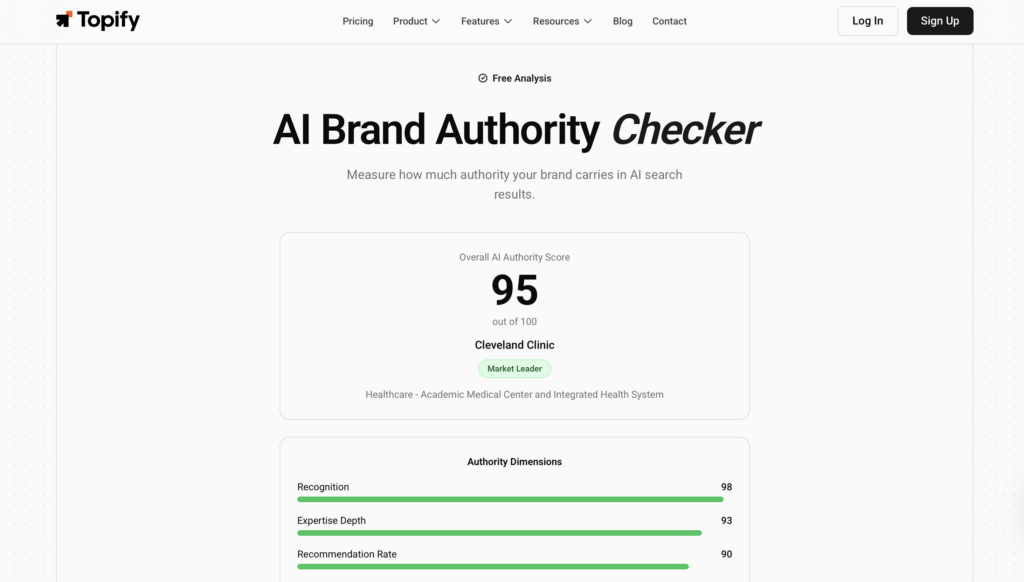
The gap is measurable, and the check takes 60 seconds. Topify‘s Brand Authority Checker scores how AI models perceive your MedTech brand’s authority across four dimensions: recognition, expertise depth, recommendation rate, and trust signals. Each score maps directly to whether AI includes you in clinical and procurement recommendations.
✅ Free ⚡ Results in 60 seconds 🔒 No signup required
AI Brand Authority Checker
The Four Scores That Tell You If AI Trusts Your MedTech Brand
Each Metric, Translated for Medical Device Companies
The Brand Authority Checker doesn’t give you a single number and walk away. It breaks your brand’s AI perception into four distinct dimensions, each with a specific meaning for MedTech.
| Metric | What It Measures | What It Means for MedTech Brands |
|---|---|---|
| Recognition (0-100) | How often AI identifies your brand in your device category | Below 40: AI doesn’t associate you with your core therapeutic area or device type |
| Expertise Depth (0-100) | How well AI understands your technical capabilities | Below 50: AI may misrepresent your FDA clearance status, clinical evidence, or integration capabilities |
| Recommendation Rate (0-100) | How often AI recommends you when buyers ask | Below 30: procurement teams and clinicians using AI for shortlisting never see your brand |
| Trust Signals (0-100) | External validation AI detects from media, clinical studies, and reviews | Below 40: AI can’t find enough third-party evidence to back up your claims |
Here’s the thing. A MedTech brand with a Recognition score of 80 but a Trust Signals score of 25 has a very specific problem: AI knows your name but doesn’t trust you enough to recommend you over alternatives. That pattern is common among mid-size device manufacturers with strong sales teams but limited peer-reviewed coverage or media presence.
On the flip side, a brand with high Trust Signals but low Expertise Depth typically has good press coverage but poor structured content. AI sees the validation but can’t parse exactly what you do.
What MedTech Brands Typically Discover
Three patterns show up repeatedly when MedTech companies run this check.
Pattern 1: Strong regulatory portfolio, weak AI recognition. You have multiple FDA clearances and CE marks, but your Recognition score is below 50. This usually means your regulatory achievements live in PDF submissions and press releases that AI crawlers can’t easily index. The clinical evidence exists, but it’s trapped in formats AI doesn’t parse well.
Pattern 2: Known brand, misrepresented capabilities. AI mentions your company but describes outdated product lines or attributes capabilities to the wrong division. This shows up as a gap between Recognition (high) and Expertise Depth (low). It’s particularly common among MedTech conglomerates with multiple business units.
Pattern 3: Invisible to purchase-intent queries. Your Recommendation Rate is significantly lower than your Recognition score. AI knows you exist but doesn’t recommend you when someone asks “best [device type] for [clinical scenario].” This often signals that your content answers informational queries but fails to position your products as solutions to specific clinical problems.
How to Run Your MedTech Brand Check
Go to the Brand Authority Checker, enter your brand name or domain, and get your four-dimensional authority breakdown in under a minute. No account creation, no credit card, no sales call. You’ll see exactly which dimension is dragging down your AI visibility, and that tells you where to focus your content and PR strategy first.
Clinicians and Procurement Teams Are Asking AI These Questions. Are You in the Answers?
Over 50% of healthcare professionals now use AI-powered search tools like ChatGPT in their professional roles, with two-thirds of those users under age 45. That number is only going up. And the questions they’re asking carry real purchasing weight.
| AI Prompt Example | Platform | Search Intent | What It Reveals About Your Brand |
|---|---|---|---|
| “Best surgical robotics systems for orthopedic procedures 2026” | ChatGPT | Category evaluation | Whether AI includes you in the top-tier shortlist for your device category |
| “Compare patient monitoring platforms with EHR integration” | Perplexity | Head-to-head comparison | How AI positions your features against alternatives |
| “Is [Brand] FDA-cleared for cardiac imaging?” | Gemini | Trust verification | Whether AI accurately represents your regulatory status |
| “Most cost-effective diagnostic equipment for community hospitals” | ChatGPT | Budget-constrained procurement | Whether AI recommends you for value-focused buyers |
| “Digital therapeutics for diabetes management with clinical evidence” | Perplexity | Evidence-based purchasing | Whether AI cites your clinical trials and outcomes data |
These aren’t hypothetical. McKinsey’s research on gen AI in MedTech found that over half of MedTech organizations have already deployed gen AI across commercial workflows, including marketing, insight generation, and customer interactions. The buyers on the other side of those interactions are increasingly using the same tools to evaluate your products.
If your brand doesn’t appear when a hospital procurement team asks ChatGPT for recommendations in your device category, you’re not losing a ranking position. You’re losing a seat at the table before your sales team ever gets a call.
Three Visibility Gaps MedTech Brands Can’t Afford to Ignore
HCPs Are Using AI to Choose Devices, But AI Doesn’t Recognize Your Authority
The generational shift in healthcare is real. Research from early 2026 shows that adoption of AI search among HCPs is driven heavily by the 25-34 age group. These are residents, fellows, and early-career specialists who’ll be making purchasing and prescribing decisions for decades. They’re not waiting for a rep to walk them through a product brochure. They’re typing clinical scenarios into AI tools and trusting the answers.
For MedTech brands, this means your authority in AI systems isn’t a future concern. It’s a current revenue issue. If your Brand Authority Checker score shows low Recognition or low Recommendation Rate in your device category, you’re already invisible to the fastest-growing segment of clinical decision-makers.
Being “Mentioned” by AI Isn’t the Same as Being Recommended
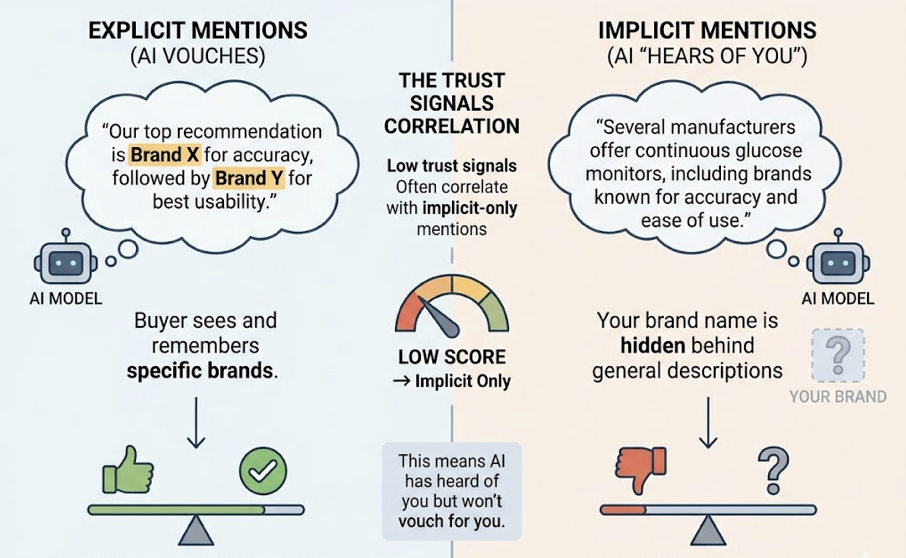
There’s a critical difference between implicit mentions and explicit citations in AI-generated responses. Analysis of major MedTech brands found that even leading device manufacturers appear mostly as implicit references in AI answers, with citation scores as low as 3.16%. That means AI may reference your brand in passing but never formally recommends or credits you.
In practice, this looks like: “Several manufacturers offer continuous glucose monitors, including brands known for accuracy and ease of use.” Your name might be behind that description, but the buyer reading the response doesn’t see it. They see the brand that AI names explicitly. The Brand Authority Checker’s Trust Signals score directly reflects this gap. Low trust signals often correlate with implicit-only mentions, telling you that AI has heard of you but won’t vouch for you.
Your Competitors May Be Gaining AI Ground While You’re Focused on Traditional Channels
MedTech marketing budgets still skew heavily toward trade shows, journal advertising, and KOL engagement. Those channels matter. But they don’t feed the AI systems that are increasingly shaping initial shortlists.
While you’re investing in conference booths, a competitor with a stronger structured data strategy, more indexable clinical evidence, and better entity clarity could be climbing the AI recommendation ladder in your category. The competitive dimension of AI visibility isn’t visible through traditional analytics. You won’t see it in your Google rankings or your website traffic. You’ll see it in the Brand Authority Checker results, where your Recommendation Rate sits next to what AI models actually tell buyers about your category.
When a One-Time Snapshot Isn’t Enough: Continuous Authority Tracking
Your Brand Authority Checker results show you where your MedTech brand stands right now. But AI models retrain, update their data sources, and shift recommendations on a rolling basis. A Recommendation Rate of 65 today could drop to 40 next quarter if a competitor publishes a major clinical trial that AI picks up, or if your latest product launch content isn’t structured for AI crawlers.
Topify‘s Comprehensive GEO Analytics dashboard picks up where the free tool leaves off. It tracks your authority, sentiment, and visibility scores continuously across ChatGPT, Perplexity, Gemini, and Google AI Overviews. You’ll see trend lines over time, get alerts when scores shift, and receive specific recommendations for what to fix. For MedTech teams reporting to a VP of Marketing or CMO, the dashboard translates AI visibility into the metrics leadership actually cares about.
| Capability | Free Brand Authority Checker | Topify Platform |
|---|---|---|
| Check frequency | One-time snapshot | Continuous daily/weekly monitoring |
| AI platforms | Aggregated score | Per-platform breakdown (ChatGPT, Perplexity, Gemini, AI Overviews) |
| Historical data | None | Full trend history with alerts |
| Competitor comparison | Not included | Real-time benchmarking against MedTech rivals |
| Action recommendations | General direction | Specific, prioritized GEO optimization steps |
| Team collaboration | Individual use | Multi-seat access for marketing, regulatory, and product teams |
Every plan starts with a 7-day free trial, no credit card required. The Starter plan begins at $99/month.
Conclusion
MedTech purchasing decisions are shifting to AI-assisted workflows, and the brands that show up in those AI-generated recommendations will capture the shortlist. The ones that don’t will keep wondering why qualified leads are drying up despite strong clinical evidence and regulatory approval.
Start with a free Brand Authority Checker scan. See which of the four authority dimensions is holding your MedTech brand back, and use that data to prioritize your content and PR strategy for AI visibility.
While you’re assessing your brand authority, a few other free checks can round out the picture. Topify’s GEO Score Checker evaluates whether AI crawlers can actually access and parse your site’s clinical content. The AI Visibility Reportshows how often your brand gets mentioned across major AI platforms. And the Competitor Analysis tool reveals which MedTech brands AI currently favors in your device category.
FAQ
Is the Brand Authority Checker really free? Do I need to create an account?
Yes, it’s completely free. No account, no email, no credit card. Enter your brand name or domain and get your scores in under 60 seconds.
What’s the difference between the free tool and the Topify platform?
The free Brand Authority Checker gives you a one-time snapshot of your four authority scores. The Topify platform adds continuous monitoring, historical trends, competitor benchmarking, per-platform breakdowns across ChatGPT, Perplexity, Gemini, and AI Overviews, and actionable optimization recommendations. Plans start at $99/month with a 7-day free trial.
How often should MedTech brands check their AI visibility?
At minimum, after every major product launch, FDA clearance, clinical trial publication, or competitor announcement. AI models update their knowledge bases on a rolling schedule, so what’s true today may shift in weeks. For serious monitoring, continuous tracking through the Topify platform catches changes before they impact your pipeline.
Does FDA clearance automatically improve my AI authority score?
Not directly. AI models don’t pull from FDA databases in real time. Your clearance information needs to be structured, indexable, and referenced by third-party sources (media coverage, clinical publications, industry reviews) before AI systems incorporate it into their recommendations. The Brand Authority Checker’s Trust Signals score reflects how well that external validation is reaching AI.

