

A hospital procurement officer typed into ChatGPT: “Best EHR system for mid-size hospitals with telehealth integration.” The AI recommended five providers. Your system, with Joint Commission accreditation and 12,000 active users, wasn’t on the list. The issue isn’t your product. It’s that AI doesn’t recognize your authority.
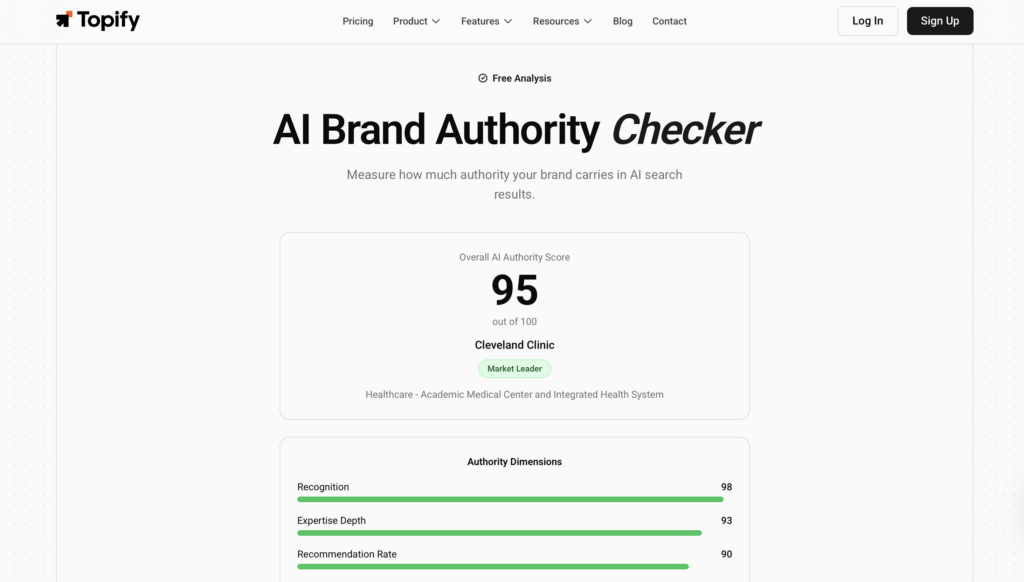
You can find out exactly where the gap is in under a minute. Topify‘s Brand Authority Checker scores how AI models perceive your healthcare brand’s authority across four dimensions that directly affect whether you get recommended.
✅ Free ⚡ Results in 60 seconds
AI Brand Authority Checker
Patients Ask AI Before They Call Your Clinic. Here’s How to Check If You’re in the Answer.
Over 40 million Americans use ChatGPT daily for healthcare questions. One in four of the platform’s 800 million weekly users submits a health-related prompt every week. And 89% of health queries now trigger AI Overviews on Google.
That’s a massive volume of patient decisions happening before anyone picks up the phone or fills out an intake form. If your brand doesn’t show up in those AI-generated answers, you’re not losing a ranking position. You’re losing the patient entirely.
The Brand Authority Checker gives you a starting point. It breaks down AI’s perception of your healthcare brand into four measurable scores, so you can see exactly where the disconnect is between your real-world credentials and how AI models describe you.
Each Score, Translated for Healthcare
Every score maps to a specific problem healthcare brands face in AI search.
| Metric | What It Measures | What It Means for Healthcare Brands |
|---|---|---|
| Recognition (0-100) | How often AI identifies your brand in your category | Below 40: AI doesn’t associate you with your core specialty or service line |
| Expertise Depth (0-100) | How well AI understands your capabilities | Below 50: AI may misrepresent your clinical services, certifications, or specialties |
| Recommendation Rate (0-100) | How often AI recommends you vs. alternatives | Below 30: you’re losing patient acquisition before your outreach team ever makes contact |
| Trust Signals (0-100) | External validation AI detects (media, reviews, citations) | Below 40: AI can’t find enough third-party evidence to vouch for your clinical authority |
A healthcare system with a Recognition score of 80 but a Trust Signals score of 25 has a very specific problem: AI knows who you are, but it doesn’t trust you enough to recommend you. That’s not a branding failure. It’s a citation gap, and now you know exactly where to focus.
Three Scenarios Healthcare Brands Discover After Running the Check
Scenario 1: High credentials, low recognition. A multi-location orthopedic practice with board-certified surgeons and published research runs the check. Recognition score: 35. AI simply doesn’t associate the brand with orthopedics in its category. The fix isn’t more content on the website. It’s building the external signals (directory listings, media mentions, structured data) that AI uses to map brands to specialties.
Scenario 2: Known brand, outdated expertise profile. A regional hospital system scores 70 on Recognition but 40 on Expertise Depth. AI still describes the system based on service lines from three years ago. The telehealth platform launched last year doesn’t exist in the AI’s understanding. The fix is updating the digital footprint that AI crawlers actually read.
Scenario 3: Strong trust, weak recommendations. A behavioral health provider scores 75 on Trust Signals thanks to strong patient reviews and media coverage, but only 20 on Recommendation Rate. AI trusts the brand but doesn’t surface it when patients ask for recommendations. The gap is usually structural: the content doesn’t answer the specific prompts patients are typing into AI.
How to Run Your Brand Authority Check
The process takes three steps.
First, go to Brand Authority Checker and enter your brand name or domain.
Second, review your four-dimensional authority breakdown. Look for the lowest score first. That’s where AI’s perception diverges most from reality.
Third, cross-reference your lowest score against the scenarios above. Each score gap points to a different category of action: entity building, content restructuring, or external signal development.
No signup required. No credit card. The full report generates in under 60 seconds.
What Healthcare Brands Are Missing in AI Search
The volume of healthcare prompts flowing through AI platforms is staggering, and most healthcare marketers aren’t tracking any of it.
Three in five U.S. adults have used AI tools for healthcare questions in the past three months. Fifty-five percent used AI to check symptoms. Forty-eight percent used it to decode medical terms. Over 40% explored treatment options through a chatbot. These aren’t casual searches. They’re decision-making moments that determine which provider gets the call.
Here’s what those prompts look like in practice, and what each one reveals about your brand’s visibility:
| AI Prompt Example | Platform | Search Intent | What It Reveals |
|---|---|---|---|
| “Best urgent care near me that accepts Aetna” | ChatGPT | Provider selection + insurance match | Whether AI associates your facility with specific payers |
| “Top cardiologist near me with good reviews” | Perplexity | Specialty + reputation check | Whether your physician profiles carry enough trust signals |
| “Is telehealth as good as in-person for anxiety?” | Gemini | Treatment comparison | Whether AI cites your telehealth content as a credible source |
| “Best EHR system for mid-size hospitals” | ChatGPT | B2B procurement | Whether your product appears in AI’s enterprise recommendation set |
| “Which hospital is best for robotic-assisted hip replacement?” | AI Overview | Procedure-specific research | Whether AI recognizes your surgical capabilities and outcomes |
Each of these prompts represents a patient or buyer forming a preference before they ever visit your website. If your brand doesn’t appear in the answer, you’re not competing for that decision. You’re invisible to it.
The gap between the volume of AI health queries and the number of healthcare brands actively tracking their AI visibility is enormous. That gap is where patient acquisition is quietly shifting.
After-Hours AI Conversations Are Shaping Your Brand. You’re Not in the Room.
70% of health conversations on ChatGPT happen outside clinical hours. That’s evenings, weekends, and holidays, when patients are researching providers, comparing treatment options, and making care decisions. Your marketing team isn’t monitoring those interactions. Your physicians aren’t available to correct misrepresentations. And AI is answering on your behalf, accurately or not.
This is where Brand Authority Checker data becomes critical. Your Trust Signals score reflects whether AI has enough third-party validation to describe your brand correctly when no one from your organization is present. A low score doesn’t just mean you’re less visible. It means AI may be actively misdescribing your services during the hours when patients are most actively researching.
Consider the practical impact. A parent searches ChatGPT at 11 PM: “Best pediatric neurologist near me.” AI pulls from whatever signals it can find. If your children’s hospital has strong directory listings, recent media coverage, and consistent patient review sentiment, AI recommends you. If those signals are thin or outdated, AI recommends the competitor whose digital footprint is cleaner.
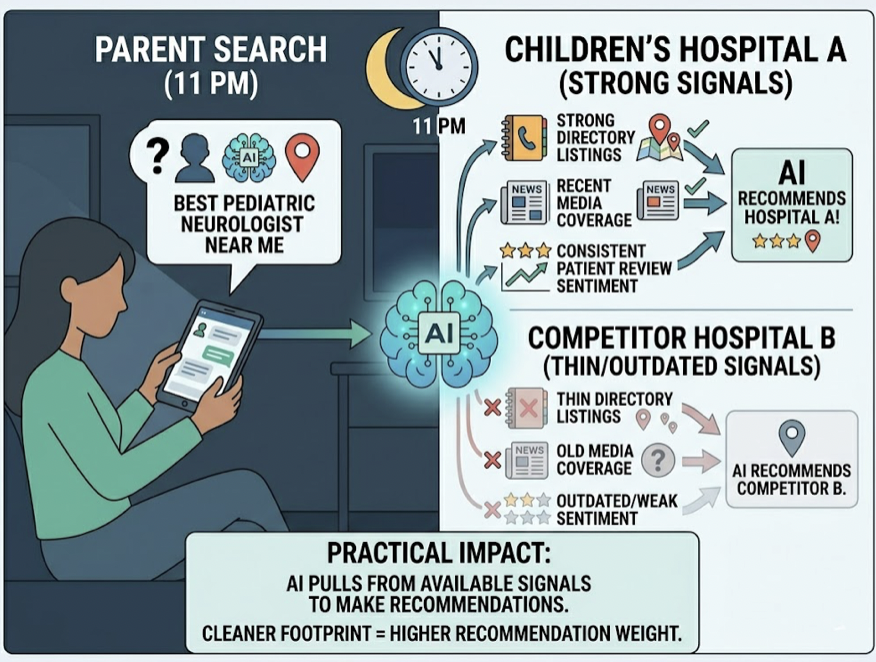
The Brand Authority Checker gives you a baseline for exactly this scenario. Run the check, look at your Trust Signals and Recommendation Rate scores, and you’ll see whether your brand can survive the after-hours AI conversation without you in the room.
Your AI Visibility Varies by Platform. One Score Doesn’t Tell the Full Story.
Healthcare AI traffic isn’t evenly distributed. According to Conductor’s 2026 data, ChatGPT captures 64-84% of health AI traffic, Gemini accounts for 21.5%, Perplexity holds 7.8%, and Copilot sits at 4.7%. Each platform uses different ranking signals, citation patterns, and source preferences.
A healthcare brand can score well on ChatGPT and be completely absent from Perplexity. The reverse is also true. Perplexity tends to favor citation-heavy, recently published sources. Gemini leans on Google’s existing knowledge graph. ChatGPT weighs a broader mix of authority signals including reviews, media mentions, and structured data.
This means a single Brand Authority Checker snapshot, while valuable as a starting point, captures an aggregated view. The per-platform differences matter, especially in healthcare, where the stakes of a misrepresentation are higher than in most industries.
Here’s the thing: AI-referred leads in healthcare convert at 27% compared to 2.1% from traditional organic search. That’s a 13x conversion gap. If your brand is visible on ChatGPT but invisible on Perplexity, you’re capturing only a fraction of a channel that converts at 13 times the rate of your existing organic traffic. And you probably don’t even know it’s happening.
One Score Is a Starting Point. Tracking It Over Time Is the Strategy.
Your Brand Authority Checker results tell you where you stand right now. But AI models update their training data, adjust ranking signals, and shift recommendations continuously. A Trust Signals score of 72 today could drop to 50 next quarter if a competitor publishes a wave of clinical research that AI picks up.
Topify‘s platform picks up where the free tool leaves off. The Comprehensive GEO Analytics dashboard tracks your authority, sentiment, and visibility scores continuously across ChatGPT, Perplexity, Gemini, and Google AI Overviews. You’ll see per-platform breakdowns, trend lines, alerts when scores shift, and specific recommendations for what to fix.
Here’s how the free check compares to the full platform:
| Capability | Free Brand Authority Checker | Topify Platform |
|---|---|---|
| Check frequency | One-time snapshot | Continuous daily/weekly monitoring |
| AI platforms | Aggregated score | Per-platform breakdown (ChatGPT, Perplexity, Gemini, AI Overviews) |
| Historical data | None | Full trend history with alerts |
| Competitor comparison | Not included | Real-time benchmarking against healthcare competitors |
| Action recommendations | General authority gaps | Specific, data-driven GEO optimization steps |
| Team collaboration | Single user | Unlimited team seats for marketing + clinical leadership |
Every plan starts with a 7-day free trial, no credit card required. The Starter plan begins at $99/month.
Conclusion
AI is now a primary channel for patient discovery. Over 40 million people ask ChatGPT healthcare questions daily, and the brands that show up in those answers are capturing patients at a conversion rate 13x higher than traditional search. The brands that don’t show up aren’t just missing traffic. They’re missing the decision entirely.
Start with a free Brand Authority Checker scan to see exactly how AI perceives your healthcare brand’s authority. Use those scores to identify the specific gaps between your real-world credentials and AI’s understanding of them. Then build a tracking system that keeps you visible as models evolve.
If you’re ready for continuous monitoring, start a free trial to track your authority, sentiment, and visibility across every major AI platform.
Other Free Tools Worth Running
While you’re assessing your brand authority, a few other free checks can round out the picture. Topify’s AI Visibility Report shows how often your healthcare brand gets mentioned across major AI platforms. The Knowledge Freshness Checker flags whether AI models are working with outdated information about your services or credentials. And the Prompts Researcher reveals the exact healthcare questions patients are asking AI in your category.
FAQ
Is the Brand Authority Checker free? Do I need to sign up?
Yes, the tool is completely free. No signup, no credit card, no account required. Enter your brand name or domain and get your four-score authority breakdown in under 60 seconds.
What’s the difference between the free tool and the Topify platform?
The free Brand Authority Checker gives you a one-time snapshot of AI’s perception of your brand. The Topify platform provides continuous monitoring across ChatGPT, Perplexity, Gemini, and AI Overviews, with historical trends, competitor benchmarking, and actionable optimization recommendations. Plans start at $99/month with a 7-day free trial.
How often should healthcare brands check their AI visibility?
AI models update frequently, and a single check can become outdated within weeks. For healthcare brands, where clinical accuracy and trust signals are critical, monthly checks with the free tool are a minimum. Continuous monitoring through the platform is the more reliable approach, especially for multi-location health systems.
Can AI visibility actually affect patient acquisition?
Yes. AI-referred leads in healthcare convert at 27% compared to 2.1% from traditional organic search. Brands cited in AI Overviews earn 35% more organic clicks and 91% more paid clicks. As more patients use AI to choose providers, AI visibility is becoming a direct driver of patient volume.

