

It’s 11 PM. ChatGPT just started recommending your competitor for your category’s most-searched prompt. Who’s going to fix it before morning?
Not your SEO team. They’re optimizing for Google rankings that don’t govern what AI models say. Not your content calendar. It was planned six weeks ago around keywords that don’t map to how buyers actually ask questions in ChatGPT or Perplexity. And not your dashboard. It can show you the drop, but it can’t do anything about it.
That gap between seeing a problem and fixing it in real time is exactly where the AEO agent enters the picture. But this term is newer than the problem it solves, and almost nobody has defined it clearly. Here’s a framework that does.
“AEO” Already Has Two Competing Definitions. That’s the First Problem.
Before unpacking what an AEO agent is, you need to know that “AEO” itself doesn’t mean one thing yet.
The most common usage is Answer Engine Optimization: the practice of structuring content so AI-powered tools like ChatGPT, Perplexity, and Google AI Overviews can understand, trust, and cite it as direct answers to user queries. This is the definition you’ll find on HubSpot, Semrush, and Frase. It’s about making your content the one AI picks when it needs a source.
The second usage emerged in April 2026 when Google Cloud AI engineering director Addy Osmani published his Agentic Engine Optimization framework. Osmani’s AEO is about structuring content so AI coding agents and research agents can autonomously fetch, parse, and reason over it. Same acronym, different audience, different problem.
| Dimension | Answer Engine Optimization | Agentic Engine Optimization |
|---|---|---|
| Core goal | Get your brand cited in AI-generated answers | Make your content machine-parsable for autonomous agents |
| Primary audience | Marketing teams, SEO professionals | Developer documentation, API publishers |
| Key metrics | Mention rate, citation share, sentiment | Token efficiency, parsability, discoverability |
| Championed by | HubSpot, Semrush, Frase | Addy Osmani, open-source community |
Here’s the thing: these two definitions aren’t in conflict. They’re solving different layers of the same problem. Answer Engine Optimization gets you into the AI conversation. Agentic Engine Optimization makes sure agents can actually use your content once they find it.
An AEO agent operates across both layers.
So What Exactly Is an AEO Agent?
An AEO agent is a system that combines AEO intelligence (what to optimize) with autonomous execution (how to do it without waiting for a human to act).
Break that into two components. The AEO layer defines the objective: make your brand visible, accurately represented, and positively recommended across AI search platforms. The agent layer defines the method: continuously monitor signals, diagnose problems, and execute fixes on its own, or with minimal human approval.
That distinction matters. Having AEO without an agent means you’re doing the optimization manually. You pull reports, spot drops, write briefs, update pages, and redeploy. By the time you’ve completed the cycle, the AI’s citation patterns may have already shifted again. Having an agent without AEO means you’ve got a general-purpose automation tool that doesn’t understand the specific variables that govern AI search visibility.
The term crystallized in May 2026 when AirOps launched Quill, an autonomous content optimization agent built specifically for AI search. Unlike traditional dashboards that show you what’s declining, Quill directly modifies content through CMS integrations, updates structured Schema, and resubmits pages for LLM indexing. The execution gap between “we see the problem” and “we fixed it” collapses from weeks to hours.
That’s the AEO agent pattern: monitor, reason, act, loop.
The AEO Layer: What the Agent Is Actually Optimizing
Most SEO professionals already know what to optimize for Google: keywords, backlinks, page speed, domain authority. The AEO layer introduces a different set of variables, because AI answer engines evaluate content through entirely different lenses.
At the content architecture level, Osmani’s framework stacks six layers of machine-readability requirements. It starts with access control (does your robots.txt let AI crawlers in?) and builds up through a discovery layer (a llms.txt file capped at 5,000 tokens acts as a machine-readable site map), capability signaling (AGENTS.md declarations that tell agents what your APIs do), content formatting (Markdown twins that strip HTML noise and cut token overhead by 20% to 30%), token surfacing (exposing page token counts in response headers), and a UX bridge (“Copy for AI” buttons for human users feeding content to tools).
Token economics is a real constraint here. Frontier models charge double for context beyond their base threshold. An AI agent retrieving a bloated 40,000-token page won’t read it all. It’ll truncate, skip sections, or chunk inefficiently, which increases hallucination risk. Osmani recommends a tiered token budget: under 5,000 tokens for your llms.txt, under 15,000 for quick-start guides, and a hard ceiling of 30,000 tokens for any single page.
At the performance measurement level, the variables shift from rankings to visibility metrics. Topify built a three-layer, 10-KPI framework that represents one of the most complete AEO evaluation standards available. The visibility layer tracks AI mention rate, prompt coverage across the buyer journey, and platform distribution health across ChatGPT, Gemini, Perplexity, and Claude. The quality layer measures AI sentiment score (0 to 100), brand position in AI answers using a decay-weighted algorithm, and citation source coverage. The impact layer captures AI search volume trends, AI Share of Voice, Conversion Visibility Rate, and week-over-week visibility delta.
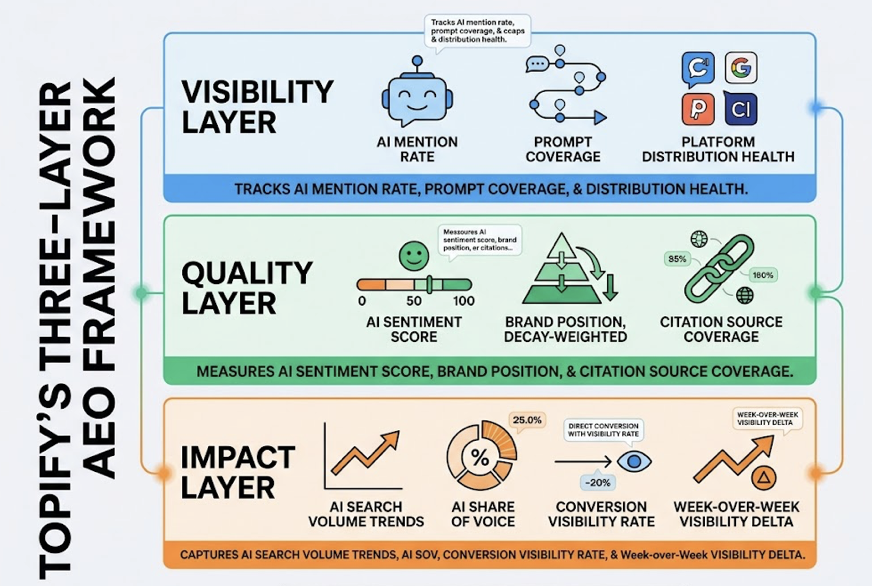
That last metric, the weekly delta, is often the trigger. When it crosses a threshold (typically a 5-percentage-point swing), it’s the signal that an AEO agent needs to activate.
The Agent Layer: Monitor, Reason, Act
A dashboard shows you data. An automation tool executes pre-set rules. An agent does something fundamentally different: it perceives changes, reasons about causes, and takes action.
Here’s what that looks like in practice. An AEO agent connects to live data sources through APIs and protocols like MCP (Model Context Protocol). It listens to signals from CMS platforms, sales call transcripts, customer support systems, and AI search monitoring tools. When it detects that a competitor’s citation rate is climbing on a high-value prompt while yours is declining, it doesn’t just flag it. It analyzes which sources the AI is citing, identifies what’s different about the competitor’s content, drafts a Markdown-twin revision in a sandbox environment, pushes it to a human approver via Slack or email, and on approval, deploys the update to the CMS and resubmits the page for indexing.
That’s not theoretical. Early adopters are already running this loop.
Kong deployed an AEO agent to filter noise from their Marketo email lifecycle data. The agent automatically separated low-value interactions (users clicking social media icons at the bottom of emails) from genuine product-demo intent, delivering clean weekly decision reports in Slack that the team previously spent hours assembling by hand. Conviva used a similar agent to extract buyer objections from thousands of hours of Gong sales recordings. The agent identified high-frequency resistance points, matched them to AEO-relevant keywords, and auto-generated dozens of blog posts and sales whitepapers within hours, a process that previously took weeks of manual transcription and writing. Bitly leveraged an agent’s Playbook feature to run large-scale landing page experiments, configuring brand voice and guidelines in natural language, then letting the agent generate, test, and deploy structured variations at a pace measured in days rather than months.
The common thread: the agent closes the loop that human-operated dashboards leave open.
Where AEO Agents Sit in the SEO, GEO, AEO Stack
If you’re coming from traditional SEO, it helps to see how these layers stack on top of each other. They’re not replacements. They’re additions.
| Layer | Core question | What it optimizes for | Key metric |
|---|---|---|---|
| SEO | Can search engines find and rank my page? | Google, Bing organic rankings | Keyword position, CTR |
| GEO | Will AI cite my content when generating answers? | LLM synthesis and citation behavior | Citation share, source authority |
| AEO | Is my content structured for AI answer extraction? | Answer engine retrieval and recommendation | Mention rate, sentiment, position |
| AEO Agent | Can the system fix problems and deploy changes autonomously? | Real-time execution across the full AEO stack | Time-to-fix, WoW visibility delta |
The data behind this stack is hard to ignore. The top 40,000 U.S. websites saw only a 2.5% dip in Google organic traffic year-over-year. Sounds manageable. But informational and discovery search traffic, the kind that fuels B2B SaaS buyer research, has collapsed by 70% to 80% in some enterprise segments. AI Overviews now appear in 42.5% of search results, and only 1% of users click on the source links embedded in those AI summaries.
Here’s the counterintuitive part. Despite the vanishing clicks, brands cited in AI summaries see 35% higher organic CTRin traditional search results and 91% higher paid click-through rates. AI referral traffic converts 42% better than non-AI channels, according to Adobe Digital Insights Q1 2026 retail data, and Semrush’s research puts the average conversion value of AI search users at 4.4x that of traditional organic.
The competition isn’t about blue links anymore. It’s about who gets recommended in the conversation. And an AEO agent is how you stay in that conversation at machine speed.
Who Actually Needs an AEO Agent Right Now, and Who Doesn’t
Not every brand needs to deploy an AEO agent tomorrow. But the signals are clear if you’re paying attention.
You likely need one if:
- Your brand already runs GEO or AEO monitoring and the manual response cycle can’t keep up with how fast citation patterns shift.
- Your competitors are actively showing up in AI search results for prompts that matter to your pipeline.
- You operate in a B2B SaaS or technology category where 73% of buyer decision groups now use AI to research vendors.
- Your content team is already producing structured, high-quality material but lacks the infrastructure to deploy updates at the speed AI models retrain and refresh.
You probably don’t need one yet if:
- Your foundational SEO isn’t in place. AI answer engines still pull primarily from pages that rank well in traditional search. Without that base, an AEO agent has nothing to optimize.
- AI search penetration in your specific category is still low. Check this before investing. Topify’s visibility trackingcan show you exactly how often your brand appears (or doesn’t) across ChatGPT, Perplexity, Gemini, and Claude for the prompts your buyers actually use.
- Your team hasn’t yet defined a consistent brand narrative. An AEO agent amplifies whatever narrative exists. If your messaging is fragmented or contradictory across different platforms, automating it faster won’t fix the underlying clarity problem.
The industry’s five-level AEO maturity model offers a useful self-assessment. Level 1 brands are still keyword-focused. Level 2 brands have started producing Q&A content. Level 3 brands have built systematic question clusters with structured data. Level 4, the “AEO Ready” stage, means machine-parsable content, Markdown twins, llms.txt, and real-time visibility tracking. Level 5 is the “Authority Engine” stage, where AEO agents autonomously iterate pages based on live market signals.
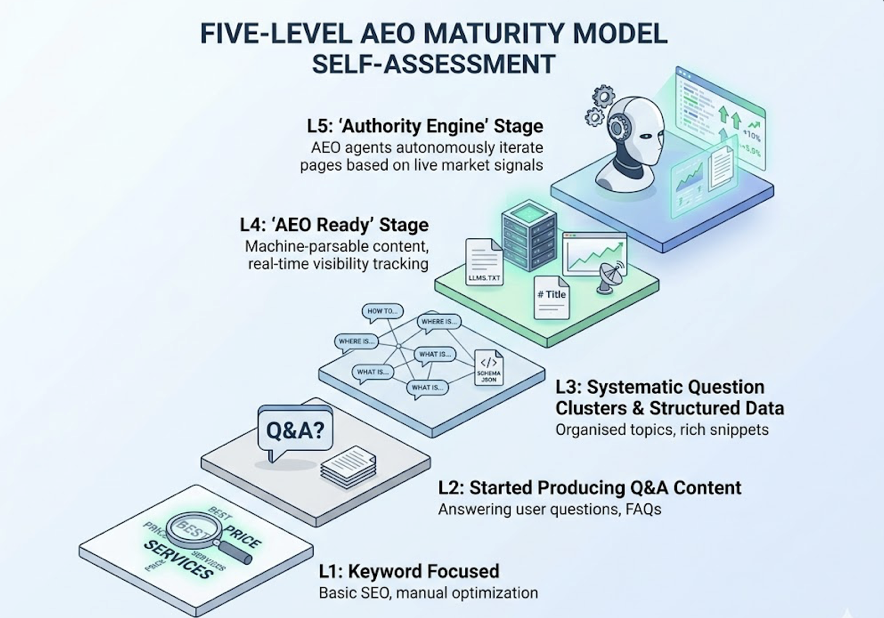
Most brands today sit between Levels 2 and 3. The gap to Level 4 is a technical and organizational problem. The gap from 4 to 5 is where agents become essential.
Conclusion
The 11 PM scenario from the top of this article isn’t hypothetical. AI search platforms shift their citation patterns on timelines that human teams can’t match with spreadsheets and monthly reviews. An AEO agent isn’t a buzzword. It’s the convergence of two real capabilities: AEO (the discipline of optimizing for AI answer engines) and autonomous agents (systems that monitor, reason, and act without waiting for a ticket). Together, they close the execution gap that makes the difference between brands AI recommends and brands AI ignores.
Start by understanding where you stand. Run an AI visibility audit across the platforms your buyers use, and you’ll know within minutes whether the gap you need to close requires better content, better structure, or an agent that can do both at speed.
FAQ
Q: What does AEO stand for in marketing?
A: AEO most commonly stands for Answer Engine Optimization, the practice of structuring content so AI platforms like ChatGPT and Perplexity can extract, trust, and cite it. A newer usage, Agentic Engine Optimization, focuses on making content machine-parsable for autonomous AI agents. Both definitions are active in the industry.
Q: What is the difference between AEO and GEO?
A: GEO (Generative Engine Optimization) focuses broadly on influencing how AI systems synthesize and cite your content. AEO focuses specifically on the answer-retrieval layer: getting your content selected when an AI engine needs a source for a specific fact, definition, or recommendation. AEO is generally considered a component within the broader GEO discipline.
Q: How does an AEO agent work?
A: An AEO agent connects to live data sources (CMS, sales tools, AI visibility platforms) through APIs and protocols like MCP. It continuously monitors brand visibility signals across AI search engines, identifies when citation rates drop or competitors gain ground, diagnoses the root cause, drafts content updates, and deploys fixes, typically with a human-in-the-loop approval step before publishing.
Q: Is AEO replacing SEO?
A: No. SEO remains the foundation. Research shows that 99% of URLs appearing in Google’s AI Mode also rank in the top 20 organic results, which means strong SEO is still a prerequisite for AI visibility. AEO adds a new optimization layer on top of SEO, targeting how AI answer engines select and present sources. The two are complementary, not competing.

