
A potential client typed into ChatGPT: “Who’s the best employment attorney in Austin for wrongful termination?” The AI returned three firms with brief descriptions and contact details. Your firm, with 20 years of employment law experience and a 94% case resolution rate, wasn’t mentioned. The client never visited your website. Never saw your track record. Never knew you existed.
The issue isn’t your expertise. It’s that AI can’t verify it.
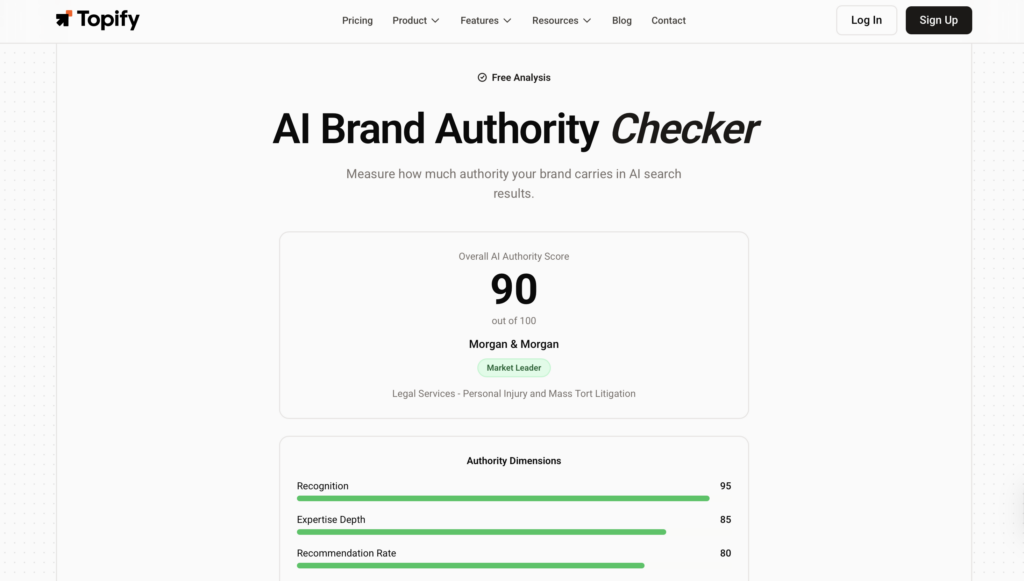
There’s a way to see exactly where the disconnect is. Topify‘s Brand Authority Checker scores how AI models perceive your firm’s authority across four dimensions that directly determine whether you get recommended when someone asks AI for a lawyer.
✅ Free ⚡ Results in 60 seconds 🔒 No signup required
AI Brand Authority Checker
The Four Scores That Tell You If AI Trusts Your Law Firm
The Brand Authority Checker doesn’t give you a single vague number. It breaks your firm’s AI-perceived authority into four distinct metrics, each mapping to a specific vulnerability in legal services.
What Each Metric Means for Law Firms
| Metric | What It Measures | What It Means for Law Firms |
|---|---|---|
| Recognition (0-100) | How often AI identifies your firm in your practice area | Below 40: AI doesn’t associate your firm with your core practice area at all |
| Expertise Depth (0-100) | How well AI understands your capabilities and specializations | Below 50: AI may describe your firm generically or misrepresent your practice focus |
| Recommendation Rate (0-100) | How often AI recommends your firm vs. alternatives | Below 30: prospective clients asking AI for referrals will never see your name |
| Trust Signals (0-100) | External validation AI detects (directory listings, reviews, peer recognition) | Below 40: AI can’t find enough third-party evidence to confidently recommend you |
Here’s the thing. A firm with a Recognition score of 80 but a Trust Signals score of 25 has a very specific problem: AI knows who you are, but doesn’t trust you enough to recommend you. That gap between recognition and trust is where client acquisition breaks down in AI search.
Three Scenarios You’ll Likely Discover
Scenario 1: High expertise, low recognition. Your attorneys have bar certifications, published articles, and case results across multiple jurisdictions. But your website doesn’t present that information in a way AI crawlers can parse. The expertise exists offline. AI just can’t see it.
Scenario 2: Strong reviews, weak recommendation rate. You’ve got 200 five-star Google reviews. But your directory listings across Avvo, Martindale-Hubbell, and FindLaw have inconsistent NAP (Name, Address, Phone) data. AI can’t confidently connect those reviews to your firm, so it recommends competitors with fewer but more consistent signals.
Scenario 3: Broad practice areas, no depth signal. Your website lists 12 practice areas. AI reads that as “generalist” and skips you when someone asks for a specialist. The Expertise Depth score will flag this immediately.
How to Run Your Check
Go to Brand Authority Checker, enter your firm name or domain, and you’ll get your four-dimensional authority breakdown in under 60 seconds. No account, no credit card, no sales pitch. Just data.
Once you have your scores, focus on the lowest one first. That’s where AI’s perception of your firm is weakest, and it’s likely the reason you’re not showing up in recommendations.
Legal Clients Are Already Asking AI for Referrals. Here’s What They’re Typing.
The prompts below represent real search patterns that Gartner predicted would drive a 25% decline in traditional search volume by 2026. That prediction is largely on track. For legal services, the shift is even more pronounced because legal questions naturally lend themselves to conversational AI queries.
| AI Prompt Example | Platform | Search Intent | What Determines Your Firm’s Inclusion |
|---|---|---|---|
| “Best divorce attorney for high-net-worth cases in [city]” | ChatGPT | Specialist referral | Expertise Depth + jurisdiction-specific case signals |
| “Do I need a lawyer for a commercial lease dispute?” | Perplexity | Legal guidance + referral | Trust Signals + content authority on commercial real estate law |
| “Compare top IP lawyers in [region] for startup patents” | Gemini | Competitive evaluation | Recommendation Rate + peer recognition in IP law |
| “What should I look for in an immigration attorney?” | ChatGPT | Criteria research + eventual hire | Expertise Depth + bar credentials + client review patterns |
| “Affordable personal injury lawyer near me with good reviews” | Google AI Overview | Local referral with price sensitivity | Trust Signals + review volume + directory consistency |
Each of these prompts triggers a different combination of authority signals. Your firm doesn’t need to rank for all of them. But if your Brand Authority Checker scores are low in the dimensions that matter for your practice area, you’re invisible to the clients asking those exact questions.
According to recent reporting, roughly 60% of Google searches now end without a click. The client makes a decision based on what AI surfaces. If your firm isn’t in the answer, you’re not in the running.
What Your Authority Score Actually Tells You (and What to Do About It)
AI Evaluates Law Firms the Same Way Clients Pick a Referral
The logic AI uses to recommend attorneys mirrors how peer referrals have always worked. A general counsel asking a colleague for a litigation firm expects the same things AI looks for: demonstrated expertise in the relevant area, third-party validation from credible sources, consistent information across platforms, and a track record that can be verified.
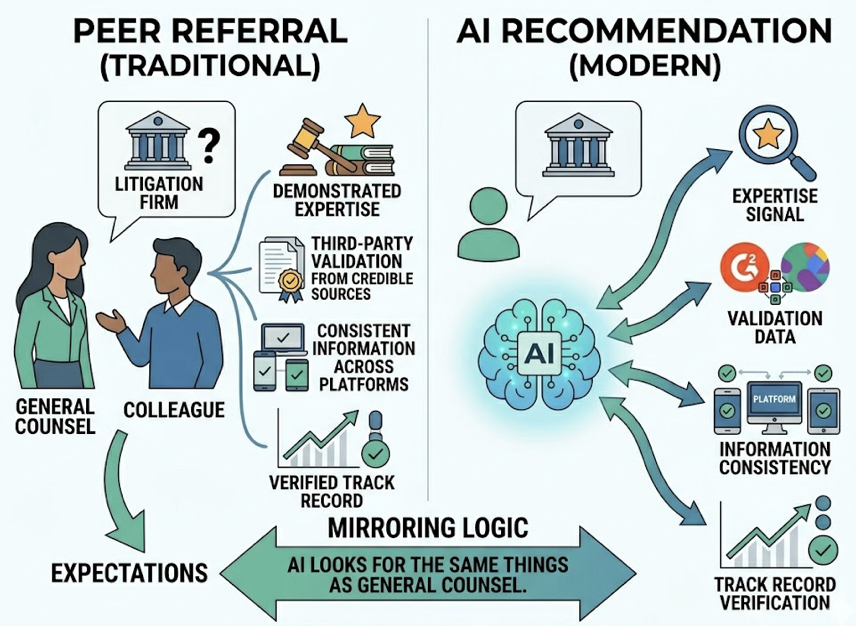
The difference is scale. A human referral network covers dozens of contacts. AI scans thousands of data points across directories, review platforms, bar association records, published content, and news mentions. If your trust signals are scattered or contradictory, AI treats your firm the same way a cautious colleague would: it recommends someone else.
The Brand Authority Checker’s four scores map directly to this referral logic. Recognition is “does AI know you practice in this area?” Expertise Depth is “does AI understand your specialization?” Recommendation Rate is “would AI refer you?” Trust Signals is “can AI verify your credibility from independent sources?”
Your Credentials Are Already There. AI Just Can’t Read Them.
Most law firms don’t have an authority problem. They have a visibility problem. Your partners have bar certifications, peer awards, Super Lawyers selections, and notable case outcomes. Your firm has been practicing for years. None of that matters if the information isn’t structured for machine consumption.
79% of legal professionals now use AI tools in their own workflows. The same AI models that help lawyers draft motions are the ones clients use to find lawyers. If your credentials aren’t machine-readable, you’re invisible to the very systems your own team relies on daily.
Here’s the action path. Run your Brand Authority Checker results, then cross-reference them with your directory listings. Is your firm’s name, address, and specialization consistent across Avvo, Martindale-Hubbell, FindLaw, and Justia? Are your attorneys’ bar numbers, jurisdictions, and practice areas explicitly listed with structured data? If not, that’s why your Trust Signals score is low.
Niche Authority Beats Firm Size in AI Recommendations
AI doesn’t sort law firms by headcount or revenue. It sorts by signal density in a specific practice area. A three-attorney immigration boutique with deep, consistent content on visa categories, verifiable case outcomes, and active bar association participation can outperform an AmLaw 100 firm in AI recommendations for immigration queries.
This is the hidden advantage for small and mid-size firms. You don’t need to compete on brand awareness. You need to compete on signal clarity. The Brand Authority Checker’s Expertise Depth score reflects this directly: it measures how well AI understands what you actually do, not how big your firm is.
A firm with an Expertise Depth of 85 in “startup IP law” will consistently appear in AI answers for that niche, even if its overall Recognition score is modest. In practice, the firms winning AI visibility in legal are the ones with the tightest match between their actual expertise and the signals AI can verify.
One Score Is a Starting Point. Tracking It Over Time Is the Strategy.
Your Brand Authority Checker results tell you where you stand right now. But AI models update their training data, adjust recommendation logic, and shift citations on a rolling basis. A score of 72 today could drop to 55 next quarter without any change on your end, simply because a competitor strengthened their signals or a directory updated its data.
Topify‘s platform picks up where the free tool leaves off. The Comprehensive GEO Analytics dashboard tracks your authority, sentiment, and visibility scores continuously across ChatGPT, Perplexity, Gemini, and Google AI Overviews. You’ll see trend lines, get alerts when scores shift, and receive specific recommendations for what to fix.
Here’s how the free check compares to the full platform:
| Capability | Free Brand Authority Checker | Topify Platform |
|---|---|---|
| Check frequency | One-time snapshot | Continuous daily/weekly monitoring |
| AI platforms covered | Aggregated score | Per-platform breakdown (ChatGPT, Perplexity, Gemini, AI Overviews) |
| Historical trends | None | Full trend history with alerts |
| Competitor tracking | Not included | Real-time competitor benchmarking |
| Action recommendations | General direction | Specific, one-click GEO optimization |
| Team collaboration | Single user | Unlimited team member seats |
Every plan starts with a 7-day free trial, no credit card required. The Starter plan begins at $99/month.
Conclusion
AI is already the first place many prospective clients turn when they need a lawyer. The firms that show up in those answers aren’t there by accident. They’ve built the kind of authority signals that AI can verify, cite, and recommend.
Start with the data. Run your firm through the Brand Authority Checker and see exactly how AI perceives your practice. It takes 60 seconds, it’s free, and it’ll tell you whether the problem is recognition, expertise depth, recommendation frequency, or trust signals. Then you’ll know exactly where to focus.
While you’re assessing your brand authority, a few other free checks can round out the picture. Topify‘s GEO Score Checker evaluates whether AI crawlers can actually access your site’s content. The Prompts Researcher reveals the exact legal questions your potential clients are asking AI in your practice area. And the AI Visibility Report shows how often your firm gets mentioned across major AI platforms.
FAQ
Is the Brand Authority Checker really free? Do I need to create an account?
Yes, it’s completely free. No account, no email, no credit card. Enter your firm name or domain and get your scores in under 60 seconds.
What’s the difference between the free tool and the Topify platform?
The free Brand Authority Checker gives you a one-time snapshot of your AI-perceived authority. The Topify platform provides continuous monitoring, historical trend data, competitor benchmarking, and actionable optimization recommendations across all major AI platforms.
How often should a law firm check its AI visibility?
At minimum, quarterly. AI models update their data and recommendation logic frequently. A firm that scored well three months ago may have dropped without any change to its own website. Firms in competitive practice areas like personal injury or family law should monitor monthly or use continuous tracking.
Can a small law firm actually compete with large firms in AI search?
Yes. AI doesn’t rank by firm size. It ranks by signal clarity and authority density in a specific practice area. A boutique firm with consistent directory data, strong peer recognition, and deep content in a niche area can outperform larger firms that spread their signals across too many practice areas.