

Your SOC 2 Badge Doesn’t Mean AI Trusts You
A CFO typed into Perplexity: “What’s the most trusted expense management tool for a 200-person fintech?” Five brands came back. Yours, with SOC 2 certification and 10,000 enterprise users, wasn’t on the list.
The issue isn’t your credentials. It’s that AI doesn’t recognize them.
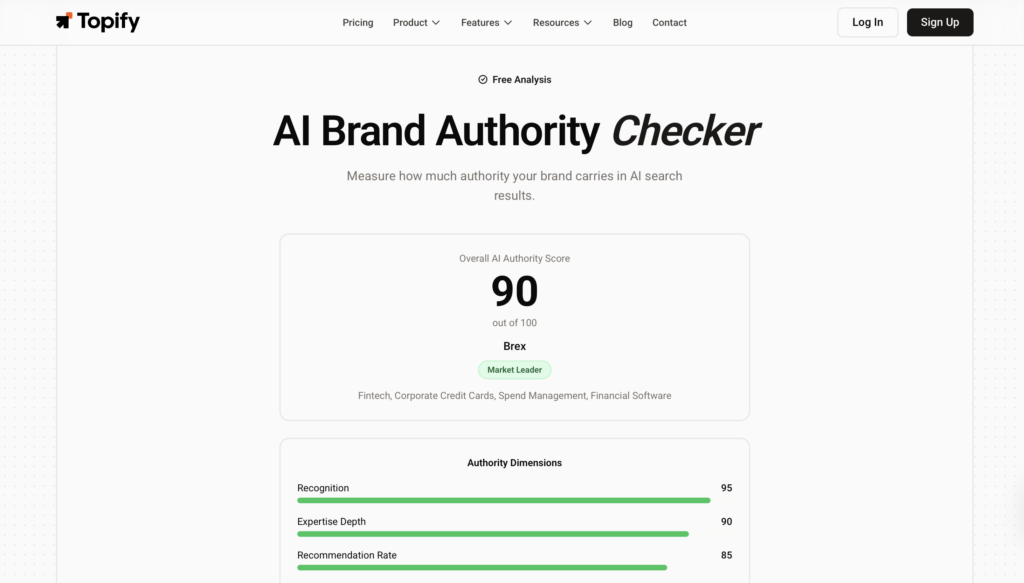
There’s a way to see exactly where the disconnect is. Topify‘s Brand Authority Checker scores how AI models perceive your brand’s authority across four dimensions that directly affect whether you get recommended in financial services queries.
✅ Free ⚡ Results in 60 seconds 🔒 No signup required
AI Brand Authority Checker
The Four Scores That Tell You If AI Trusts Your Fintech Brand
Each Score, Translated for Financial Services
The Brand Authority Checker doesn’t give you a single number and send you on your way. It breaks your brand’s AI-perceived authority into four distinct dimensions, each mapping to a specific problem fintech companies face in AI search.
| Metric | What It Measures | What It Means for Fintech Brands |
|---|---|---|
| Recognition (0-100) | How often AI identifies your brand in your category | Below 40: AI doesn’t associate you with your core product category, even if you process billions in transactions |
| Expertise Depth (0-100) | How well AI understands your capabilities | Below 50: AI may misrepresent your compliance certifications or fee structures |
| Recommendation Rate (0-100) | How often AI recommends you vs. alternatives | Below 30: you’re losing enterprise deals before your sales team talks to the prospect |
| Trust Signals (0-100) | External validation AI detects (media, reviews, citations) | Below 40: AI can’t find enough third-party evidence to vouch for your brand’s reliability |
Here’s the thing: these four scores often tell a very different story than your internal brand perception. A fintech brand with a Recognition score of 85 but a Trust Signals score of 30 has a specific, fixable problem. AI knows who you are but doesn’t trust you enough to recommend you. That gap is where deals disappear.
Three Signals That Should Worry a Fintech CMO
High recognition, low recommendation. AI identifies your brand when users ask about your category, but consistently recommends others. This typically means your product information is visible but your third-party validation is weak. AI models in financial services weight external signals like analyst coverage, review platforms, and media mentions heavily before putting a brand on a shortlist.
Low expertise depth in a regulated category. If AI can’t accurately describe what your product does, including its compliance posture, integration capabilities, and pricing model, it won’t recommend you for specific use cases. In fintech, where buyers ask precise questions like “Which payment processor supports PCI DSS Level 1 for marketplace transactions?”, a shallow expertise profile means you’re filtered out before the conversation starts.
Declining trust signals after a product pivot. Fintech companies that rebrand, merge, or launch new product lines often see trust signals drop. The reason: AI models rely on a consensus of external sources. If your old product still dominates the media landscape while your new offering has thin coverage, AI will describe the version of your brand that no longer exists.
Run Your Brand Through the Checker in 60 Seconds
The process is straightforward. Go to the Brand Authority Checker, enter your brand name or domain, and get your four-dimensional authority breakdown. No account creation, no credit card, no strings. You’ll see exactly which of the four scores is dragging your AI visibility down and where to focus your effort.
Fintech Buyers Ask AI Before They Call Sales. Here’s What AI Tells Them.
58% of B2B technology buyers now use AI-powered search tools as part of their initial vendor research, up from 17% in 2023. In fintech, where switching costs are high and procurement cycles are long, the AI’s answer often determines which brands make the shortlist and which ones never get a meeting.
The prompts these buyers type are specific, comparison-driven, and high-intent. Here’s what that looks like in practice:
| AI Prompt Example | Platform | Search Intent | What It Reveals |
|---|---|---|---|
| “Best payment processor for SaaS startups with PCI DSS compliance” | ChatGPT | Purchase decision | Whether your brand gets recommended for compliance-sensitive use cases |
| “Is [brand] SOC 2 certified for enterprise payment processing?” | Perplexity | Trust verification | How accurately AI describes your security posture |
| “Compare embedded finance providers for marketplace apps” | Gemini | Competitive research | Where you rank against alternatives in AI’s assessment |
| “Most trusted lending platform for small businesses 2026” | ChatGPT | Category research | Whether AI considers you a category leader |
| “Which regtech platform handles KYC for mid-size banks?” | Perplexity | Specific capability match | Whether AI understands your product’s niche capabilities |
Each of these prompts represents a real moment where a buyer is forming a shortlist. If your brand isn’t in the AI’s response, you’re not on that list.
Organic traffic in finance is down 7.4% year over year, while AI referral traffic to top sites surged 357%. The shift isn’t coming. It’s already here.
The Credentials Gap: Why Your SOC 2 and Your AI Authority Score Don’t Match
Most fintech brands assume that their real-world credentials, regulatory licenses, SOC 2 certifications, millions of users, translate directly into AI search authority. They don’t.
AI models measure authority differently. They pull from external sources: analyst reports, review platforms like G2 and Trustpilot, media coverage, developer community discussions, and structured content on third-party sites. Your own website is one input among many, and often not the most influential one. Nearly 90% of AI citations come from earned media, according to a Muck Rack study. That means NerdWallet’s description of your product carries more weight in AI’s recommendation than your own feature page.
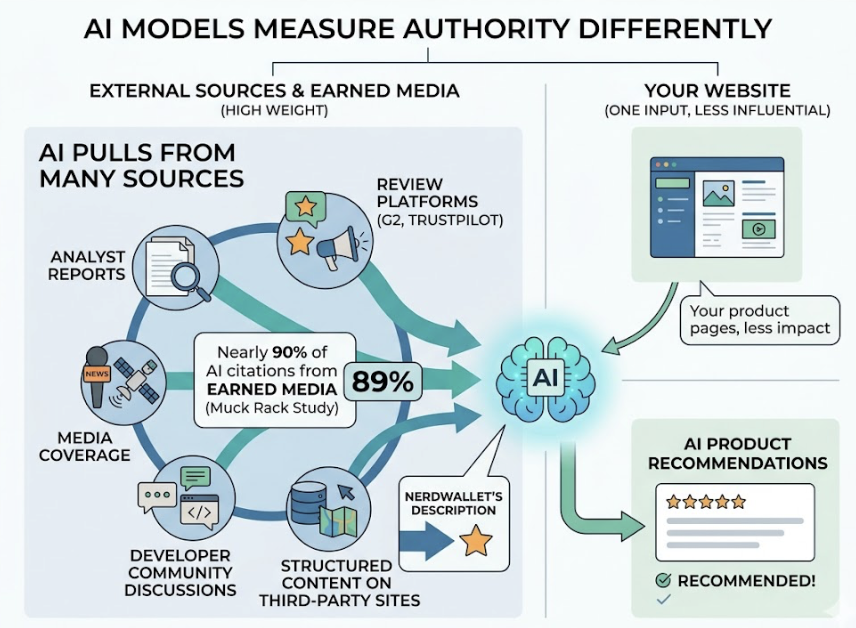
This creates a specific problem for fintech brands. You may have invested heavily in compliance documentation, security audits, and product capabilities, but if those credentials aren’t reflected in the external sources AI trusts, the models won’t surface them.
The Brand Authority Checker makes this gap visible. When your Trust Signals score is 30 points below your Recognition score, you’re looking at a brand that AI knows about but doesn’t trust enough to recommend. That’s the gap between what you’ve built and what the AI ecosystem can verify.
AI Search Is Reshaping the Top of the Fintech Acquisition Funnel Right Now
This isn’t a 2028 problem.
Buyers arriving via AI citations convert at 5.1 times the rate of traditional search traffic. ChatGPT referrals convert at roughly 15.9%, Perplexity at 10.5%, compared to Google’s 1.8%. These aren’t vanity metrics. They reflect that AI-referred buyers arrive with higher intent and a pre-built shortlist.
For fintech companies, this means the acquisition funnel is being restructured from the top. When a procurement officer at a regional bank asks ChatGPT to compare compliance platforms, the three or four brands in the response become the evaluation set. Everyone else starts at a deficit.
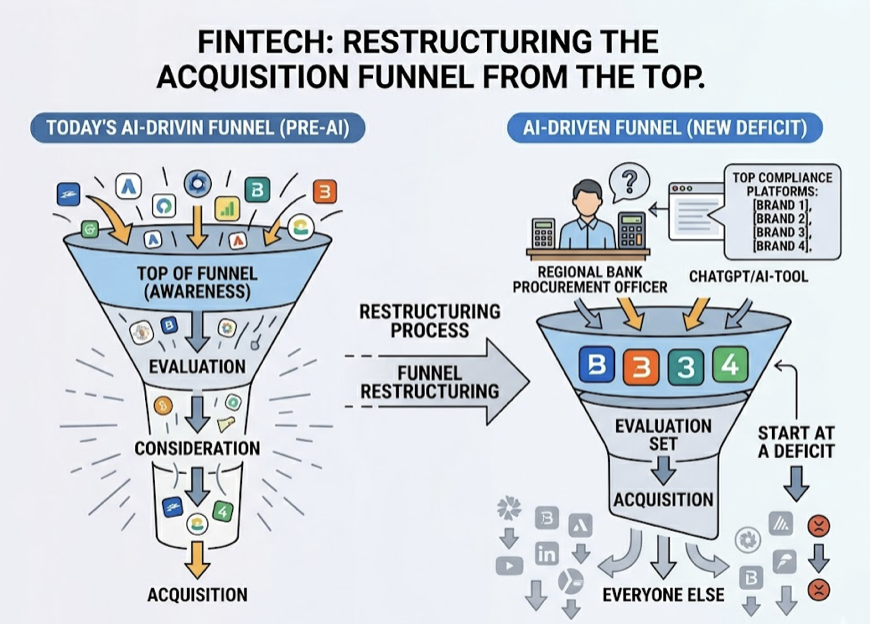
The financial impact compounds. In fintech, where average contract values run into six or seven figures and switching costs lock in relationships for years, losing the initial shortlist doesn’t just cost you one deal. It costs you the entire lifetime value of that customer relationship.
Fintech brands with structured, data-rich content are 3.5 times more likely to receive unprompted AI citations in procurement-related queries. The pattern is clear: brands that make their expertise accessible and verifiable in formats AI can parse are the ones that show up. Brands that bury their best information in PDFs and gated whitepapers don’t.
Your Brand Authority Checker score is the fastest way to see which side of that divide you’re on.
One Authority Score Is a Starting Point. Tracking It Is the Strategy.
Your Brand Authority Checker results tell you where you stand right now. But AI models update their training data, adjust ranking signals, and shift recommendations on a rolling basis. A Trust Signals score of 72 today could drop to 55 next quarter without any change on your end.
Topify‘s platform picks up where the free tool leaves off. The Comprehensive GEO Analytics dashboard tracks your authority, sentiment, and visibility scores continuously across ChatGPT, Perplexity, Gemini, and Google AI Overviews. You’ll see trend lines, get alerts when scores shift, and receive specific recommendations for what to fix.
Here’s how the free check compares to the full platform:
| Capability | Free Brand Authority Checker | Topify Platform |
|---|---|---|
| Check frequency | One-time snapshot | Continuous daily/weekly monitoring |
| AI platforms covered | Aggregated score | Per-platform breakdown (ChatGPT, Perplexity, Gemini, AI Overviews) |
| Historical trends | None | Full trend history with shift alerts |
| Competitor tracking | Not included | Real-time competitor benchmarking |
| Action recommendations | General | Specific, one-click GEO optimization |
| Team collaboration | No | Unlimited team member seats |
Every plan starts with a 7-day free trial, no credit card required. The Starter plan begins at $99/month.
Conclusion
AI search is already deciding which fintech brands make the shortlist and which ones stay invisible. The gap between your real-world credentials and your AI-perceived authority is measurable, and closing it starts with knowing your score.
Run your brand through the Brand Authority Checker to see exactly where AI trusts you and where it doesn’t. Then use what you learn to build a visibility strategy that matches the way your buyers actually research financial products in 2026.
For a complete picture, a few other free checks from Topify’s free tools can round out your diagnosis. The GEO Score Checker evaluates whether your site is technically optimized for AI crawlers. The AI Visibility Report shows how often your brand gets mentioned across major AI platforms. And the Competitor Analysis tool reveals who AI recommends instead of you, and why.
FAQ
Is the Brand Authority Checker really free? Do I need to create an account?
Yes, it’s completely free with no registration required. Enter your brand name or domain and get your four-score authority breakdown in under 60 seconds.
What’s the difference between the free tool and the Topify paid platform?
The free tool gives you a one-time snapshot of your brand’s AI authority. The Topify platform provides continuous monitoring, historical trends, competitor benchmarking, and actionable optimization recommendations across all major AI platforms.
How often should a fintech brand check its AI visibility?
At minimum, monthly. AI models update their training data and ranking signals regularly. A quarterly review is the bare minimum for regulated industries where accuracy of AI descriptions carries compliance implications.
Can AI really misrepresent my fintech product’s compliance status?
Yes. AI models synthesize information from multiple sources, and outdated or conflicting data can lead to inaccurate descriptions of your certifications, fee structures, or regulatory standing. In fintech, this isn’t just a brand risk, it’s a potential legal exposure.

