

A player typed into ChatGPT: “Best roguelike with base-building mechanics, 2025.” The AI listed five games. Yours, a critically acclaimed title with a 92% positive rating on Steam and 50,000 wishlists, didn’t make the cut. The problem isn’t your game. It’s that AI doesn’t know it exists.
The gap is measurable, and the check takes 60 seconds. Topify‘s AI Visibility Report scans how often AI platforms mention your game or studio, where you rank in recommendations, and which AI providers include you in their answers.
✅ Free ⚡ Results in 60 seconds
AI Visibility Report
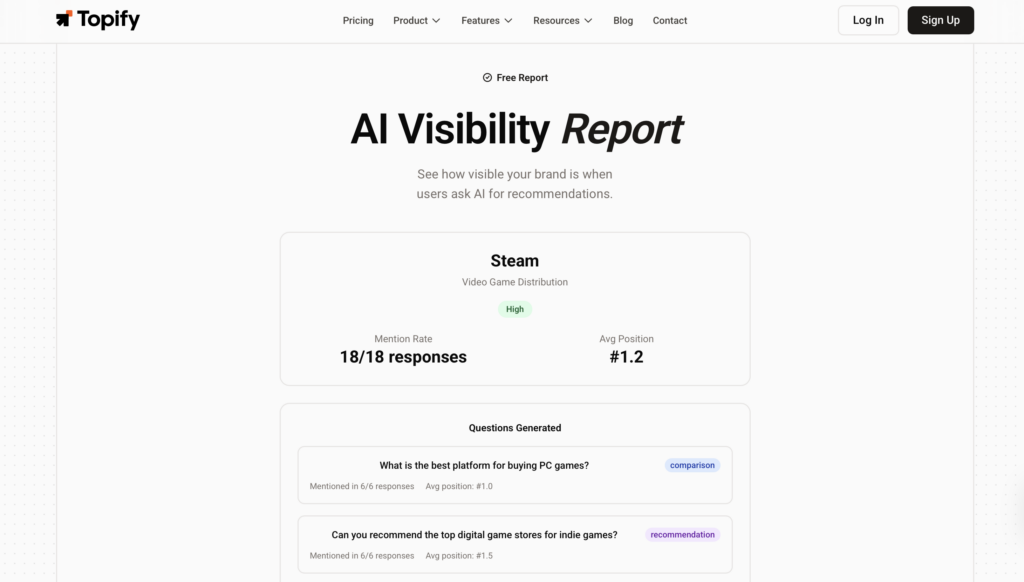
What AI Actually Sees When Players Ask for Game Recommendations
The AI Visibility Report breaks your presence across AI search into three core metrics. Each one maps directly to a specific discoverability problem gaming studios face.
Three Metrics That Decide If Your Game Gets Recommended
| Metric | What It Measures | What It Means for Gaming Studios |
|---|---|---|
| Mention Rate | How frequently AI includes your brand in relevant answers | Below 10%: AI doesn’t associate your game with its genre or category |
| Ranking Position | Where your game appears in the AI’s recommendation order | Position 6+: players rarely scroll past the first five suggestions |
| Provider Breakdown | Which AI platforms mention you (ChatGPT, Perplexity, Gemini, AI Overviews) | Missing from one platform: you’re invisible to its entire user base |
A studio might see a mention rate of 35% on Perplexity but 0% on ChatGPT. That’s not a random gap. It tells you exactly which platform’s information pipeline is missing signals about your game, and where your optimization effort should go first.
Here’s the thing: two studios in the same genre can have wildly different visibility profiles. One might dominate ChatGPT recommendations because of strong Reddit presence and YouTube coverage, while the other only shows up in Gemini because of structured Steam data. The report surfaces these asymmetries in seconds.
Where Gaming Studios Typically Find Problems
Scenario 1: New release with strong reviews, zero AI presence. You launched three months ago, earned 2,000 positive Steam reviews, and got coverage from mid-tier outlets. But AI platforms still recommend older titles in your genre. The AI Visibility Report confirms: your mention rate is under 5%. The likely cause is that AI training data hasn’t caught up, and the third-party sources AI relies on haven’t created enough recent content about your game.
Scenario 2: Established studio, dropping recommendations. Your flagship title used to appear in “best strategy games” prompts. Now it doesn’t. The report shows your ranking position dropped from 3rd to 8th over the last quarter. The signal: a competitor released a major update, generating fresh coverage that pushed your game down in the AI’s relevance ranking.
Scenario 3: Multi-title publisher with inconsistent visibility. You publish six games across four genres. Three show up in AI recommendations consistently. Three don’t appear at all. The provider breakdown reveals the invisible titles lack coverage on Reddit and YouTube, the two sources that contribute to roughly 48% of AI citations.
How to Run Your First Check
Go to the AI Visibility Report, enter your studio name or game title, and you’ll get a cross-platform visibility breakdown. No account required, no credit card, no setup. The output tells you three things: where you stand, where you’re missing, and which platforms to prioritize.
The Prompts Players Are Typing Into AI Instead of Browsing Steam
Around 20,000 new games shipped on Steam in 2025. About half received fewer than 10 reviews. The old discovery model of scrolling storefronts and watching 30-minute YouTube reviews is giving way to conversational search. A Bain & Company gaming survey found that 62% of gamers aged 18-34 use AI tools monthly, with game discovery ranking among the top use cases.
Here’s what those prompts actually look like.
| AI Prompt Example | Platform | Search Intent | What It Means for Studios |
|---|---|---|---|
| “Best co-op games for two people who liked It Takes Two” | ChatGPT | Preference-based discovery | AI recommends based on similarity signals, not sales volume |
| “Top indie roguelikes under $20 on Steam right now” | Perplexity | Budget-filtered purchase decision | Price + platform + genre create a narrow recommendation window |
| “Is Hollow Knight: Silksong worth the wait or should I play something else” | Gemini | Alternative-seeking | AI surfaces competitors when players express doubt |
| “Best open-world survival games 2025 with base building” | ChatGPT | Feature-specific search | AI matches mechanics descriptions, not marketing taglines |
| “Games like Elden Ring but easier for casual players” | AI Overview | Accessibility-adjusted discovery | Difficulty and accessibility language in reviews affects AI matching |
Each of these prompts represents a moment where a player is making a decision. And in each case, AI pulls from a specific set of sources: Steam reviews, Reddit threads, YouTube content, game journalism, and structured storefront data. If your game’s signal is weak across these inputs, it won’t appear in the output.
AI Is the New Steam Front Page, and Only 10 Games Are on It
The discovery funnel for games used to run through a predictable set of channels: press coverage, Steam featured placements, YouTube trailers, influencer campaigns, and word-of-mouth. That funnel is fracturing.
ChatGPT reached 5.8 billion monthly visits by mid-2025. Perplexity crossed 100 million monthly visits by Q4 2024. Google now displays AI Overviews for an estimated 84% of informational queries, and gaming queries like “best roguelike 2025” or “games like Elden Ring” are heavily affected.
Players aren’t replacing Steam entirely. But they’re increasingly starting their discovery on AI platforms and arriving at Steam, Epic, or console stores with a shortlist already formed. If your game isn’t in that shortlist, your Steam page traffic drops before your store optimization even gets a chance to work.
The 80/20 problem is real. When players ask AI for game suggestions, the same 10 AAA titles appear in more than 80% of responses. That’s not because those are objectively the 10 best games. It’s because those titles have the densest web of signals AI models can pull from: thousands of reviews, deep Reddit discussion threads, extensive YouTube coverage, and structured data across multiple storefronts.
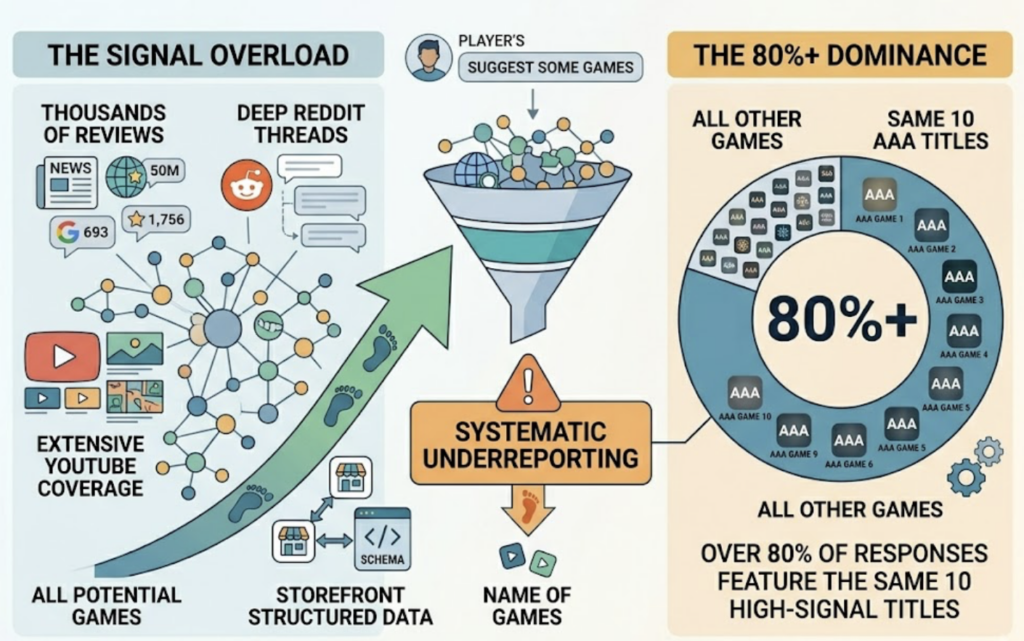
For mid-size and indie studios, this creates a compounding disadvantage. Less coverage means fewer AI mentions, which means less player traffic, which means less coverage. Breaking into the AI recommendation loop requires understanding exactly what signals you’re missing, not just producing more content.
That’s the gap the AI Visibility Report is built to diagnose. Run your studio’s name through it, see where you stand across platforms, and you’ll know whether the problem is recognition, ranking, or platform coverage.
One Snapshot Shows the Problem. Continuous Tracking Solves It.
Your AI Visibility Report tells you where you stand today. But AI search results shift constantly. Only 30% of brands stay visible from one AI answer to the next, and just 20% remain present across five consecutive queries. A game that shows up in “best survival horror 2025” today could drop out next month after a model update or a competitor’s content push.
Topify‘s AI Visibility Checker picks up where the free report leaves off. It tracks your mention rate, ranking position, and provider breakdown continuously across ChatGPT, Perplexity, Gemini, and Google AI Overviews, with historical trend data and alerts when your visibility shifts.
Here’s how the free check compares to the full platform:
| Capability | Free AI Visibility Report | Topify Platform |
|---|---|---|
| Check frequency | One-time snapshot | Continuous daily/weekly monitoring |
| AI platforms covered | Aggregated overview | Per-platform breakdown with trends |
| Historical data | None | Full trend history with change alerts |
| Competitor tracking | Not included | Real-time competitor benchmarking |
| Action recommendations | General | Specific, data-driven optimization steps |
| Team collaboration | Not available | Multi-seat access for marketing teams |
Every plan starts with a 7-day free trial, no credit card required. The Starter plan begins at $99/month.
Conclusion
The players who would love your game are already asking AI what to play next. The question is whether AI knows enough about your game to recommend it.
Start with a free AI Visibility Report to see your baseline: where you’re mentioned, where you’re ranked, and which platforms are blind spots. From there, you can build a targeted strategy around the specific signals AI is missing.
While you’re checking visibility, a few other free tools can round out the picture. Topify‘s Brand Sentiment Checkershows how AI describes your game’s strengths and weaknesses, so you’ll know if outdated reviews are shaping the narrative. The Prompts Researcher reveals the exact questions players are asking AI in your genre. And the Competitor Analysis tool shows which studios AI considers your direct competitors and where they have a signal advantage.
FAQ
Is the AI Visibility Report free? Do I need to sign up? Yes, it’s completely free. No account, no credit card, no signup required. Enter your studio or game name and get results in under 60 seconds.
What’s the difference between the free report and Topify’s paid platform? The free report gives you a one-time snapshot of your current AI visibility. Topify’s platform adds continuous monitoring, historical trends, competitor benchmarking, and specific optimization recommendations. You can start a free trial to test the full feature set.
How often should a gaming studio check its AI visibility? At minimum, after every major release, content update, or marketing campaign. AI models update their data regularly, and competitor activity can shift your ranking at any time. Continuous monitoring catches drops before they compound.
Can indie studios compete with AAA titles in AI recommendations? Yes, but not by outspending them. AI recommendations are driven by signal density across specific sources: Steam reviews, Reddit discussions, YouTube content, and press coverage. Indie studios that concentrate their community-building efforts on these high-signal channels can break into AI recommendation lists for niche queries, even against larger publishers.

