

A collector asked Perplexity, “What’s the best luxury watch brand for someone who values hand-finished movements?” The AI returned five names. A heritage maison with 180 years of horological expertise wasn’t on the list. The brand’s craftsmanship hadn’t changed. But AI’s ability to recognize it had never been tested.
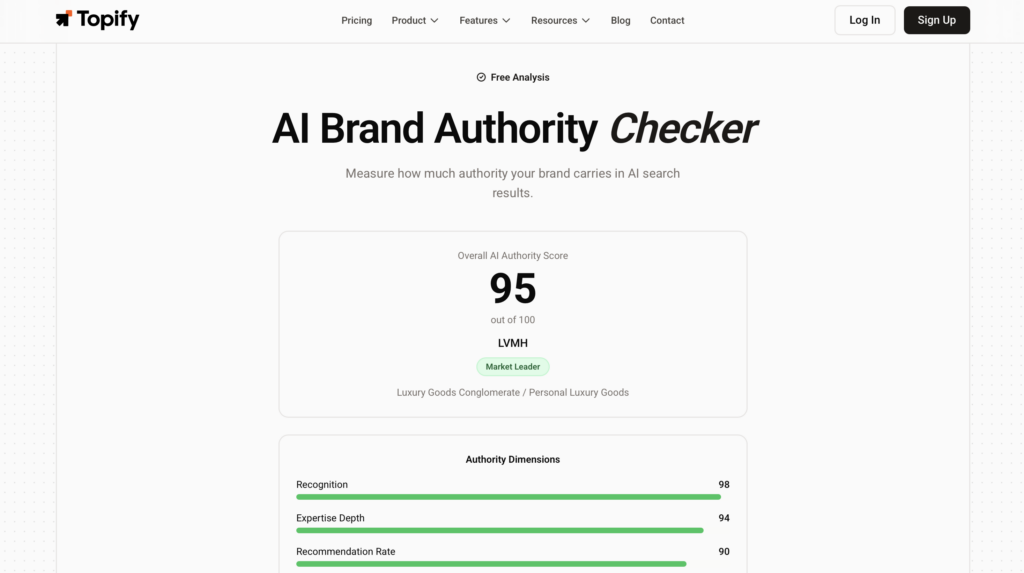
There’s a way to find out exactly where the gap is. Topify‘s Brand Authority Checker scores how AI models perceive your brand’s authority across four dimensions that directly affect whether you get recommended in luxury purchase queries.
✅ Free ⚡ Results in 60 seconds 🔒 No signup required
AI Brand Authority Checker
The Four Scores That Tell You If AI Trusts Your Luxury Brand
The Brand Authority Checker doesn’t give you a single pass/fail grade. It breaks your brand’s AI authority into four distinct metrics, each measuring a different dimension of how AI models evaluate whether your brand deserves a recommendation.
What Each Authority Metric Means for Luxury
Here’s how those four scores translate into luxury-specific signals.
| Metric | What It Measures | What It Means for Luxury Brands |
|---|---|---|
| Recognition Score | How consistently AI identifies your brand in its category | Low score = AI doesn’t associate you with “luxury watches” or “high-end skincare” even if you’ve been in the category for decades |
| Expertise Depth | How well AI understands your capabilities and differentiators | Low score = AI can’t distinguish your hand-stitched leather goods from mass-market alternatives |
| Recommendation Rate | How often AI includes you when users ask for suggestions | Low rate = you’re absent from the shortlists high-net-worth buyers now generate through AI before visiting a boutique |
| Trust Signals | External validation AI detects (media, reviews, certifications) | Weak signals = AI doesn’t find enough third-party proof to confidently recommend a $5,000+ purchase from your brand |
A luxury brand might score 85 on Recognition but 40 on Expertise Depth. That pattern tells a specific story: AI knows you exist but can’t articulate what makes you different. For a category built on differentiation, that’s a serious problem.
Three Scenarios Luxury Brands Typically Discover
When luxury brands run this check for the first time, a few patterns come up repeatedly.
Scenario 1: High heritage, low expertise depth. The brand has a long history and strong name recognition, but its website is image-heavy with minimal structured content about materials, processes, or craftsmanship. AI models can identify the brand but can’t explain why it’s worth the premium.
Scenario 2: Strong owned media, weak third-party signals. The brand invests heavily in its own editorial content and campaign storytelling. But AI models weigh external validation (press coverage, independent reviews, forum discussions) more heavily than brand-owned narratives. The Trust Signals score reveals this imbalance.
Scenario 3: Category leader offline, invisible online to AI. The brand dominates in-store and in print media but has minimal structured digital presence. AI models, which primarily crawl web content, simply don’t have enough material to build a confident recommendation.
How to Run Your Brand Through the Checker
The process takes three steps.
First, go to the Brand Authority Checker and enter your brand name. Second, review your four-dimensional authority breakdown. Pay close attention to which scores are pulling the overall number down. Third, compare the AI’s perception against your actual brand positioning. The gaps between what you are and what AI thinks you are become your optimization roadmap.
No account needed. No email required. You’ll have your scores in under a minute.
Luxury Buyers Ask AI for Shortlists. Here’s What Gets You Left Off.
The shift isn’t theoretical. BCG’s analysis of leading European brands found that LLM-driven traffic in luxury grew nearly 1,200%. McKinsey’s State of Fashion 2026 report stated it plainly: “AI chatbot responses are the new SEO.”
Here’s what your buyers are actually typing into AI platforms.
| AI Prompt Example | Platform | Search Intent | What It Reveals |
|---|---|---|---|
| “Best luxury watches under $10,000 for everyday wear” | ChatGPT | Purchase shortlist | Whether AI includes your brand in price-tier recommendations |
| “Is [Brand] worth the price compared to [Category peer]?” | Perplexity | Value validation | How AI describes your brand’s value proposition and craftsmanship |
| “Recommend a luxury hotel in Milan with a Michelin restaurant” | Gemini | Experience research | Whether your property appears in curated AI recommendations |
| “Top luxury skincare brands for sensitive skin” | ChatGPT | Category discovery | If AI recognizes your brand’s expertise in a specific niche |
| “Which luxury real estate developers in Dubai are most trusted?” | Perplexity | Trust verification | How AI evaluates your brand’s authority signals in a high-stakes category |
Each of these prompts represents a high-intent buyer making a decision. Similarweb’s 2026 data shows 35% of consumers now use AI tools at the discovery stage. For luxury, where the average transaction value is high and the consideration set is small, being left off an AI-generated shortlist isn’t a minor inconvenience. It’s a lost sale you’ll never know about.
Your Visual-First Strategy Is Working Against You in AI Search
Luxury brands have always led with aesthetics. A Celine campaign page or a Patek Philippe product showcase is designed to evoke emotion, not deliver structured facts. That approach works for human visitors. It doesn’t work for AI crawlers.
AI models can’t interpret a beautifully art-directed image. They need text: materials, dimensions, pricing context, production methods, design philosophy articulated in words. A 303.london analysis put it directly: luxury brand identity is built on emotion, heritage, and aspiration, qualities that are “notoriously difficult to encode in the kind of structured, quotable content that AI engines prefer to surface.”
This is where the Brand Authority Checker’s Expertise Depth score becomes diagnostic. A low Expertise Depth score typically correlates with websites that prioritize visual storytelling over structured, crawlable content. The fix isn’t to abandon aesthetics. It’s to layer in the structured information that AI needs alongside the visual experience your audience expects.
In practice, that means adding detailed product pages with specifications, publishing editorial content about craftsmanship and materials, and structuring FAQ content that answers the exact questions buyers ask AI. The brands doing this well don’t look less luxurious. They just give AI something to work with.
AI Now Controls Your Brand’s First Impression
For decades, luxury brands controlled every detail of the first encounter. The store’s architecture, the lighting, the staff’s demeanor, the tissue paper in the shopping bag. That level of control extended to digital through carefully curated websites and campaign microsites.
That era is ending. When a high-net-worth buyer asks ChatGPT “Which luxury handbag brands offer the best craftsmanship?”, the AI produces a synthesized answer drawn from media coverage, reviews, forums, and web content. It has already decided which brands are worth mentioning. The buyer reads a paragraph, not a list of links. The brand’s carefully crafted homepage never enters the picture.
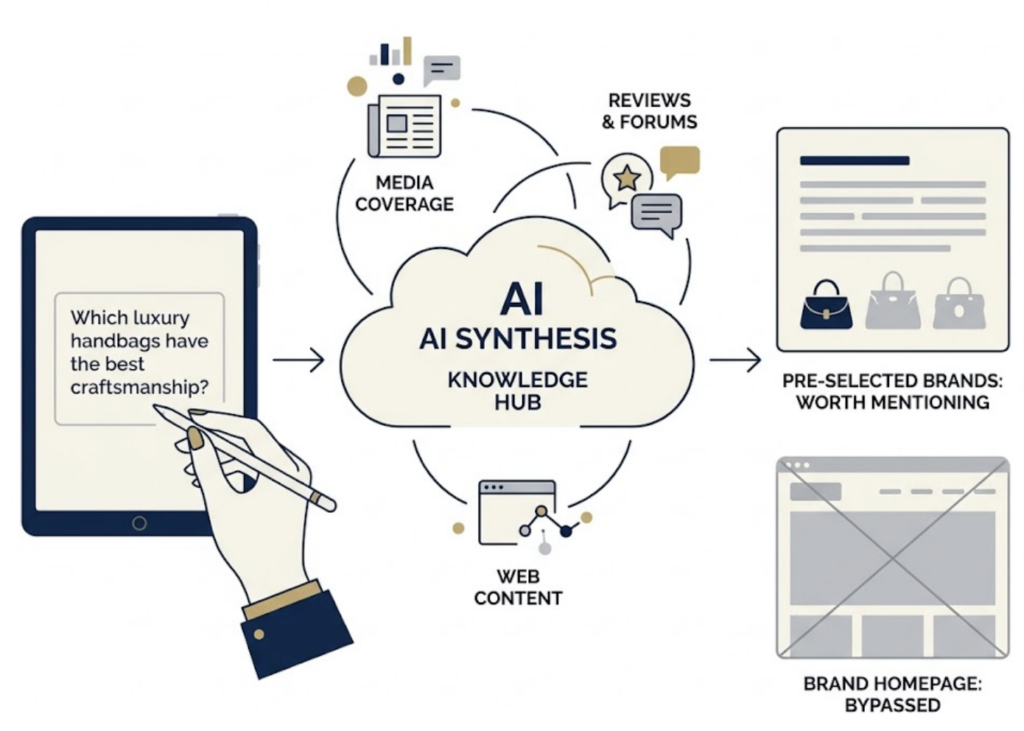
BCG’s Luxury CX and AI Survey confirmed that luxury clients are “moving away from traditional online searches and viewing more conversational interactions with AI as a superior outcome.” The first impression is now written by the model, not the maison.
The Brand Authority Checker’s Recognition Score quantifies this shift. It shows whether AI models consistently associate your brand with its category. A low Recognition Score means the AI doesn’t reliably connect your brand to “luxury watches” or “premium hospitality” when those topics come up. Your heritage and reputation exist in the real world but not in the model’s understanding.
LLM Traffic in Luxury Grew 1,200%. Most Brands Aren’t Tracking It.
BCG’s numbers are stark: LLM-driven referral traffic to luxury brands increased nearly 1,200% between 2024 and 2025. Yet only 22% of marketers currently track AI visibility at all.
That’s a blind spot with real revenue implications. AI search traffic converts at 14.2% compared to Google organic’s 2.8%, a 5.1x advantage. For luxury brands with high average order values, even a small volume of AI-referred traffic can represent significant revenue. But you can’t optimize a channel you’re not measuring.
The Brand Authority Checker gives you a starting point: a one-time snapshot of where your brand stands in AI’s perception. That snapshot tells you whether you have a visibility problem and where it’s concentrated. But AI models update regularly. Your competitors’ digital strategies evolve. The scores you see today could shift next quarter.
From a One-Time Score to Ongoing Authority Tracking
The Brand Authority Checker gives you a clear diagnostic. But AI search results aren’t static. Models retrain, new content gets indexed, and competitor strategies shift month to month. A score that looks solid today might erode by next quarter without any action on your part.
That’s the gap between a one-time check and continuous monitoring. Topify’s Comprehensive GEO Analytics dashboard tracks your brand’s authority, visibility, sentiment, and citation trends across ChatGPT, Perplexity, Gemini, and Google AI Overviews on an ongoing basis. Instead of a snapshot, you get a trendline showing whether your AI presence is strengthening or weakening over time.
Here’s how the free tool and the full platform compare.
| Capability | Free Brand Authority Checker | Topify Platform |
|---|---|---|
| Check frequency | One-time snapshot | Continuous daily/weekly monitoring |
| Authority dimensions | 4-score breakdown | Full authority tracking with historical trends |
| AI platforms covered | Single check | ChatGPT + Perplexity + Gemini + AI Overviews |
| Competitor benchmarking | No | Real-time competitor authority comparison |
| Trend alerts | No | Automated alerts when scores shift |
| Content optimization | Manual interpretation | One-click GEO optimization recommendations |
Topify’s platform starts at $99/month with a 7-day free trial, no credit card required. For luxury brands where a single AI-referred conversion can represent thousands in revenue, the math tends to work out quickly. You can start a free trial to see the full picture.
Conclusion
Luxury brands have spent decades perfecting how the world perceives them. AI is now rewriting that perception based on signals most brands aren’t tracking. The gap between your brand’s real authority and AI’s understanding of it is measurable, and fixing it starts with seeing the numbers.
Run your brand through the Brand Authority Checker to get your four-dimensional authority score. It’s free, takes 60 seconds, and requires no signup. From there, you’ll know exactly which dimensions need attention and whether continuous monitoring makes sense for your brand.
Other free tools worth checking:
Beyond brand authority, a few other Topify free tools can round out your AI visibility diagnostic. The Brand Sentiment Checker shows how AI describes your brand’s strengths and weaknesses in its own words. The Competitor Analysis tool reveals who AI considers your competition, which may not match your internal view. And the AI Visibility Report gives you a cross-platform snapshot of how often your brand gets mentioned across major AI engines.
FAQ
Is the Brand Authority Checker really free? Do I need to create an account?
Yes, it’s completely free with no registration required. Enter your brand name at topify.ai/tools/brand-authority-checker and you’ll have your four authority scores in under 60 seconds.
What’s the difference between the free tool and Topify’s paid platform?
The free Brand Authority Checker gives you a one-time snapshot of your AI authority scores. Topify’s platform provides continuous monitoring across all major AI platforms, historical trend tracking, competitor benchmarking, and actionable optimization recommendations. Plans start at $99/month with a 7-day free trial.
How often should a luxury brand check its AI visibility?
At minimum, quarterly. AI models retrain regularly and new content gets indexed constantly. Luxury brands launching new collections or entering new markets should check more frequently, as AI’s perception can shift within weeks of major announcements or media coverage cycles.
Why does my luxury brand have high recognition but low recommendation rates in AI?
This is common in luxury. AI models may know your brand exists but lack enough structured, crawlable content to confidently recommend you. Luxury websites that rely on visuals and minimal text often score well on Recognition but poorly on Expertise Depth and Recommendation Rate. The fix is layering in structured content, detailed product information, and ensuring third-party coverage is accessible to AI crawlers.

