

Your customer just asked ChatGPT, “What’s the best sustainable sneaker brand under $150?” The AI responded with three recommendations, detailed pros and cons for each, and a confident verdict. Your brand, the one with 4.8-star reviews and a carbon-neutral supply chain, didn’t make the list. Worse, a competitor with fewer reviews and a higher price point did.
The gap isn’t your product. It’s how AI perceives your brand.
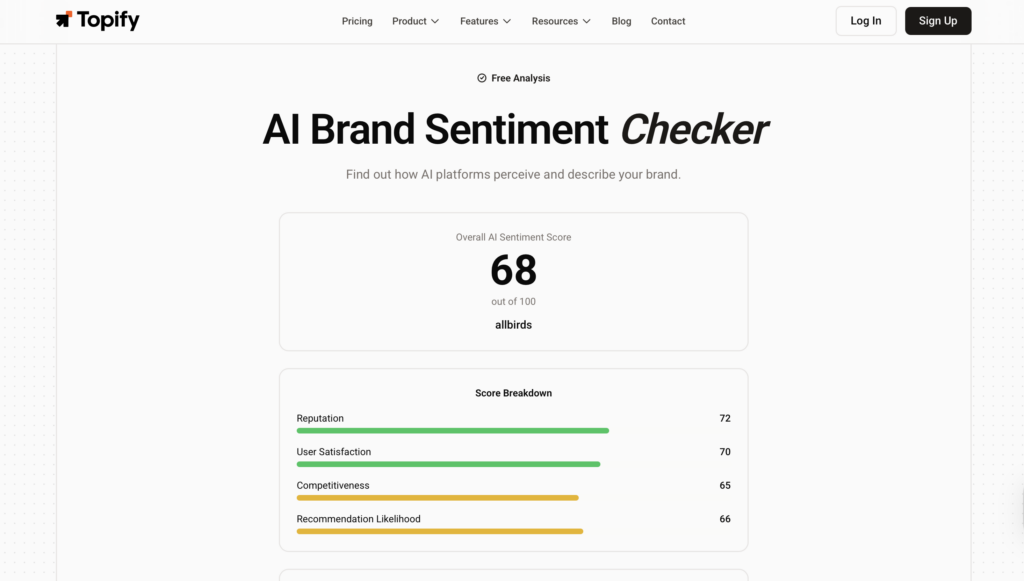
Topify‘s Brand Sentiment Checker shows you exactly what AI models think about your DTC brand, broken down by strengths, weaknesses, and an overall sentiment score that directly affects whether you get recommended or warned against.
✅ Free ⚡ Full sentiment breakdown in seconds 🔒 No signup required
AI Brand Sentiment Checker
What the Brand Sentiment Checker Actually Tells You About Your DTC Brand
Most DTC teams track NPS, Trustpilot scores, and social mentions. None of those tell you what AI models are saying about your brand when a shopper asks for a recommendation. That’s a different data layer entirely.
The Brand Sentiment Checker bridges that gap. It analyzes how AI systems describe your brand and translates the output into actionable dimensions.
Three Scores That Decide Whether AI Recommends or Warns Against You
Each dimension maps to a specific risk for DTC brands competing in AI-driven product discovery.
| Sentiment Dimension | What It Measures | What It Means for DTC Brands |
|---|---|---|
| Overall Sentiment Score (0-100) | Net positive vs. negative tone AI associates with your brand | Below 50: AI is attaching caveats or warnings when mentioning your products |
| Strengths Detected | Specific positive attributes AI highlights | Shows which product claims AI actually believes and repeats to shoppers |
| Weaknesses Flagged | Specific negative attributes AI surfaces | Reveals outdated complaints or misconceptions AI is still circulating |
A DTC skincare brand might score 75 overall but discover that AI consistently flags “fragrance irritation” as a weakness. If that formula was reformulated two years ago, you’ve found the exact disconnect costing you AI recommendations.
That single insight is worth more than a month of keyword research.
When AI Sentiment Doesn’t Match Your Current Product
Here’s the pattern that hits DTC brands hardest: you ship V2 of your product, but AI still describes V1.
AI models pull sentiment from reviews, articles, Reddit threads, and third-party comparisons. If the loudest signals in that mix are two-year-old complaints about sizing, durability, or shipping speed, the AI’s description of your brand is frozen in time. Your product improved. The AI’s opinion didn’t.
This plays out in three common scenarios for DTC brands:
Scenario 1: The fixed flaw. Early reviews mentioned a quality issue. You fixed it 18 months ago. AI still references it when shoppers ask about your category.
Scenario 2: The missing upgrade. You launched a new product line or feature. AI doesn’t know it exists because the third-party content hasn’t caught up.
Scenario 3: The sentiment mismatch. Your owned channels emphasize sustainability and premium quality. AI describes you as “budget-friendly but inconsistent.” The positioning you built isn’t the positioning AI learned.
The Brand Sentiment Checker surfaces all three. You don’t need to guess which scenario applies to your brand.
How to Run Your Brand Sentiment Check
Three steps, under 60 seconds:
- Go to Brand Sentiment Checker
- Enter your brand name or domain
- Get your sentiment breakdown: overall score, specific strengths AI recognizes, and specific weaknesses AI flags
No account needed. No credit card. You’ll see exactly how AI describes your brand to the shoppers asking about your category right now.
The AI Prompts DTC Shoppers Are Already Using to Find (or Skip) Your Products
37% of consumers now start their search journey with AI tools instead of Google. For DTC brands, that means your next customer might never visit a search engine at all. They’ll ask an AI assistant, get a direct answer, and buy.
The table below shows how real DTC shoppers are prompting AI, and what each query reveals about your brand’s visibility.
| AI Prompt Example | Platform | Search Intent | What It Reveals About Your Brand |
|---|---|---|---|
| “Best DTC protein powder for women over 40” | ChatGPT | Purchase decision | Whether AI recommends you in your target demographic |
| “Is [brand] worth the price compared to alternatives?” | Perplexity | Trust verification | How AI frames your value proposition vs. competitors |
| “Sustainable sneaker brands under $150” | Gemini | Category discovery | Whether your brand appears in AI’s curated shortlist |
| “What do people say about [brand] quality?” | ChatGPT | Sentiment check | The exact language AI uses to describe your product quality |
| “Best dog food brands for allergies 2026” | Google AI Overview | Specific need match | Whether AI associates your brand with the right use case |
Each of these prompts triggers an AI response that either includes your brand or doesn’t. And when it does include you, the sentiment attached to your mention determines whether the shopper clicks through or moves on.
DTC brands like Pawco have already reported that customers are discovering them through AI searches for terms like “best food for dogs with allergies.” The channel is real. The question is whether AI’s description of your brand helps or hurts when those queries happen.
Two Shifts DTC Brands Can’t Afford to Ignore in AI Search
AI Sentiment Is Stuck on Your Old Reviews. Your Product Has Moved On.
A DTC bedding brand reformulates its pillow fill after early complaints about firmness. New reviews are overwhelmingly positive. But when a shopper asks Perplexity, “Is [brand] pillow too firm?”, the AI answers with a qualified yes, citing language patterns from reviews that are now two years old.
This isn’t a hypothetical. AI models synthesize sentiment from everything published about your brand online, and they don’t weight recency the way a human reviewer would. A Criteo study tracking 28 fashion brands across ChatGPT, Gemini, and Claude found that AI recommendations correlated with consistent, specific positioning across all published content, not with the most recent content alone.
For DTC brands that iterate fast, this creates a structural disadvantage. You ship improvements quarterly. AI updates its perception on a much slower cycle.
The Brand Sentiment Checker makes this gap visible. Run your brand through the tool, and compare the weaknesses AI flags against your current product. If there’s a mismatch, you’ve identified exactly which narratives need to be updated across review platforms, PR, and third-party content.
Ad Spend Doesn’t Buy AI Recommendations. Sentiment Signals Do.
DTC growth has historically been a budget game. Bid higher on Meta, scale spend on Google, win more customers. The median DTC brand now spends $130 to $156 to acquire a single customer through those channels.
AI search works on entirely different rules. You can’t bid your way into a ChatGPT recommendation.
What determines whether AI recommends your brand? The signals it can verify: review quality, third-party citations, brand positioning consistency, and structured product data. In an analysis of over 5,000 ChatGPT shopping carousels, an online-only DTC brand most shoppers had never heard of appeared in nearly 30% of triggered results, while a globally recognized retailer appeared in fewer than 2%. The difference wasn’t brand awareness or ad spend. It was data quality and sentiment signals.
This is the shift DTC teams need to internalize. AI referral traffic already converts at 11.4% compared to 5.3% for organic search. The channel is higher-intent, higher-converting, and completely inaccessible through traditional paid media.
48% of AI citations come from community platforms like Reddit, review sites, and forums. That means your brand’s AI sentiment isn’t shaped by what you publish on your own site. It’s shaped by what others say about you on platforms you don’t control.
The starting point is knowing what AI currently thinks. That’s what the Brand Sentiment Checker gives you in 60 seconds, for free.
One Sentiment Snapshot vs. Continuous Brand Monitoring
The Brand Sentiment Checker gives you a clear picture of where your brand stands right now. But AI models don’t stay static. They retrain, update their retrieval sources, and shift recommendations on a rolling basis. A sentiment score of 72 today could drop to 55 next quarter if a wave of negative reviews hits Reddit or a competitor’s PR push reshapes your category narrative.
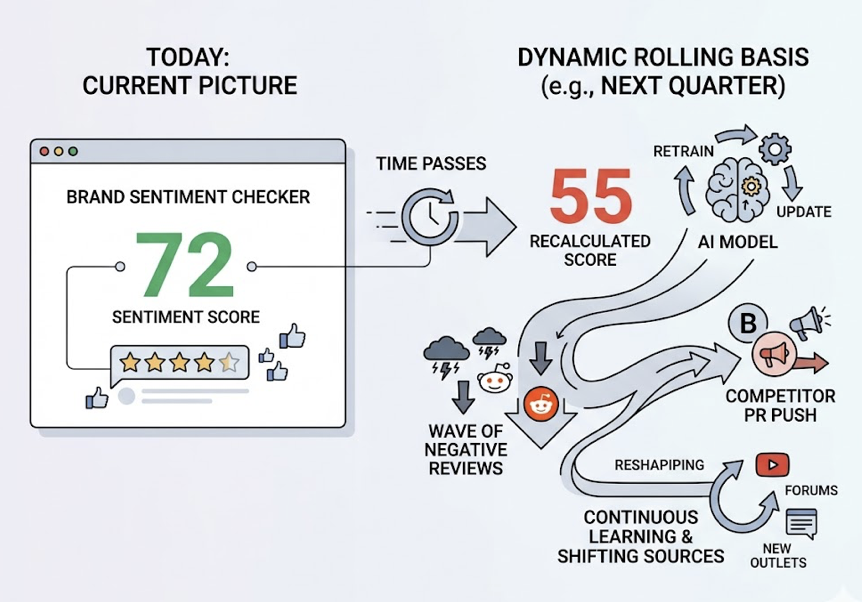
For DTC brands running product launches, seasonal campaigns, or responding to PR issues, a one-time check isn’t enough. You need to know when AI’s perception of your brand changes, not discover it after sales dip.
Topify‘s Comprehensive GEO Analytics dashboard picks up where the free tool leaves off. It tracks your sentiment, visibility, and authority scores continuously across ChatGPT, Perplexity, Gemini, and Google AI Overviews. You’ll get trend data, alerts when scores shift, and specific recommendations for what to fix.
Here’s how the free check compares to the full platform:
| Capability | Free Brand Sentiment Checker | Topify Platform |
|---|---|---|
| Check frequency | One-time snapshot | Continuous daily/weekly monitoring |
| AI platforms covered | Aggregated score | Per-platform breakdown (ChatGPT, Perplexity, Gemini, AI Overviews) |
| Historical trends | None | Full trend history with shift alerts |
| Competitor sentiment tracking | Not included | Real-time competitor benchmarking |
| Action recommendations | General | Specific, one-click GEO optimization |
| Team collaboration | No | Unlimited team member seats |
Every plan starts with a 7-day free trial, no credit card required. The Starter plan begins at $99/month.
Conclusion
DTC brand discovery is moving to AI, and it’s moving fast. Referral traffic from AI chatbots to US retailers grew 760% year-over-year in late 2025. Your customers are asking AI what to buy. The sentiment AI attaches to your brand in those answers determines whether you get the click or get passed over.
Start with a free Brand Sentiment Checker scan. See what AI actually says about your products. Then build a plan to close the gap between your brand’s reality and AI’s perception of it.
For ongoing monitoring, start a free trial of Topify’s platform to track sentiment shifts across every major AI platform.
Other Free Tools to Round Out Your AI Visibility Audit
While you’re checking your brand sentiment, a few other free tools can fill in the picture. Topify‘s GEO Score Checkerevaluates whether AI crawlers can access and understand your site’s structure. The AI Visibility Report shows how often your brand gets mentioned across major AI platforms. And the Prompts Researcher reveals the exact product questions DTC shoppers are asking AI in your category.
FAQ
Is the Brand Sentiment Checker free? Do I need to sign up?
Yes, it’s completely free. No signup, no credit card, no email required. Enter your brand name or domain and get your sentiment breakdown in under 60 seconds.
What’s the difference between the free tool and the Topify platform?
The free Brand Sentiment Checker gives you a one-time snapshot of AI sentiment. The Topify platform provides continuous monitoring across ChatGPT, Perplexity, Gemini, and Google AI Overviews, with historical trends, competitor benchmarking, and actionable optimization recommendations. Plans start at $99/month with a 7-day free trial.
How often should DTC brands check their AI sentiment?
At minimum, after every major product launch, reformulation, or PR event. AI models update their knowledge on irregular cycles, so a quarterly manual check with the free tool is a reasonable baseline. For brands in competitive categories or running frequent product updates, continuous monitoring through the platform is the more practical approach.
Can AI sentiment actually affect DTC sales?
Yes. ChatGPT-referred visits convert at 11.4% compared to 5.3% for organic search. When AI attaches negative sentiment or outdated complaints to your brand, shoppers who discover you through AI start with a negative impression, or skip your brand entirely. The sentiment AI associates with your brand is increasingly a direct driver of purchase decisions.

