

A shopper typed into ChatGPT: “Compare running shoes under $150 with good arch support.” Your brand appeared in the response, but with a caveat: “some users report inconsistent sizing.” That sizing issue was resolved two product lines ago. The AI doesn’t know that.
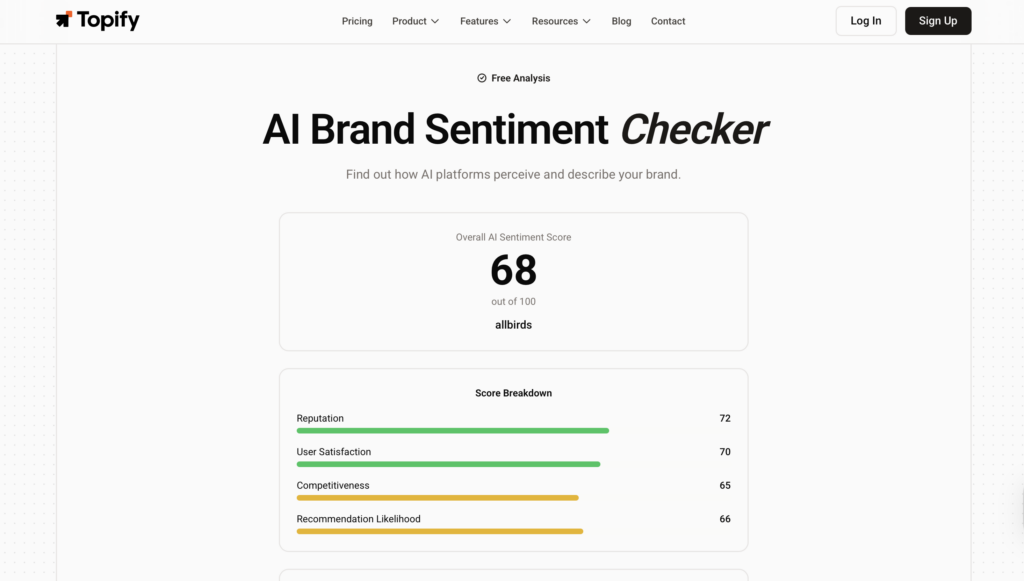
You can see exactly how AI describes your brand right now. Topify‘s Brand Sentiment Checker analyzes the sentiment AI models attach to your brand, surfaces specific strengths and weaknesses AI associates with your products, and shows you where perception doesn’t match reality.
✅ Free ⚡ Full sentiment breakdown in seconds 🔒 No signup required
AI Brand Sentiment Checker
What AI Actually Says About Your Brand When Shoppers Ask
Your product pages tell one story. AI tells another. When a consumer asks ChatGPT, Perplexity, or Gemini for a product recommendation, the AI doesn’t pull your marketing copy. It synthesizes reviews, forum discussions, media coverage, and third-party evaluations to construct a description of your brand. That description includes a sentiment layer, and it directly affects whether AI recommends you or steers shoppers elsewhere.
The Brand Sentiment Checker breaks down AI’s perception of your brand into specific, measurable dimensions. Here’s what each one tells you in an e-commerce context.
The Scores That Decide If AI Recommends or Warns
| Metric | What It Measures | What It Means for E-Commerce Brands |
|---|---|---|
| Overall Sentiment Score | Net positive/negative/neutral tone AI uses to describe your brand | Below neutral: AI is actively cautioning shoppers about your products |
| Strengths Identified | Specific positive attributes AI associates with your brand | Few strengths: AI has no compelling reason to recommend you over alternatives |
| Weaknesses Flagged | Specific negative attributes or concerns AI highlights | Active weaknesses: AI may add caveats like “some users report issues with…” |
| Sentiment Gap | Difference between how AI describes you vs. how customers actually rate you | Large gap: AI is working with outdated or skewed information |
A brand with strong sales and a 4.6-star average on its own site can still carry a negative sentiment score in AI. That disconnect is the problem the checker is built to surface.
When “Fixed Two Years Ago” Still Shows Up in AI Answers
Here’s where e-commerce brands run into trouble. AI models don’t update their understanding of your brand in real time. They synthesize from a broad content ecosystem, and that ecosystem has a long memory.
Scenario 1: The ghost review. Your brand had a batch of defective units in 2023. You issued a recall, improved QC, and moved on. But the Reddit threads, blog reviews, and forum complaints from that period are still indexed. AI picks up “quality control issues” as a recurring theme and mentions it when shoppers ask about your category.
Scenario 2: The outdated comparison. A popular review site published a head-to-head comparison 18 months ago where your product scored lower on durability. You’ve since launched a redesigned version. AI still references the old comparison because no updated content has replaced it in the training ecosystem.
Scenario 3: The sentiment mismatch. Your Trustpilot score is 4.5 with 3,000+ reviews, but AI describes your brand as “mixed reviews.” The reason: a cluster of negative reviews from a single incident weighs disproportionately in AI’s synthesis because those reviews generated the most discussion and backlinks.
Running your brand through the checker exposes which of these patterns are affecting you.
Run Your Brand Through the Checker in 60 Seconds
Go to the Brand Sentiment Checker, enter your brand name or domain, and get your full sentiment breakdown. You’ll see the exact strengths AI associates with your brand, the specific weaknesses it flags, and your overall sentiment score. No account, no credit card, no waiting.
The whole process takes under a minute, and the output tells you exactly where AI’s description of your brand diverges from reality.
The AI Prompts Driving E-Commerce Decisions Right Now
64% of consumers plan to use AI chatbots for shopping in 2026. That’s not a projection. It’s survey data from over 1,000 consumers. And among daily AI users, 70% have already used AI for shopping, spending an average of $540 across 9 transactions in 2025.
The prompts these shoppers use aren’t vague. They’re specific, comparison-driven, and high-intent. Here’s what they look like in practice.
| AI Prompt Example | Platform | Search Intent | What It Reveals About Your Brand |
|---|---|---|---|
| “Best wireless earbuds under $100 for running” | ChatGPT | Purchase decision | Whether AI recommends your product or flags comfort/durability concerns |
| “Compare organic skincare brands for sensitive skin” | Perplexity | Competitive comparison | How your sentiment stacks up against alternatives in the same category |
| “Most reliable laptop brand for remote workers” | Gemini | Trust verification | Whether AI describes your brand as “reliable” or adds qualifiers |
| “Which DTC mattress has the best return policy?” | ChatGPT | Policy-driven decision | Whether AI accurately reflects your current policies or cites outdated info |
| “Top-rated coffee makers under $200, 2026” | Perplexity | Category research | Whether your brand appears at all, and with what sentiment |
Each of these prompts represents a moment where AI either recommends your brand with confidence or adds a caveat that sends the shopper elsewhere. The sentiment AI attaches to your brand in these responses isn’t random. It’s a direct reflection of what the content ecosystem says about you.
On Black Friday 2025, shoppers arriving from ChatGPT converted on Amazon at 1.7x the rate of Google-referred shoppers, with 11% higher average order value. The channel is already converting. The question is whether your brand shows up in it with the right sentiment.
AI’s Perception of Your Brand Is Built on Third-Party Reviews, Not Your Website
Here’s the thing most e-commerce teams miss: the content that shapes AI’s sentiment about your brand isn’t on your website. It’s on Trustpilot, Reddit, YouTube reviews, niche blogs, and comparison sites. AI models weight third-party, user-generated content far more heavily than brand-owned marketing copy when forming sentiment judgments.
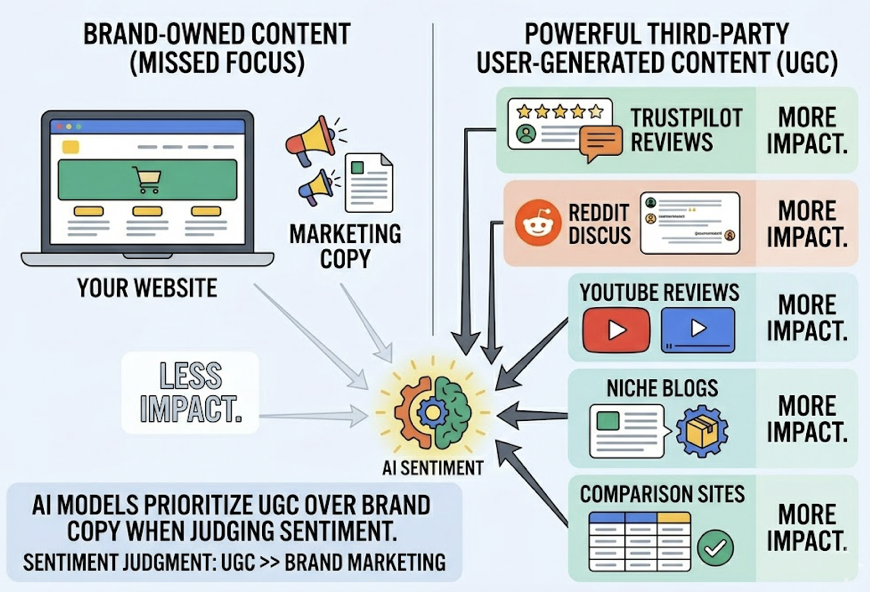
This is a fundamental shift from traditional SEO. In Google rankings, you can control a significant portion of the narrative through on-page optimization, content marketing, and link building. In AI search, the narrative is shaped by what others say about you, and AI is very good at detecting patterns in that external conversation.
A practical example: if your brand has a 4.7-star average across 5,000 reviews on your own site, but your Trustpilot score sits at 3.8 with 800 reviews and active negative threads on Reddit, AI will lean toward the Trustpilot and Reddit signals. Not because those platforms are more accurate, but because AI treats independent sources as more credible for sentiment synthesis.
The data supports this pattern. 78% of consumers say reviews increase their trust in AI recommendations, and 98% verify AI’s suggestions by checking external sources. AI models anticipate this verification behavior and front-load sentiment signals from the same sources consumers will check.
What This Means for Your Sentiment Strategy
| Review Source | AI Weighting | Why It Matters for E-Commerce |
|---|---|---|
| Trustpilot / Google Reviews | High | Primary sentiment signal for consumer brands |
| Reddit threads and comments | High | AI treats candid user discussion as high-trust signal |
| YouTube product reviews | Medium-High | Video review sentiment gets synthesized into text descriptions |
| Niche comparison blogs | Medium | Category-specific authority influences AI’s competitive framing |
| Brand-owned website copy | Low | AI discounts self-reported claims in favor of external validation |
This isn’t about gaming reviews. It’s about understanding which parts of your review ecosystem are actually shaping how AI describes you, and making sure that ecosystem reflects your current product quality, not last year’s problems.
Outdated Negative Reviews Are Costing You AI Recommendations Right Now
AI models don’t have a “recency” filter the way you’d expect. When ChatGPT or Perplexity synthesizes information about your brand, it pulls from the entire content history available to it. A negative review from 2022 that generated significant discussion carries roughly the same weight as a positive review from last month, sometimes more, because older content often has more backlinks and cross-references.
For e-commerce brands, this creates a specific problem: product improvements don’t automatically update AI’s perception. You may have redesigned your packaging, upgraded your materials, or overhauled your customer service process. If the content ecosystem still has more volume and engagement around the old problems than the new solutions, AI keeps surfacing the old narrative.
The Brand Sentiment Checker helps you identify exactly which negative signals AI is still picking up. Once you see the specific weaknesses AI flags, you can trace them back to their source and build a content strategy that addresses them directly. That might mean publishing updated comparison content, encouraging recent customers to leave reviews on high-weight platforms, or creating case studies that directly counter the outdated narrative.
Only 16% of brands currently track their AI search performance systematically. That means the majority of e-commerce brands don’t know what AI is saying about them. In a channel where AI-referred traffic converts 42% better than non-AI traffic, that blind spot has a direct revenue impact.
One Sentiment Check Is a Snapshot. Tracking It Is the Strategy.
Your Brand Sentiment Checker results tell you where you stand right now. But AI models update their training data, ingest new content, and shift how they describe brands on a rolling basis. A positive sentiment score today doesn’t guarantee the same result next quarter, especially if a competitor launches a review campaign or a negative thread goes viral in your category.
Topify‘s platform picks up where the free tool leaves off. The Comprehensive GEO Analytics dashboard tracks your sentiment, visibility, and authority scores continuously across ChatGPT, Perplexity, Gemini, and Google AI Overviews. You’ll see trend lines over time, get alerts when sentiment shifts, and receive specific recommendations for what to fix.
Here’s how the free check compares to the full platform:
| Capability | Free Brand Sentiment Checker | Topify Platform |
|---|---|---|
| Check frequency | One-time snapshot | Continuous daily/weekly monitoring |
| AI platforms covered | Aggregated sentiment score | Per-platform breakdown (ChatGPT, Perplexity, Gemini, AI Overviews) |
| Historical trends | None | Full trend history with shift alerts |
| Competitor sentiment | Not included | Real-time competitor sentiment benchmarking |
| Actionable next steps | General insight | Specific, data-driven optimization recommendations |
| Team collaboration | No | Unlimited team member seats |
Every plan starts with a 7-day free trial, no credit card required. The Starter plan begins at $99/month.
Conclusion
AI shopping isn’t a future channel. ChatGPT processes roughly 50 million shopping queries per day, and the consumers using it convert at significantly higher rates than those arriving from traditional search. For e-commerce brands, the question isn’t whether AI matters. It’s whether AI describes your brand accurately and favorably when shoppers ask.
Start with the free Brand Sentiment Checker to see exactly what AI says about your brand today. If the sentiment doesn’t match your current product quality and customer experience, you’ve found the gap. From there, Topify’s platform gives you the continuous monitoring and optimization tools to close it.
Other Free Tools to Round Out the Picture
While you’re assessing brand sentiment, a few other free checks can cover additional dimensions. Topify‘s GEO Score Checker evaluates whether AI crawlers can access and interpret your product pages properly. The AI Visibility Reportshows how often your brand gets mentioned across major AI platforms. And the Competitor Analysis tool reveals which brands AI considers your direct competitors and how you stack up.
FAQ
Is the Brand Sentiment Checker free? Do I need to sign up?
Yes, it’s completely free with no signup, no login, and no credit card required. Enter your brand name or domain and get your sentiment breakdown in under 60 seconds.
What’s the difference between the free tool and Topify’s paid platform?
The free tool gives you a one-time sentiment snapshot. The paid platform adds continuous monitoring, per-platform breakdowns, historical trend tracking, competitor benchmarking, and actionable optimization recommendations. Plans start at $99/month with a 7-day free trial.
How often should e-commerce brands check their AI sentiment?
At minimum, once a month. If you’re running active campaigns, launching new products, or recovering from a PR issue, check bi-weekly. Significant changes in your review ecosystem, like new Trustpilot reviews, Reddit threads, or media coverage, can shift AI sentiment within weeks.
Can AI sentiment actually affect my e-commerce revenue?
Directly. AI-referred traffic to retail sites converts 42% better than non-AI traffic in 2026, and 64% of consumers plan to use AI for shopping this year. If AI describes your brand with negative sentiment or outdated caveats, those high-converting shoppers are going to your competitors instead.

