

A VP of Procurement typed into ChatGPT: “Best project management software for enterprise teams with Salesforce integration.” Five brands came back. Yours wasn’t one of them. That VP didn’t search Google next. They didn’t visit your website. They shortlisted the five names AI gave them and moved on.
This is happening at scale. 51% of B2B software buyers now start their research with an AI chatbot more often than with Google. And 69% end up choosing a different vendor than they originally planned, based on what the chatbot recommended.
The question isn’t whether your product is good. It’s whether AI knows that.
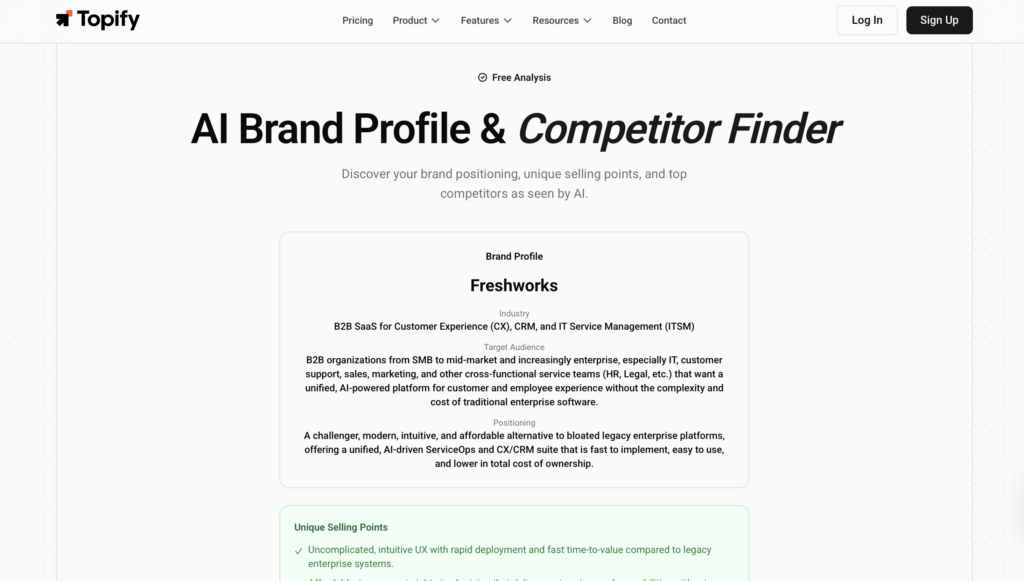
Topify‘s Brand Profile Checker shows you exactly how AI models perceive your brand: what category they place you in, which competitors they associate you with, and how much your positioning overlaps with theirs. ✅ Free ⚡ Results in 60 seconds 🔒 No signup required.
Brand Profile & Competitor Finder
What AI Actually Thinks About Your B2B Software Brand
Most B2B software companies assume AI understands their positioning because their website does a good job explaining it. That assumption is wrong more often than you’d expect.
AI models build their own brand portraits based on training data, citations, reviews, and content signals. The Brand Profile Checker surfaces that portrait and breaks it into three dimensions you can act on.
The Three Dimensions That Shape Your AI Identity
Each dimension maps to a specific risk for B2B software brands.
| Dimension | What It Reveals | What It Means for B2B Software |
|---|---|---|
| Brand Portrait | How AI describes your product, category, and positioning | If AI calls your enterprise platform a “small business tool,” every recommendation goes to the wrong buyer segment |
| Competitor Discovery | Which brands AI associates as your direct competitors | AI may compare you to brands outside your actual competitive set, diluting your positioning |
| Competitive Overlap Score | How much your brand identity overlaps with each competitor | High overlap with the wrong competitor means AI can’t differentiate you when buyers ask “which one should I pick” |
A B2B analytics platform with a strong Brand Portrait but high overlap with a general BI tool has a specific problem: AI recognizes what you do, but can’t articulate why you’re different. That’s the gap where deals get lost.
Three AI Positioning Errors That Cost B2B Software Companies Pipeline
Here’s what the Brand Profile Checker typically uncovers for B2B software brands.
Wrong category placement. Your product serves mid-market and enterprise buyers, but AI categorizes you alongside SMB tools. Every time a buyer asks for “enterprise-grade” options, you’re filtered out before the answer is generated.
Stale feature narrative. You launched a major platform update six months ago, but AI still describes capabilities from two versions back. Buyers comparing features through AI get an outdated picture of what you offer.
Competitor mismatch. AI associates you with brands you don’t consider competitors. When a buyer asks “How does [your brand] compare to [unexpected competitor]?”, the comparison framework works against you because AI has grouped you incorrectly.
How to Run Your Brand Profile Check
Go to the Brand Profile Checker, enter your brand name or domain, and get your full AI brand portrait in under 60 seconds. You’ll see the exact language AI uses to describe you, the competitors it associates with you, and the overlap scores that show where differentiation is weak. No account, no credit card, nothing to install.
The Prompts Your Buyers Type Before They Ever Visit Your Website
B2B software buyers don’t type keywords into AI. They describe their exact situation, constraints, and requirements. These prompts are increasingly where shortlists get built.
G2’s 2026 research found that 71% of B2B software buyers rely on AI chatbots somewhere in their research process. The prompts below represent the types of questions that determine whether your brand makes the cut.
| AI Prompt Example | Platform | Buyer Intent | What Determines If You Show Up |
|---|---|---|---|
| “Best CRM for mid-market B2B with Salesforce integration” | ChatGPT | Vendor shortlisting | Whether AI places you in the CRM category for that company size |
| “Compare [Category] tools for healthcare compliance” | Perplexity | Feature comparison | Whether AI accurately describes your compliance capabilities |
| “What project management software do 500-person tech companies use?” | Gemini | Social proof validation | Whether AI associates your brand with that company profile |
| “Is [Your Brand] good for enterprise teams?” | ChatGPT | Direct brand evaluation | How AI describes your strengths, weaknesses, and ideal customer |
| “Top analytics platforms under $50K/year for B2B” | Perplexity | Budget-filtered discovery | Whether AI knows your pricing tier and positions you correctly |
| “Which [Category] tool has the best API and integrations?” | Claude | Technical evaluation | Whether AI has indexed your technical documentation and partner ecosystem |
Notice the pattern. These aren’t keyword searches. They’re full buying scenarios. And AI assembles its answer based on how well it understands your brand’s profile, not just whether your website ranks for a given term.
AI Is the New Front Door to B2B Software Discovery
The shift is no longer emerging. It’s measurable and accelerating.
73% of B2B buyers now use AI tools in their purchase research process. Among B2B software buyers specifically, the number starting with AI over Google jumped from 29% to 51% in just 11 months. This isn’t a niche behavior pattern. It’s the new default.
Here’s the thing: AI doesn’t generate a page of ten links. It generates a single answer with three to five recommendations. If you’re not in that answer, you don’t get a second chance on “page two.” There is no page two.
The pipeline impact is direct. AI search traffic converts at 14.2% compared to Google organic’s 2.8%. Buyers who arrive through AI recommendations are further along in their decision process and more likely to convert. But only 22% of marketers currently track AI visibility at all.
The math is uncomfortable. The channel with the highest conversion rate is the one almost nobody is monitoring.
A DerivateX benchmark of 50 B2B SaaS companies found the average AI Presence Score is 56.9 out of 100, with 44% scoring below 50. The gap between the top scorer (89) and the bottom (2) is 87 points. Both companies had active marketing teams. The difference wasn’t marketing effort. It was whether AI could find, classify, and recommend them.
Running your brand through the Brand Profile Checker is the fastest way to see which side of that gap you’re on.
Your Real Competitors in AI Search Might Not Be Who You Think
Most B2B software companies have a well-defined competitive set. You know who shows up in RFPs, who your sales team loses deals to, and who appears on G2 comparison pages.
AI has its own competitive map. And it doesn’t always match yours.
AI models construct competitive relationships based on content co-occurrence, citation patterns, review site associations, and training data signals. If a series of blog posts and analyst reports consistently mention your brand alongside a company you’ve never considered a competitor, AI will treat that association as real. When a buyer asks “How does [your brand] compare to [that company]?”, AI will generate a detailed comparison, whether or not the comparison makes sense.
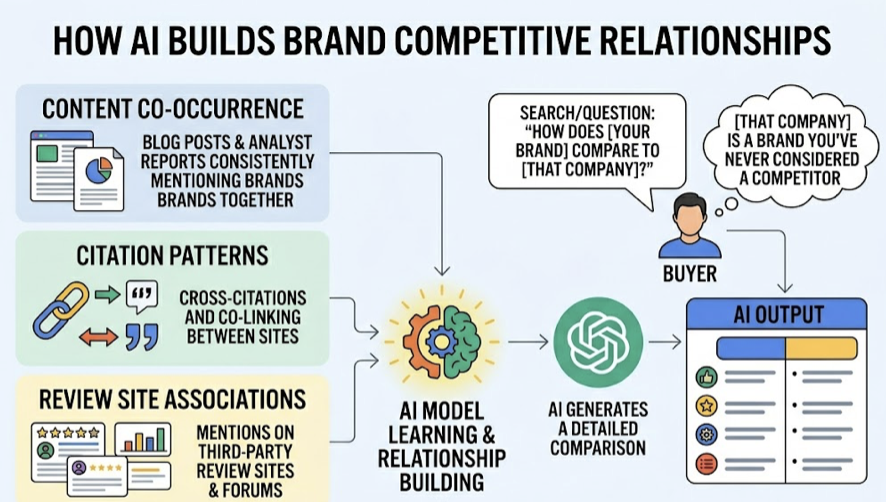
This creates two problems. First, you may be getting compared against brands that serve a different market segment, making your product look like a poor fit for the buyer’s needs. Second, the brands you actually compete with may not show up in AI’s competitive frame at all, meaning buyers never see the comparison you’d actually win.
The Brand Profile Checker’s competitor discovery feature shows you exactly which brands AI associates with yours. The competitive overlap scores tell you how differentiated AI thinks you are from each one. If your overlap with the wrong competitor is 80%, that’s a positioning problem you can fix. But you have to see it first.
On the flip side, low overlap with your actual competitors could mean AI isn’t even placing you in the right competitive conversation. Both scenarios require different strategies, and both start with knowing what AI currently sees.
From a One-Time Brand Check to Continuous Competitive Intelligence
Your Brand Profile Checker results show you a snapshot. It’s valuable, but it’s a snapshot of a moving target.
AI models update their training data, re-index content, and adjust recommendation patterns continuously. A competitor publishes a wave of thought leadership content, and their overlap score with your brand shifts. A product review site updates its rankings, and AI’s competitive map reorganizes. Your brand portrait today may not be your brand portrait next quarter.
Topify‘s Dynamic Competitor Benchmarking picks up where the free check leaves off. It tracks your brand’s competitive positioning across ChatGPT, Perplexity, Gemini, and Google AI Overviews on an ongoing basis, alerting you when competitive dynamics shift and giving you specific recommendations on how to respond.
| Capability | Free Brand Profile Checker | Topify Platform |
|---|---|---|
| Check frequency | One-time snapshot | Continuous daily/weekly monitoring |
| Competitor discovery | AI-identified competitors at one point in time | Ongoing competitor tracking with new entrant alerts |
| Overlap scoring | Static score | Trend lines showing overlap changes over time |
| AI platforms covered | Aggregated result | Per-platform breakdown (ChatGPT, Perplexity, Gemini, AI Overviews) |
| Positioning alerts | None | Automated alerts when AI changes how it describes you |
| Action recommendations | Manual interpretation | Specific, prioritized optimization steps |
Every plan starts with a 7-day free trial, no credit card required. The Starter plan begins at $99/month.
Conclusion
B2B software buying starts in AI now. Over half of buyers open a chatbot before they open Google, and most of them follow the recommendation they get. If AI doesn’t recognize your brand, place it in the right category, or differentiate it from competitors, you’re losing pipeline before your sales team has a chance to engage.
Start with what you can see. Run your brand through the Brand Profile Checker and find out how AI perceives your positioning today. Then decide whether a one-time check is enough, or whether continuous monitoring through Topify’s platform is what your competitive landscape requires.
Other Free Tools Worth Running
While you’re checking your brand profile, a few other free checks can round out the picture. Topify‘s Competitor Analysistool shows you how AI ranks your brand against specific competitors on strengths, weaknesses, and market positioning. The AI Visibility Report gives you a cross-platform snapshot of how often your brand gets mentioned across major AI platforms. And the Prompts Researcher reveals the exact questions buyers in your category are asking AI, so you can align your content to the prompts that drive shortlists.
FAQ
Is the Brand Profile Checker free? Do I need to create an account?
Yes, it’s completely free. No account, no signup, no credit card. Enter your brand name or domain and get results in under 60 seconds.
What’s the difference between the free tool and the Topify platform?
The free Brand Profile Checker gives you a one-time snapshot of your AI brand portrait and competitor associations. The Topify platform provides continuous monitoring, historical trend data, per-platform breakdowns, automated alerts, and actionable optimization recommendations. Plans start at $99/month with a 7-day free trial.
How often should B2B software companies check their AI visibility?
At minimum, after any major product launch, pricing change, or competitive shift. AI models update frequently, and your brand’s positioning can change without any action on your end. Companies in fast-moving categories benefit from weekly or daily monitoring through the full platform.
Can AI visibility actually impact B2B software pipeline?
Yes. AI search traffic converts at 5.1x the rate of traditional organic search, and 69% of B2B software buyers have changed their vendor choice based on an AI chatbot’s recommendation. Brands that are visible and correctly positioned in AI answers enter the consideration set earlier and more often.

