

A corporate sustainability director typed into ChatGPT: “Best clean energy providers for a 50 MW corporate PPA in the Southeast.” Five companies came back. Yours, with 3 GW of installed capacity and contracts across 12 states, wasn’t on the list. The problem isn’t your track record. It’s that AI doesn’t recognize it.
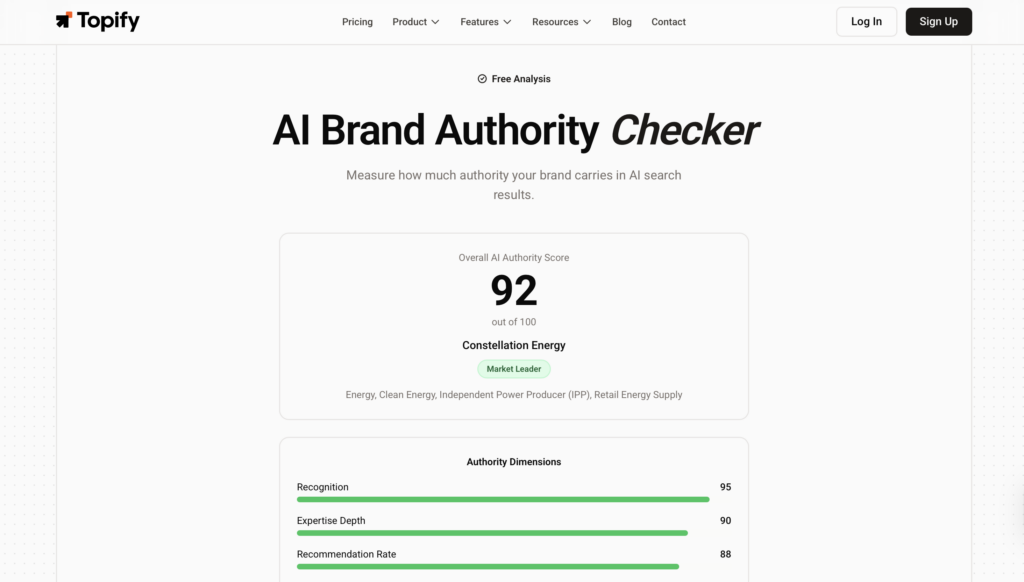
There’s a way to see exactly where the disconnect is. Topify‘s Brand Authority Checker scores how AI models perceive your clean energy brand’s authority across four dimensions that directly affect whether you get recommended.
✅ Free ⚡ Results in 60 seconds 🔒 No signup required
AI Brand Authority Checker
The Four Authority Scores That Determine If AI Trusts Your Clean Energy Brand
Each Score, Translated for Clean Energy
The Brand Authority Checker doesn’t give you a single number and send you on your way. It breaks AI’s perception of your brand into four distinct scores, each one mapping to a specific challenge clean energy companies face.
| Metric | What It Measures | What It Means for Clean Energy Brands |
|---|---|---|
| Recognition (0-100) | How often AI identifies your brand in your category | Below 40: AI doesn’t associate you with solar, wind, storage, or your core vertical |
| Expertise Depth (0-100) | How well AI understands your technical capabilities | Below 50: AI may not know about your latest product line, grid services, or PPA structures |
| Recommendation Rate (0-100) | How often AI recommends you vs. alternatives | Below 30: you’re being excluded from AI-generated shortlists that procurement teams rely on |
| Trust Signals (0-100) | External validation AI detects (media, reviews, citations) | Below 40: AI can’t find enough third-party evidence to vouch for your credibility |
Here’s the thing. A clean energy company with a Recognition score of 80 but a Trust Signals score of 25 has a very specific problem: AI knows who you are, but doesn’t trust you enough to recommend you over alternatives. That’s a fixable gap, and now you know where to focus.
A brand with strong Expertise Depth but low Recommendation Rate faces a different issue. AI understands what you do but still picks someone else, often because external validation is missing.
Three Scenarios Clean Energy Brands Discover After Running the Check
Scenario 1: The “Invisible Incumbent” You’ve deployed hundreds of megawatts. You have utility-scale references. But your Recognition score is 35. AI simply doesn’t connect your brand to the clean energy category. This typically happens when a company’s digital footprint is heavy on project-level documentation but light on brand-level content that AI can parse.
Scenario 2: The “Outdated Expert” Your Expertise Depth sits at 45, even though you launched a next-gen battery storage platform six months ago. AI’s understanding of your capabilities is stuck in 2024. Your latest innovations aren’t reflected in what AI tells buyers about you.
Scenario 3: The “Unverified Contender” Strong scores across Recognition and Expertise, but Trust Signals under 30. You’re doing the work, but the industry press, analyst reports, and review platforms haven’t caught up. AI notices that gap.
How to Run Your Brand Authority Check
Go to the Brand Authority Checker, enter your brand name or domain, and you’ll get a four-dimensional authority breakdown in under 60 seconds. No signup, no credit card, no email required.
Once you have your scores, you’ll know exactly which dimension is holding back your AI visibility. That’s the starting point for a targeted optimization strategy.
The AI Prompts That Shape Clean Energy Procurement Decisions
Every day, procurement officers, sustainability directors, and energy consultants are asking AI platforms questions that directly influence which clean energy brands make it onto shortlists. The table below shows what those prompts look like and what they reveal about your visibility.
| AI Prompt Example | Platform | Search Intent | What It Reveals |
|---|---|---|---|
| “Best solar EPC companies for commercial rooftop projects” | ChatGPT | Vendor selection | Whether AI recommends you for your core service |
| “Most reliable battery storage providers for grid-scale” | Perplexity | Technical evaluation | How AI rates your technical credibility |
| “Compare clean energy companies for corporate PPA deals” | Gemini | Competitive comparison | Where you rank against alternatives in AI’s view |
| “Which renewable energy companies have the strongest ESG ratings?” | ChatGPT | Compliance verification | Whether AI associates your brand with ESG leadership |
| “Top EV charging infrastructure companies for fleet operations” | Perplexity | Niche specialization | If AI recognizes your presence in adjacent verticals |
| “Is [your brand] a trusted partner for data center clean energy?” | Google AI Overview | Brand-specific trust check | How AI describes your reputation to a buyer who already knows your name |
If you’re not showing up in responses to these types of prompts, you’re not losing a marketing channel. You’re losing a seat at the procurement table before your sales team even gets a call.
Enterprise Energy Buyers Are Being Pre-Screened by AI. Your Brand May Not Make the Cut.
73% of B2B buyers now use AI tools in their purchase research process. In clean energy, where deal cycles are long and stakes are high, this shift is hitting harder than most sectors realize.
Consider what a typical enterprise clean energy procurement process looks like in 2026. A sustainability director opens ChatGPT and types: “Which companies offer the best corporate PPA terms for renewable energy in Texas?” The AI returns five names. That list, generated in 12 seconds, becomes the starting shortlist for a deal worth tens of millions of dollars.
Your brand, with a decade of Texas wind projects and 2 GW of operational capacity, isn’t on it. You don’t get a call. You don’t get an RFP. You don’t even know the opportunity existed.
This is the new “pre-qualification” layer. AI is functioning as an unpaid analyst, and procurement teams trust its output. AI search traffic converts at 14.2% compared to Google organic’s 2.8%. When a buyer reaches your website through an AI recommendation, they’re already further down the decision funnel.
The Brand Authority Checker gives you a direct read on whether your brand is clearing this AI pre-screen. A low Recommendation Rate score tells you that even when AI knows who you are, it’s not putting you forward. That’s the metric that maps most directly to lost pipeline.
In practice, clean energy companies that run this check often discover a pattern: strong internal credentials, weak external signal. The fix isn’t more project announcements. It’s building the kind of third-party validation, structured content, and entity clarity that AI systems rely on to generate recommendations.
Cross-Platform AI Visibility Gaps Hit Clean Energy Brands Harder Than Most
Here’s a data point that should concern every clean energy marketer: only 11% of domains are cited by both ChatGPT and Perplexity. The overlap between platforms is razor-thin.
For most consumer brands, platform fragmentation is an inconvenience. For clean energy companies, it’s a structural risk. Here’s why.
Clean energy procurement decisions involve multiple stakeholders. A VP of Sustainability might use ChatGPT to build an initial vendor list. A CFO might check Perplexity for financial credibility data. A legal team might use Google AI Overview to verify regulatory compliance. If your brand shows up on one platform but not the others, you’re visible to one decision-maker and invisible to the rest.
| Stakeholder | Likely AI Platform | What They’re Checking | Risk If You’re Missing |
|---|---|---|---|
| VP Sustainability | ChatGPT | Vendor recommendations, ESG fit | Not on the initial shortlist |
| CFO / Finance | Perplexity | Financial credibility, deal structure | Perceived as financially unverified |
| Legal / Compliance | Google AI Overview | Regulatory track record, certifications | Flagged as compliance risk |
| Operations / Engineering | Gemini | Technical specs, grid integration capability | Excluded from technical evaluation |
Research shows that citation volumes for the same brand can differ by 615x between platforms. A clean energy company might have strong visibility on ChatGPT from media coverage but zero presence on Perplexity because its content isn’t structured for citation-based retrieval.
The Brand Authority Checker gives you an aggregated view, but the real question is whether your authority holds up across every platform your buyers use. That’s where a one-time check reaches its limits.
One Snapshot Shows the Gap. Continuous Tracking Closes It.
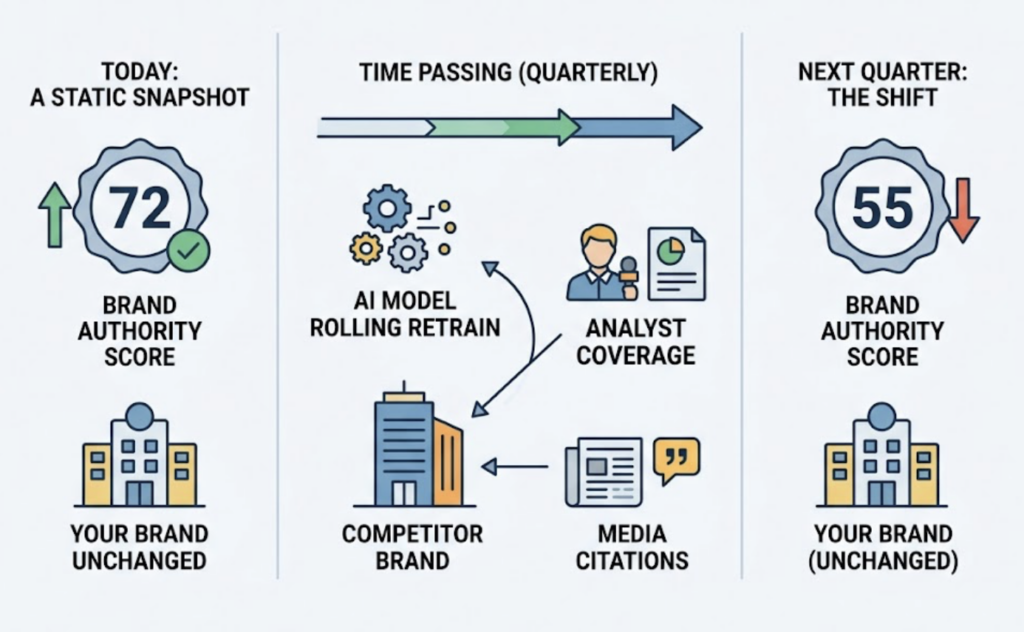
Your Brand Authority Checker results tell you where you stand right now. But AI models retrain, adjust their ranking signals, and shift recommendations on a rolling basis. A score of 72 today could drop to 55 next quarter without any change on your end, simply because a competitor published a wave of analyst coverage or earned new media citations.
Topify‘s platform picks up where the free tool leaves off. The Comprehensive GEO Analytics dashboard tracks your authority, sentiment, and visibility scores continuously across ChatGPT, Perplexity, Gemini, and Google AI Overviews. You’ll see trend lines, get alerts when scores shift, and receive specific recommendations for what to fix.
Here’s how the free check compares to the full platform:
| Capability | Free Brand Authority Checker | Topify Platform |
|---|---|---|
| Check frequency | One-time snapshot | Continuous daily/weekly monitoring |
| AI platforms covered | Aggregated score | Per-platform breakdown (ChatGPT, Perplexity, Gemini, AI Overviews) |
| Historical trends | None | Full trend history with alerts |
| Competitor tracking | Not included | Real-time competitor benchmarking |
| Action recommendations | General direction | Specific, one-click GEO optimization |
| Team collaboration | Single user | Unlimited team member seats |
Every plan starts with a 7-day free trial, no credit card required. The Starter plan begins at $99/month.
Conclusion
Clean energy brands are winning contracts, securing funding, and building market share based on how AI perceives their authority. The shift is already here: 73% of B2B buyers research with AI, and the brands that show up in those results capture a disproportionate share of pipeline.
Start with the Brand Authority Checker. In 60 seconds, you’ll know exactly how AI scores your brand across recognition, expertise, recommendation likelihood, and trust signals. From there, you can decide whether a one-time diagnostic is enough or whether continuous monitoring through Topify’s platform fits your growth strategy.
While you’re assessing your brand authority, a few other free checks can round out the picture. Topify‘s GEO Score Checker evaluates whether AI crawlers can properly access and index your site. The AI Visibility Report shows how often your brand gets mentioned across major AI platforms. And the Competitor Analysis tool reveals which clean energy brands AI favors in your category and why.
FAQ
Is the Brand Authority Checker free? Do I need to sign up?
Yes, it’s completely free. No signup, no credit card, no email required. Enter your brand name or domain at topify.ai/tools/brand-authority-checker and get your scores in under 60 seconds.
What’s the difference between the free tool and the Topify paid platform?
The free Brand Authority Checker gives you a one-time snapshot of your four authority scores. The Topify platform adds continuous monitoring, historical trends, per-platform breakdowns, competitor benchmarking, and actionable optimization recommendations. Plans start at $99/month with a 7-day free trial.
How often should clean energy brands check their AI visibility?
AI models update their training data and ranking signals regularly. A quarterly check with the free tool is a reasonable minimum. Brands in active procurement cycles or competitive markets benefit from weekly or daily monitoring through the full platform.
Why does my brand show up on ChatGPT but not Perplexity?
Each AI platform pulls from different data sources and applies different ranking logic. Only 11% of domains get cited on both ChatGPT and Perplexity. Your content structure, third-party citations, and entity signals may be optimized for one platform’s retrieval method but not another’s. The Brand Authority Checker gives an aggregated score, while the full platform shows per-platform visibility.

