

A VP of Sustainability opens ChatGPT and types: “Best carbon accounting platforms for mid-market companies.” The response lists five names. Your company, the one with SBTi-validated targets and a CDP A-rating, isn’t among them.
This scenario plays out across climate tech every day. Procurement leads, ESG analysts, and sustainability officers are using AI search to build vendor shortlists before they ever speak to a sales rep. If your brand doesn’t show up in those AI-generated answers, you’re not losing a ranking. You’re losing pipeline.
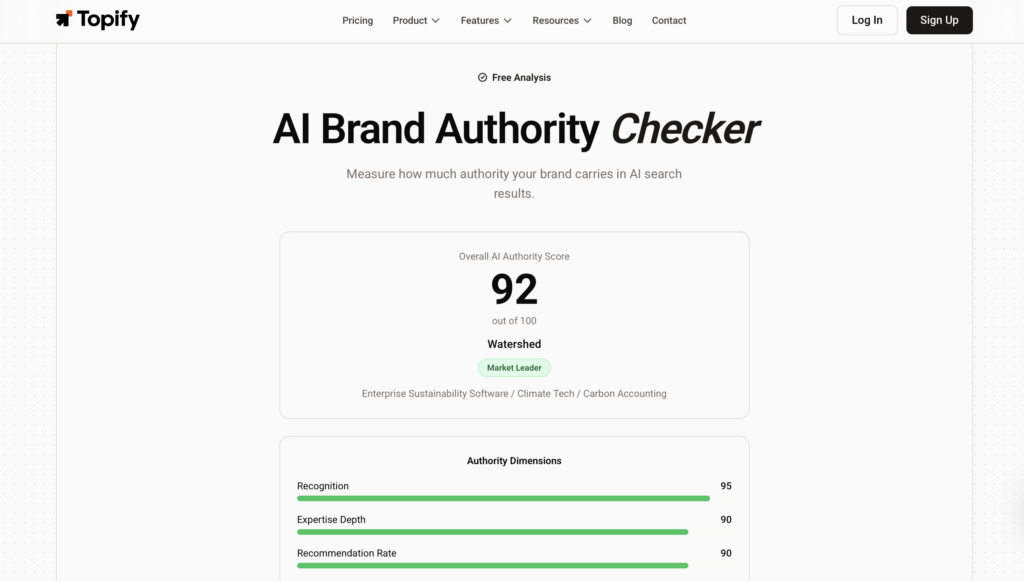
The gap between what your climate tech brand has earned and what AI models actually know about you is measurable. Topify‘s free Brand Authority Checker scores how AI platforms perceive your brand across four trust dimensions, giving you a concrete starting point instead of guesswork.
AI Brand Authority Checker
Greenwashing Fears Are Rewriting AI’s Trust Algorithm
Climate tech operates under a level of credibility scrutiny that most industries don’t face. A Stand.earth analysis of 154 climate-related claims found that 74% of statements about AI’s climate benefits lacked robust evidence. Only 26% cited peer-reviewed academic papers. That matters for your brand, even if you’re not making those specific claims.
Here’s the thing. AI models absorb the broader trust environment of an industry. When greenwashing allegations dominate climate tech discourse, the models become more selective about which brands they recommend. They lean toward companies with strong, verifiable third-party signals: academic citations, regulatory filings, independent audits, and consistent media coverage from credible outlets.
The European Commission found that 42% of green claims were exaggerated, false, or deceptive. That stat shapes how AI treats the entire sector. Your brand gets filtered through the same skepticism, regardless of whether your claims are legitimate.
This is the new baseline for climate tech visibility. Being good isn’t enough. You need AI to recognize that you’re good.
The Four Scores That Reveal Whether AI Trusts Your Climate Tech Brand
The Brand Authority Checker evaluates your brand across four dimensions. Each one maps to a specific trust signal that matters in climate tech buyer decisions.
| Authority Dimension | What It Means in Climate Tech | Low Score Signal | High Score Signal |
|---|---|---|---|
| Recognition | AI knows your category (carbon accounting vs. clean energy vs. climate adaptation) | AI confuses your brand with adjacent sectors or doesn’t mention you at all | AI correctly identifies your vertical, product category, and target market |
| Expertise Depth | AI perceives technical credibility in your domain | Generic descriptions, no mention of methodology or differentiation | AI references your proprietary approach, technical framework, or research |
| Recommendation Rate | Frequency of AI recommending you in relevant prompts | Brand absent from “best tools for…” or “top platforms for…” responses | Consistently named in category-specific recommendation prompts |
| Trust Signals | Third-party validation AI can verify | No certifications, awards, or independent coverage detected | AI references SBTi targets, CDP ratings, peer-reviewed studies, or analyst coverage |
To run your own check, enter your brand name and domain at the Brand Authority Checker. The tool returns scores for each dimension plus a breakdown of what AI models currently say about your brand.
Start by reading the Recognition score. If AI doesn’t even know what you do, the other three scores won’t matter. A carbon accounting platform that AI classifies as “a sustainability consulting firm” has a positioning problem that no amount of content can fix without first correcting the signal.
Then look at Trust Signals. This is where the certification gap becomes visible.
Your SBTi Targets and CDP Ratings Might Be Invisible to AI
Many climate tech brands carry serious credentials. SBTi-validated targets. CDP A-ratings. B Corp certification. ISO 14064 compliance. These are hard-won signals that buyers actively look for.
But AI models don’t always pick them up.
The disconnect happens because certifications live in PDFs, registry databases, and gated reports that AI crawlers can’t easily access or index. Your CDP score might be public, but if the structured data on your website doesn’t reference it in a way AI can parse, the model won’t include it when evaluating your authority.
This is the certification gap: a climate tech brand with strong third-party validation that scores lower than expected because the validation signals aren’t reaching AI models.
Here’s what typically causes it. Certifications are mentioned only in footer badges or image-based logos, not in crawlable text. Methodology pages sit behind login walls. Research partnerships and peer-reviewed publications link to paywalled journals without summarizing findings on your own domain. Awards and recognitions appear in press releases that expire from news indexes after a few months.
The fix isn’t complicated, but it does require deliberate action. Put your certifications in structured, crawlable HTML on key pages. Summarize your methodology in public-facing content. Reference your peer-reviewed work with enough context that an AI model can extract the claim without accessing the full paper.
What Climate Tech Buyers Are Asking AI Right Now
Understanding which prompts drive AI recommendations in your category is half the strategy. Climate tech buyers aren’t typing vague queries. They’re asking specific, procurement-oriented questions.
| AI Prompt | Buyer Intent | Authority Signal You Need |
|---|---|---|
| “Best carbon accounting software for Scope 3 reporting” | Vendor shortlisting for supply chain emissions | Expertise depth in Scope 3 methodology, integration partners |
| “Top climate risk platforms for asset managers” | Due diligence for investment decisions | Trust signals from financial analyst coverage, regulatory alignment |
| “Compare carbon credit verification tools” | Procurement evaluation for offset programs | Recognition in carbon markets, third-party audit references |
| “Which ESG reporting platforms support CSRD compliance” | Regulatory compliance tool selection | Expertise depth in EU regulatory frameworks, compliance track record |
| “Most trusted clean energy procurement platforms” | Enterprise clean energy sourcing | Recommendation rate in energy procurement prompts, case study references |
| “AI tools for climate adaptation planning” | Municipal or corporate resilience planning | Recognition in adaptation category, government or NGO partnerships |
Each prompt represents a moment where your brand either appears or doesn’t. The Brand Authority Checker’s Recommendation Rate score tells you how often AI includes your brand in these types of queries.
If your Recommendation Rate is low but your Expertise Depth is high, the problem is likely distribution, not substance. AI knows you’re credible but doesn’t associate you with the right buying prompts. That’s a content strategy issue, not a product issue.
On the flip side, if both scores are low, you’ve got a foundational authority problem. AI doesn’t know enough about your brand to recommend it in any context.
Turning a One-Time Check Into a Visibility Strategy
The Brand Authority Checker gives you a snapshot. It tells you where you stand right now across those four dimensions. For many climate tech brands, that snapshot alone is enough to identify the most urgent gap and take action.
But climate tech moves fast. New regulations (CSRD, SEC climate disclosure rules) shift what buyers search for. Competitor positioning changes quarterly. A single product launch or partnership announcement can move your authority scores in either direction.
That’s where a one-time check reaches its limit.
Topify’s Comprehensive GEO Analytics picks up where the free tool leaves off. It tracks your authority scores over time, shows trend lines, and alerts you when competitor brands gain ground in your category prompts.
| Capability | Free Brand Authority Checker | Topify Platform (GEO Analytics) |
|---|---|---|
| Authority score across 4 dimensions | One-time snapshot | Continuous tracking with historical trends |
| Competitor authority comparison | Not included | Real-time benchmarking against named competitors |
| Prompt-level visibility | Not included | Track which prompts mention your brand, and which don’t |
| Sentiment tracking | Not included | Monitor how AI describes your brand over time |
| Certification signal detection | Current state only | Track whether new certifications improve AI recognition |
| Alert system | Not included | Notifications when authority scores shift |
The platform starts at $99/month with a 7-day free trial, no credit card required. For climate tech brands tracking visibility across ChatGPT, Perplexity, Gemini, and Google AI Overview, it consolidates what would otherwise be manual prompt-by-prompt checking into a single dashboard.
You can start a free trial to see how your authority scores trend over the first week.
Conclusion
Climate tech brands face a trust filter that most industries don’t. Greenwashing concerns have made AI models more cautious about recommending companies in this space, which means your certifications, methodology, and third-party validation need to be visible to AI, not just to human reviewers.
Start with the Brand Authority Checker. Run your brand, read the four scores, and identify which dimension needs the most attention. If Recognition is the gap, your positioning signals need work. If Trust Signals are low, your certifications aren’t reaching AI models.
Two other free tools worth running alongside it: the GEO Score Checker evaluates whether AI crawlers can technically access your site, and the AI Visibility Report shows how often your brand gets mentioned across major AI platforms. Together, the three tools give you a full picture of your climate tech brand’s AI visibility in under ten minutes.
The brands that win in climate tech aren’t just the ones doing the best science. They’re the ones whose science is visible where buyers are looking, and increasingly, buyers are looking in AI.
FAQ
How do AI models decide which climate tech brands to recommend?
AI models pull from a mix of signals: structured website data, third-party mentions, media coverage, academic citations, and user reviews. In climate tech specifically, trust signals carry extra weight because the industry faces heightened greenwashing scrutiny. Brands with verifiable certifications, consistent expert coverage, and clear technical differentiation tend to score higher in AI recommendations than brands relying on self-reported claims alone.
Does having SBTi or CDP certification automatically improve my AI visibility?
Not automatically. Certifications improve AI visibility only if the signals are accessible to AI crawlers. If your SBTi validation lives in a PDF badge or your CDP score appears only in a gated annual report, AI models likely won’t detect them. You’ll need to surface these credentials in crawlable HTML on your homepage, about page, and product pages. The Brand Authority Checker can show whether AI currently recognizes your certifications under the Trust Signals dimension.
Which climate tech subcategories have the strongest AI visibility right now?
Carbon accounting and ESG reporting platforms tend to have the highest AI visibility because buyer search volume in those categories is large and growing, driven by regulatory pressure from CSRD and SEC disclosure rules. Climate adaptation, carbon credit verification, and clean energy procurement platforms often have lower AI visibility despite strong product-market fit. Running an AI Visibility Report for your brand can show exactly where you stand relative to your specific subcategory.
How often should a climate tech brand check its AI authority scores?
A quarterly check with the free Brand Authority Checker is a reasonable starting cadence. That said, if your company is going through a major event, like closing a funding round, launching a new product, publishing research, or earning a new certification, check within two to four weeks after the event to see if AI models have picked up the signal. For continuous monitoring, Topify’s platform tracks score changes automatically.
Can a small climate tech startup compete with established brands in AI search?
Yes, but through a different path. Startups rarely win on Recognition or Recommendation Rate early on. The faster lever is Expertise Depth. If you publish detailed methodology content, contribute to open-source climate data projects, or co-author research with credible institutions, AI models can pick up those signals quickly. A startup with two peer-reviewed papers and a well-structured technical blog can outscore a larger competitor that relies on brand awareness but has thin public-facing content.
Does AI treat “clean energy” and “climate tech” as the same category?
Not always. AI models often distinguish between subcategories like clean energy infrastructure, carbon management software, climate risk analytics, and sustainability consulting. If your brand spans multiple subcategories, AI might struggle to classify you accurately, which drags down your Recognition score. Use the Brand Authority Checker to see how AI currently categorizes your brand, and adjust your positioning signals if the classification doesn’t match your core market.
Read More:

