

A car owner asked ChatGPT, “What are the best aftermarket brake pads for a 2021 Honda Civic?” The AI listed five brands. Yours wasn’t one of them. Your pads have 50,000 verified installs, 4.7-star reviews across major retailers, and full ACES fitment coverage. None of that mattered, because AI didn’t recognize your brand as authoritative in the category.
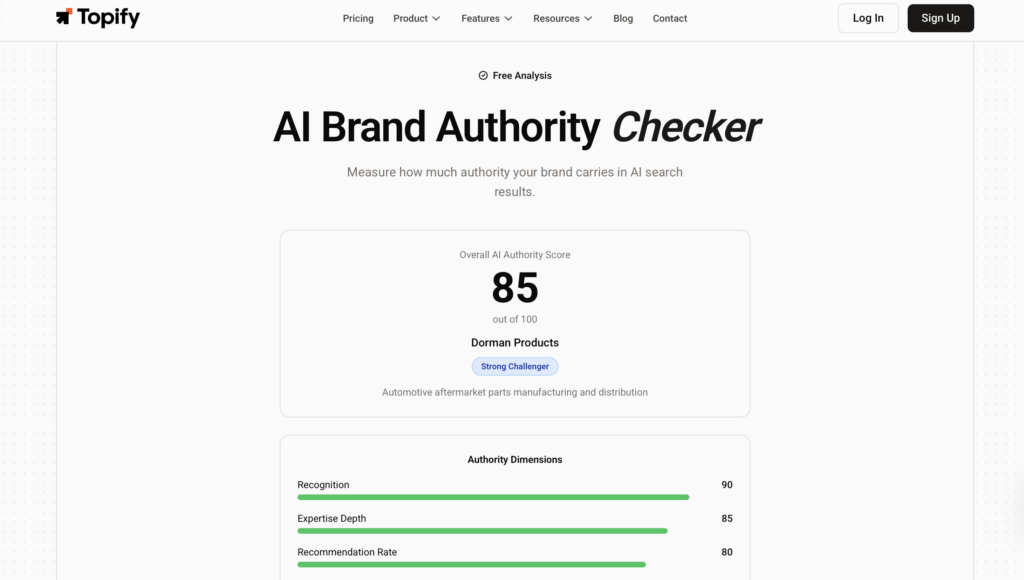
The gap is measurable, and the check takes 60 seconds. Topify‘s Brand Authority Checker scores how AI models perceive your aftermarket brand’s authority across four dimensions that directly affect whether you get recommended. ✅ Free ⚡ Results in under a minute.
AI Brand Authority Checker
The Four Trust Scores That Decide If AI Recommends Your Aftermarket Brand
The aftermarket parts business runs on trust. Buyers need to believe your non-OEM part will perform, fit, and last. AI search engines apply that same trust logic when deciding which brands to recommend. The Brand Authority Checkerbreaks that logic into four measurable scores.
What Each Score Means for Aftermarket Brands
Each metric maps to a specific challenge aftermarket companies face in AI-generated answers.
| Metric | What It Measures | What It Means for Aftermarket Brands |
|---|---|---|
| Recognition (0-100) | How often AI identifies your brand in your category | Below 40: AI doesn’t associate you with your parts category (e.g., suspension, filters, exhaust) |
| Expertise Depth (0-100) | How well AI understands your capabilities | Below 50: AI may confuse your product line, list wrong fitment data, or miss key certifications |
| Recommendation Rate (0-100) | How often AI recommends you vs. alternatives | Below 30: buyers asking “best aftermarket [part] for [vehicle]” will never see your name |
| Trust Signals (0-100) | External validation AI detects (reviews, media, citations) | Below 40: AI can’t find enough third-party evidence that your parts perform as claimed |
An aftermarket brand with a Recognition score of 80 but a Trust Signals score of 25 has a clear diagnosis: AI knows your brand exists but doesn’t trust it enough to recommend over OEM or better-cited competitors. That’s a gap you can close once you know it’s there.
Where Aftermarket Brands Typically Get Flagged
Three scenarios show up repeatedly when aftermarket companies run their first authority check.
Scenario 1: High reviews, low recognition. You have thousands of positive ratings on Amazon and RockAuto, but AI doesn’t associate your brand with the correct parts category. This often happens when product pages lack structured data that AI crawlers can parse.
Scenario 2: Strong expertise, weak trust signals. AI understands what you make and which vehicles your parts fit, but it can’t find enough third-party validation. Installer forums, independent review sites, and trade publications carry heavy weight here.
Scenario 3: Brand confusion. AI mixes up your brand with a similarly named company or attributes a competitor’s recall to your product line. The Expertise Depth score is the first place this shows up.
How to Run Your Check
Go to Brand Authority Checker, enter your brand name or domain, and get your four-dimensional authority breakdown in under 60 seconds. No signup, no credit card required. Start with your primary brand, then run each sub-brand or product line separately if you operate across multiple aftermarket categories.
What Aftermarket Buyers Actually Ask AI (And Whether Your Brand Shows Up)
The shift from Google keyword searches to AI conversations changes what aftermarket buyers expect. A traditional search for “best air filter 2022 F-150” returns links. An AI query returns a recommendation, often with only two or three brand names. If your brand isn’t in that shortlist, you don’t get a second chance.
Here’s what those prompts look like in practice:
| AI Prompt Example | Platform | Search Intent | What It Reveals |
|---|---|---|---|
| “Best aftermarket brake pads for daily driving a 2020 Camry” | ChatGPT | Purchase decision | Whether AI recommends your brand for common vehicle/use-case combos |
| “Are aftermarket suspension kits safe for highway driving?” | Perplexity | Trust verification | How AI describes aftermarket quality and which brands it cites as trustworthy |
| “OEM vs aftermarket catalytic converter, which lasts longer?” | Gemini | Comparative research | Whether your brand gets mentioned in the OEM vs aftermarket debate |
| “Cheapest reliable aftermarket headlights for a 2019 Tacoma” | ChatGPT | Price-sensitive purchase | If AI considers your brand a value leader with acceptable quality |
| “What aftermarket parts should I avoid putting on my car?” | Perplexity | Risk assessment | Whether AI names your category or brand in a negative context |
These aren’t hypothetical. Adobe’s Q1 2026 data showed AI-referred traffic to retail sites grew 393% year over year. A Capgemini report found roughly two-thirds of millennials and Gen Z have replaced traditional search engines with AI tools for product recommendations. The aftermarket isn’t exempt from this shift.
Three Dynamics Reshaping Aftermarket AI Visibility
AI Is Replacing the “Ask Your Mechanic” Recommendation
For decades, aftermarket brand loyalty followed a simple path: a trusted mechanic or installer recommended a brand, and the vehicle owner bought it. That loop is breaking. Buyers now verify recommendations with AI before committing, and many skip the mechanic entirely for parts they plan to install themselves.
Here’s the thing: AI doesn’t recommend brands the way a mechanic does. A mechanic draws on years of hands-on experience. AI draws on web content, structured data, user reviews, and third-party citations. If your brand has strong relationships with installers but weak digital authority signals, you’ll score well in the shop and poorly in ChatGPT.
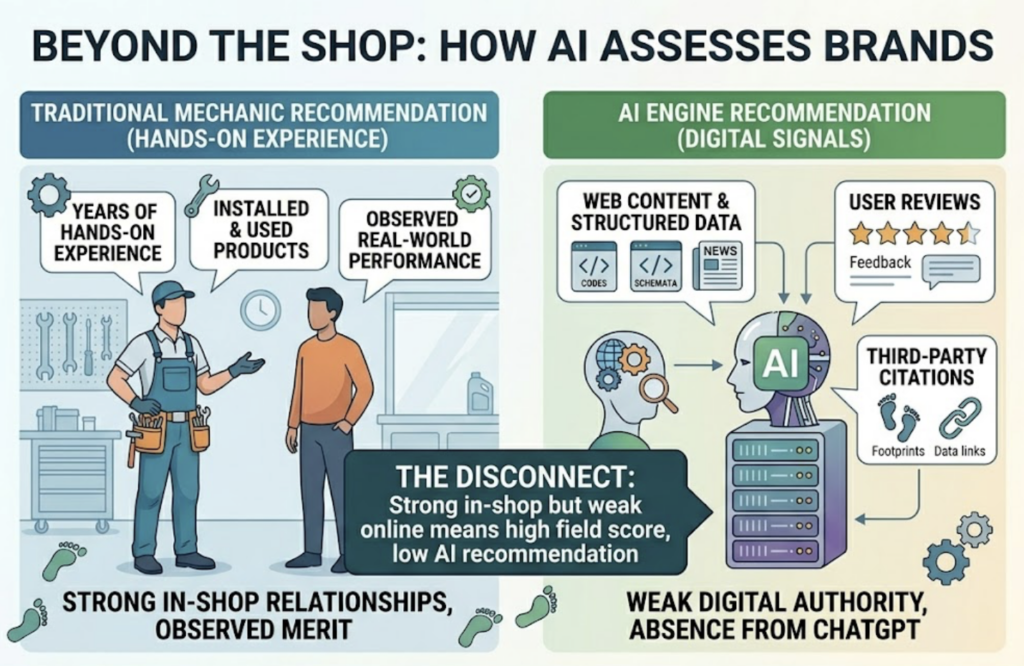
The Brand Authority Checker’s Recommendation Rate score tells you exactly where you stand in this new dynamic. A score below 30 means AI is actively choosing other brands over yours in purchase-intent prompts.
Small Aftermarket Brands Can Compete Through AI Visibility
One of the clearest signals from recent data: AI search doesn’t automatically favor the biggest brands. A case study published in May 2026 documented an aftermarket retailer that grew AI referral revenue by 344% in six months. The company started with under 1% AI visibility across 100 commercial-intent prompts. Six months later, they appeared in over 20% of tracked prompts.
The company’s marketing manager put it directly: “They took a small brand like ours and put us in the same arena as brands 10 to 20x our size.”
This matters for every mid-size aftermarket brand watching larger competitors dominate traditional search. AI recommendations are still forming. The brands that establish authority signals now, before the channel fully matures, will hold structural advantages as AI search volume scales.
Fitment Data Is the Hidden Threshold for AI Recommendations
Aftermarket parts have a complexity layer that most product categories don’t: vehicle-specific fitment. A shopper asking AI for “best aftermarket control arms for a 2018 Jeep Wrangler JL” expects the AI to return parts that actually fit that exact vehicle. If your product data doesn’t include machine-readable fitment information, AI can’t confidently recommend you.
The Auto Care Association released ACES 5.0 and PIES 8.0 in 2026, specifically designed as machine-readable XML standards for exchanging fitment and product data. That phrase, “machine-readable,” signals where the industry is heading. AI shopping agents, including Google’s Universal Commerce Protocol, need structured fitment data to make accurate recommendations.
Your Brand Authority Checker’s Expertise Depth score reflects this directly. A low score often traces back to incomplete or unstructured product data that AI can’t parse into accurate fitment conclusions.
From a One-Time Check to Ongoing AI Visibility Tracking
Your Brand Authority Checker results show you where you stand today. But AI models update their training data, adjust ranking signals, and shift recommendations continuously. A score of 72 this month could drop to 55 next quarter without any change on your end, simply because a competitor improved their authority signals or a model update re-weighted its trust criteria.
Topify‘s platform picks up where the free tool leaves off. The Comprehensive GEO Analytics dashboard tracks your authority, sentiment, and visibility scores continuously across ChatGPT, Perplexity, Gemini, and Google AI Overviews. You’ll see trend lines, get alerts when scores shift, and receive specific recommendations for what to fix.
Here’s how the free check compares to the full platform:
| Capability | Free Brand Authority Checker | Topify Platform |
|---|---|---|
| Check frequency | One-time snapshot | Continuous daily/weekly monitoring |
| AI platforms covered | Aggregated score | Per-platform breakdown (ChatGPT, Perplexity, Gemini, AI Overviews) |
| Historical trends | None | Full trend history with alerts |
| Competitor tracking | Not included | Real-time benchmarking against aftermarket rivals |
| Action recommendations | General direction | Specific, data-driven GEO optimization steps |
| Team collaboration | Single user | Multi-seat access for marketing and product teams |
Every plan starts with a 7-day free trial, no credit card required. The Starter plan begins at $99/month.
Conclusion
AI search is now part of how aftermarket buyers discover, evaluate, and choose parts brands. The brands that show up in AI recommendations aren’t necessarily the biggest or the oldest. They’re the ones with the strongest authority signals in the places AI actually looks.
Start with a single check. Run your aftermarket brand through the Brand Authority Checker and see where AI ranks your recognition, expertise, recommendation rate, and trust signals. That baseline tells you exactly what to fix and where to focus.
While you’re assessing your brand authority, a few other free checks can round out the picture. Topify’s GEO Score Checker evaluates whether AI crawlers can actually access and parse your site’s product and fitment data. The AI Visibility Report shows how often your brand gets mentioned across major AI platforms. And the Competitor Analysistool reveals which aftermarket brands AI considers your direct rivals and where they outperform you.
FAQ
Is the Brand Authority Checker really free? Do I need to create an account?
Yes, the tool is completely free with no registration required. Enter your brand name or domain, and you’ll get your four-dimension authority breakdown in under 60 seconds.
What’s the difference between the free tool and the Topify platform?
The free Brand Authority Checker gives you a one-time snapshot of your current authority scores. The Topify platform provides continuous monitoring across multiple AI engines, historical trend data, competitor benchmarking, and specific action recommendations to improve your scores over time.
How often should an aftermarket brand check its AI visibility?
At minimum, run a free check monthly. AI models update their training data and recommendation logic on rolling schedules, and aftermarket is a category where new product releases, fitment updates, and seasonal demand shifts can change your visibility quickly. For ongoing protection, continuous monitoring through the platform is the more reliable approach.
Does fitment data quality actually affect AI recommendations?
Directly. AI shopping agents need structured, machine-readable product data (including ACES/PIES-compliant fitment information) to make accurate vehicle-specific recommendations. Brands with incomplete or poorly structured fitment data often see low Expertise Depth scores, which means AI either skips them or risks recommending the wrong part for a given vehicle.

