

Car Buyers Ask AI for Dealer Recommendations. Your Dealership Might Not Like the Answer.
A first-time buyer typed into ChatGPT: “Best Honda dealer near me with honest pricing and good service reviews.” Five dealerships came back. Yours, with 600 Google reviews and a 4.8-star average, wasn’t one of them. The problem isn’t your reputation. It’s that AI built a different version of it.
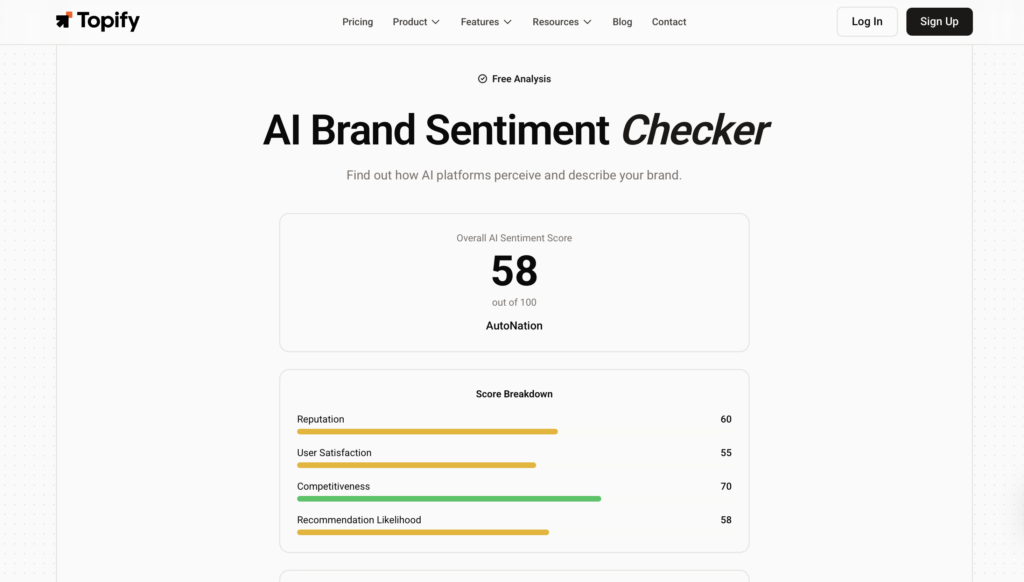
You can see that version right now. Topify‘s Brand Sentiment Checker analyzes how AI models describe your dealership’s strengths, weaknesses, and overall sentiment, then surfaces the specific language AI uses when buyers ask about you.
✅ Free ⚡ Full sentiment breakdown in seconds 🔒 No signup required
AI Brand Sentiment Checker
What AI Actually Says About Your Dealership (And Where It Gets Its Data)
Your Google Business Profile tells one story. AI tells another. The gap between the two is where you’re losing buyers who never call, never visit, and never show up on your CRM.
The Brand Sentiment Checker breaks AI’s perception of your dealership into measurable dimensions. Here’s what each one means in automotive terms.
Three Scores That Determine Whether AI Trusts Your Dealership
| Sentiment Dimension | What It Measures | What It Means for Your Dealership |
|---|---|---|
| Overall Sentiment (Positive / Neutral / Negative) | The net tone AI uses when describing your brand | Negative sentiment = AI actively steers buyers away with language like “mixed reviews” or “some complaints” |
| Strengths Identified | Specific positives AI associates with your dealership | Missing strengths = AI doesn’t mention your certified pre-owned program, financing options, or service quality |
| Weaknesses Surfaced | Specific negatives AI pulls from reviews, forums, news | Outdated weaknesses = AI still references a complaint from 2022 that you resolved two years ago |
A dealership with strong overall sentiment but zero identified strengths has a visibility gap. AI knows you exist but can’t articulate why a buyer should choose you. That’s a fixable problem, and now you can see exactly where the language breaks down.
Two Scenarios Every Dealer Should Check For
Scenario 1: The ghost complaint. Your service department had a string of negative Yelp reviews in 2021 after a staffing shortage. You’ve since hired a new service director, cut wait times by 40%, and earned hundreds of positive reviews. But when a buyer asks Perplexity “Is [your dealership] service department reliable?”, the AI response still references “some customers report long wait times.” The sentiment check surfaces this exact language so you know what to fix in your content strategy.
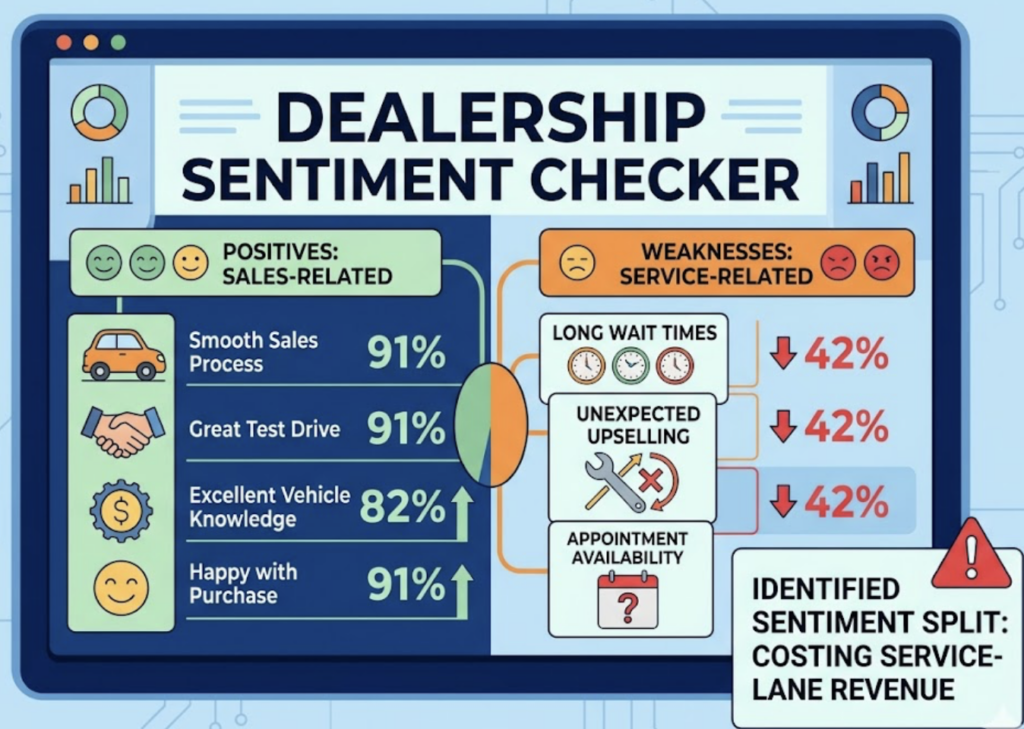
Scenario 2: The split reputation. AI treats your sales floor and your service lane as separate entities. Your sales team gets described as “knowledgeable and low-pressure.” Your service department gets tagged with “upselling concerns.” In traditional SEO, these blend into one star rating. In AI search, they’re distinct sentiment signals that show up in different types of buyer queries. The Brand Sentiment Checker reveals this split so you can address each one independently.
How to Run Your Dealership’s Sentiment Check
The process takes about 60 seconds.
Go to the Brand Sentiment Checker and enter your dealership name or domain. The tool scans how AI models currently describe your brand and returns a full sentiment breakdown: overall tone, specific strengths AI recognizes, and specific weaknesses AI surfaces. No account needed, no credit card, no data collected.
Once you have your results, compare the strengths and weaknesses against what you’d actually want a buyer to hear about your dealership. The gap between those two lists is your optimization roadmap.
The AI Prompts Your Buyers Are Already Typing
Thirty percent of car buyers now use AI tools during their vehicle research. Among those who do, 68.4% use ChatGPT as their primary research tool. They’re not typing keywords. They’re asking full questions, and each question triggers a different type of AI evaluation.
| AI Prompt Example | Platform | Search Intent | What It Reveals About Your Dealership |
|---|---|---|---|
| “Best Toyota dealer near me with good reviews” | ChatGPT | Purchase decision | Whether AI recommends you or a competitor |
| “Is [dealership name] trustworthy?” | Perplexity | Trust verification | The exact sentiment language AI uses about you |
| “Best dealership for first-time car buyers in [city]” | Gemini | Niche match | Whether AI associates you with specific buyer segments |
| “Which dealer has the best service department in [area]?” | ChatGPT | Service loyalty | How AI separates your service reputation from sales |
| “[Dealership] vs [competitor] reviews” | Perplexity | Competitive comparison | Where AI ranks your sentiment against alternatives |
| “Best financing deals at car dealerships near me” | Google AI Overview | Financial decision | Whether AI links your name to competitive financing |
| “Honest used car dealers [city] Reddit” | Perplexity | Social proof | What Reddit threads AI pulls your name from |
Here’s the thing. Eighty-four percent of dealership websites score below 60 out of 100 on AI visibility tests, and 48% actively block AI crawlers. That means nearly half the industry is invisible to the systems their buyers are already using.
Five-Star Google Rating, Three-Star AI Reputation: Why the Gap Exists
AI’s Sentiment Data Doesn’t Come From Where You Think
Most dealer principals assume their Google review score is their reputation. In AI search, it’s one input among many. ChatGPT leans on business listings for nearly half its local source citations. Perplexity pulls heavily from Reddit and community forums. Gemini prioritizes official website content.
That means a single unresolved Reddit thread from 2023 can carry more weight on Perplexity than 200 five-star Google reviews. A dealership that invested heavily in Google review management but ignored forum mentions and social sentiment is optimized for one channel and invisible, or worse, negatively represented, on the others.
The Brand Sentiment Checker exposes these hidden signal sources. If AI lists “pushy sales tactics” as a weakness but your last 300 Google reviews say otherwise, you’ve found the disconnect. The negative signal is likely coming from an older forum post or news mention that AI hasn’t deprioritized.
Your Service Drive and Your Showroom Have Separate AI Reputations
This is something most dealerships don’t realize. When a buyer asks “best place to buy a car in [city],” AI evaluates sales-related sentiment. When they ask “reliable dealership for oil changes near me,” AI evaluates service sentiment separately.
A dealership can have excellent sales sentiment and terrible service sentiment. Or the reverse. In a traditional Google search, both blend into your aggregate star rating. In AI search, they’re separate answers to separate questions.
Run your dealership through the sentiment checker and look specifically at the weaknesses section. If the negatives cluster around service-related language (wait times, upselling, appointment availability) while the positives are all sales-related, you’ve identified a sentiment split that’s costing you service-lane revenue.
A Negative AI Sentiment Tag Costs More Than a Bad Google Review
When someone reads a one-star Google review, they also see your 4.8-star average and your management response. They have context. They make their own judgment.
AI doesn’t work that way.
When a buyer asks ChatGPT for a recommendation and your dealership comes back with “some customers report concerns about transparency in pricing,” that’s a verdict. There’s no star average next to it. No management response. No context. Ninety-seven percent of AI users say AI will influence their purchase decisions. A negative sentiment tag in an AI answer eliminates you from consideration before the buyer ever reaches your website.
That’s why knowing your AI sentiment profile isn’t optional anymore. It’s the difference between being recommended and being filtered out.
One Sentiment Snapshot Isn’t Enough When AI Updates Every Week
The Brand Sentiment Checker gives you a clear picture of where you stand today. But AI models ingest new data continuously. A viral Reddit post next month, a local news story next quarter, or a competitor’s content campaign next week can shift how AI describes your dealership overnight. One check is a diagnosis. Staying visible requires ongoing monitoring.
Topify‘s Comprehensive GEO Analytics dashboard picks up where the free tool leaves off. It tracks your sentiment, visibility, and authority scores continuously across ChatGPT, Perplexity, Gemini, and Google AI Overviews, with trend lines, alerts when scores shift, and specific recommendations for what to address next.
Here’s how the free check compares to the full platform:
| Capability | Free Brand Sentiment Checker | Topify Platform |
|---|---|---|
| Check frequency | One-time snapshot | Continuous daily/weekly monitoring |
| AI platforms covered | Aggregated sentiment | Per-platform breakdown (ChatGPT, Perplexity, Gemini, AI Overviews) |
| Historical trends | None | Full trend history with shift alerts |
| Competitor sentiment tracking | Not included | Real-time competitor benchmarking |
| Actionable next steps | Manual interpretation | Specific, prioritized optimization recommendations |
| Team access | Single user | Unlimited team member seats |
Every plan starts with a 7-day free trial, no credit card required. The Starter plan begins at $99/month.
Conclusion
AI is already shaping which dealerships get foot traffic and which get overlooked. Thirty percent of buyers use AI during research, and that number is climbing. Your reputation in AI search is a measurable, trackable metric now, not a guess.
Start with the Brand Sentiment Checker to see exactly how AI describes your dealership today. From there, build a monitoring routine that catches shifts before they cost you leads.
While you’re at it, a few other free checks can round out the picture. Topify‘s GEO Score Checker evaluates whether AI crawlers can actually access your website, which matters when 48% of dealerships accidentally block them. The AI Robots Checker scans your robots.txt to flag exactly which AI bots you’re allowing or blocking. And the Prompts Researcher reveals the specific questions car buyers are asking AI in your market.
FAQ
Is the Brand Sentiment Checker really free? Do I need to create an account?
Yes, it’s completely free. No account, no signup, no credit card. Enter your dealership name or domain, and you’ll get your full sentiment breakdown in under a minute.
What’s the difference between the free tool and the Topify paid platform?
The free tool gives you a one-time sentiment snapshot. The Topify platform provides continuous monitoring across all major AI platforms, historical trend tracking, competitor benchmarking, and prioritized optimization recommendations. Plans start at $99/month with a free 7-day trial.
How often should a dealership check its AI visibility?
At minimum, monthly. AI models update frequently, and external events (a new Reddit thread, a local news story, a competitor’s content push) can shift your sentiment profile without warning. Dealerships in competitive markets should consider weekly monitoring through the Topify platform.
Can AI really send buyers to a competing dealership based on sentiment alone?
Yes. When a buyer asks ChatGPT “best dealer near me,” AI synthesizes sentiment from reviews, forums, and web content to build its recommendation list. If your dealership has weaker AI sentiment than a competitor, even if your Google rating is higher, AI will recommend the competitor. The buyer never sees your listing, your reviews, or your response to any complaint.

