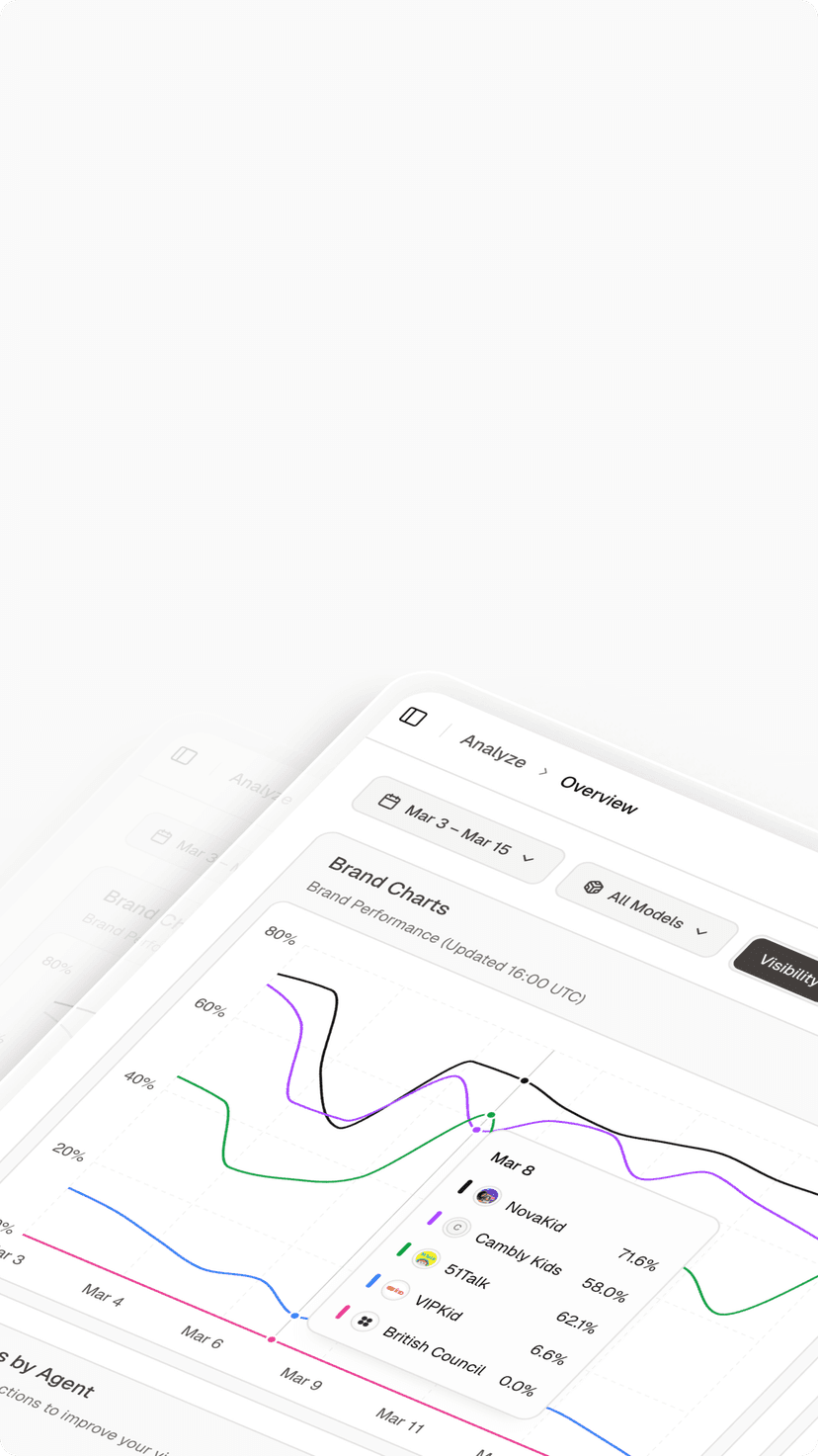

Run the same brand through three AI visibility checkers and you’ll get three different numbers. One says 72. Another says 41. A third says 88. None of them explains why, and none of them agrees on what “visible” even means. Your keyword rankings and domain authority won’t help you here, because they weren’t built to measure what ChatGPT decides to say. When leadership asks for a single, defensible number, you’re stuck defending a black box.
The problem isn’t the score. It’s that most scores have no system behind them, no consistent sampling, no benchmark, no way to trace a number back to an actual AI answer. Once you understand what a real AI visibility score system measures, the three-conflicting-numbers problem disappears.
A Score Without a System Is Just a Number
An AI visibility score system is not a single metric. It’s a four-layer architecture: a fixed prompt universe (typically 100+ buyer-intent queries relevant to your category), multi-engine sampling across ChatGPT, Gemini, Perplexity, and DeepSeek, a weighted scoring logic that balances frequency, sentiment, and position, and a benchmarking layer that normalizes your score against named competitors.
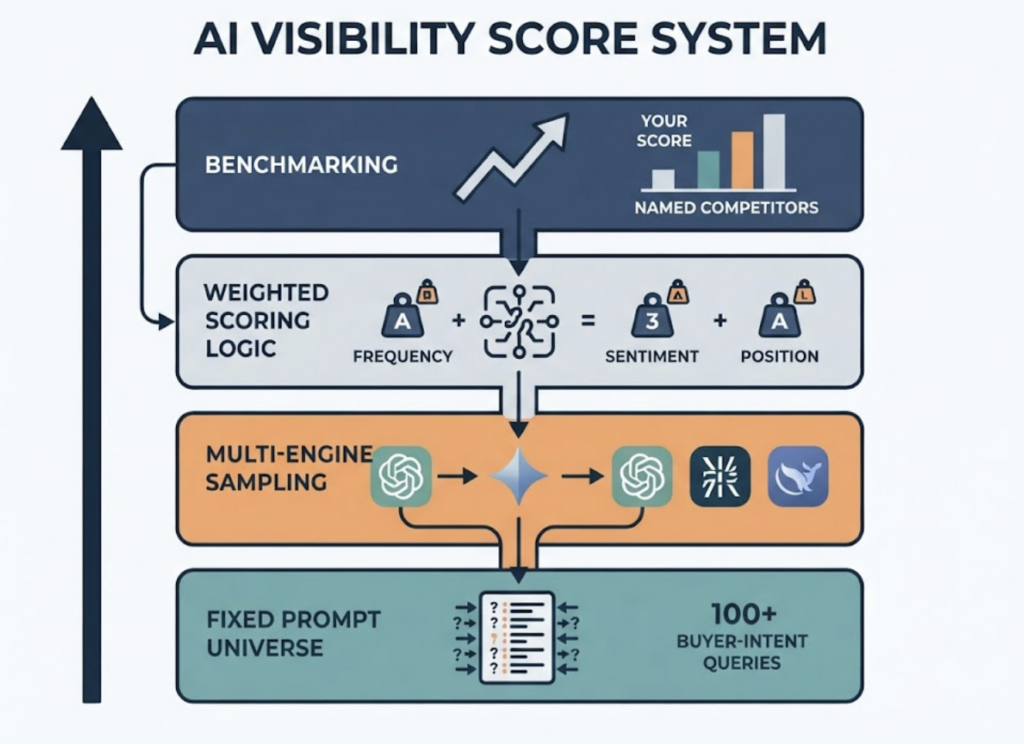
Strip away any one of those layers and the number stops meaning anything. A score built on ad-hoc queries can’t be reproduced next week. A score sampled from one engine ignores where half your buyers actually ask questions. A score without competitor context can’t tell you whether 62 is winning or losing.
Volatility makes the system layer non-negotiable. AI citation patterns shift weekly, and the recency bias is measurable: content updated within the last 90 days earns a 3.2x citation multiplier, and 76.4% of ChatGPT’s most-cited pages were updated within the past 30 days, according to 2026 citation research. A scoring system that refreshes monthly is reporting history, not visibility.
That’s why two tools can score the same brand 41 and 88 in the same week. Different prompt universes, different sampling cadence, different math.
The Seven Metrics an AI Visibility Score System Should Track
A composite score only becomes actionable when you can decompose it. In practice, a professional-grade system tracks seven dimensions, each answering a distinct business question.
| Metric | Business Question | How It’s Measured |
|---|---|---|
| Visibility Rate | Are we appearing in the answer at all? | Multi-engine prompt sampling |
| Mention Frequency | How often do we capture buyer intent? | Historical trend analysis |
| Position | Are we the first recommendation or an afterthought? | Entity recognition and rank scoring |
| Sentiment | How is the brand being framed? | NLP tone classification |
| Citation Share | Are we the source AI actually cites? | Domain and URL attribution |
| Prompt Volume | Which high-intent queries are we missing? | Buyer-intent prompt mapping |
| Conversion Signal | Do mentions drive clicks and leads? | Integrated attribution data |
The separation between these metrics matters more than most teams expect. A brand can hold strong Google rankings and still be invisible in AI answers: up to 80% of AI citations don’t rank in Google’s top 10 organic results for the same query, based on SparkToro’s 2026 attribution studies. Visibility Rate and Citation Share measure something your SEO dashboard structurally cannot see.
Benchmarks give the composite number context. Per Foglift’s Q1 2026 industry data, top-quartile SaaS and B2B performers score between 73 and 84 on a 100-point scale. If your score sits at 62 with no benchmark attached, you don’t know whether to celebrate or panic.
Tool, Dashboard, or Platform: Why the Naming Actually Matters
The market uses AI visibility score tool, software, platform, and solution almost interchangeably. The labels actually map to three distinct capability tiers, and buying the wrong tier is the most common procurement mistake in this category.
| Tier | What It Does | Where It Breaks Down |
|---|---|---|
| The Checker (tool) | One-off, single-query spot checks | High volatility, statistically insignificant, can’t support strategy |
| The Reporter (dashboard) | Aggregates and visualizes score data over time | Shows what changed, rarely explains why or what to do |
| The System (platform / solution) | Persistent monitoring, competitor benchmarking, source attribution, execution | Higher cost, requires workflow integration |
A spot-check tool has real uses. It’s how most teams first discover they have an AI visibility problem, and it costs nothing to run. But a single query against a probabilistic model is one dice roll. Ask the same question tomorrow and the answer may change.
An AI visibility score dashboard solves the reporting problem. It won’t solve the strategy problem, because a visualization layer without source-gap analytics can show you a 12-point drop without ever telling you which citation you lost.
Here’s the pattern that repeats across enterprise buying cycles: teams search for a tool, then discover their actual requirement is a system. The moment someone asks “why did the score change” or “what do we do about it,” they’ve outgrown the checker tier. AI visibility score analytics only pays for itself when the data connects to an action.
Five Checks Before You Trust Any AI Visibility Score
Before committing to any AI visibility score software, run it against five credibility benchmarks.
1. Engine coverage. Does it sample the models your customers actually use? A platform that only tracks ChatGPT misses Gemini’s integration with Google’s ecosystem and Perplexity’s research-heavy user base. If your market includes China or developer audiences, DeepSeek coverage stops being optional.
2. Sample stability. Is the score built on a consistent, high-volume prompt set, or on whatever queries happened to run that week? Unstable samples produce scores that swing 20 points with no underlying change in your visibility.
3. Explainability. Can you click into a score and see the exact AI answers, citations, and sentiment classifications that produced it? If the vendor can’t show the receipts, the number is marketing, not measurement.
4. Competitive relative-scoring. Raw scores mislead. A 55 in a category where your top rival scores 40 is a different situation than a 55 against a rival at 80. Normalization against named competitors is what turns a metric into intelligence.
5. Actionability loop. The system should close the distance between diagnosis and fix, telling you, for instance, that adding structured data to your pricing page would recover visibility on “vs” queries. This one compounds: brands with full answer-engine schema score on average 23 points higher on visibility benchmarks than those relying on standard SEO metadata, so a system that surfaces schema gaps is pointing at your highest-leverage fix.
Fail any one of the five and the score becomes something worse than useless. It becomes confidently wrong.
How Topify Turns Seven Metrics into One Actionable Score
For teams that need the full system rather than a spot-check, Topify maps almost one-to-one onto the architecture above. Its Comprehensive GEO Analytics tracks the same seven dimensions covered earlier, visibility, sentiment, position, volume, mentions, intent, and CVR, across ChatGPT, Gemini, Perplexity, DeepSeek, Doubao, Qwen, and other major engines. In practice, that means you can spot a drop in ChatGPT mentions, trace it to a specific domain that stopped citing your brand, and see which competitor picked up that citation, all inside the same view.
The competitor layer runs continuously rather than on demand. Dynamic Competitor Benchmarking detects emerging rivals as AI engines start recommending them, so your relative score stays normalized against the market as it exists this week, not the one you defined at onboarding.
Where Topify diverges from dashboard-tier products is the execution loop. Instead of exporting a gap report for someone to act on later, its One-Click Execution takes a plain-English goal, proposes a strategy, and deploys it after your review. The distance from “score dropped” to “fix shipped” is a single approval.
Pricing starts at $99 per month for 100 tracked prompts and 9,000 AI answer analyses, with plan details here. You can get started with a 30-day trial to establish a baseline before committing.
Platforms like Profound and Peec AI compete in the same monitoring space, and both handle multi-engine tracking competently. The trade-off tends to appear at the execution stage, where most tools stop at data and hand the fixing back to your team.
What a Visibility Score Looks Like in a Niche Market
Vertical markets change the math. In veterinary care, prompts like “emergency vet near me” are low-volume but extremely high-intent, and AI answers are driven heavily by entity signals: Google Business Profile accuracy, local review sentiment, and answer-first content such as clearly stated emergency hours.
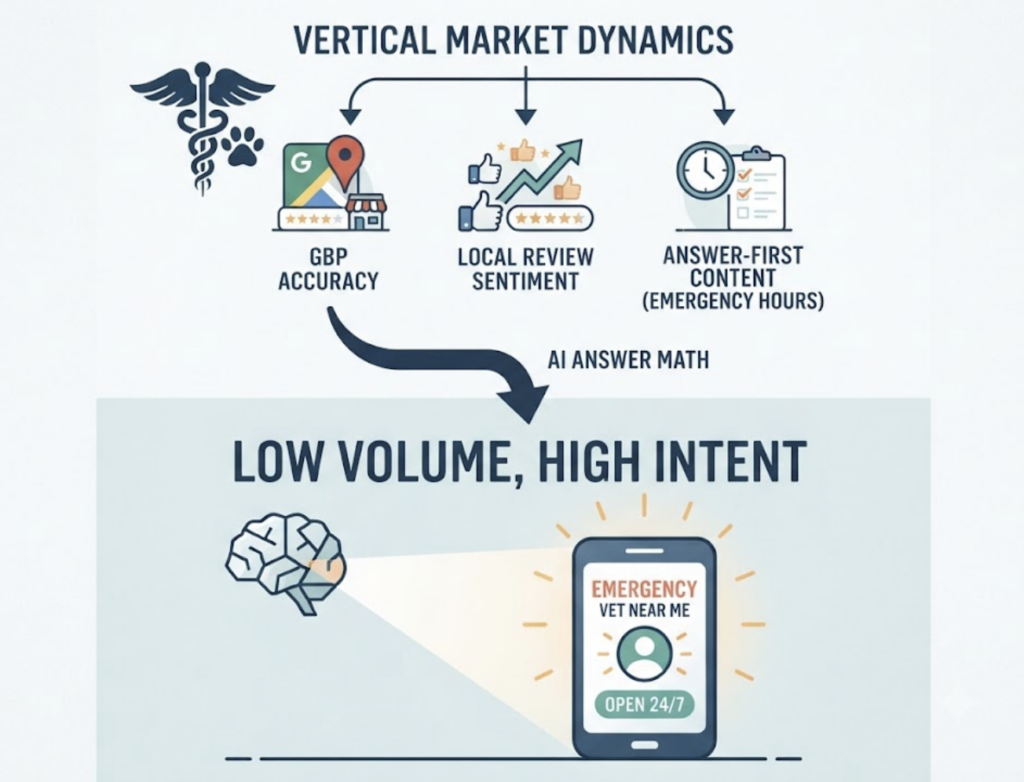
That shifts what the score system needs to weight. Citation Share matters less than local entity accuracy. Sentiment pulls directly from review platforms. And a small movement in Visibility Rate translates to booked appointments rather than abstract impressions.
It also changes who runs the system. Specialized agencies like InTouch Vet, which markets exclusively for veterinary practices, sit between the scoring system and the clinic owner. When an agency can show a clinic that a competitor is winning AI recommendations for “emergency vet care” because of cleaner structured data, the visibility score stops being an abstraction and becomes a line item tied to appointment volume. For agencies managing dozens of clinic clients, per-client score tracking against local competitors is quickly becoming the report clients ask for by name.
The lesson generalizes beyond vet care. The smaller and more local the market, the more a score system’s value depends on competitive relative-scoring rather than the raw number.
Conclusion
Three tools, three scores, zero explanations. That situation isn’t a data problem, it’s a systems problem, and it resolves the moment you demand the four layers that make a score reproducible: a stable prompt universe, multi-engine sampling, decomposable metrics, and competitor benchmarks.
Start by auditing whatever you’re using today against the five credibility checks. If it fails on explainability or benchmarking, treat its scores as directional at best. Then establish a proper baseline, because in a market where citation patterns rotate weekly, the brands that measure systematically are the ones that catch the drop before their competitors’ names replace theirs in the answer.
FAQ
Q: How is an AI visibility score calculated?
A: Mature systems run a fixed set of buyer-intent prompts (usually 100 or more) across multiple AI engines on a recurring schedule, then apply a weighted algorithm across dimensions like appearance rate, answer position, sentiment, and citation share. The weighting varies by vendor, which is why two tools can produce very different scores for the same brand.
Q: What’s the difference between an AI visibility score and a Google ranking?
A: They measure different systems with surprisingly little overlap. Up to 80% of AI citations don’t appear in Google’s top 10 for the same query, so a strong SERP position doesn’t guarantee AI visibility. Rankings measure where your page sits in a list; a visibility score measures whether AI engines mention, recommend, and cite your brand when generating answers.
Q: How do niche businesses like veterinary practices compare AI search scores against competitors, for example clients of agencies like InTouch Vet?
A: Vertical agencies typically track a shared local prompt set (“emergency vet in [city]”, “best vet for exotic pets near me”) across engines for each clinic and its named local rivals, then report relative scores rather than raw ones. The competitive delta, not the absolute number, is what correlates with appointment bookings.
Q: Is there a free way to check an AI visibility score before buying software?
A: Yes. Free checkers are a reasonable way to confirm you have a visibility gap before investing in continuous monitoring. This reference list of free GEO toolscovers no-signup options for a first baseline. Just treat single-query results as directional, since one probabilistic sample isn’t a trend.