

Your team finally ran an AI visibility check. The report came back: 42 out of 100. Now what? Nobody on the team can say whether 42 is bad, why it’s 42 and not 60, or which of next quarter’s content projects would actually move it. Meanwhile, leadership saw the same number and wants a plan by Friday.
That’s the trap most teams fall into. They treat the score as the deliverable, when the score is only the starting point. An AI visibility score strategy is what turns that number into a baseline, a diagnosis, and a repeatable optimization loop. Here’s how to build one.
The Score Is a Symptom. The Strategy Is the Treatment.
AI search has moved from experiment to default behavior. According to Semrush’s 2026 analysis, AI engines like ChatGPT, Gemini, and Perplexity now facilitate over 37% of initial search queries and B2B research, with AI-driven search interactions projected to exceed 1 trillion queries globally by the end of 2026.
The click economy is shrinking alongside it. Zero-click behavior has climbed to 68% of U.S. Google searches, and when an AI Overview appears, organic click-through rates decline by up to 47%. The prize is no longer the click. It’s becoming the default recommendation inside the answer itself.
This is why a single visibility number, checked once, tells you almost nothing. AI answers are stochastic: the same prompt can return different brands on different days. A one-time spot check is a sample of one, and research on measurement stability in generative engine optimization confirms that AI answers vary significantly across repeated prompts.
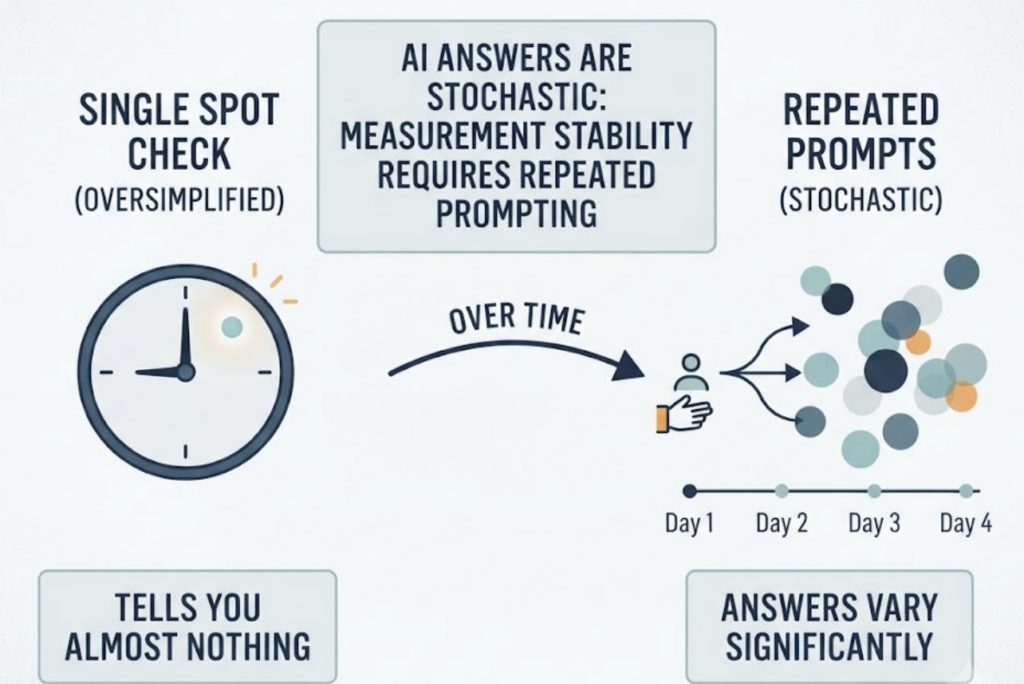
A strategy accounts for that variance. A dashboard screenshot doesn’t.
What an AI Visibility Score Actually Measures
Before you can act on a score, you need to know what’s inside it. A credible AI visibility score decomposes into at least four dimensions:
- Mention rate: how often your brand appears across a fixed prompt set. This is binary inclusion-exclusion, not a ranking spectrum. You’re either in the answer or you don’t exist.
- Position: whether you’re the lead recommendation or a footnote. Being mentioned fifth in a list of five is technically visibility, but it rarely converts.
- Sentiment: how the AI frames you. “Budget-friendly option” and “industry standard” are both mentions with very different commercial value.
- Citation share: which sources the AI leans on when it talks about your category, and whether any of them are yours.
Two brands can hold the same composite score for completely different reasons. One has a mention problem, the other has a sentiment problem, and the fixes don’t overlap. Platforms like Topify extend this decomposition to seven metrics, adding volume, intent, and conversion signals on top of the core four, which matters once you’re trying to connect visibility to pipeline rather than just tracking it.
The takeaway: never optimize a composite score directly. Optimize the dimension that’s dragging it down.
Step 1: Build a Baseline You Can Defend
An AI visibility score strategy starts with a measurement design decision, not a marketing decision. You need three things locked before the first data point counts.
A fixed prompt universe. Define 50 to 200 high-intent queries that mirror how buyers actually ask: “best [product] for [industry],” “[your brand] vs [competitor],” “[category] tools for small teams.” This set stays frozen so results are comparable over time.
Longitudinal sampling. Run the same prompts across ChatGPT, Claude, Gemini, and Perplexity on a weekly cadence. Citation logic differs wildly between engines, and volatility within a single engine means monthly snapshots are misleading by the time anyone reads them.
A 30-day window before conclusions. One week of data still carries too much noise. Thirty days of weekly sampling gives you a baseline you can defend in a leadership meeting.
Skip this step and every number downstream is anecdote, not evidence.
Step 2: Diagnose the Gap Before You Write Anything
Most teams jump from “our score is low” straight to “publish more content.” That skips the most valuable question: why is the score what it is?
The most common actionable finding is the source gap. AI engines tend to favor specific third-party domains as ground truth for a category: G2, Reddit, industry news sites, comparison publishers. If your competitor keeps showing up in answers, the reason usually lives in those citations, not in their homepage copy.
Reverse-engineering citations answers the operational question directly. Is the AI citing their documentation? A third-party review? One specific blog post from 2024? Topify’s citation analysis surfaces the exact domains and URLs AI platforms pull from, so you can see whether your brand or your competitors dominate the reference layer at scale.
Benchmarking makes the score interpretable. Visibility is relative: a score of 60 is excellent if your industry average is 30, and weak if the category leader sits at 90. Without a competitor baseline, you can’t even tell whether your number is a problem.
Diagnosis first. Content second.
Step 3: Run the Optimization Loop, Not a One-Off Project
You don’t improve a score. You improve the inputs the score measures.
Three input categories consistently move AI visibility, based on 2026 research into citation and extractability factors:
Content architecture. Adopt an answer-first structure where the first 30% of a page delivers a declarative, summary-style answer the AI can extract cleanly. Long wind-ups bury the exact sentence a RAG pipeline is looking for.
Entity authority. Keep your brand’s entity description consistent across Wikipedia, LinkedIn, and major industry directories. AI systems reward entity coherence over raw backlink counts.
Freshness and technical signals. Pages updated within the last 60 days earn roughly 28% more AI citations, per WP Engine’s 2026 research on technical citation factors. Structured data (JSON-LD for FAQ, Organization, and Product schemas) remains the entry fee for machine extractability.
Then close the loop: re-run your prompt universe weekly, compare against baseline, and set thresholds that trigger action. A 10-point drop in mention rate on ChatGPT should generate a task, not a shrug in next month’s report.
How to Choose an AI Visibility Score Tool That Closes the Loop
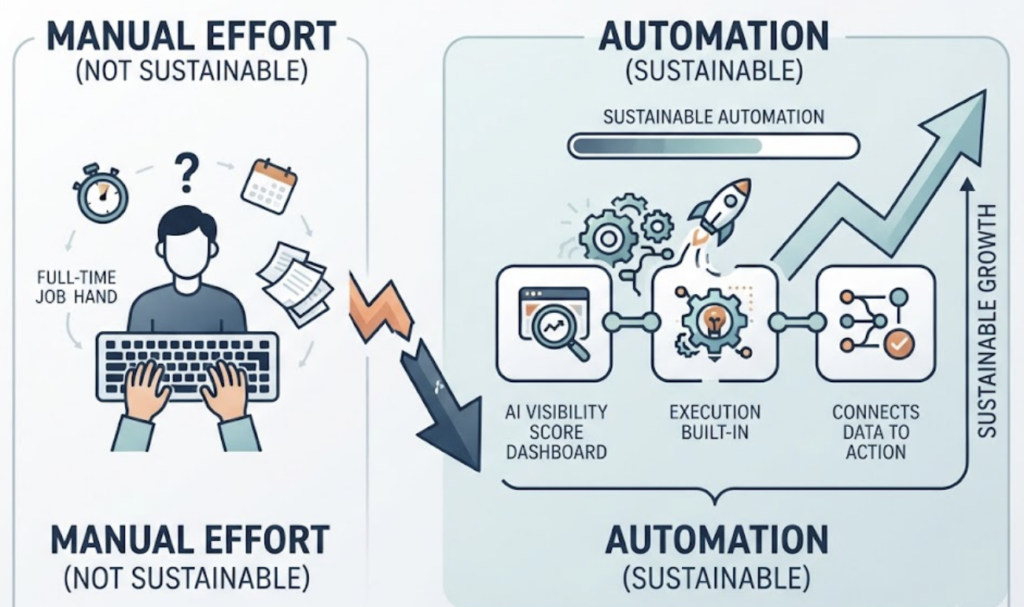
The strategy above is only sustainable with automation behind it. Running 100 prompts across four engines every week by hand is a full-time job, and the market now offers everything from a lightweight AI visibility score dashboard to a full AI visibility score platform with execution built in. The difference that matters is whether the product stops at reporting or connects data to action.
Four dimensions separate a reporting tool from a decision system:
| Evaluation Dimension | What to Require | Why It Matters |
|---|---|---|
| Engine coverage | Sampling across ChatGPT, Claude, Gemini, and Perplexity at minimum | Citation logic varies wildly between engines; single-engine data misleads |
| Prompt depth | Thousands of analyses per month | Anything less can’t overcome stochastic noise |
| Sentiment granularity | Distinguishes “brand mention” from “positive recommendation” | Mentions without endorsement rarely convert |
| Execution loop | Translates a visibility drop into a content task | A dashboard shows the problem; a system fixes it |
Pricing in this category typically runs from $99/mo for basic monitoring to $500+/mo for enterprise-grade sampling frequency and competitor coverage. That range maps to sampling depth more than feature count, so match the tier to your prompt volume, not to the feature list.
Where Topify Fits in This Framework
For teams that want one AI visibility score solution covering measurement through execution, Topify checks all four dimensions in a single system. Its Comprehensive GEO Analytics tracks the seven metrics discussed earlier (visibility, sentiment, position, volume, mentions, intent, and CVR) across ChatGPT, Gemini, Perplexity, DeepSeek, and other major engines, including non-Western platforms like Doubao and Qwen for brands with global exposure.
The execution side is what separates it from most AI visibility score software. Instead of exporting a CSV and briefing your content team manually, you state a goal in plain English, review the proposed strategy, and deploy it with one click. The system handles monitoring, reasoning, and execution as a continuous loop rather than a monthly reporting cycle.
Pricing starts at $99/mo on the Basic plan, which covers 100 tracked prompts and 9,000 AI answer analyses per month. That’s enough sampling depth for a defensible 30-day baseline on a single brand. If you want to test the water before committing, Topify also maintains a set of free GEO tools for one-off visibility and citation checks, and you can get started without a sales call.
Conclusion
A score without a strategy is just a number on a dashboard, and in AI search, it’s a number that changes every week whether you’re watching or not. The teams pulling ahead in 2026 treat their AI visibility score as a leading indicator of market influence: they lock a prompt universe, build a 30-day baseline, diagnose source gaps before producing content, and re-sample weekly so every optimization has a before-and-after.
Start with the three moves that compound fastest. Replace manual spot checks with automated prompt tracking. Audit your top three competitors’ citation sources. Refactor your highest-intent pages for answer-first extraction. The score will follow the inputs.
FAQ
Q: What is a good AI visibility score?
A: There’s no universal benchmark, because visibility is relative to your category. A score of 60 is strong if your industry average is 30 and weak if the leader holds 90. Benchmark against your top three competitors on the same prompt set before judging your own number.
Q: How often should you track your AI visibility score?
A: Weekly, at minimum. AI answers are probabilistic and citation patterns shift within weeks, so monthly snapshots are often stale on arrival. Weekly sampling across a fixed prompt set is the standard cadence for a defensible trend line.
Q: How do you choose an analytics tool for AI search performance?
A: Evaluate on four dimensions: engine coverage (ChatGPT, Claude, Gemini, and Perplexity at minimum), prompt depth (thousands of analyses monthly to beat stochastic noise), sentiment granularity (mention vs. recommendation), and an execution loop that turns visibility drops into content tasks. A tool that only reports data leaves the hardest work manual.
Q: Is an AI visibility score the same as an SEO ranking?
A: No. SEO rankings sit on a deterministic spectrum where position 4 still gets traffic. AI visibility follows binary inclusion-exclusion dynamics: you’re either in the answer or invisible. High organic rankings also don’t guarantee AI mentions, since RAG pipelines weigh topical authority and extractability over backlink counts.

