

Someone asks ChatGPT whether your brand is trustworthy. The answer it gives pulls from a two-year-old Reddit thread, a forum complaint you resolved long ago, and a competitor’s comparison page. Your review scores are strong, your press coverage is clean, and none of it shows up in the response. That’s the uncomfortable reality of 2026: your AI reputation and your web reputation are two different things, and most teams are only tracking one of them. AI reputation monitoring exists to close that gap, and it works differently from anything in your current social listening stack.
What Is AI Reputation Monitoring, and Why Legacy Tools Miss It
AI reputation monitoring is the systematic tracking of how generative AI platforms like ChatGPT, Gemini, and Perplexity portray, recommend, and frame your brand. Not whether you rank. Not whether you’re mentioned. How you’re described.
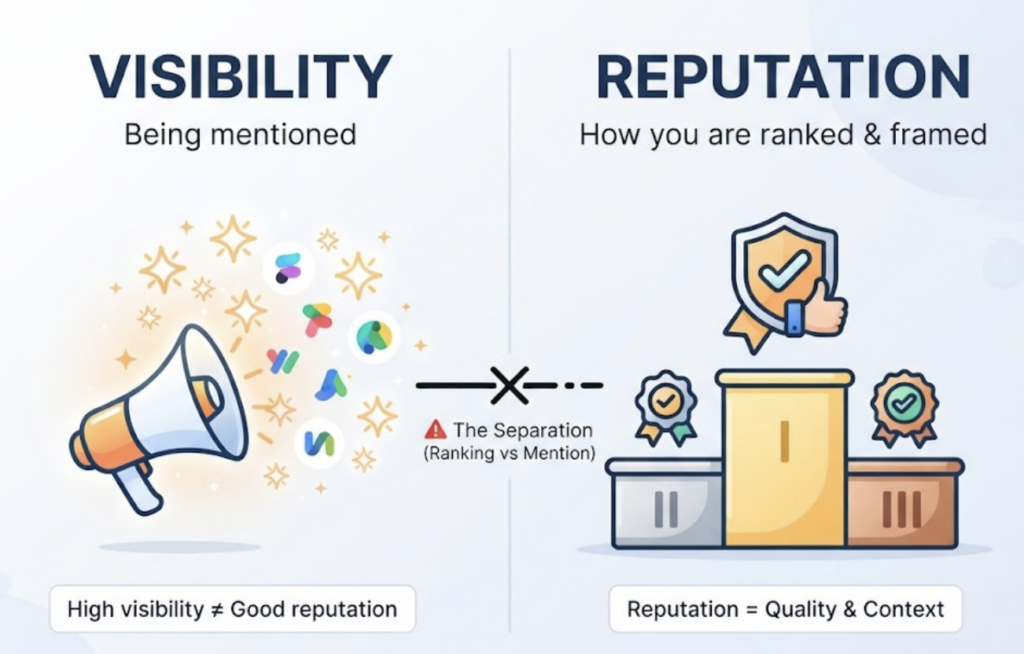
That distinction matters because it separates reputation from AI search visibility. Visibility measures the frequency and prominence of your brand in AI answers. Reputation measures the contextual sentiment and narrative accuracy of those mentions. A brand can score high on one and fail badly on the other.
Traditional reputation tools weren’t built for this. Social listening platforms and SEO trackers monitor what’s written on the web: reviews, posts, articles, rankings. AI engines don’t serve users that raw material. They serve a synthesized summary, assembled from whatever sources the model has ingested and currently prioritizes. Research on narrative bias in large language models, including recent arXiv work on measuring it, shows these summaries can hallucinate details or selectively cite sources in ways no web crawler anticipates.
The result is what analysts have started calling a decoupling of AI reputation from web reputation. Your website can say “trusted by 10,000 teams” while Gemini tells users you’re “expensive and hard to set up.” Only one of those statements reaches the buyer.
How Does AI Reputation Monitoring Work
The core challenge is that LLMs are non-deterministic. Ask the same question twice and you’ll often get different answers, different sources, and sometimes different sentiment. A single spot check tells you almost nothing.
Effective monitoring solves this with high-volume, continuous sampling. In practice, the pipeline has four steps.
Step 1: Build a prompt universe. Define a fixed set of category-specific questions your buyers actually ask, like “Why choose [Brand] over [Competitor]?” or “Best tools for [category].” This becomes your measurement baseline.
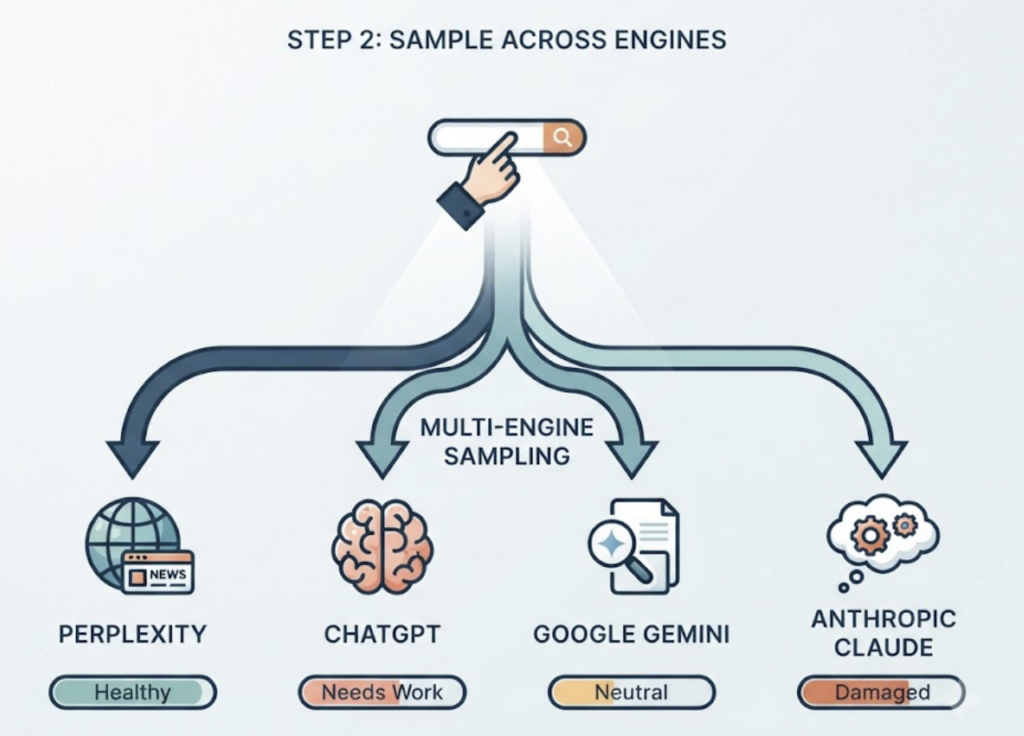
Step 2: Sample across engines. Run those prompts on every major platform, not just one. Citation logic varies significantly between models. Perplexity tends to favor real-time news and social sources, while ChatGPT leans on static training data and documentation. Your reputation can be healthy on one engine and damaged on another at the same time.
Step 3: Quantify sentiment. Use NLP scoring to assign each brand mention a 0 to 100 sentiment value, filtering out noise so you’re measuring framing, not just presence.
Step 4: Track against a longitudinal baseline. Compare current results to historical data to catch narrative shifts early, like a sudden increase in AI answers labeling your product “pricey.” Longitudinal research from Foglift on sentiment shifts in AI search found that these narrative changes build gradually, which means the earlier you spot the drift, the cheaper it is to correct.
This is where AI search analytics earns its keep. One sample is an anecdote. Two hundred prompts across four engines, repeated weekly, is a dataset.
How to Measure AI Reputation: 5 Metrics That Actually Matter
Reputation feels qualitative, but it breaks down into five measurable components.
| Metric | What It Tells You |
|---|---|
| Mention rate | The percentage of category queries where your brand appears at all |
| Sentiment score | How positively or negatively AI frames you, on a 0 to 100 scale |
| Positioning rank | Whether you’re the top recommendation or the “if budget is tight” alternative |
| Source authority | The credibility of the domains AI cites as evidence about you |
| Narrative accuracy | Whether AI’s description matches your actual value proposition |
Here’s the insight most teams miss: these metrics only make sense together. A high mention rate with a low sentiment score is the worst possible combination, what researchers describe as the Negative Visibility Paradox. Being frequently mentioned as “the one with billing complaints” does more damage than total obscurity.
That’s also why sentiment can’t be read in isolation from competitors. A sentiment score of 60 sounds fine until you learn your top three rivals sit at 85. Reputation in AI search intelligence is always relative.
Narrative accuracy deserves special attention from brand and PR teams. It measures consistency: does the AI describe you as enterprise-grade when your positioning is enterprise-grade? Drift here usually signals that the AI is weighting outdated or third-party sources over your own messaging, which points you directly at the fix.
The Strategy: How to Improve Your AI Reputation
Monitoring tells you where you stand. Improving your standing is an AI search optimization problem, and it follows a repeatable playbook borrowed from generative engine optimization.
Audit your sources first. Identify the specific third-party domains, often Reddit, G2, or niche forums, that AI engines consistently cite as evidence for negative descriptions. This is the single highest-leverage step, because you can’t counter a narrative until you know where it lives.
Reframe the content. Publish structured, high-quality content that addresses those negative narratives directly: FAQs, comparison tables, and documentation written in language AI models can easily extract. This is where AI SEO diverges from traditional SEO. You’re optimizing for extraction and synthesis, not just ranking.
Enforce entity consistency. Make sure your core value proposition reads identically across Wikipedia, official documentation, and PR coverage. Inconsistent signals give the model room to improvise, and improvisation is where inaccurate framing creeps in.
Close the feedback loop. Reputation shifts in AI answers are slow. Engines update their source preferences over weeks and months, not days, so treat this as continuous reinforcement rather than a one-time fix.
A working checklist for the first 90 days:
- Define 50 to 100 category and brand prompts
- Sample all major engines, ChatGPT, Gemini, Perplexity, and DeepSeek included
- Record baseline sentiment, mention rate, and position
- List every domain cited in negative answers
- Publish structured content targeting the top 3 negative narratives
- Update brand descriptions across owned and earned channels
- Re-sample every week and compare against baseline
- Report sentiment relative to competitors, not in isolation
If you want to run a quick self-audit before committing to a full program, there’s a maintained list of free GEO tools that covers no-cost ways to check how AI engines currently see your brand.
Common Mistakes in AI Reputation Monitoring
Most failed monitoring programs fail the same four ways.
The brand-only error. Teams track prompts containing their brand name and ignore category-intent queries like “best CRM software.” But category queries are where reputation is actually won or lost, because that’s where buyers form first impressions before they know your name exists.
Single-engine snapshots. Testing only ChatGPT while ignoring Perplexity and Gemini produces incomplete and often misleading results, since each engine weights sources differently. One engine is a sample. Four engines is a signal.
Confusing visibility with reputation. Research on ranking-mention separation in generative engines, including Conductor’s 2026 analysis, shows that the factors driving whether you’re mentioned differ from the factors driving how you’re ranked and framed. A brand can be highly visible and poorly regarded at once. Treating a mention count as a reputation score hides exactly the problem you’re trying to find.
Ignoring competitors. Without competitive benchmarks, your sentiment score is a number without meaning. The question is never “is 60 good,” it’s “is 60 good relative to the brands AI recommends instead of you.”
One habit fixes most of these: measure continuously, across engines, against rivals. Anything less is a snapshot pretending to be a trend.
Best Tools for AI Reputation Monitoring and What They Cost
Selection criteria come before tool names. Based on how monitoring actually gets used, four capabilities matter most: engine coverage across ChatGPT, Gemini, Perplexity, and DeepSeek; source attribution that shows exactly which domain triggered a negative score; sampling cadence frequent enough to catch shifts weekly; and a workflow that connects findings to content actions instead of stopping at a dashboard.
Measured against those criteria, Topify covers the full loop in one AI visibility platform. Its Sentiment Analysis assigns 0 to 100 scores to brand mentions across major engines, so you can quantify framing instead of guessing at it. Visibility Tracking and Position Tracking handle the mention-rate and ranking side, while Competitor Monitoring benchmarks your scores against rivals automatically, which solves the “is 60 good” problem out of the box. The piece most tools skip is Source Analysis: Topify reverse-engineers the exact domains and URLs each AI platform cites, so when your sentiment drops, you can trace it to the specific Reddit thread or review page responsible and target your content response there. In practice, that attribution step is what turns monitoring data into a repair strategy.
On pricing, the Basic plan runs $99/month with 100 tracked prompts, 9,000 AI answer analyses, and coverage of ChatGPT, Perplexity, and AI Overviews, with a 30-day trial included. Pro is $199/month for 250 prompts and 22,500 analyses, and Enterprise starts at $499/month with a dedicated account manager. For most in-house teams, Basic is enough to establish a baseline and catch narrative drift.
General-purpose social listening suites and SEO platforms have started adding AI answer features, and they’re reasonable if AI monitoring is a minor add-on for you. The trade-off is depth: most stop at mention counting and skip sentiment attribution, which is the layer reputation work depends on.
Conclusion
AI answers have become your brand’s second face, and it’s the face a growing share of buyers sees first. The uncomfortable part isn’t that AI might describe you inaccurately. It’s that without monitoring, you’d never know.
Start small. Define your prompt universe, sample the major engines, and establish a sentiment baseline this month. Once you can see the narrative, you can shape it. You can get started with Topify on a 30-day trial and have your first baseline report within a week.
FAQ
Q: What are examples of AI reputation monitoring in practice?
A: A SaaS brand tracking whether ChatGPT calls it “enterprise-ready” or “a budget option,” an ecommerce company checking which review sites Perplexity cites when asked about product quality, or a PR team catching a sentiment drop after a negative Reddit thread starts appearing in AI citations. Each case pairs prompt sampling with sentiment scoring over time.
Q: How is AI reputation monitoring different from social listening?
A: Social listening tracks what people write on the web. AI reputation monitoring tracks what AI engines say after synthesizing that material, which often diverges from the source content. Since buyers increasingly see the AI’s summary rather than the original posts, the synthesized version is the one that shapes decisions.
Q: How often should you run AI reputation checks?
A: Weekly sampling is the practical minimum, since AI engines shift citation patterns over weeks. Daily cadence makes sense during launches, PR events, or active reputation repair. One-time snapshots aren’t reliable because LLM answers vary between sessions.
Q: How much does AI reputation monitoring cost?
A: Dedicated platforms typically start around $99 to $199 per month for core sentiment and visibility tracking, with enterprise tiers from $499/month. Free GEO checkers can give you a rough initial read, but continuous multi-engine monitoring with source attribution requires a paid tool.

