

Your domain authority is solid. Your keyword rankings are holding. But none of that tells you whether Perplexity is recommending your competitor instead of you. Traditional SEO tools were built for a crawl-index-rank world. AI search engines don’t work that way, and the brands that figure out how to measure AI visibility score monitoring first are quietly taking market share from those that haven’t.
Your Google Rank Doesn’t Tell You What ChatGPT Says About You
Over 60% of Google searches now resolve without a click. On AI-native platforms like ChatGPT or Perplexity, that number approaches 100%. Users ask a question and get a synthesized recommendation. They don’t scroll through ten blue links.
The problem is that traditional SEO tools track your position in a ranked list. AI search engines use Retrieval-Augmented Generation (RAG) to select and recommend brands based on a completely different set of signals. Whether you get cited depends on your authoritative footprint across the web, not your backlink profile.
That’s the gap. You can rank #1 on Google and still be invisible in every AI answer your customers are reading.
What AI Visibility Score Monitoring Actually Measures
AI visibility score monitoring is the practice of systematically tracking how, where, and how favorably a brand appears in AI-generated answers across multiple platforms.
It’s not a single number. It’s a composite framework built from seven dimensions:
- Visibility (Mention Rate): How often does your brand appear in AI answers for your target prompts?
- Position: Are you mentioned at the top of the shortlist, or buried in a footnote? Top-of-answer placement converts significantly better.
- Sentiment Score: Does the AI describe your brand as “enterprise-grade” or “a budget alternative”? Qualitative tone matters as much as presence.
- AI Volume: How much demand exists for the prompts that trigger AI-led discovery in your category?
- Mentions: Quantitative tracking of brand appearances across specific buyer contexts.
- Intent Alignment: Is the AI surfacing your brand at the right buyer stage, consideration versus active procurement?
- CVR (Conversion Visibility Rate): What’s the correlation between your AI visibility and downstream pipeline growth?
Topify structures these seven dimensions into a unified GEO Analytics framework, letting teams treat AI visibility as a measurable growth variable rather than a guessing game.
How AI Visibility Score Monitoring Works
The mechanics are more systematic than most brands expect.
A monitoring platform starts with prompt discovery: identifying the specific questions your target buyers are actually asking AI engines. Not broad keywords, but high-intent buyer questions like “What’s the best CRM for a mid-size healthcare company?” These become your tracking prompts.
From there, the system runs those prompts simultaneously across ChatGPT, Perplexity, Gemini, AI Overviews, and other relevant platforms. It parses the AI-generated answers, extracts brand mentions, scores sentiment, records position, and aggregates the data into trend reports.
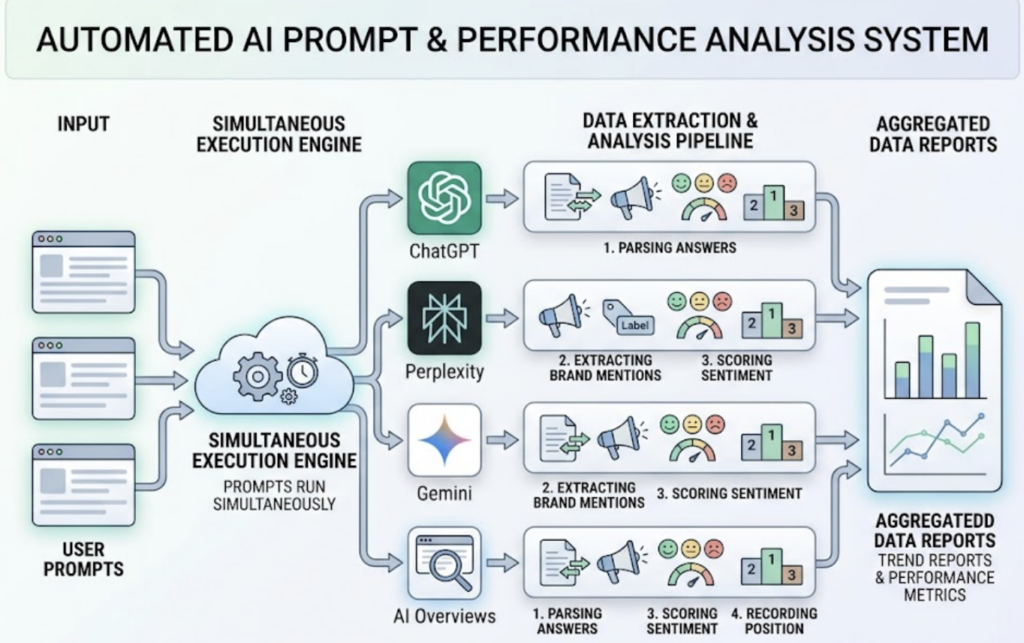
The cadence matters. AI models update their citation patterns constantly as new training iterations roll out. A one-time audit tells you where you stood last Tuesday. Continuous monitoring tells you when something changed and what likely caused it.
Topify’s Basic plan, at $99/month, covers up to 100 high-intent prompts and 9,000+ AI answer analyses per month, which provides enough statistical depth to identify real trends rather than noise.
5 Metrics That a Proper AI Visibility Score Should Include
Not all monitoring platforms track the same things. When evaluating AI SEO rank tracking platforms, the coverage of these five metrics is the right place to start:
Mention Rate tells you baseline presence. You can’t optimize what you’re not tracking. Start here.
Sentiment Score tells you whether presence is actually good. A brand mentioned as “often criticized for poor support” has worse visibility than a brand that isn’t mentioned at all.
Position Rank separates shortlist placements from footnotes. AI answers frequently recommend 3-5 products in a list. Being #1 versus #5 on that list has meaningful conversion implications.
Source Coverage shows which domains and URLs the AI is currently citing in your category. This is actionable: if you’re not present on those sources, that’s your content gap.
CVR closes the loop between visibility data and business outcomes. Without it, you can’t build a business case for GEO investment.
The mistake most teams make is treating mention rate as the whole score. It’s one variable. A brand with 70% mention rate and consistently negative sentiment is in worse shape than a brand with 40% mention rate and strong positive framing.
Common Mistakes That Skew Your AI Visibility Score
Flawed monitoring leads to flawed optimization. Here are the patterns that show up most often:
Platform siloing is the most common error. Teams optimize for ChatGPT and ignore Perplexity, DeepSeek, or Gemini. In practice, different AI platforms have different discovery patterns and different citation preferences. A brand that dominates on one may be invisible on another.
Over-broad prompting produces data that looks comprehensive but isn’t actionable. Monitoring “best marketing software” tells you almost nothing. Monitoring “best email automation tool for B2B SaaS under 50 seats” tells you exactly where you stand with a specific buyer.
No competitor baseline. Measuring your visibility in isolation is like reviewing your traffic without knowing your category’s total search volume. What matters is Share of Voice: how your visibility compares to the brands your customers are actually choosing between.
Insufficient sampling frequency. A monthly spot-check doesn’t capture the volatility of AI citation patterns. Model updates can shift recommendations in days. Weekly or daily monitoring is the standard that makes optimization decisions statistically meaningful.
How to Improve Your AI Visibility Score: A Practical Checklist
Improving your score starts with understanding why AI engines cite certain sources and not others. The short answer is authority and parsability.
- Structure content for RAG extraction. Use clear H1-H3 headings, concise definitions, and FAQ sections. AI systems need to parse and extract coherent answers quickly. Dense paragraphs without clear structure get skipped.
- Build third-party authority. AI models prioritize sources that reputable third parties already cite: industry roundups, high-authority directories, analyst reports. Digital PR strategy is now GEO strategy.
- Audit your source footprint. Use Topify’s Source Analysis to identify which domains your AI search competitors are currently being cited from, then close the gap by getting featured on those platforms.
- Maintain entity consistency. Name, description, and value proposition should be identical across every web touchpoint. Inconsistency signals unreliability to AI models that are trying to verify brand information across sources.
- Monitor and address negative sentiment. Forum discussions on Reddit, G2, and Trustpilot get ingested by AI grounding systems. A pattern of negative mentions in those communities can suppress your visibility score even if your owned content is excellent.
- Respond to model updates. When citation patterns shift after a model update, you need monitoring data to know it happened. Without that signal, you’re optimizing blind.
- Expand prompt coverage over time. Start with 20-30 high-intent prompts, validate which ones drive meaningful visibility data, and build from there. More prompts = more signal.
Choosing an AI Visibility Score Monitoring Platform: What to Look For
The AI SEO rank tracking platforms market has grown quickly, and not all of them measure the same things. Here’s how to evaluate options against what actually matters in 2026:
| Evaluation Dimension | What to Require |
|---|---|
| Platform Breadth | Full coverage: ChatGPT, Perplexity, Gemini, AI Overviews, and ideally international LLMs |
| Data Frequency | Daily or near-daily updates for prompt-level visibility (weekly is becoming the floor) |
| Sentiment Analysis | Qualitative tone tracking, not just presence/absence |
| Position Tracking | Shortlist placement vs. footnote differentiation |
| Competitor Benchmarking | Share of Voice relative to named competitors |
| Source Analysis | Which domains and URLs the AI cites in your category |
| Business Conversion Mapping | Ability to connect visibility data to pipeline or conversion metrics |
| Pricing Model | Tiered by prompt volume, not inflated enterprise bundles |
Topify covers all eight dimensions. The Basic plan at $99/month gives teams 100 prompts and 9,000 AI answer analyses monthly, which is enterprise-relevant scale for most marketing teams getting started. The Pro plan at $199/month expands to 250 prompts and 22,500 analyses. Enterprise plans start at $499/month and include custom configurations and a dedicated account manager.
For teams that want optimization execution alongside monitoring, Topify’s managed GEO service runs $3,999-$5,999/month and includes content production, Reddit visibility, and prompt-level strategy. That’s a different category than software-only monitoring, but worth knowing if your team needs more than a dashboard.
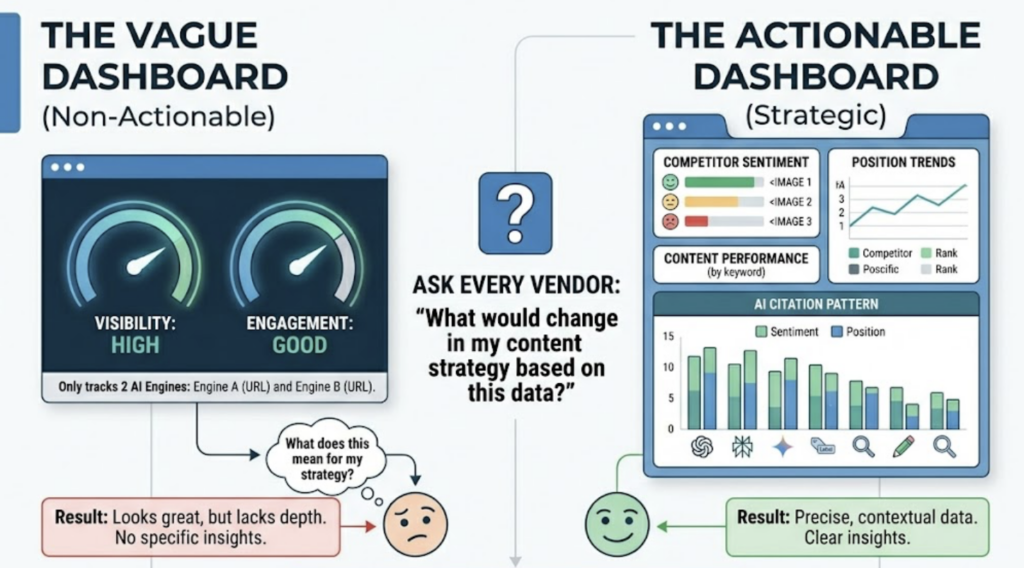
The platforms that only track one or two AI engines, or that report visibility without sentiment or position context, tend to produce dashboards that look impressive but don’t generate actionable decisions. The question to ask any vendor is: “What would change in my content strategy based on this data?” If the answer is vague, the tool probably is too.
Get started with Topify if you want to run your first prompt set and see where your brand actually stands across AI search platforms.
Conclusion
AI visibility score monitoring isn’t a replacement for SEO. It’s the layer that SEO tools don’t cover, and increasingly the layer that matters most to your buyers. The brands that know their visibility score, track its components, and optimize systematically will have a structural advantage over brands still waiting for their ranking tools to explain why organic traffic is declining.
The data infrastructure exists. The monitoring frameworks are established. What’s missing for most teams is simply starting: picking a prompt set, choosing a platform that covers the metrics that matter, and building the feedback loop that makes GEO optimization as routine as any other channel.
FAQ
Q: What is AI visibility score monitoring?
A: AI visibility score monitoring is the systematic practice of tracking how often, how favorably, and in what position a brand appears in AI-generated search answers across platforms like ChatGPT, Perplexity, and Gemini. It measures a composite score built from dimensions including mention rate, sentiment, position, source coverage, and conversion visibility.
Q: How do I measure my AI visibility score?
A: You measure it by defining a set of high-intent buyer prompts relevant to your category, running those prompts across multiple AI platforms on a regular cadence, and analyzing the resulting AI answers for brand mentions, sentiment, and position. Platforms like Topify automate this workflow across 100+ prompts and thousands of AI answer analyses per month.
Q: How does AI visibility score monitoring work technically?
A: Monitoring platforms use automated querying to run defined prompts against AI engines, then parse the generated answers to extract brand mentions, qualitative sentiment, and placement position. Results are aggregated into trend dashboards that show how visibility changes over time and across platforms. Continuous monitoring is necessary because AI citation patterns shift with every model update.
Q: What are common mistakes in AI visibility score monitoring?
A: The four most common mistakes are: tracking only one AI platform (each platform has distinct citation behaviors), using prompts that are too generic to be actionable, measuring visibility without a competitor baseline to contextualize the data, and running ad-hoc audits instead of consistent daily or weekly monitoring that provides statistically reliable trend data.

