

Search “best GEO tool” and you’ll find a dozen platforms, each claiming to track AI search visibility. Half of them only cover ChatGPT. The other half show you dashboards full of numbers but no explanation of what changed or why. Meanwhile, AI search engines are shifting their citation patterns every few weeks, and last month’s data is already stale.
The real problem isn’t finding an AI search monitoring tool. It’s figuring out which one actually measures what matters, across the platforms your audience is using right now.
Why Your Current SEO Stack Can’t Monitor AI Search
Traditional rank trackers were built on a simple loop: crawl, index, rank. That model doesn’t apply to generative search, and the gap is widening faster than most marketing teams realize.
Here’s the core issue. AI search engines like ChatGPT, Perplexity, and Google AI Overviews synthesize answers from multiple sources and deliver them as natural language summaries. A significant portion of search volume now ends without a click. Users read the AI’s answer, take the recommendation, and move on. Your domain authority and keyword rankings played no role in whether you were mentioned.
Traditional SEO tools track position in a static list. AI search monitoring tracks something different: citation frequency and share of model, metrics that measure whether your brand appears in the AI’s synthesized answer at all.
There’s a third gap that’s easy to miss. Traditional tools can’t tell you how your brand is being described. An AI might mention your product in every response but consistently frame it as “a budget option” or “suited for small teams,” even if your positioning is enterprise-grade. That kind of brand narrative drift is invisible without dedicated AI search monitoring analytics.
5 Capabilities That Separate Real AI Search Monitoring from Noise
The market for AI search monitoring software is crowded with tools that look similar on a demo call but diverge significantly in what they actually measure. These five capabilities are the clearest differentiators.
Multi-Platform Coverage
Any AI search monitoring platform that only tracks one or two AI engines is giving you an incomplete picture. As the research from Nightwatch confirms, ChatGPT, Perplexity, Gemini, Claude, and Google AI Overviews each have different training corpora and citation logic. A brand that ranks prominently in Perplexity answers may be nearly invisible in Gemini, and vice versa. Coverage has to span the full ecosystem.
Prompt-Level Tracking
AI search engines respond to conversational queries, not keyword fragments. An effective AI search monitoring system tracks performance against sets of “buyer-intent prompts,” such as “What’s the best CRM for enterprise sales teams?” or “Which project management tools integrate with Slack?” These are the actual questions your prospects are asking. Monitoring generic brand keywords won’t tell you how visible you are at the moments that drive purchase decisions.
Sentiment and Position Analysis
Being mentioned is not the same as being recommended. According to Graph Digital’s visibility framework, high-quality AI search monitoring analytics must capture two distinct signals: sentiment (whether the AI’s description of your brand is positive, neutral, or negative) and position (whether your brand appears at the top of the AI’s shortlist or is buried in a closing disclaimer). Both signals are actionable. Neither shows up in a traditional SEO dashboard.
Competitor Benchmarking in AI Answers
Your AI search visibility only matters relative to your competitors’. A good AI search monitoring solution shows you Share of Voice within the same AI-generated responses where your brand appears. If a competitor is being cited in 70% of high-intent prompts and you’re cited in 20%, that gap is more important than any individual keyword ranking. The actionable question is: what sources is the AI using to build its answer for them, and not for you?
Source and Citation Tracking
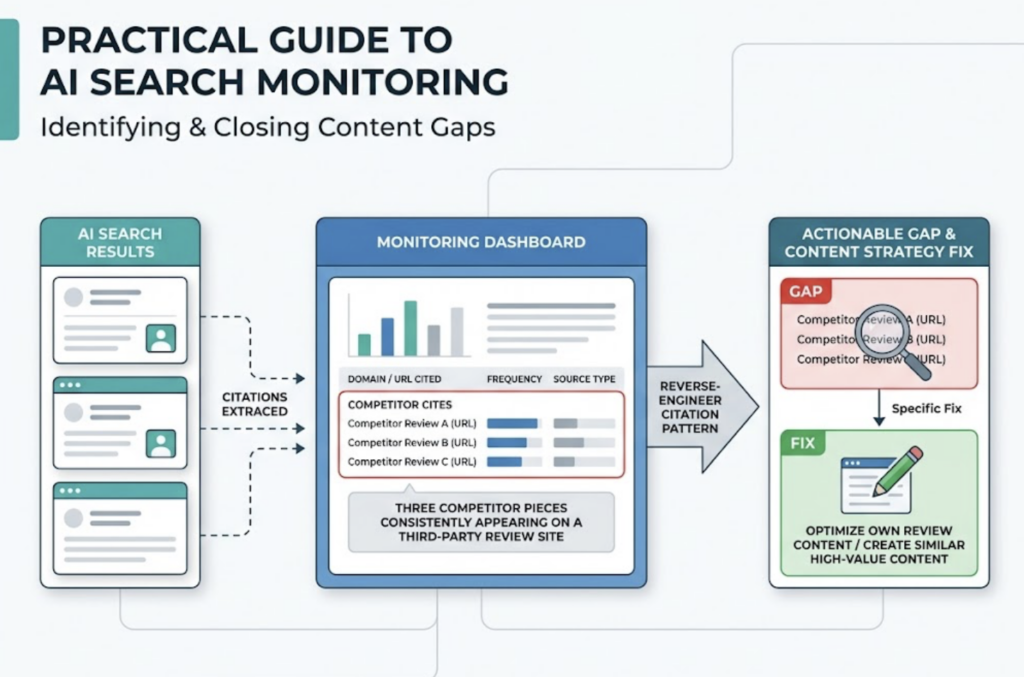
This is where AI search monitoring becomes directly useful to a content team. As Omnia’s practical guide to AI search monitoring documents, identifying which URLs and domains AI models are citing to construct their answers lets content teams reverse-engineer the citation pattern. If three of your competitor’s pieces on a third-party review site are consistently appearing in AI citations, that’s a specific gap with a specific fix.
What a Real AI Search Monitoring Dashboard Shows You
A mature AI search monitoring dashboard doesn’t just confirm that your brand was mentioned. It quantifies the full picture across seven dimensions.
According to the measurement framework now adopted by leading organizations, the seven KPIs that define AI visibility are:
- Visibility Rate: the percentage of target queries where your brand appears in AI answers
- Share of Model: your prominence relative to competitors within the same AI response
- Sentiment Score: a qualitative rating of how AI engines describe your brand
- Citation Source: the specific URLs and domains AI platforms are pulling from
- AI Search Volume: demand for specific prompts and topic clusters
- Intent Alignment: whether AI surfaces your brand at the right stage of the buyer journey
- CVR (Conversion Visibility Rate): the correlation between AI-led discovery and downstream traffic or conversions
In practice, a dashboard that shows all seven metrics lets you move from “we’re being mentioned” to “we understand exactly why our AI visibility dropped last month and what content to create to recover it.”
Topify: An AI Search Monitoring Platform Built Around These Seven Metrics
Topify is one of the few AI search monitoring platforms that tracks all seven dimensions out of the box. Built by founding researchers from OpenAI and champion Google SEO practitioners, it covers ChatGPT, Gemini, Perplexity, DeepSeek, Doubao, Qwen, and other major AI platforms, including both Western and Asian markets.
The core product is built around a few things that most monitoring tools don’t offer together.
Prompt Discovery continuously surfaces high-value AI search queries relevant to your brand and category, so you’re not manually guessing which prompts to track. It finds the questions your target customers are actually asking AI engines before they visit any website.
Competitor Benchmarking runs automatically. Topify detects which competitors appear in the same AI responses as your brand, then tracks their position, sentiment, and citation sources over time. You don’t need to manually add rivals to a watchlist.
Source Analysis shows the exact URLs and domains that AI platforms are citing when they mention your brand or your competitors. This is the most direct path from monitoring to action: see the citation gap, identify the content type, close it.
One-Click Agent Execution ties the analytics layer to a strategy layer. Once the data identifies an opportunity, such as a citation gap on a high-intent prompt cluster, Topify’s AI agent can propose and deploy a GEO strategy with a single click.
Pricing starts at $99/month on the Basic plan, which includes 100 prompts and 9,000 AI answer analyses per month across 4 projects. The Pro plan ($199/month) scales to 250 prompts and 22,500 AI answer analyses. Enterprise plans start at $499/month with a dedicated account manager and custom configurations.
How to Evaluate AI Search Monitoring Services in 2026
Beyond SaaS platforms, some organizations opt for service-oriented AI search monitoring, where an agency or consulting team runs audits and executes strategy on their behalf. As the buyer’s evaluation framework from Rankability outlines, the right choice depends on what your team actually needs.
| Dimension | SaaS Platform (e.g., Topify) | Service-Oriented (Agency) |
|---|---|---|
| Best for | Daily/weekly monitoring, trend analysis | Strategy, content production, citation PR |
| Data frequency | Daily or real-time | Periodic audits or campaign-based |
| Actionability | Data provided; team executes | Agency executes on your behalf |
| Pricing model | Subscription-based | Retainer-based |
| Team fit | In-house marketing or SEO team | Teams without GEO execution capacity |
Topify also offers a managed service tier, where their team handles prompt strategy, content production, Reddit visibility campaigns, and monthly reporting alongside platform access. The managed plans start at $3,999/month and are designed for brands that want full execution rather than just data.
For most in-house marketing teams and agencies managing multiple clients, the SaaS platform is the faster path to visibility data. Managed services make more sense for brands that don’t have the internal bandwidth to act on the data themselves.
3 Signs You Need an AI Search Monitoring System Now
Most brands delay investing in AI search monitoring until a specific event forces the question. These three patterns are the clearest early signals.
Competitors are showing up in AI answers and you don’t know why. If you can see that a rival is being recommended on high-intent queries but your team can’t identify which sources are driving those citations, you’re operating blind. That’s not an SEO problem. It’s a monitoring gap that traditional tools won’t close.
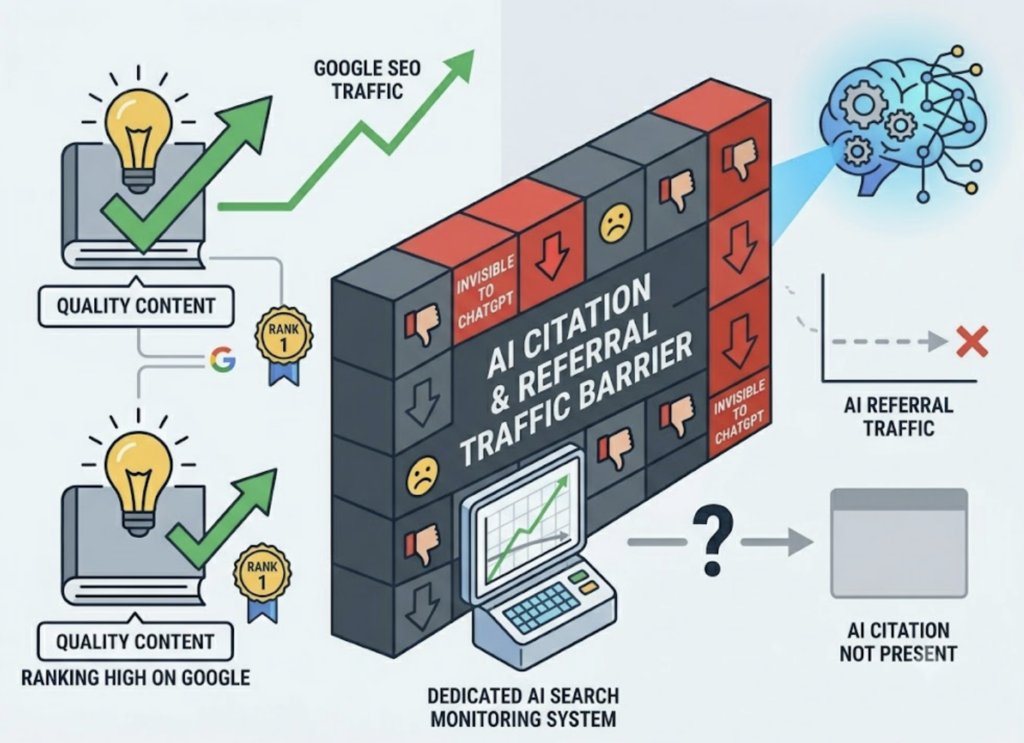
Your content is ranking on Google but AI referral traffic is flat. SEO/AI divergence is one of the most reliable indicators that your content is optimized for keyword crawlers but not for AI citation. Ranking high on Google and being invisible to ChatGPT are not mutually exclusive. Without a dedicated AI search monitoring system, you won’t know which is happening.
You’re not sure what AI is saying about your brand. This one surprises most teams. You can be mentioned frequently in AI answers and still have a brand narrative problem, where the AI consistently frames you in ways that don’t match your positioning. Without sentiment tracking, that drift is silent.
Conclusion
The monitoring question used to be simple: where do we rank? In 2026, that question has split into two. Where do we rank on Google, and what is AI saying about us? The tools that answer the first question don’t answer the second.
An AI search monitoring system that covers multi-platform visibility, prompt-level tracking, sentiment analysis, competitor benchmarking, and source citation gives your team the data to act on both. Get started with Topify to see where your brand currently stands across ChatGPT, Perplexity, Gemini, and the other platforms your audience uses before they ever reach your website.
FAQ
Q: What is the best AI search tracking software in 2026?
A: The best AI search tracking software in 2026 depends on your team’s specific needs, but a strong platform should cover multiple AI engines (not just ChatGPT), track performance at the prompt level, and provide sentiment and competitor benchmarking. Topify is one of the most comprehensive options, offering seven-dimensional GEO analytics across ChatGPT, Gemini, Perplexity, DeepSeek, and other major AI platforms, with plans starting at $99/month.
Q: How is AI search monitoring different from SEO monitoring?
A: SEO monitoring tracks where a page ranks in a static list of search results. AI search monitoring tracks whether and how your brand appears in AI-generated answers, what sentiment those mentions carry, how your brand is positioned relative to competitors within the same AI response, and which external sources the AI is citing. These are fundamentally different data sets, and traditional SEO tools aren’t built to capture the AI layer.
Q: What does an AI search monitoring analytics dashboard typically include?
A: A mature AI search monitoring dashboard covers visibility rate (how often your brand appears in AI answers for target queries), share of model (your prominence relative to competitors), sentiment score, citation source analysis, AI search volume for specific prompts, intent alignment, and CVR. Tools that only show mention frequency without sentiment or citation data are giving you an incomplete picture.
Q: What should I look for in an AI search monitoring solution for a small team?
A: For smaller teams, the key is a platform that surfaces actionable insights without requiring a dedicated analyst to interpret the data. Look for automated competitor detection, prompt discovery that identifies high-value queries without manual input, and clear citation tracking that tells you exactly which content gaps to address. Topify’s Basic plan at $99/month is designed with this use case in mind.

