

Your rankings haven’t moved in three months. Your organic clicks have. If you’re staring at a rank tracker that says “position 3, no change” while Search Console shows a steady decline, you’re not imagining a glitch. You’re looking at two different systems that happen to share a search bar.
Google AI Mode doesn’t rank pages the way classic search does, and that gap is exactly why most SEO dashboards can’t see what’s actually happening to your traffic.
Google Ranking Tracks Positions. AI Mode Tracks Something Else Entirely
A traditional rank tracker works by simulating a search, scraping the results page, and recording where your URL lands in a list. Position 1 beats position 2. Simple, stable, and built for a page of ten blue links.
AI Mode breaks that model completely. When someone activates AI Mode, Google’s AI reads across multiple sources and hands back one synthesized, conversational answer instead of a ranked list. There’s no number one, because there’s no ordered list to place you in.
That’s the gap most SEO dashboards still don’t measure.
Your brand can be woven into that answer, described accurately, and never show up in a single rank-tracking report. Or it can hold a top-three position on the classic results page and still be left out of the AI Mode conversation entirely.
Three Ways AI Mode Results Behave Differently From Ranked Pages
The differences aren’t cosmetic. They change what “visibility” even means.
Presentation. A ranked page is a list you scan. AI Mode is a narrative you read. Your brand can be referenced inside that narrative without a clickable link attached to it at all, which means a mention can happen with zero footprint in a traditional crawl.
Unit of visibility. Classic tracking counts URLs. AI Mode counts entities. A page ranking outside the top ten can still see its parent brand cited inside an AI Mode answer, because the system pulls information at the passage and entity level rather than the page level.
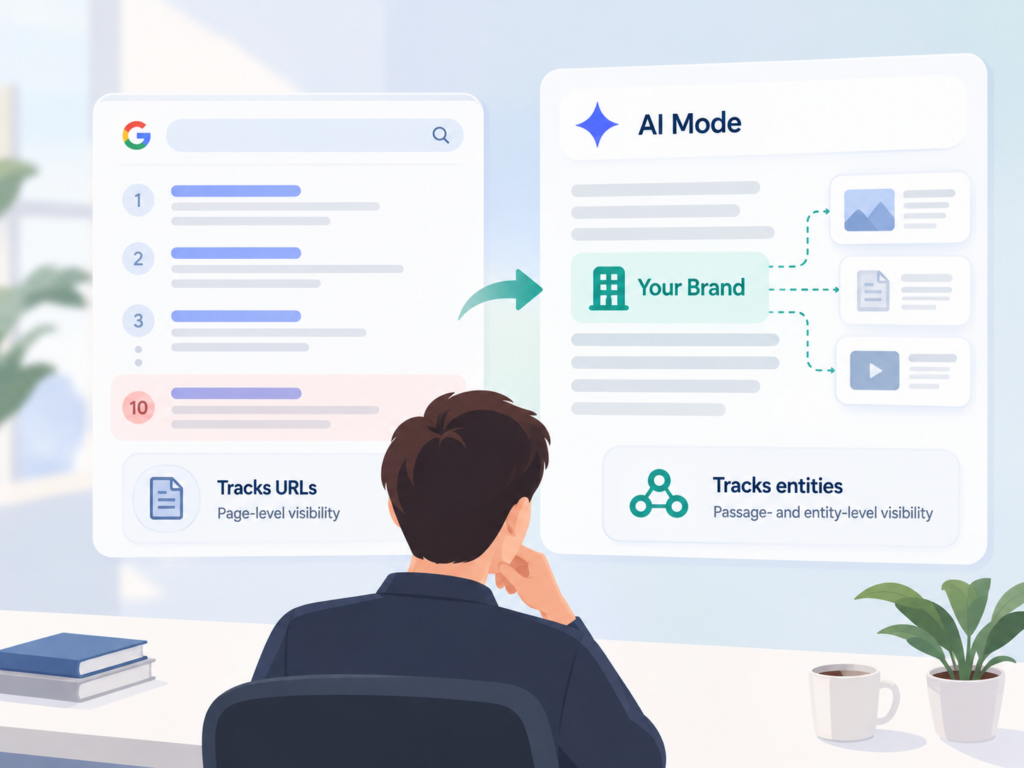
Volatility pattern. Search rankings shift with algorithm updates, usually over weeks. AI Mode answers shift with phrasing, context, and session history, sometimes within the same day. Two people asking the same question in slightly different words can get answers that cite different sources.
The overlap between what AI Mode cites and what shows up in classic organic rankings is smaller than most teams assume. Depending on the study, AI Mode citations line up with the traditional top ten only 17% to 54% of the time, and the overlap between AI Mode citations and AI Overview citations, a related but separate surface, sits at just 13.7%. Three surfaces, three different citation lists, one search bar.
| Signal | Classic Search Ranking | Google AI Mode |
|---|---|---|
| Output format | Ordered list of links | Single synthesized answer |
| What’s measured | URL position | Brand or entity mention |
| Retrieval method | Page-level ranking | Multi-query synthesis across passages |
| Overlap with top-10 organic | 100% by definition | 17% to 54%, varies by study |
| Click behavior | 34% to 43% zero-click | 92% to 94% zero-click |
Why Your Rank Tracker Can’t See What’s Happening in AI Mode
The technical reason is simple. A rank tracker is built to scrape a static results page and match your URL against it. AI Mode output isn’t cached the same way, isn’t structured as a list, and can vary between two identical queries run minutes apart.
That mismatch has real consequences. Top-10 organic rankers accounted for 76% of AI Overview citations in mid-2025, but that share had dropped to roughly 38% by early 2026. Ranking well used to be a reasonable proxy for AI visibility. It’s becoming a weaker one every quarter.
Meanwhile the traffic stakes keep rising. AI Mode has passed 1 billion monthly users, and 93% of those sessions end without a click to any external site. Independent clickstream analysis puts the zero-click rate for AI Mode specifically between 92% and 94%, compared with 34% to 43% for traditional search. Whatever share of that conversation your brand occupies, your analytics probably aren’t showing it.
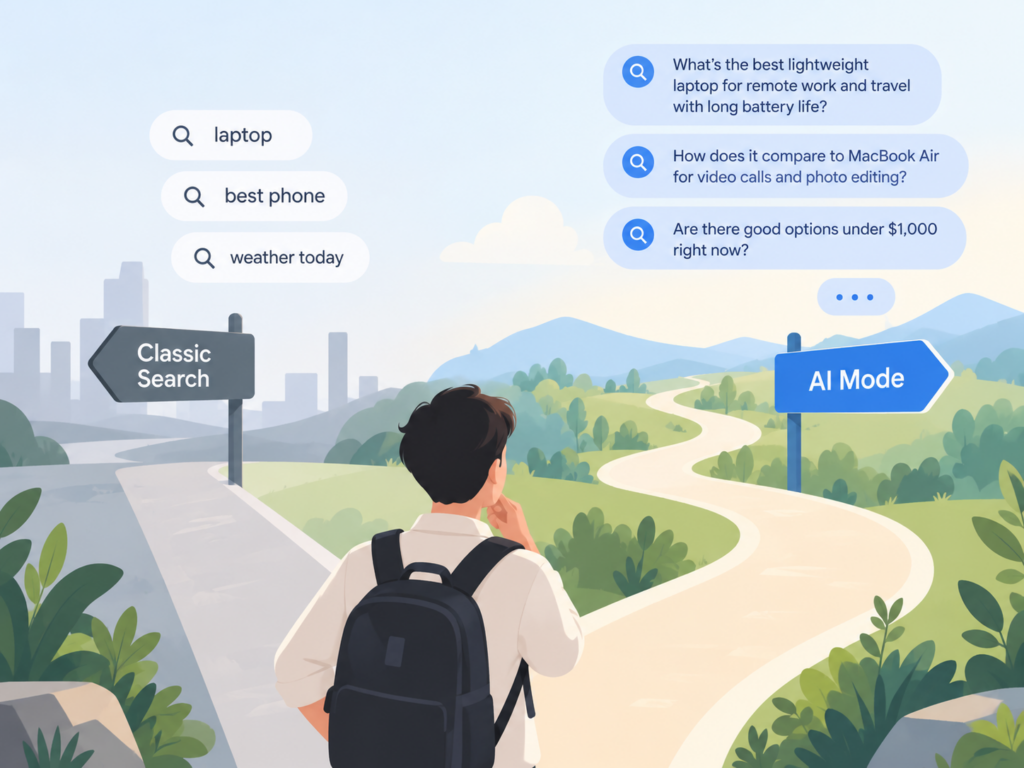
Queries look different in AI Mode too. The average AI Mode query runs about 7.22 words, nearly double the 4.0-word average for classic Google search, and follow-up questions inside a single AI Mode session have been climbing fast. That longer, more conversational query pattern is exactly the kind of input a URL-matching rank tracker was never built to parse.
What Tracking AI Mode Actually Requires
If position isn’t the metric, what is? Four things matter more:
- Mention rate. How often your brand shows up in AI Mode answers for the prompts that matter to your category, not just your target keywords.
- Sentiment. Whether the mention describes you accurately and favorably, or gets your positioning wrong.
- Source attribution. Which domains AI Mode actually cites when it talks about your space, and whether any of them are yours.
- Relative position. Where you land against named competitors inside the same answer, since AI Mode often surfaces two or three options side by side.
This is closer to brand monitoring than classic rank tracking, which is why most AI Mode trackers separate mention rate, citation share, and sentiment into distinct metrics rather than collapsing everything into a single rank number.
Topify builds around that same logic. Its Visibility Tracking metric measures how often your brand actually appears across AI Mode and other major AI platforms, rather than assuming a strong organic rank will carry over. Position Tracking shows where you land relative to named competitors inside the same conversational answer, and Source Analysis breaks down which domains AI Mode is citing for your category, so you can see whether the gap is a content problem or a citation problem.
None of that replaces classic SEO reporting. It sits next to it, covering the part of the funnel a URL-based crawler was never designed to see.
How to Set Up AI Mode Monitoring Without Losing Sight of Traditional SEO
Run both systems in parallel rather than picking one.
Start with a fixed list of the prompts your buyers actually ask, not just your target keywords, since AI Mode queries tend to be longer and more conversational than a typical search box entry. Check those prompts on a regular cadence and log three things each time: whether you’re mentioned, how you’re described, and which sources got cited alongside you.
Cross-reference that log against your traditional rank data monthly. If a keyword holds steady in classic rankings while its matching AI Mode prompts show declining mentions, that’s your early warning that the two systems have started to diverge for that topic.
Topify’s One-Click Execution can shorten that loop. State the visibility goal in plain language, review the proposed content or citation strategy, and deploy it without building a manual workflow from scratch each time a gap shows up.
Conclusion
Google ranking and Google AI Mode are running two different games on the same platform. One rewards position in a list. The other rewards being named inside an answer the user never has to click past. Tracking only one of them means flying blind on the surface that’s already sending 1 billion people a month home without visiting a single website.
FAQ
Is AI Mode ranking the same as SEO ranking?
No. Classic SEO ranking measures where a URL lands in an ordered list of results. AI Mode has no fixed order, so tracking it means measuring mention rate, sentiment, and citation share instead of position.
How do you track brand mentions in Google AI Mode?
Run a consistent set of buyer-relevant prompts through AI Mode on a regular schedule and log whether your brand is mentioned, how it’s described, and which sources are cited. Dedicated GEO platforms like Topify automate this across multiple AI engines at once.
Why does my page rank well but not appear in AI Mode?
AI Mode retrieves and synthesizes information at the passage and entity level rather than ranking whole pages, so strong keyword rankings don’t guarantee inclusion. Citation overlap between AI Mode and traditional top-10 rankings runs as low as 17% in some studies.
Can traditional rank trackers monitor AI Mode results?
Generally, no. Most rank trackers are built to scrape a static, list-based results page, while AI Mode output is conversational, dynamic, and varies by query phrasing, which requires a purpose-built AI visibility tool instead.

