
Your content team published 30 articles last quarter. Organic traffic went up. Google rankings held steady. But when a potential buyer asked ChatGPT for a recommendation in your category, the AI pulled from three sources you’d never heard of, and your brand wasn’t part of the answer.
The gap isn’t in your content volume. It’s in your visibility data. Traditional SEO tools can’t show you what AI search engines cite, recommend, or ignore. And without that data, every content decision your team makes is a guess.
Most Content Teams Optimize Without Knowing What AI Actually Cites
Here’s the core disconnect: Google Search Console and GA4 were built for the ten-blue-links era. They track keyword rankings, click-through rates, and referral traffic from traditional search.
AI search works differently. When someone asks Perplexity or ChatGPT a question, the model synthesizes information from multiple sources and delivers a direct answer. That’s the zero-click problem. Your content might be the primary source an AI cites, yet you’ll see zero referral traffic in your analytics dashboard. Traditional tools have no way to attribute that kind of visibility.
What makes this worse is that the sources AI models cite often don’t match what ranks on page one of Google. A page sitting at position 12 in Google’s index can be the top-cited source in ChatGPT’s answer for the same query. The overlap between Google’s top 10 and LLM citation lists is lower than most teams assume.
That means optimizing for Google rankings alone leaves your team flying blind in AI search.
What AI Visibility Analytics Software Actually Measures
The shift from traditional SEO analytics to AI visibility analytics software comes down to one word: citations.
Traditional tools ask, “Where do we rank?” AI visibility tools ask, “Are we being cited, recommended, and trusted by AI models?” Those are fundamentally different questions, and they require different data.
Here’s what the core metrics look like side by side:
| Metric | Traditional SEO | AI Visibility Analytics |
|---|---|---|
| Primary metric | Keyword ranking / CTR | Citation frequency / Visibility Score |
| Success indicator | Referral traffic | Brand placement in AI answers |
| Optimization goal | User satisfaction on SERPs | AI model preference for your content |
| Feedback loop | Search Console data | Source analysis and sentiment tracking |
AI visibility analytics software typically tracks five dimensions that traditional tools can’t touch:
Visibility Score measures how often and how prominently your brand appears in AI-generated responses across high-value prompts. Citation Sources identifies the exact domains and URLs that AI platforms pull from when they build an answer. Sentiment and Tone tracks how AI characterizes your brand: market leader, budget option, or invisible. AI Search Volume shows how many users are asking specific prompts in LLMs rather than typing keywords into Google. And Position Rank tells you where your brand sits relative to competitors within the same AI-generated answer.
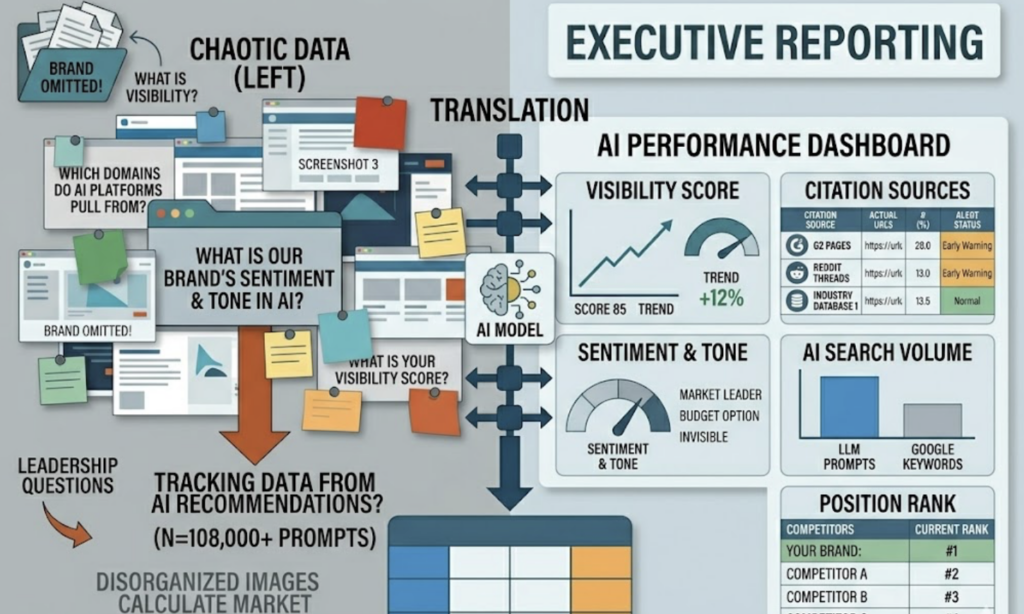
The difference between monitoring tools and analytics software matters here. Monitoring tools tell you whether your brand was mentioned. AI visibility analytics software tells you why it was mentioned, what sources the AI preferred, and what your content is missing.
How AI Content Optimization Tools Use Visibility Data
This is where ai content optimization tools diverge from traditional content workflows. Instead of starting with a keyword list and writing to match search volume, the process starts with data from AI search behavior.
The workflow follows what researchers call the “Prompt-to-Content” loop:
Step 1: Discovery. Identify high-value prompts, the questions users are asking AI that signal purchase intent or deep research interest. These aren’t always the same as high-volume Google keywords.
Step 2: Source Analysis. For each prompt, analyze which sources the AI currently cites. Look at the structure, data density, and format of those sources. If a competitor’s page is cited and yours isn’t, the analytics should tell you why.
Step 3: Optimization. Update your content to match the structural patterns AI models favor. That often means clearer definitions, more statistical citations, and a direct answering style. AI models tend to prioritize information density and factual authority over traditional SEO signals like backlink count.
Step 4: Verification. After content updates, track whether your Visibility Score and citation frequency improved. Close the loop.
This is what separates ai content optimization from traditional content optimization. Traditional content optimization asks, “Does this page rank for the target keyword?” AI content optimization asks, “Does this page get cited when someone asks an AI about this topic?”
Why Generative Content Optimization Teams Need Analytics, Not Guesswork
Generative content optimization teams face a specific trap: applying Google-era playbooks to AI search.
Research into content team behavior highlights two recurring mistakes. The first is ranking obsession. Teams see a page ranking #3 in Google and assume it’s performing well in AI search too. But AI models don’t rank pages the way Google does. They prioritize information density, factual authority, and direct-answer formatting over traditional signals like backlink volume or keyword frequency.
The second mistake is ignoring citation logic. AI models aren’t searching the web in real time the way a human would. They retrieve information based on training data, vector databases, and retrieval patterns that favor what researchers call “authoritative summarization.” If your content reads like a marketing page instead of an authoritative reference, it won’t get cited.
That’s the gap most content teams still can’t see.
Without analytics that specifically measure AI citation behavior, generative content optimization teams are making content decisions based on data that doesn’t reflect how AI search actually works. They’re optimizing for a system that isn’t the one evaluating their content.
How Topify Turns AI Visibility Data into Content Action
For content teams looking for ai visibility analytics software that connects data to decisions, Topify stands out by covering the full loop: discovery, tracking, analysis, and execution in one platform.
Here’s how it maps to a content team’s actual workflow:
High-Value Prompt Discovery surfaces the AI prompts that matter most to your category. Instead of guessing which topics to write about, your content manager sees which questions users are actually asking ChatGPT, Perplexity, Gemini, and DeepSeek, along with real volume data for each prompt.
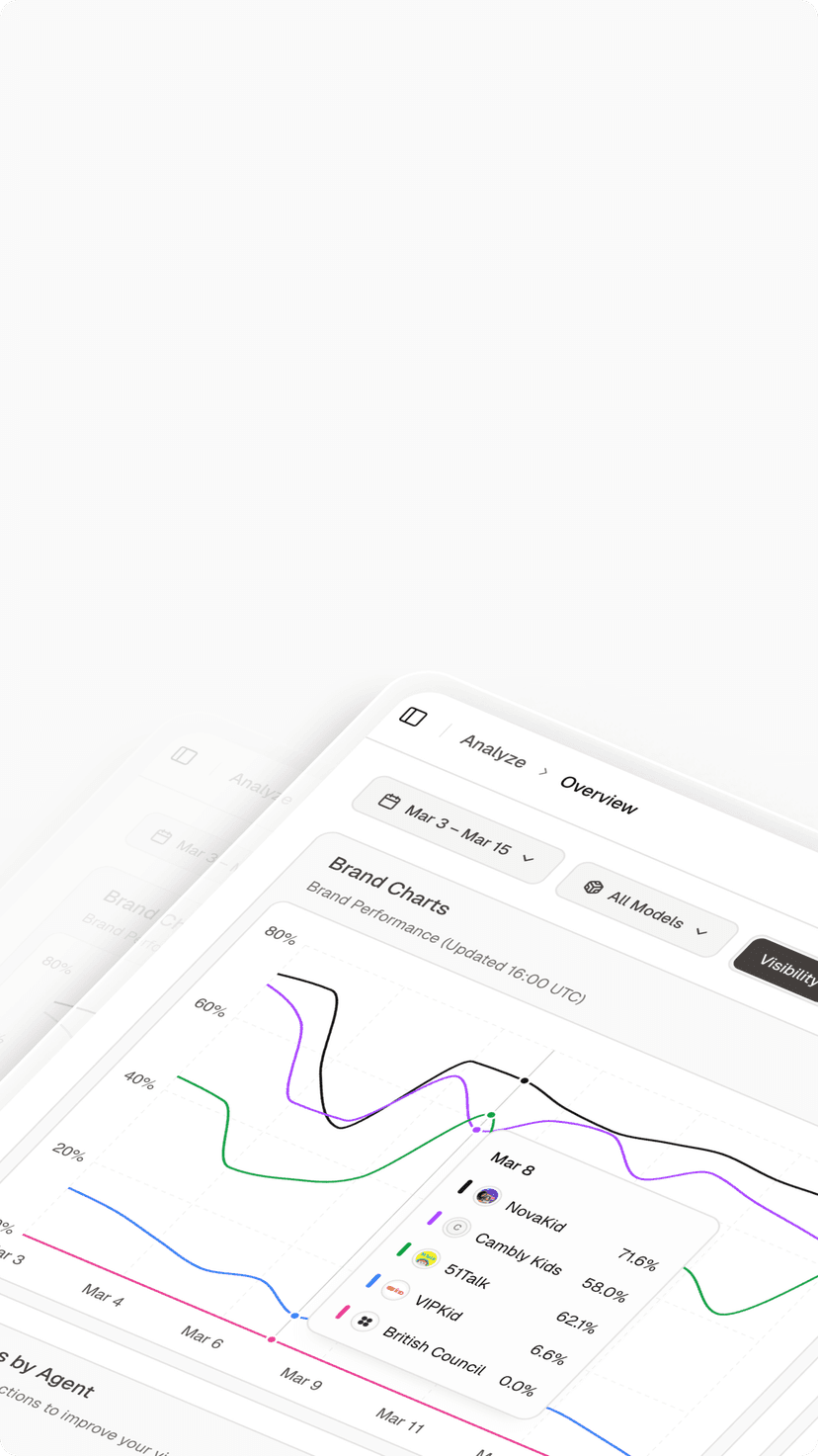
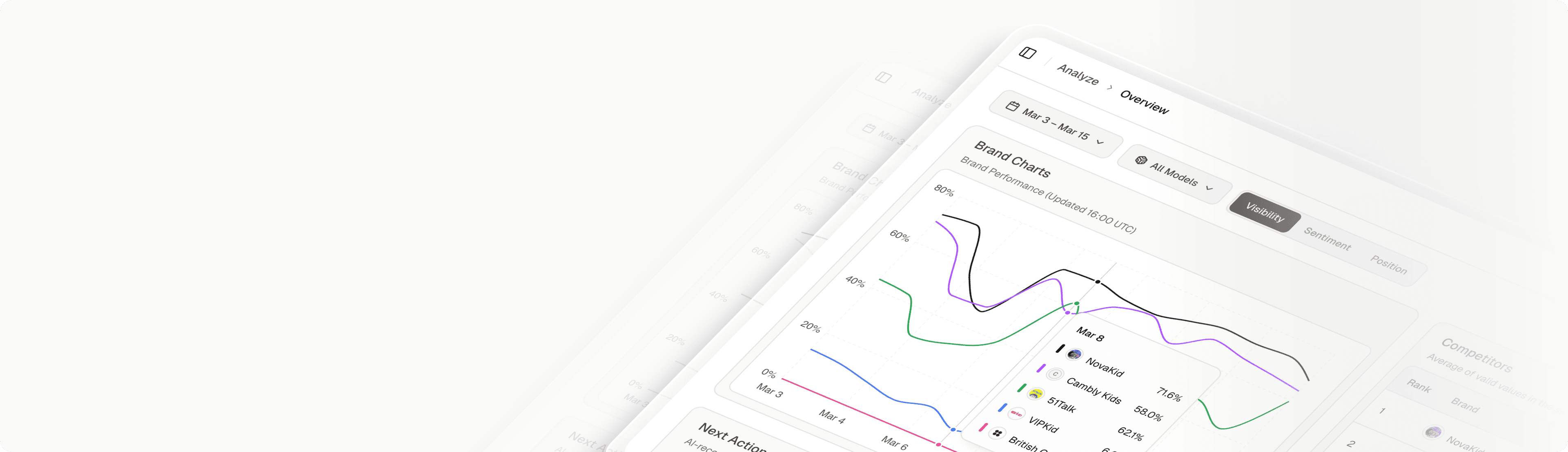
Visibility Tracking monitors how often your brand appears in AI-generated answers across those prompts. Coverage spans ChatGPT, Gemini, Perplexity, DeepSeek, Doubao, Qwen, and other major AI platforms. The Visibility Score updates as AI models shift their citation patterns, so your team isn’t working with stale snapshots.
Source Analysis is where the content optimization insight lives. It identifies the exact domains and URLs that AI platforms cite for each prompt. If a competitor’s blog post is getting cited and yours isn’t, Source Analysis shows you what that content has that yours doesn’t. This is the difference between knowing you’re invisible and knowing how to fix it.
One-Click Agent Execution takes the insights from Source Analysis and turns them into content actions. State your optimization goal in plain English, review the proposed strategy, and deploy it. No manual workflows, no handoff delays between analytics and content production.
The platform was built by a team that includes founding researchers from OpenAI and Google’s top SEO practitioners, which shows up in the precision of its citation tracking algorithm. Pricing starts at $99/month for the Basic plan (100 prompts, 9,000 AI answer analyses) and $199/month for Pro (250 prompts, 22,500 analyses). Both tiers include multi-seat access, so your entire content team works from the same data.
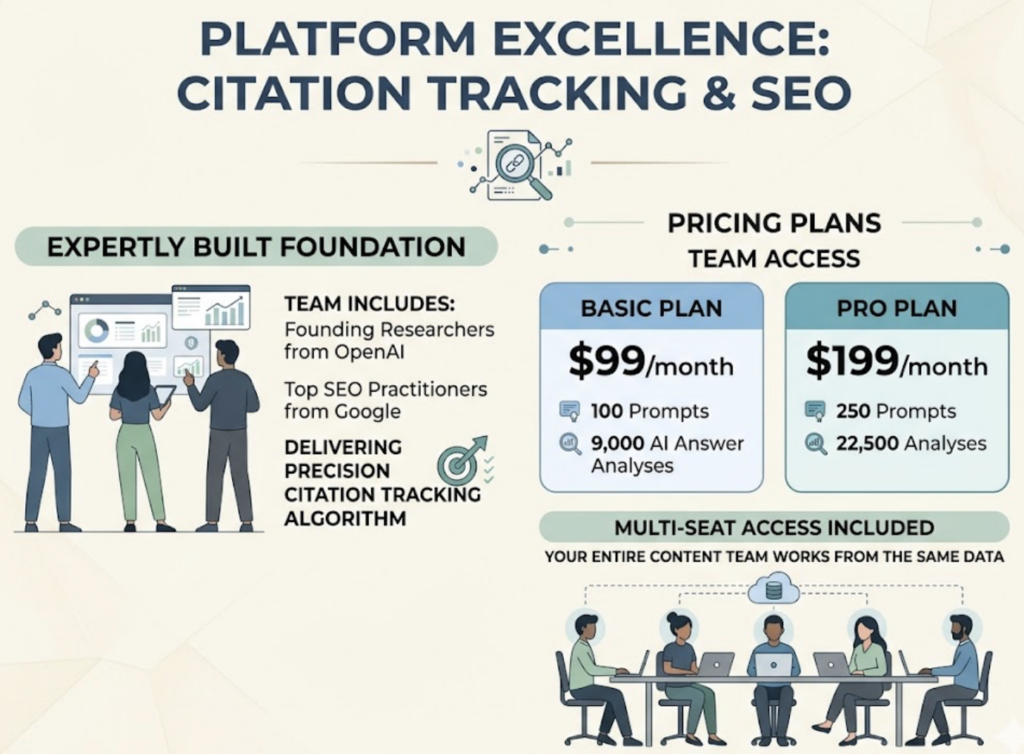
Bottom line: Topify doesn’t just show you what AI is saying about your brand. It shows your content team exactly what to do about it.
Picking the Right AI Content Optimization Software for Your Team
When evaluating the best ai content optimization for search, content teams should filter on four dimensions:
| Dimension | Monitoring-Only Tools | AI Visibility Analytics Software |
|---|---|---|
| Coverage | Single platform or brand mentions only | Multi-platform (ChatGPT, Gemini, Perplexity, etc.) |
| Analytics depth | “Were we mentioned?” | “Why were we cited? What sources did AI prefer?” |
| Content action | Manual interpretation | Integrated optimization workflows |
| Team fit | PR and reputation monitoring | Content strategy and production teams |
Monitoring-only tools like brand mention trackers are useful for PR, but they don’t give content teams enough data to make optimization decisions. If your team needs to know which pages to update, which prompts to target, and how to structure content for AI citation, you need an analytics platform with source-level depth.
Three questions to ask before committing:
Does it cover the AI platforms your audience actually uses? A tool that only tracks ChatGPT misses the half of your audience on Perplexity or Gemini. Does it connect analytics to action? Dashboards without execution workflows create bottlenecks. Does it scale with your team? Multi-seat access and project-based organization matter when more than one person is involved in content decisions.
If you’re starting from zero, get started with Topify by tracking 10-20 prompts in your category and running Source Analysis on the top results. Within a week, your content team will have a prioritized list of content gaps that no Google-based tool would surface.
Conclusion
Content teams that still rely on Google rankings to guide their AI search strategy are optimizing for the wrong system. AI visibility analytics software gives your team the data layer that’s been missing: what AI cites, why it cites it, and where your content falls short.
The content teams that move fastest on this will be the ones whose brands show up when AI answers the questions that matter. The ones that wait will keep publishing into a gap they can’t measure.
FAQ
Q: What’s the difference between AI visibility analytics and traditional SEO analytics?
A: Traditional SEO analytics track keyword rankings, click-through rates, and referral traffic from search engines like Google. AI visibility analytics measure how often and how prominently your brand gets cited in AI-generated answers across platforms like ChatGPT, Perplexity, and Gemini. The two datasets rarely overlap, which is why you need both.
Q: Can ai tools for content optimization based on search data replace manual content strategy?
A: They don’t replace your content team’s judgment, but they dramatically improve what that judgment is based on. Instead of guessing which topics to prioritize, your team gets data on which AI prompts have volume, which sources AI currently cites, and where your content has gaps. Strategy still requires human decisions, but the inputs are sharper.
Q: How often should content teams check AI visibility data?
A: AI models update their citation patterns more frequently than most teams expect. A weekly check on Visibility Score and Source Analysis is a good baseline. For high-priority prompts or competitive categories, daily monitoring catches shifts before they compound.
Q: What’s the best ai content optimization for search if you’re just starting out?
A: Start with a platform that covers multiple AI search engines and includes source-level analysis, not just brand mention tracking. Topify’s Basic plan at $99/month gives content teams 100 tracked prompts and 9,000 AI answer analyses, which is enough to identify your biggest visibility gaps and prioritize your first round of content updates.