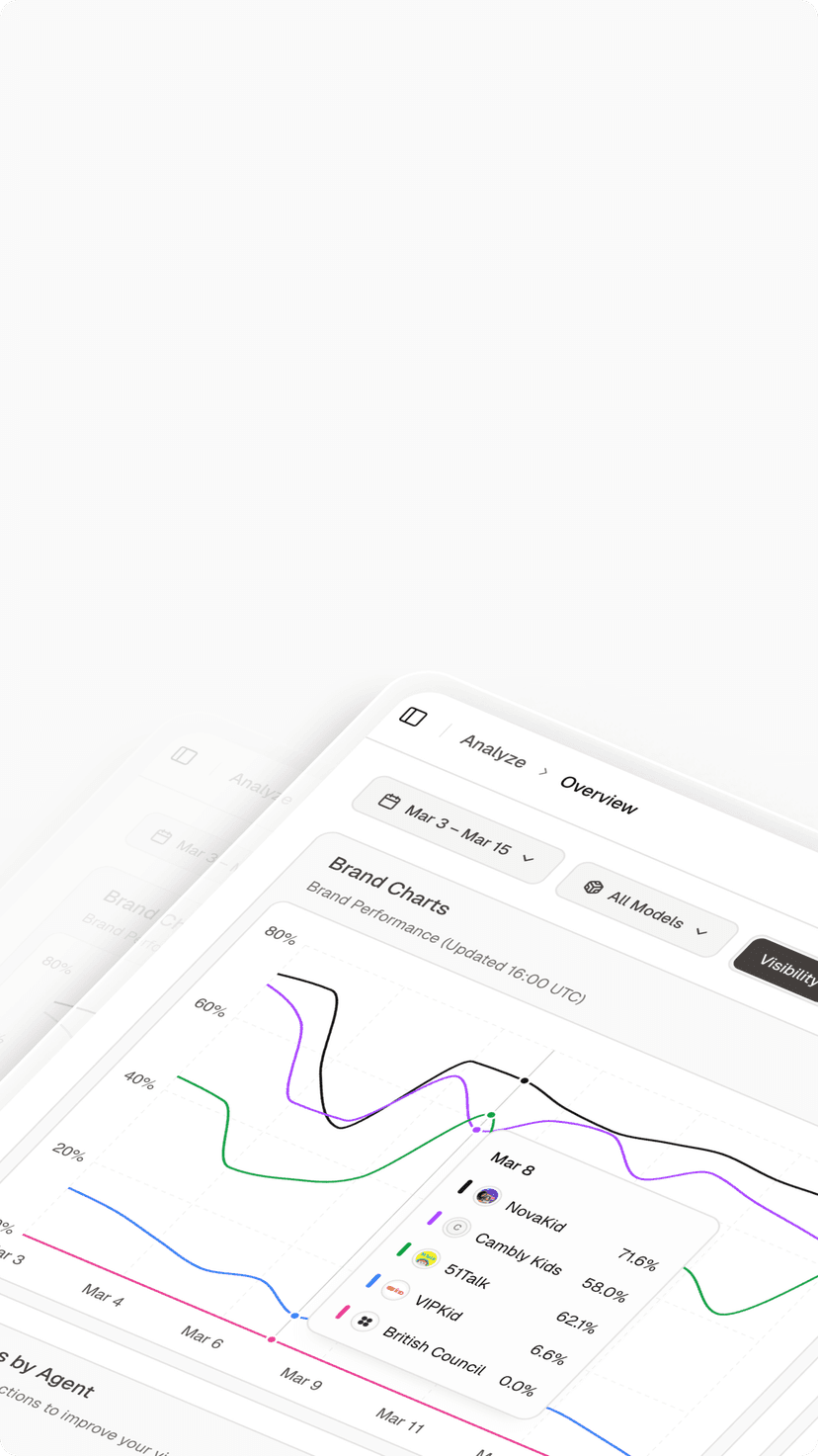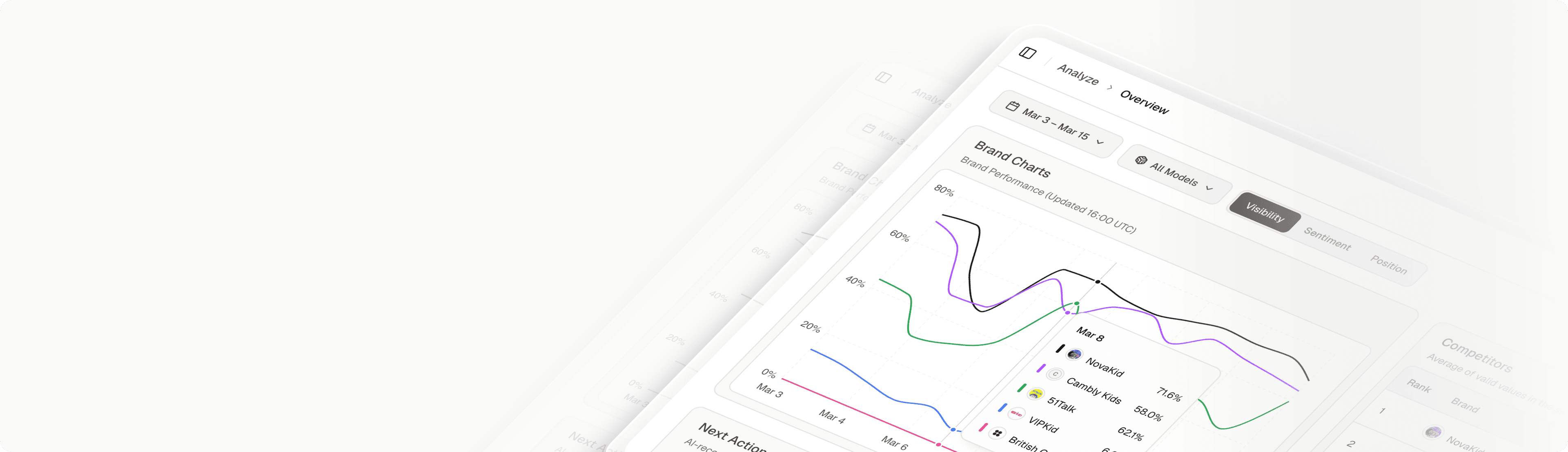

Your competitor dashboard says you’re winning. Higher domain authority, more ranking keywords, a bigger share of voice than the brand you’ve been tracking for years. Then someone on your team asks ChatGPT which brand to pick in your category, and it recommends the competitor you just beat on every SEO metric. That gap isn’t a glitch. AI visibility competitor analysis runs on a different set of signals than the research most teams still rely on, and the tools built for blue links were never designed to see it.
Your Competitor Report Still Thinks Rankings Are Everything
The logic behind most competitor analysis hasn’t changed in a decade: track keyword rankings, count backlinks, compare SERP share. That logic assumes being findable means being seen. In AI search, that assumption breaks. Roughly 93% of AI search sessions now end without a single click, which means the entire premise of “who ranks higher” stops mattering the moment a user asks an AI system for a recommendation instead of a link.
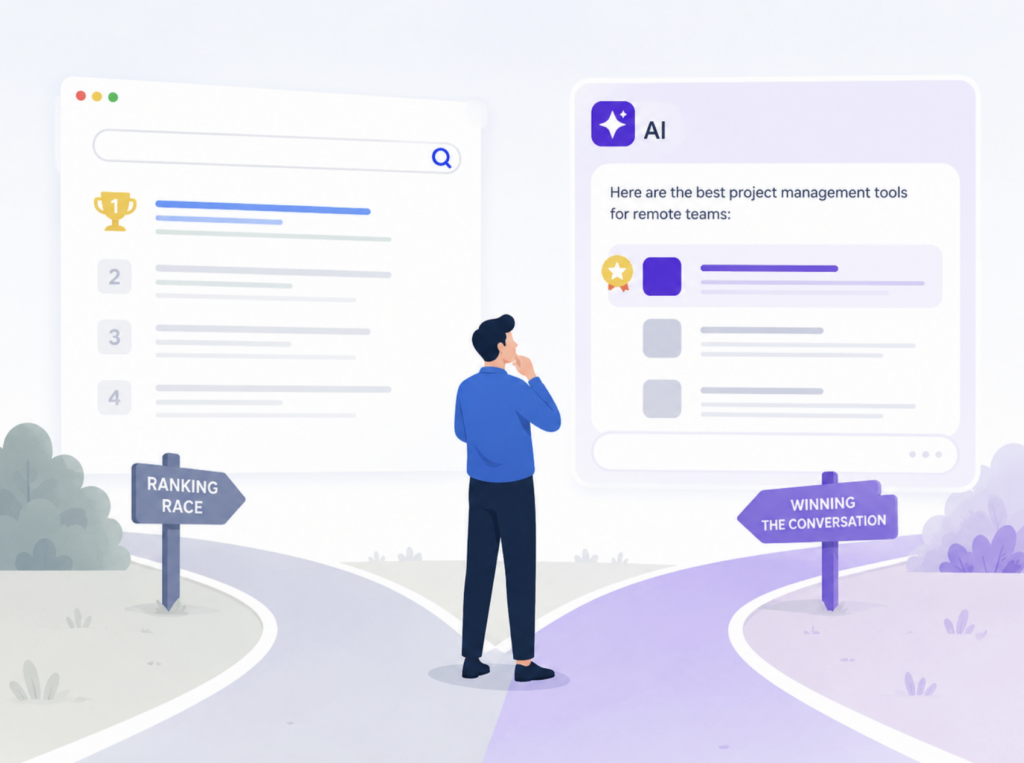
Here’s the harder part: your competitor might be losing the keyword race and still winning the conversation that actually decides the sale. Ranking on page one means nothing if the AI never mentions you.
Blind Spot 1: They Track Search Rank, Not Answer Inclusion
Traditional tools answer one question well: where do you sit in the SERP. AI search asks a different question entirely: did the model choose to mention you at all. Those aren’t the same metric, and treating them as interchangeable is where most competitor analysis for AI search visibility falls apart.
The emerging metric hierarchy looks different from anything in a classic rank tracker. Analysts now recommend starting with mention frequency as a baseline, then layering in citation quality and relative share against competitors. A brand can dominate organic rankings and still register a mention frequency near zero across the prompts that matter most to its category. That’s the blind spot a keyword-first competitor report simply can’t surface.
Blind Spot 2: They Miss the Prompt-Level Battlefield
Competition used to happen at the keyword level. It now happens at the prompt level, and the difference is bigger than it sounds. A single topic can fan out into dozens of differently worded prompts, and each one can produce a completely different set of brands in the answer.
Traditional competitor analysis tools were built to monitor a finite keyword list, not an open-ended set of natural language questions. That’s a structural mismatch, not a feature gap you can patch with more keywords. Without prompt-level tracking, you’re comparing yourself to competitors on a battlefield that no longer represents how buyers actually search.
Blind Spot 3: They Can’t See Which Sources AI Actually Cites
AI answers don’t come from nowhere. They’re built on sources the model has learned to trust and cites when it responds, and those sources shift constantly. Recent tracking found that 40% to 60% of cited sources change month to month across major AI platforms, which makes citation share one of the most volatile competitive metrics in AI search today.
Traditional competitor analysis looks at a competitor’s own domain authority and backlink profile. It has no visibility into whether that competitor has quietly captured the third-party sources an AI model actually pulls from, like review sites, forums, or comparison pages. Once a domain becomes a regularly cited source, the volatility gap between it and rarely cited domains can run as high as 70x, meaning early movers in citation share get progressively harder to dislodge.
Blind Spot 4: They Ignore How AI Talks About Your Competitor
Traditional competitor analysis produces neutral data points: traffic, rankings, keyword overlap. None of that captures tone. When an AI system recommends a brand, it often frames it with implicit judgment, calling one option “industry-leading” and another “a budget pick” for the exact same query.
That framing shapes buyer perception before a click ever happens, and it’s invisible to a tool built to count rankings. Two competitors with identical visibility scores can walk away with very different outcomes if one gets described as the premium choice and the other doesn’t get described at all.
Blind Spot 5: They’re Blind to Multi-Platform Fragmentation
Competitive position in one AI engine tells you almost nothing about your position in another. Visibility on ChatGPT doesn’t predict visibility on Perplexity or Claude, and multi-platform monitoring is the only way to get the complete competitive picture. The scale gap between platforms adds to the problem. ChatGPT alone processes roughly 2 billion queries a day and holds over 60% of the AI platform market, while Perplexity handles more than 30 million daily queries with its own distinct citation patterns.
Winning in ChatGPT doesn’t mean you’re winning in Perplexity. Most competitor analysis workflows still center on a single search engine, which leaves entire categories of AI-driven competition completely unmonitored.
How Closed-Loop Competitor Monitoring Closes These Gaps
Each of these blind spots points to the same root cause: competitor analysis built for a single search engine can’t account for a discovery layer that runs on prompts, citations, and multiple AI platforms at once. Closing that gap takes a different kind of monitoring, one built around AI answers instead of search results.
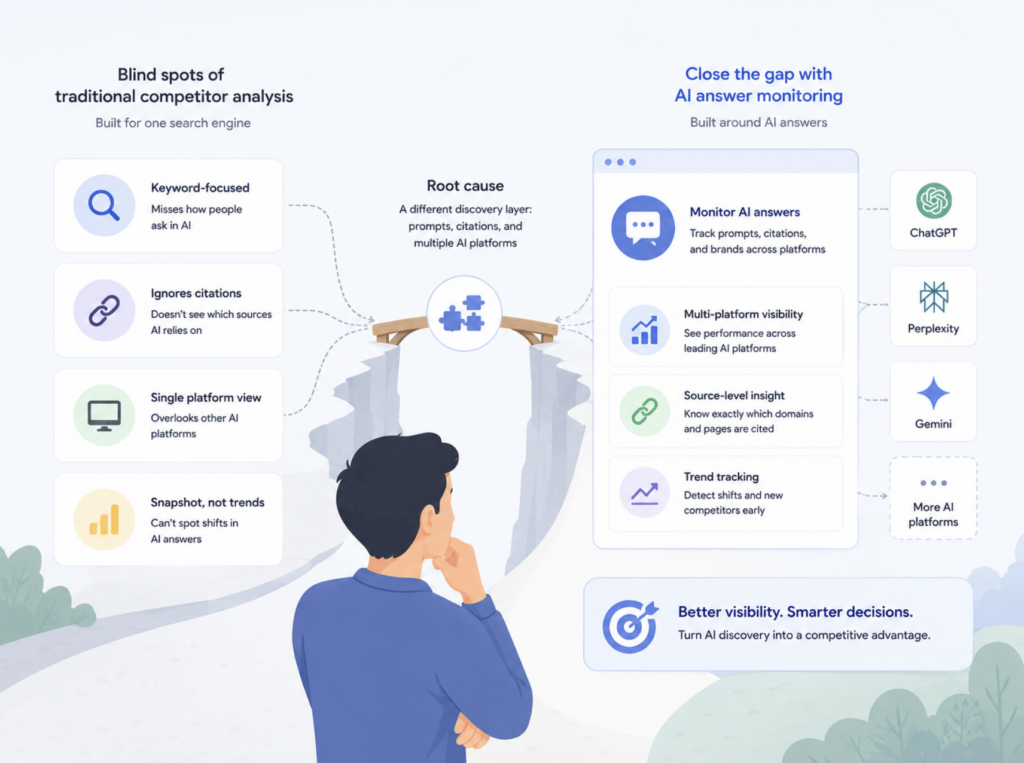
Topify’s competitor analysis tool approaches this by tracking Dynamic Competitor Benchmarking across ChatGPT, Perplexity, Gemini, and other major AI platforms at once. In practice, that means you can see which competitors are gaining mention frequency on prompts you thought you owned, and catch a new rival emerging in AI answers before it shows up anywhere in your traditional SEO reports.
The same system layers in Source Analysis, which reveals the domains AI platforms are actually citing for your category, and Sentiment Analysis, which tracks how AI language frames your brand relative to competitors. Instead of comparing rankings after the fact, teams get a live view of where the competitive gap is opening and which specific prompt or source is driving it. Only 14% of brands currently run any kind of AI visibility strategy, which means most competitor analysis workflows haven’t caught up to where the competition has already moved.
Conclusion
Traditional competitor analysis was built to measure a search engine that ranks links. AI search recommends answers instead, and that shift changes what “winning” against a competitor actually looks like. Teams that keep measuring rank position, backlinks, and SERP share will keep missing the mention frequency, citation sources, and cross-platform gaps where the real competitive battle is happening. Closing those five blind spots starts with expanding what you track, not just how often you check it.
FAQ
Q: How is AI search competitor analysis different from traditional SEO competitor analysis?
A: Traditional SEO competitor analysis compares rankings, backlinks, and organic traffic share. AI search competitor analysis compares mention frequency, citation sources, and sentiment across AI platforms like ChatGPT and Perplexity, where search rank often has little bearing on whether a brand gets mentioned at all.
Q: Why does my competitor rank lower in Google but appear more often in ChatGPT?
A: AI platforms pull from a different mix of sources than classic search rankings reward, including forums, review sites, and third-party comparison content. A competitor can be weaker on domain authority while still being more frequently cited across the sources an AI model actually trusts.
Q: Do I need to track competitors on every AI platform, or is one enough?
A: One platform tends to give an incomplete picture. Visibility on ChatGPT doesn’t reliably predict visibility on Perplexity, Gemini, or Claude, so a full competitive view generally requires monitoring across the platforms your audience actually uses.
Q: How often does competitive positioning change in AI search compared to traditional SEO?
A: AI search tends to move faster. Cited sources can shift from month to month, and mention frequency for a given prompt can change as AI platforms update their models or discover new content, making competitive monitoring closer to a continuous process than a quarterly check-in.