

Your brand ranks second on Google for your category’s biggest keyword. You’ve checked Ahrefs, you’ve checked Search Console, everything looks fine. Then someone on your team asks ChatGPT the exact same question, and your brand doesn’t show up at all. A competitor with a thinner backlink profile gets recommended instead.
That gap isn’t a fluke. It’s a measurement problem, and it’s the reason most competitor analysis frameworks built for Google don’t transfer to AI search.
Your Google Competitors Aren’t Your AI Competitors
Traditional competitor analysis runs on a handful of metrics: domain rating, referring domains, keyword overlap, share of voice in organic rankings. Those numbers still matter for classic SEO. They tell you almost nothing about who AI engines actually recommend.
A large-scale correlation study cited by Digital Applied found that branded web mentions correlate with AI visibility at roughly 0.66, while backlink counts correlate at just 0.22, about a third as strong. Domain rating fares slightly better at 0.33, still less than half the pull of brand mentions. The signal that used to define competitive strength in Google barely registers in AI answers.
There’s a second layer to this. AI engines don’t share a source pool the way Google’s top 10 is a single shared list. Research from Authority Tech analyzing 680 million citations found only 11% domain overlap between ChatGPT and Perplexity. A separate 300,000-citation study of six B2B SaaS brands found citation volume for the same brand varied by up to 615x between platforms. Your ChatGPT competitor and your Perplexity competitor might not even be the same company.
That’s the gap most brands still can’t see.
Step 1: Find Out Who AI Actually Recommends
Start the way you’d start any competitor analysis: figure out who shows up. But the method has to change.
The manual version looks like this: open ChatGPT, Perplexity, and Gemini, run the prompts a buyer would actually type (“best project management tool for remote teams,” “top GEO platforms for agencies”), and log which brands get mentioned. Do this for 15 or 20 prompts and a pattern starts to form.
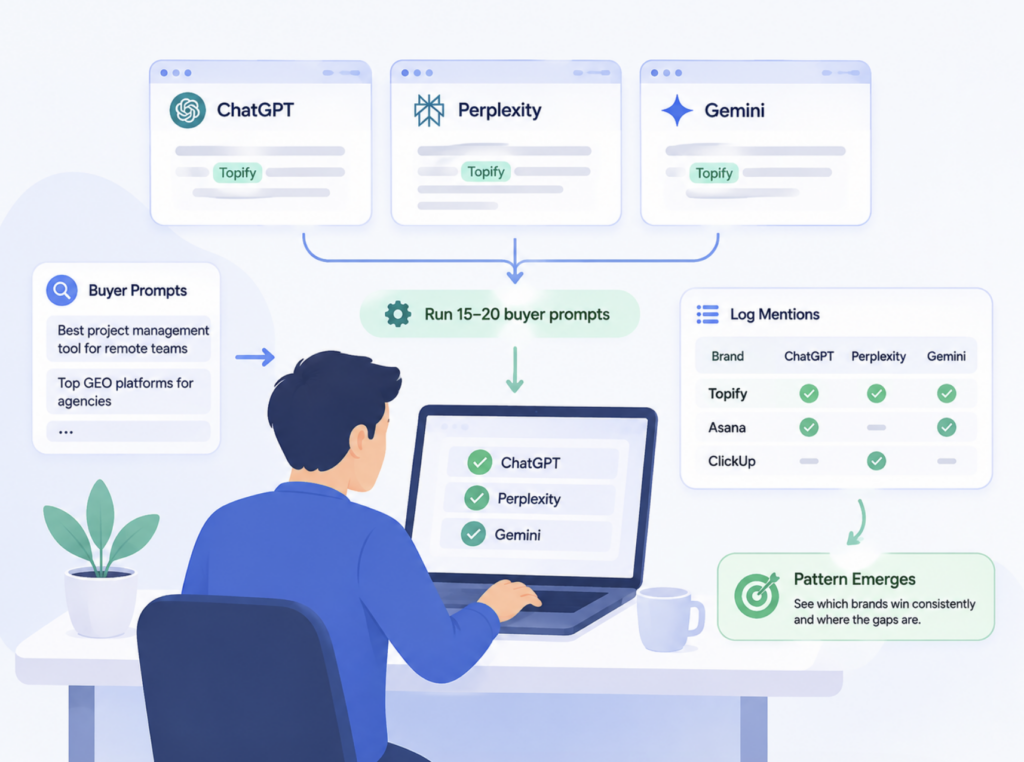
The problem is scale. A handful of manual prompts gives you a snapshot, not a trend line, and AI answers shift as models update, as source pools rotate, and as competitors publish new content. Ahrefs’ Brand Radar research tracked 75,000 brands to get a reliable read on what predicts citation, a scale no manual process reaches.
This is where automated competitor monitoring earns its keep. Topify’s Competitor Monitoring tracks which brands AI engines mention against a running prompt set, across platforms, without you retyping the same 20 questions every week.
Step 2: Compare Across the Metrics That Actually Matter
Once you know who’s showing up, the next question is how they’re showing up. A single mention count flattens a lot of useful detail.
| Metric | What it tells you | Manual process | Automated process |
|---|---|---|---|
| Visibility | How often a brand appears across prompts | Spot-check a handful of queries | Continuous tracking across the full prompt set |
| Sentiment | Whether the mention is positive, neutral, or negative | Read each answer individually | Scored automatically per response |
| Position | Where a brand lands in a list of recommendations | Hard to judge consistently by eye | Tracked over time, per platform |
| Mentions | Raw frequency across platforms | Limited to what you manually test | Covers ChatGPT, Perplexity, Gemini, and more |
Position matters more than it looks. One analysis of Perplexity responses found 86% of brand mentions land in position five or earlier, while ChatGPT tends to produce longer, more exhaustive lists. A brand that gets mentioned but buried at position nine is functionally invisible to a user who reads the first three recommendations and moves on.
Sentiment is the metric most manual audits skip entirely, and it’s the one that separates a real competitive win from a hollow one. Getting mentioned isn’t the same as getting recommended.
Step 3: Reverse-Engineer What Content Gets Competitors Cited
This is the step that turns competitor analysis into a content plan instead of a scoreboard.
For every competitor that outranks you in AI answers, trace the citation back to its source. Which specific page did the AI engine pull from? Is it a comparison article, a product page, a Reddit thread, a review site? A meta-analysis synthesizing 54 studies found that editorial blog content accounts for over half of all AI citations, while press releases account for a vanishing fraction, near zero. If your competitor’s advantage traces back to a single well-structured comparison page, that’s a specific, fixable gap, not an abstract brand problem.
This is the step most teams skip, and it’s the one most worth doing.
Topify’s Reverse-Engineer AI Citations feature automates this trace, surfacing the exact domains and URLs AI platforms pull from when they cite a competitor instead of you.
Step 4: Track Position Changes Over Time, Not Just a Snapshot
A single competitor analysis is a photo. AI rankings move more like weather.
Model updates shift what gets cited. Source pools change, sometimes abruptly: Perplexity’s Reddit citations reportedly dropped 86% after a 2025 scraping dispute, with YouTube partially filling the gap. A competitor that dominated your category’s AI answers in January can lose ground by June, and you won’t know unless you’re watching continuously.
The fix is a fixed, repeatable prompt set, tested on a regular cadence rather than once per quarter. Topify’s Position Tracking handles this automatically, flagging when a competitor moves up or down relative to your brand across the same prompts, on the same schedule, every time.
Common Mistakes When Analyzing AI Search Competitors
A few patterns show up again and again in teams doing this for the first time.
Testing one platform and calling it done. With domain overlap between ChatGPT and Perplexity sitting around 11%, a ChatGPT-only audit misses most of the competitive picture.
Treating a one-time screenshot as an ongoing benchmark. AI answers aren’t static. A snapshot from three months ago tells you almost nothing about today’s competitive landscape.
Counting mentions without checking sentiment. A competitor mentioned ten times with lukewarm framing isn’t necessarily beating a brand mentioned five times with a strong recommendation.
Turning Competitor Analysis Into an Action Plan
The output of a good competitor analysis isn’t a report, it’s a backlog. Once you know which competitors are winning, on which platforms, and from which sources, the next moves are specific: close the content gap on the topics where a competitor’s page keeps getting cited, fix accessibility issues on pages that should be citable but aren’t, and build the branded mentions that correlate far more strongly with AI visibility than another round of link building.
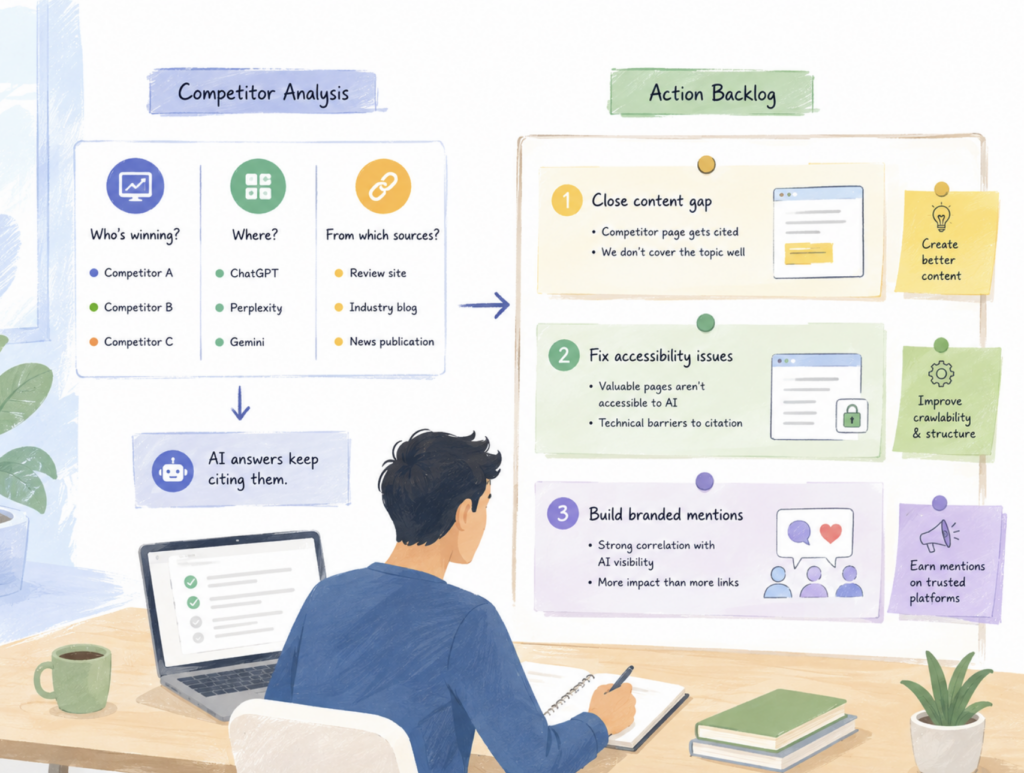
You can run this whole workflow, competitor detection, metric comparison, and source tracing, through Topify’s Competitor Analysis tool. Enter your brand and a shortlist of competitors, and it maps out where you stand across the platforms that matter, in minutes rather than a week of manual prompting.
Conclusion
Google competitor analysis and AI search competitor analysis are not the same exercise wearing different clothes. The metrics that used to signal competitive strength, backlinks, domain rating, don’t carry the same weight when an AI engine decides who to recommend. Brands that win in AI search are the ones tracking mentions, sentiment, and citation sources across platforms, on a schedule, not the ones with the biggest link profile.
FAQ
How do I analyze competitors in ChatGPT specifically?
Run a consistent set of buyer-intent prompts through ChatGPT and log which brands get mentioned, at what position, and with what sentiment. Repeat on a fixed schedule since ChatGPT’s citation pool shifts with model updates.
Is the AI search competitive landscape the same as Google’s?
No. Domain overlap between major AI engines runs as low as 11%, and correlation studies show backlinks and domain rating matter far less than branded mentions for AI citation. Treat AI search as a separate competitive map, not an extension of your Google rankings.
What is GEO competitor benchmarking?
It’s the practice of tracking a brand’s visibility, sentiment, and position against named competitors across AI platforms like ChatGPT, Perplexity, and Gemini, typically automated since manual prompt testing doesn’t scale to multiple platforms and a regular cadence.
How often should I re-run a competitor analysis for AI search?
At minimum monthly. AI citation pools shift with model updates and source pool changes, so a quarterly or one-time check will miss meaningful competitive movement.

