

Someone opens ChatGPT and types “find me running shoes under $150 in size 10.” The agent searches, compares, and either checks out on the spot or hands the shopper straight to a merchant. No browser tabs. No scrolling through search results. No side-by-side comparison of ten websites.
That’s agentic commerce. And it’s already live.
What “Agentic Commerce” Actually Means
Agentic commerce is when autonomous AI agents research, compare, and purchase products on behalf of a human buyer. It’s a step beyond conversational commerce, where a chatbot just assists a human shopper. Here, the AI system takes over decision-making and, in a growing number of cases, the transaction itself.
The shopper states intent. The agent handles discovery, comparison, and either checkout or a seamless handoff to the merchant. That’s the entire shift in one sentence.
This isn’t a future scenario. McKinsey projects the global agentic commerce opportunity will hit $3 trillion to $5 trillion by 2030, and Morgan Stanley estimates $190 billion to $385 billion of U.S. e-commerce spending will run through agentic shoppers by that same year. Bain puts the U.S. market even higher, at $300 billion to $500 billion, or 15% to 25% of e-commerce.
Why This Is Different From Ranking on Google or Being Cited by ChatGPT
Traditional SEO solves for “being found.” GEO solves for “being mentioned.” Agentic commerce solves for something harder: being selected and paid for, without a human ever seeing the alternatives you lost to.
In classic e-commerce, retailers see impressions, clicks, dwell time, add-to-cart events, and funnel drop-offs. In agent-mediated commerce, that entire story disappears. The behavioral data stream starts at the add-to-cart moment, while the discovery, browsing, and consideration all happen inside the AI system.
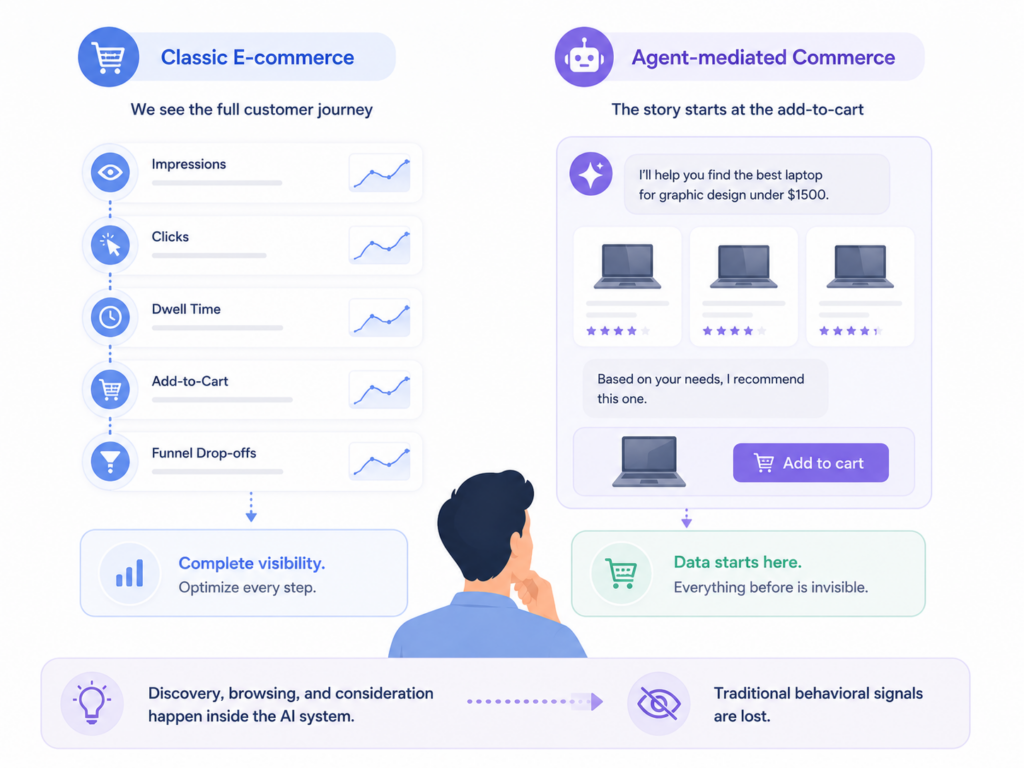
That’s not a small detail. It means a brand can lose a customer during the comparison stage and never know it happened.
The scale backs this up. Shopify reported AI-driven traffic to its stores grew 8x year over year in Q1 2026, with orders from AI-powered search up nearly 13x. Those orders also carried 14% higher average order values compared to organic search. Brands catching this wave aren’t seeing marginal gains. They’re seeing a new channel outperform the old one.
Where Brands Are Already Going Invisible
Here’s the part most marketing teams miss. AI agents don’t crawl your website the way Google does. They read a feed.
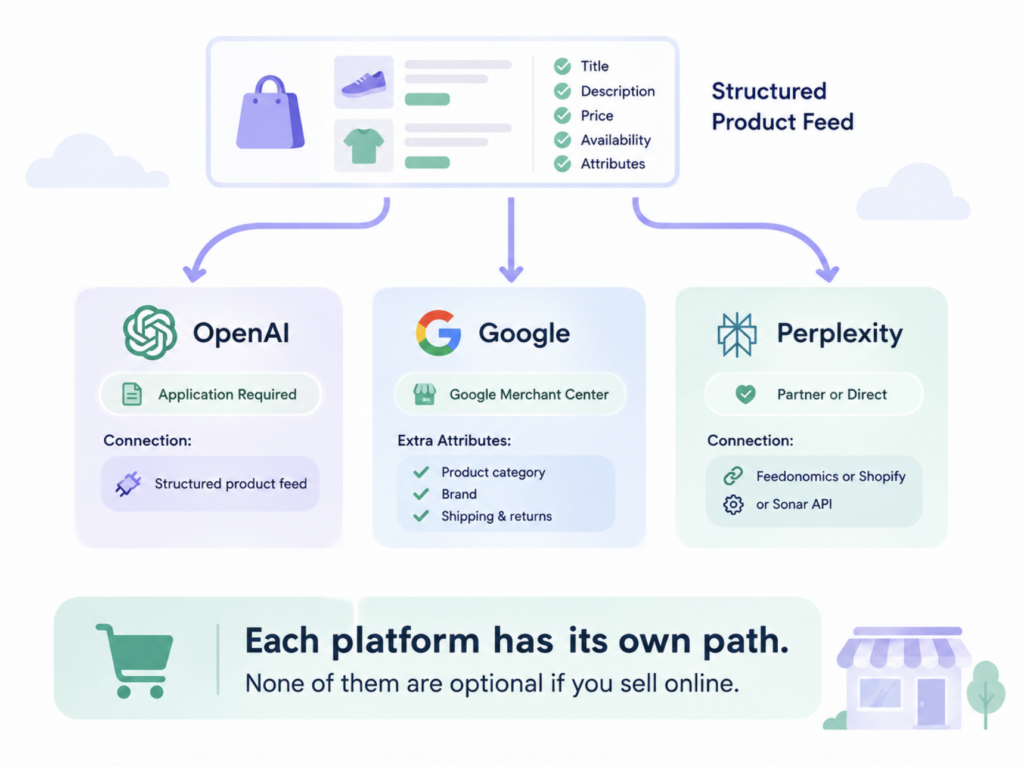
The OpenAI Product Feed acts as the single source of truth for a merchant’s product data, including titles, prices, stock, and media, and powers search, discovery, and checkout inside ChatGPT. Critically, this data isn’t crawled. Merchants push a structured file directly to OpenAI’s endpoint. No feed, no listing, no matter how well your site ranks on Google.
If you’re not in the feed, you don’t exist to the agent.
The numbers on structured data make the stakes concrete. Pages with structured data are cited 3.1x more frequently than pages without it. And the honest state of most catalogs isn’t good. Google’s Universal Commerce Protocol launched in January 2026 with Shopify, Wayfair, Target, Etsy, and Walmart as founding partners, and OpenAI’s Agentic Commerce Protocol already powers ChatGPT’s Instant Checkout. The infrastructure exists. The real question is whether a given merchant’s product data is in a format agents can read, trust, and act on, and for most stores today the honest answer is no.
What Determines Whether an AI Agent Picks Your Brand
Agents don’t judge a brand by tone of voice or homepage design. They judge it by data completeness.
The minimum bar is low but strict. Every product record needs an ID, title, description, price, availability, URL, and image, with 25 or more additional structured attributes recommended for discovery quality. Fields like GTIN coverage per SKU are called out as the single highest-leverage fix for Perplexity and ChatGPT discoverability. Marketing copy actually hurts you here. ChatGPT rejects feeds that use promotional language in the description field, and mismatched pricing between the feed and the live product page is one of the leading reasons feeds get rejected outright.
Consumer behavior adds another layer. 73% of consumers already use AI somewhere in their shopping journey, mostly for getting product ideas, summarizing reviews, and comparing prices. But trust hasn’t caught up to comfort. 70% say they’re at least somewhat comfortable with an AI agent making a purchase on their behalf, yet only 4% trust an AI to buy without a final human review. That gap is exactly why the brands that show up clearly, with clean data and credible signals, win the moment a shopper does let the agent decide.
That’s the practical difference between traditional visibility and agentic visibility.
| Traditional SEO / GEO | Agentic Commerce | |
|---|---|---|
| What’s tracked | Rankings, citations, mentions | Selection and transaction completion |
| Data source for AI | Crawled web pages | Merchant-pushed structured feed |
| Update frequency | Days to weeks | As often as every 15 minutes |
| Failure mode | Lower ranking, fewer clicks | Total absence from the agent’s candidate set |
How to Check If Your Brand Is Visible to Shopping Agents
The fastest test costs nothing. Open ChatGPT, Perplexity, or Gemini and run the exact prompts your customers would use to shop your category. Note whether your brand shows up, in what position, and against which competitors. Do this across a handful of real purchase-intent prompts, not just your brand name.
That manual check tells you where you stand today. It won’t tell you where you’re losing ground next month, or which competitor just improved their feed and jumped ahead of you.
This is where Topify’s Comprehensive GEO Analytics becomes useful. It tracks brand performance across major AI platforms through seven metrics: visibility, sentiment, position, volume, mentions, intent, and CVR, the last of which estimates how likely an AI answer is to actually drive a real interaction or purchase rather than just a mention. For agentic commerce specifically, CVR matters more than any single citation count, because being named by an agent means nothing if the agent never routes the shopper toward you. Topify’s Dynamic Competitor Benchmarking layers on top of that, showing who the agent recommends instead of you and how that ranking shifts as your feed and content change.
Checking once tells you your current score. Checking continuously tells you whether you’re gaining or losing ground as protocols like ACP and UCP keep expanding what agents can do.
What Brands Can Do Before Agentic Commerce Scales Further
Start with the feed, not the marketing copy. OpenAI requires an application and a structured product feed, Google runs through Google Merchant Center with extra attributes, and Perplexity connects through partners like Feedonomics or Shopify, or directly via its Sonar API. Each platform has its own path, and none of them are optional if you sell online.
Audit before you rebuild. If your Google Merchant Center feed is already clean and your images meet a 1,500×1,500 resolution standard, you’re roughly 60% of the way to being ready across surfaces. That’s a lower lift than most teams assume.
Fraud and trust infrastructure is catching up too. 78% of financial institutions expect fraud to spike specifically from AI shopping agents, which means authentication standards for distinguishing real agents from bots will keep tightening this year. Brands that get their structured data and merchant verification in order now won’t be scrambling when those standards become gatekeepers.
Being invisible to an agent isn’t a ranking problem. It’s a data completeness problem, and it’s fixable in weeks, not quarters.
Conclusion
Agentic commerce isn’t a distant trend to plan for next year. It’s a live channel already redirecting traffic, orders, and average order value away from brands that haven’t structured their data for it. The brands showing up in agent-driven results aren’t necessarily the ones with the best product. They’re the ones an agent can actually read.
Check where your brand stands with an AI agent today, before a competitor’s cleaner feed makes that decision for you.
FAQ
What is agentic commerce?
It’s AI-agent-driven shopping, where an autonomous system researches, compares, and completes a purchase for a human buyer instead of the human clicking through search results themselves.
How is agentic commerce different from traditional e-commerce?
Traditional e-commerce puts the human through every step: search, compare, click, buy. Agentic commerce delegates discovery and comparison, and increasingly checkout itself, to the AI system.
How do I know if AI shopping agents can see my brand?
Run real purchase-intent prompts through ChatGPT, Perplexity, and Gemini for your product category, or track it continuously with a tool built for AI visibility monitoring.
Do I need a product feed to appear in ChatGPT Shopping?
Yes. ChatGPT indexes a structured feed pushed directly by the merchant rather than crawling your website, so without a feed submission your products generally won’t surface in shopping results.

