

Your quarterly competitive review probably has a slide for search rankings, one for backlink growth, and one for social share of voice. None of them show what ChatGPT told a prospect who asked for a recommendation in your category last week. That gap doesn’t show up in a rank tracker, and it won’t show up until someone on your team happens to ask the same question a customer already asked an AI. By then, the answer that mattered already happened, and it probably favored someone else.
Your Competitor Analysis Probably Stops Before It Gets to AI Search
Most competitive intelligence stacks were built for a world with ten blue links. They track keyword rankings, backlink velocity, paid search spend, and social mentions. None of those dimensions tell you whether an AI platform is recommending you or your competitor when a buyer asks for options.
That blind spot is common. Only 14% of marketers currently track how their brand shows up in AI-generated answers at all. Everyone else is running competitor analysis on a channel that’s shrinking in influence while ignoring the one that’s growing.
The disconnect gets worse the closer you look. Pages that rank well on Google used to be a reliable predictor of AI citation. Not anymore. The overlap between top-10 Google rankings and the sources AI Overviews actually cite has dropped from roughly 76% to 38% in under a year. Your rank tracker and your AI visibility are answering two different questions now.
What AI Visibility Competitor Analysis Actually Means
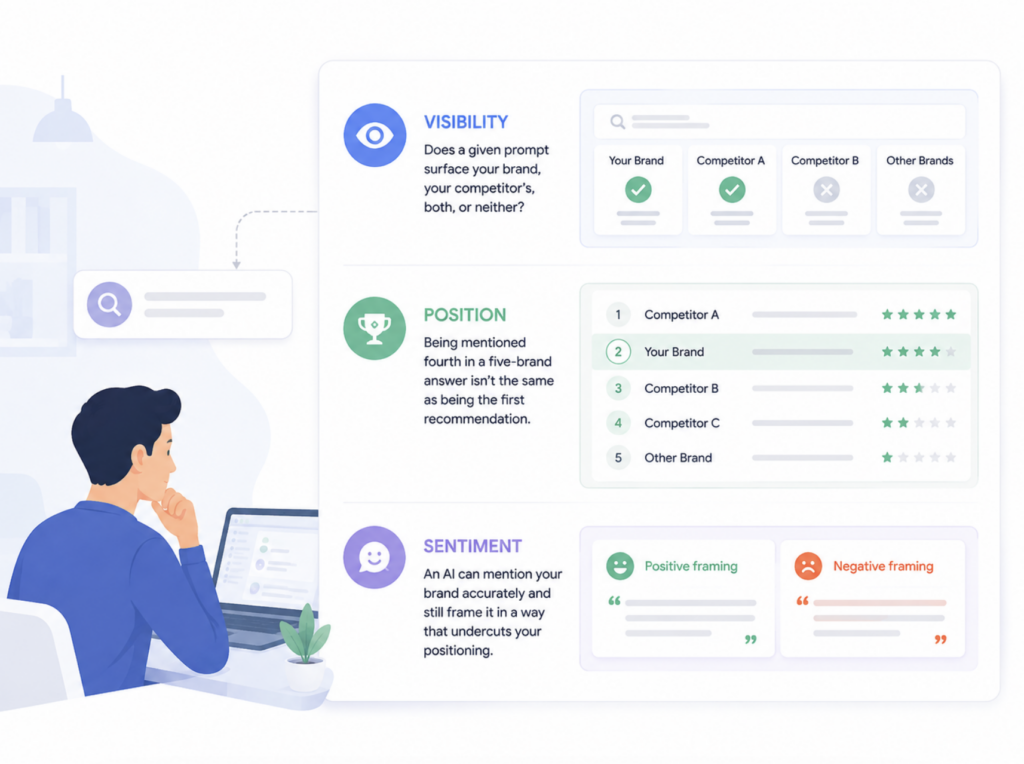
AI visibility competitor analysis isn’t “check if we rank higher than them.” It’s a comparison across three separate layers: whether you’re mentioned at all, where you land relative to competitors when you are, and how the AI describes you when it does.
Visibility is the baseline. Does a given prompt surface your brand, your competitor’s, both, or neither? Position matters once you clear that bar. Being mentioned fourth in a five-brand answer isn’t the same as being the first recommendation. Sentiment is the layer most teams skip entirely. An AI can mention your brand accurately and still frame it in a way that undercuts your positioning.
Run all three side by side against your top two or three competitors, across the prompts your buyers actually use, and you get a real picture of where you stand. Run just one, and you’re guessing.
The Gap Most Brands Never See
Here’s the part that doesn’t show up in a monthly report: the brands winning AI visibility aren’t necessarily the ones winning search.
Top-performing SaaS brands earn 8.4x more AI citations than the median brand in their category, and the gap is widening. Part of the reason is that AI platforms pull the vast majority of what they say about you from somewhere other than your own website. Roughly 79% of AI citations come from third-party domains rather than vendor pages.
That means your competitor could be losing the SEO fight on paper and still be winning the narrative in ChatGPT, simply because a review site, a comparison article, or a forum thread is doing the talking for them. Your existing competitor analysis has no way to catch that.
Think about how this plays out in practice. Your team ranks on page one for your category’s main keyword. Your top competitor ranks on page two. On paper, you’re ahead. But a G2 comparison page and a handful of Reddit threads happen to favor your competitor’s positioning, and those are exactly the kinds of pages AI platforms lean on for third-party validation. Ask ChatGPT for a recommendation, and your competitor shows up first. Your rank tracker never flags this, because it isn’t measuring the same thing anymore.
This is also why B2B discovery is shifting faster than most teams have adjusted for. AI-driven answers now account for 17% of B2B SaaS discovery, up from just 4% a year earlier. A channel growing that quickly deserves its own line in a competitive review, not a footnote under “emerging trends.”
How to Run a Real AI Visibility Competitor Analysis
Start with the prompts, not the platforms. Build a list of 15 to 30 real buyer questions: category questions (“best tools for X”), comparison questions (“X vs Y”), and problem-based questions (“how do I solve Z”). These are the moments where AI answers actually shape a purchase decision.
Run that prompt set across ChatGPT, Perplexity, and Gemini at minimum. Citation behavior and sentiment can shift dramatically depending on the platform, and relying on a single one gives you an incomplete, sometimes misleading picture. Then compare your brand against the same competitors on each of the three layers: visibility, position, and sentiment.
The last step is tracing citations back to source. If a competitor consistently outranks you in AI answers, find out which domains AI is pulling that recommendation from. That tells you exactly where to focus outreach or content work, instead of guessing.
Keep a simple scorecard while you do this. For each prompt, log which brands appeared, in what order, and whether the framing was positive, neutral, or negative. After a few rounds, patterns show up fast. Maybe a competitor dominates “best for beginners” prompts but disappears entirely from “enterprise” ones. Maybe your brand shows up consistently but always described with a qualifier that undersells you, like “budget option” when your positioning is premium. Those patterns are the actual output of an AI visibility competitor analysis, and they’re specific enough to act on immediately.
Don’t skip the sentiment column to save time. A brand that’s mentioned often but described unfavorably isn’t actually winning, even though a visibility-only view would suggest otherwise.
Where Competitor Monitoring Tools Fit In
Doing this manually, prompt by prompt, platform by platform, works for a one-time snapshot. It doesn’t scale to weekly or monthly tracking, and AI answers change often enough that a snapshot goes stale fast.
Topify built Dynamic Competitor Benchmarking specifically for this gap. It automatically detects who’s competing with you across AI platforms, even competitors you haven’t manually added, and tracks Visibility, Sentiment, and Position for all of them side by side. Pair that with Reverse-Engineer AI Citations, which surfaces the exact domains and URLs feeding your competitors’ AI mentions, and you get the source-level detail that a manual prompt audit can’t easily produce at scale.
If you want to see where you stand against a specific competitor right now, Topify’s AI visibility competitor analysis tool runs that comparison directly, without needing to set up prompt tracking from scratch first.
Reading the Results Without Overreacting
One important caveat before you act on any of this: AI answers move.
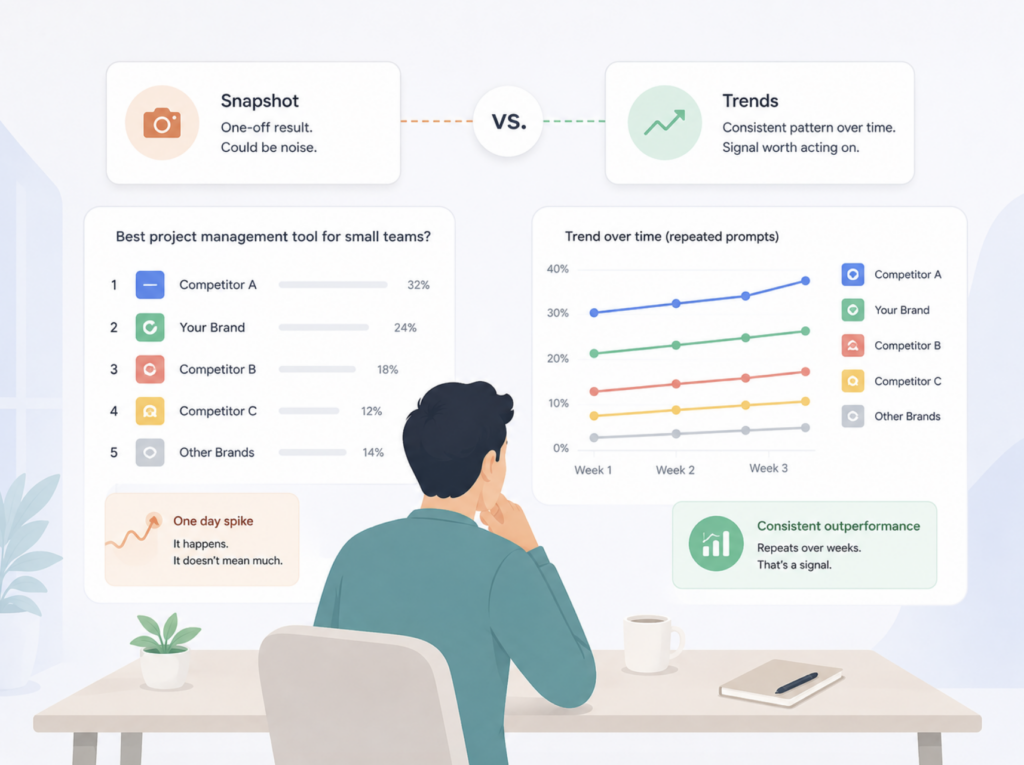
Citation rates and sentiment can vary by up to 615x depending on the platform, and only about 30% of brands stay visible across back-to-back runs of the exact same query. A single check where a competitor outranks you isn’t proof of a permanent gap. It might just be that day’s answer.
That’s the real reason to track trends instead of snapshots. If a competitor consistently outperforms you across two or three weeks of repeated prompts, that’s a signal worth acting on. If it’s a one-off, it’s noise.
Brands that show up both mentioned and cited by name tend to hold their position better over time than brands that only get cited without a direct mention. That’s a useful marker to watch as you build out your own tracking, since it points to which competitors have durable AI visibility and which are just having a good week.
Conclusion
The traditional competitor analysis playbook, rankings, backlinks, and social mentions, was never built to answer the question buyers are now asking an AI directly. Closing that gap starts with treating AI visibility as its own dimension of competitive intelligence, tracked across visibility, position, and sentiment, not folded into an SEO report where it doesn’t fit. Start with a handful of real buyer prompts this week, check where you and your top two competitors land, and build the habit of repeating it before the next quarterly review catches you off guard again.
FAQ
Q: How is AI visibility competitor analysis different from a traditional competitor analysis?
A: Traditional competitor analysis compares rankings, backlinks, and traffic. AI visibility competitor analysis compares whether, where, and how favorably each brand is mentioned inside AI-generated answers, which increasingly draws on a different set of sources than classic search rankings.
Q: How often should I run this kind of analysis?
A: Weekly or biweekly, if possible. AI answers can shift noticeably from one run to the next, so a single check tells you less than a repeated pattern over two or three weeks.
Q: Which AI platforms should I actually track?
A: At minimum, ChatGPT, Perplexity, and Gemini. Citation behavior and sentiment differ enough between platforms that tracking only one can give you a misleading sense of where you actually stand.
Q: Can a small team without a dedicated SEO person do this?
A: Yes. A manual version works fine for an initial check: pick 15 to 20 real buyer prompts, run them across the major AI platforms, and note who gets mentioned and how. Scaling that into ongoing tracking is where a monitoring tool becomes worth the time saved.

