

Your Google Analytics dashboard says everything’s fine. Traffic is steady, rankings haven’t moved, and the SEO report looks the same as it did last quarter.
ChatGPT disagrees.
Somewhere between your last board meeting and this one, a buyer typed a question into ChatGPT, Perplexity, or Google AI Mode about your category. An answer came back. A brand got named. There’s a decent chance it wasn’t yours, and there’s an even better chance nobody on your team knows that happened. This is what an AI visibility competitor analysis is built to catch, and most brands are running one for the first time only after they’ve already lost ground.
The Traffic Numbers That Are Lying to You
Your analytics stack was built to measure clicks. It counts visits, sessions, and conversions from people who landed on your site. What it can’t count is the answer a user got before they ever searched for you, or didn’t.
That gap is widening fast. ChatGPT alone now handles an estimated <cite index=”2-1″>2.8 billion queries per day, and product research and shopping is its fastest growing use case, up 89% year over year</cite>. Separately, roughly <cite index=”7-1″>37% of consumers say they now start their searches with an AI tool instead of a traditional search engine</cite>. None of that shows up as “traffic” until a user clicks through, and a large share of them never do.
Here’s the uncomfortable part: this isn’t a tool failing to do its job. Google Analytics was never designed to see inside an AI-generated answer. The blind spot is structural, not accidental.
What “AI Visibility Competitor Analysis” Actually Means
Most teams hear “competitor analysis” and think keyword rankings. In AI search, the unit of comparison isn’t a keyword. It’s a prompt, and how your brand fares inside the answer that prompt generates.
A real analysis breaks that answer into three separate questions:
| Dimension | What It Measures | Why It Matters |
|---|---|---|
| Mentions | Does the AI name your brand at all when a relevant question is asked | If you’re not mentioned, nothing else matters |
| Position | Where you land relative to competitors when multiple brands are named | First-mentioned brands get disproportionate trust |
| Sentiment | The tone the AI uses when it does mention you | A neutral or negative mention can be worse than silence |
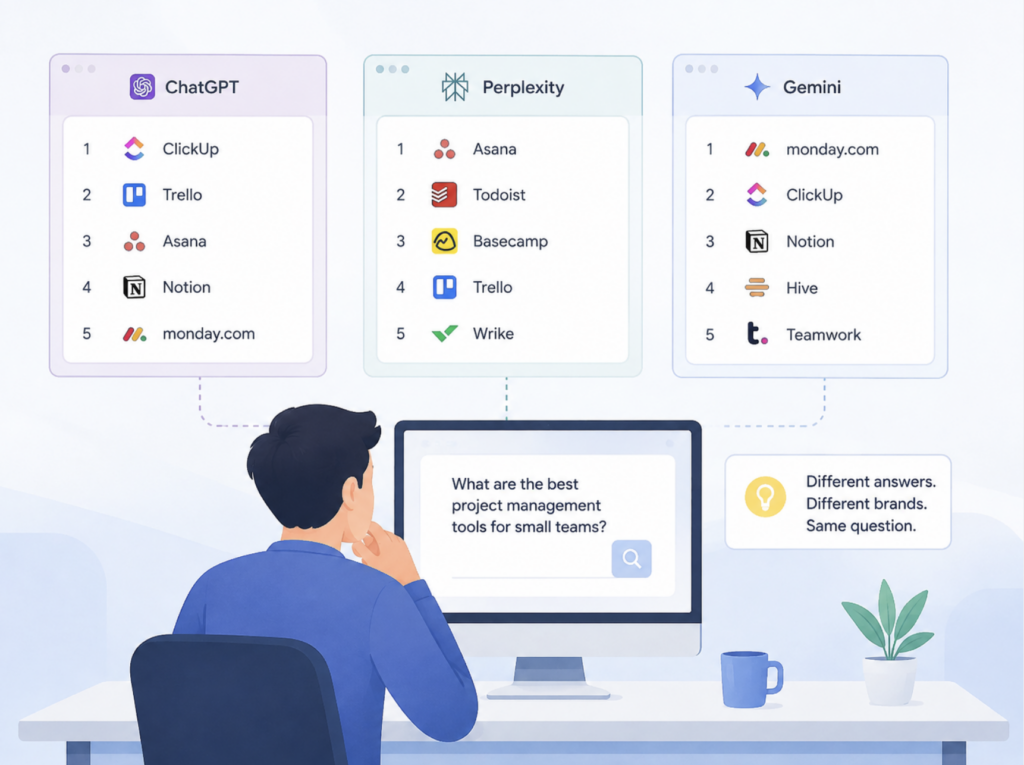
Run the same buyer-intent prompt across ChatGPT, Perplexity, and Gemini, and you’ll often see three different rosters of brands. That inconsistency is the whole point of doing this analysis by hand at least once: it shows you the gap between what you assume AI says about your category and what it actually says.
Three Signs Your Competitor Is Already Ahead
You don’t need a full audit to spot early warning signs. A few patterns tend to show up before anyone notices the bigger trend.
Sign one: they’re the answer to “X vs Y.” Comparison-style prompts are where AI visibility gets decided. Research on B2B citation behavior found that <cite index=”10-1″>comparison queries produced a 54% citation rate compared to just 18% for how-to queries</cite>. If a competitor’s content is built around head-to-head comparisons and yours is built around educational how-tos, they’re winning the exact moment a buyer is deciding between vendors.
Sign two: they’re being cited, not just mentioned. There’s a meaningful gap between an AI naming a brand and an AI actually linking to it. One retail study found <cite index=”11-1″>a beverage brand mentioned in 92% of AI responses but cited in only 3% of them</cite>, with the citation traffic instead flowing to third-party review sites. A competitor showing up in the citation layer, not just the mention layer, is capturing the click you’re missing.
Sign three: you’ve never been evaluated at all. This is the quiet, dangerous one. An audit of B2B purchase-intent prompts found that <cite index=”16-1″>comparison, alternatives, product-fit, and price questions named the audited brand in exactly zero of thirty-four cases</cite>. Not a bad mention. No mention. If your competitor is even showing up as a footnote and you’re not showing up at all, that’s the real gap to close first.
How to Run a Competitor Analysis for AI Search
You can do a first pass manually, and you should, at least once, to understand what you’re dealing with.
- Build a prompt list. Write out 15 to 20 questions a real buyer would type into ChatGPT when evaluating your category. Mix in comparison prompts (“best X for Y”), alternative prompts (“X vs Y”), and problem-first prompts (“how do I solve Z”).
- Run each prompt across platforms. Test the same list on ChatGPT, Perplexity, and Google AI Mode. Note who gets named, in what order, and what tone the AI uses.
- Trace the citations. For every answer that includes a link, record the domain. This tells you whose content the AI actually trusts enough to point to.
- Repeat on a schedule. AI answers shift as models update and as competitors publish new content. A one-time check tells you where things stand today, not where they’ll be next month.
The catch is scale. Multiply 20 prompts by three platforms by a monthly cadence, and you’re looking at hours of manual testing every cycle, and that’s before you factor in tracking new competitors who show up out of nowhere.
Where Automated Competitor Tracking Fits In
This is exactly the workload Topify’s competitor analysis tool is built to take off your plate. Instead of manually running prompts across platforms, you set your competitor list once and let it track Visibility, Sentiment, and Position continuously across ChatGPT, Perplexity, Gemini, and other major AI engines.
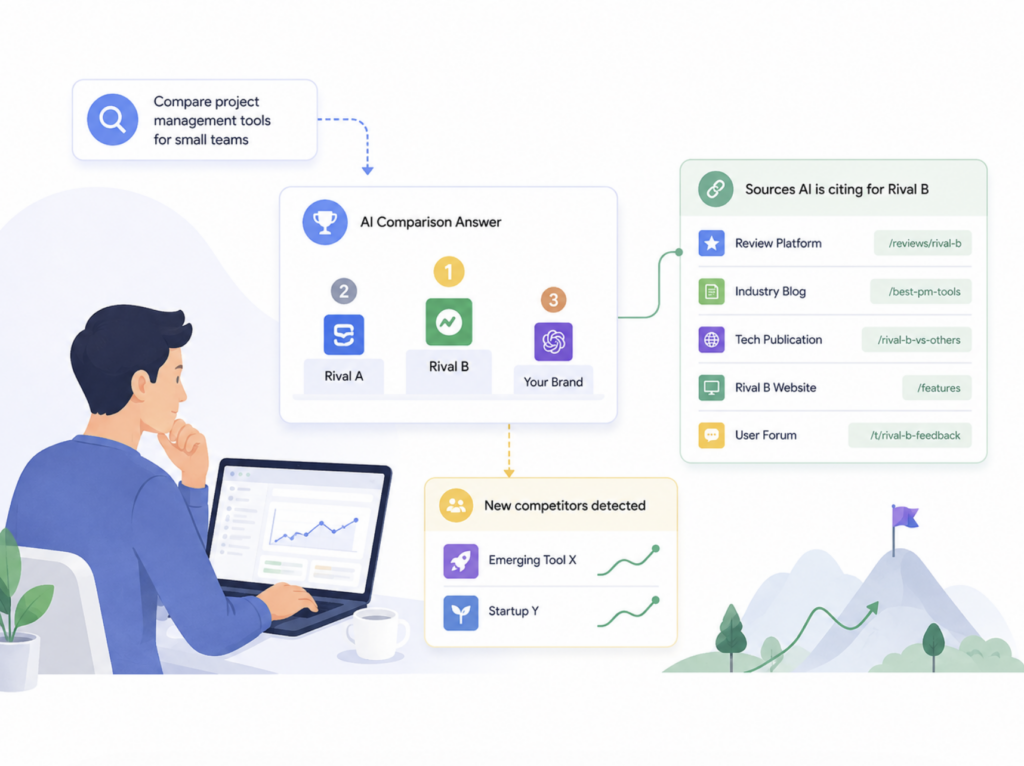
The part most teams find most useful isn’t the score itself. It’s the ability to reverse-engineer why a competitor is winning. If a rival keeps showing up in comparison-style answers, Topify surfaces the exact domains and URLs the AI is citing to get there, so you can see whether it’s their own site, a review platform, or a third-party publication doing the work. It also flags new competitors as they start appearing in your prompt set, which matters because the AI visibility landscape moves faster than most brand-tracking spreadsheets get updated.
For a broader view beyond just competitors, this pairs with Topify’s Comprehensive GEO Analytics, which scores your own AI visibility across seven metrics including mentions, sentiment, and estimated conversion visibility rate.
What to Do Once You See the Gap
Finding out you’re behind isn’t the end of the exercise. It’s the starting point.
If your competitor is winning comparison prompts, look at whether your content actually answers comparison-style questions, or whether it’s still written for keyword rankings instead of AI-readable evaluation. If they’re getting cited and you’re not, check whether your pages carry the structural signals AI systems look for: clear dates, extractable text, and named authorship. Industry-wide analysis found that of thousands of pages checked, <cite index=”14-1″>36% were too thin or non-extractable for AI systems to use, and 77% carried no visible date at all</cite>, which is often the simplest fix on the list.
This isn’t a one-time project. Treat it the way you’d treat rank tracking: a recurring check that tells you whether the gap is closing or widening.
Conclusion
The scoreboard for AI visibility competitor analysis doesn’t run on the same clock as your SEO dashboard. Rankings can hold steady for months while the AI layer above them shifts week to week. The brands treating this as a continuous practice, not a one-off audit, are the ones showing up when it counts: the exact moment a buyer asks AI which brand to choose.
FAQ
What’s the difference between SEO competitor analysis and AI visibility competitor analysis?
SEO competitor analysis compares keyword rankings and backlink profiles. AI visibility competitor analysis compares how often and how favorably brands are named inside AI-generated answers, which doesn’t always correlate with search rankings at all.
How often should I run a competitor analysis for ChatGPT?
Monthly is a reasonable baseline for most brands, though fast-moving categories with frequent content publishing from competitors often benefit from checking every two weeks.
Can I track competitors across multiple AI platforms at once?
Yes. Manual testing means running the same prompts separately on each platform. Automated tools consolidate ChatGPT, Perplexity, Gemini, and other engines into a single view so you’re not stitching results together by hand.
Do I need my competitor’s permission to track their AI mentions?
No. You’re only observing publicly generated AI answers to questions you’re asking, not accessing any private or gated data belonging to the competitor.

