

Your rank tracking dashboard looks healthy. Keywords are holding, domain authority is climbing, and the monthly report practically writes itself. Then someone asks ChatGPT for the best option in your category, and your brand doesn’t come up once. None of your existing tools can explain that, because they were built to measure positions on a results page, not what an AI decides to say. The gap between what you can report and what actually drives discovery keeps widening, and most trackers on the market still sit on the wrong side of it.
So the real question isn’t whether you need an AI visibility analytics tracker. It’s how to tell the ones that work from the ones that just look the part.
Most “AI Rank Trackers” Watch One Engine. That’s the Problem
Here’s where most teams go wrong. They pick a tool for AI visibility that bolts a “ChatGPT tracker” onto a legacy SEO suite, run it for a month, and assume they’re covered.
They’re not. The 2026 research on AI search is consistent on this: most legacy tools monitor only one engine, usually Google AI Overviews, and miss the fragmentation across ChatGPT, Perplexity, Gemini, and Claude. A brand can dominate one assistant and be invisible in the next, and a single-engine view will never tell you that.
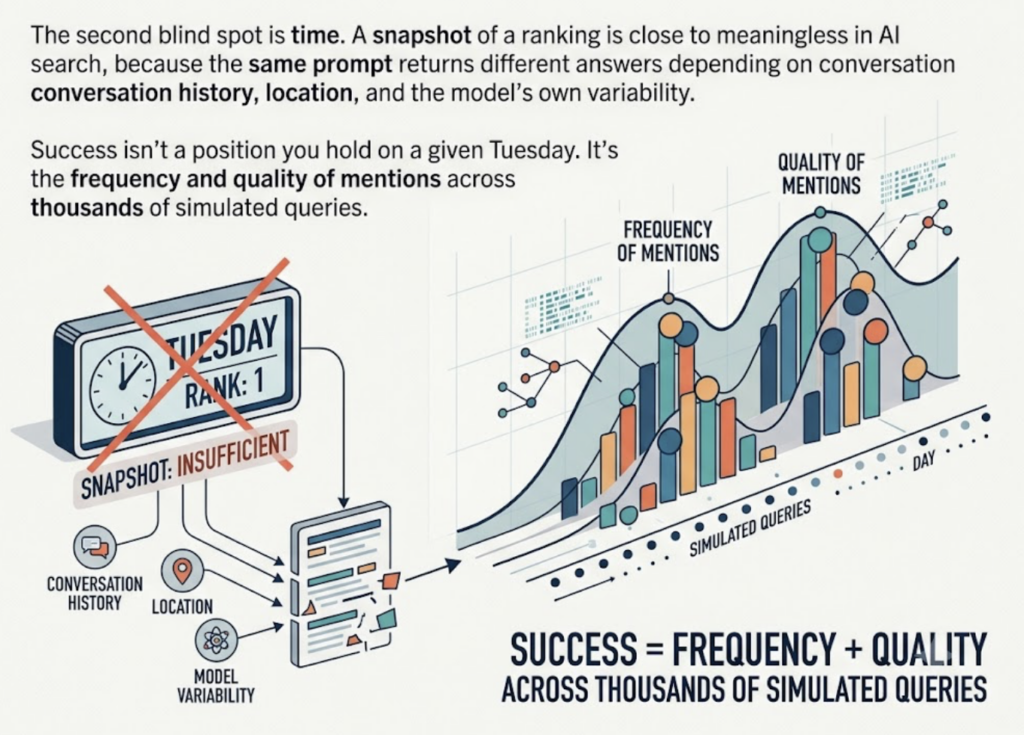
The second blind spot is time. A snapshot of a ranking is close to meaningless in AI search, because the same prompt returns different answers depending on conversation history, location, and the model’s own variability. Success isn’t a position you hold on a given Tuesday. It’s the frequency and quality of mentions across thousands of simulated queries.
That’s the part a one-time check can’t see.
What a Real AI Visibility Analytics Tracker Measures
The shift the research describes is a shift from ranking to influence: not where you sit on a list, but how often and how favorably an AI treats you as a trusted source. A genuine tool for AI search visibility measures the second thing, continuously.
A few metrics matter more than the rest:
- Brand presence. Does your brand show up in the answer at all? This is the closest thing to a North Star metric for AI search market share, and it’s binary before it’s anything else.
- Citation frequency. How often does an AI actually link or reference your domain? This reflects how much the model trusts your content as a source.
- Share of voice. Your mentions versus competitors’ across a fixed prompt set. This is your competitive standing, quantified.
- Sentiment. The tone of the mention, not just its existence. A frequent but negative mention is a reputation problem hiding inside a visibility win.
- Citation quality. Whether the AI pulls from a deep, authoritative page or a thin one, which tells you which content assets are doing the work.
The distinction between a basic monitor and a real analytics tracker comes down to what each one can actually answer:
| Capability | Basic AI Monitor | AI Visibility Analytics Tracker |
|---|---|---|
| Engine coverage | One engine (often Google AIO) | ChatGPT, Perplexity, Gemini, AI Overviews, and more |
| Measurement | One-off ranking snapshot | Probabilistic monitoring across many query runs |
| Output | “You appeared” or “you didn’t” | Presence, share of voice, sentiment, source attribution |
| Actionability | A score | The reason behind the score, tied to content fixes |
If a tool can only tell you whether you showed up, it’s a monitor. If it can tell you why, and what to do about it, it’s an analytics tracker.
Rank Tracking in AI Mode Isn’t Google Rank Tracking
This is the part SEO veterans underestimate. A rank tracker tool for AI mode looks familiar enough that teams expect their old playbook to carry over. It doesn’t.
Traditional rank tracking assumes a deterministic, grid-like results page: position 3 is position 3, and it stays there until it moves. Google’s AI Mode and AI Overviews don’t work that way. There’s no fixed slot to occupy. “Ranking” becomes a question of whether you’re mentioned at all, and if so, in what order relative to competitors, across responses that shift query to query.
So a rank tracking tool built for AI has to do something old tools never had to: average out volatility. Instead of checking a position once a day, it runs prompts frequently and uses statistical averaging to separate a real trend from normal model noise. A single query that omits your brand might mean nothing. The same query omitting you in eight runs out of ten is a signal worth acting on.
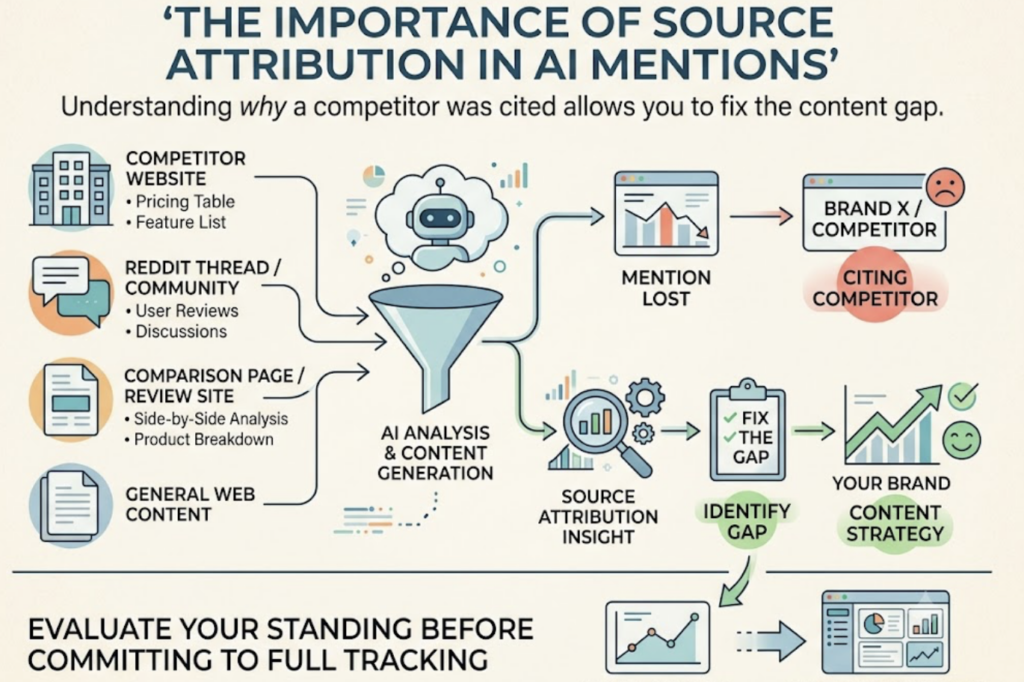
There’s a related capability that separates serious tools here: source attribution. Knowing you lost a mention is useful. Knowing the AI cited a competitor because it pulled their pricing table, or a Reddit thread, or a comparison page, is what lets you actually fix the gap. You can check where your brand currently stands before committing to a full tracking setup, which is a reasonable way to gauge how deep the problem runs.
The Best Tool for AI Visibility: What Topify Does Differently
Plenty of platforms claim to be the best tool for AI visibility. The useful way to judge that claim is against the checklist above: multi-engine, probabilistic, attributable, actionable. On those terms, Topify tends to line up well, because it was built as an analytics layer rather than a monitor.
Its core is Comprehensive GEO Analytics, which tracks brand performance across major AI platforms through seven metrics: visibility, sentiment, position, volume, mentions, intent, and CVR. That last one, conversion visibility rate, estimates how likely an AI answer is to push a user toward actually engaging with your brand, which moves the conversation past raw presence and into outcomes.
Three pieces map directly onto the gaps the research flags.
Position Tracking handles the “where do I rank in AI” question the right way, by monitoring your standing relative to competitors inside AI answers rather than pretending there’s a static SERP slot. Competitor Benchmarking turns that into share of voice, surfacing not just your own movement but emerging rivals in real time. And Source Analysis reverse-engineers the citations themselves, showing the exact domains and URLs an AI references so you can see whether you or a competitor owns those sources.
Coverage is the other thing that matters here. Topify tracks across ChatGPT, Gemini, Perplexity, DeepSeek, Doubao, Qwen, and others, which matters more than it sounds if your audience spans Western and Asian markets where the dominant assistant changes by region.
The part that keeps the data from becoming shelfware is execution. You state a goal in plain English, review the proposed strategy, and deploy it, so an insight like “the AI cites this competitor because of their pricing page” becomes a content task instead of a line item in a report nobody reads. Pricing starts at $99 a month on the Basic plan and $199 on Pro, with the full breakdown here.
Picking the Best Tool for AI Search Visibility for Your Team
The best tool for AI search visibility depends less on a feature list and more on who’s using it and why. The research breaks this down cleanly by operational need.
If you’re an agency, weight white-label reporting and competitive benchmarking. Your ROI lives in proving to a client that their brand presence climbed across multiple AI engines, so cross-engine coverage and clean client-facing reports do the heavy lifting.
If you’re an enterprise in-house team, sentiment monitoring stops being optional. Large brands carry real risk of misinformation or negative tone getting amplified inside AI models, so a tracker that flags sentiment shifts early earns its keep before it ever helps with growth.
If you’re a content strategist, look for source attribution and optimization suggestions that connect to your actual workflow. The value isn’t the dashboard, it’s the line that says “add a comparison table, that’s what the AI is citing from your competitor.”
Other tools fit other shapes. Some legacy SEO suites now offer AI modules that work fine if you mostly live in Google’s ecosystem and want everything in one login. The trade-off is usually depth: broad coverage and real attribution tend to come from platforms built for GEO first, not bolted on later.
Conclusion
The blunt version, borrowed from the 2026 research, is that a team still leaning on traditional rank tracking is measuring a ghost. The positions are real, but they no longer describe where discovery actually happens.
Choosing an AI visibility analytics tracker comes down to four questions. Does it cover the engines your audience uses, not just one? Does it average out volatility instead of trusting a single snapshot? Does it tell you why a competitor got cited? And does that insight connect to something your team can change this week? Start there, run a check against your own brand, and you’ll know within a few days whether you’ve got a real tracker or just a prettier dashboard.
FAQ
What is an AI visibility analytics tracker?
It’s a tool that measures how often and how favorably AI engines like ChatGPT, Perplexity, and Gemini mention or cite your brand, then turns that into trackable metrics over time. Unlike a rank tracker, it focuses on presence, share of voice, sentiment, and citation sources rather than fixed positions on a results page.
How do you track brand rankings in Google AI Mode?
You can’t track them the way you’d track blue-link positions, because AI Mode has no fixed slots. Instead, a capable tool runs your prompts repeatedly, measures whether and where your brand appears across many responses, and uses statistical averaging to tell a real trend apart from normal model variability.
What’s the difference between AI rank tracking and Google rank tracking?
Google rank tracking measures a deterministic position on a static page. AI rank tracking measures probabilistic mentions across non-deterministic answers that change with user history, location, and model settings. One is a coordinate, the other is a frequency.
Which is the best tool for AI search visibility for a small SEO team?
Look for the widest engine coverage you can get, probabilistic monitoring rather than daily snapshots, and source attribution that ties findings to specific content fixes. A small team benefits most from a tracker that explains the “why” so limited hours go toward the changes that actually move presence.

