

Your rank tracker still reports clean numbers. Position three for your money keyword, climbing impressions, a domain authority of 70. None of that tells you whether Claude just recommended a competitor when a buyer asked for the best tool in your category, or whether ChatGPT mentioned your brand at all. People are reading synthesized answers now, not scanning blue links. The problem is that the analytics most teams rely on were built to measure pages, not what an AI decides to say about you. That gap is where AI search visibility starts to matter.
What AI Search Visibility Analytics Actually Measures
AI search visibility is how often, and how well, your brand shows up inside AI-generated answers. AI visibility analytics is the discipline that measures it.
The distinction matters because traditional SEO analytics tracks where a URL sits on a results page. AI visibility analytics tracks something different: how a model synthesizes and represents your brand when it answers a question.
That shift changes the signals worth watching. Instead of rank and click-through, the useful metrics are visibility rate (the share of high-intent prompts where your brand appears), citation share (how often you’re cited as a source rather than mentioned in passing), framing (recommended solution versus expensive alternative), and competitive share of voice against rivals in the same response.
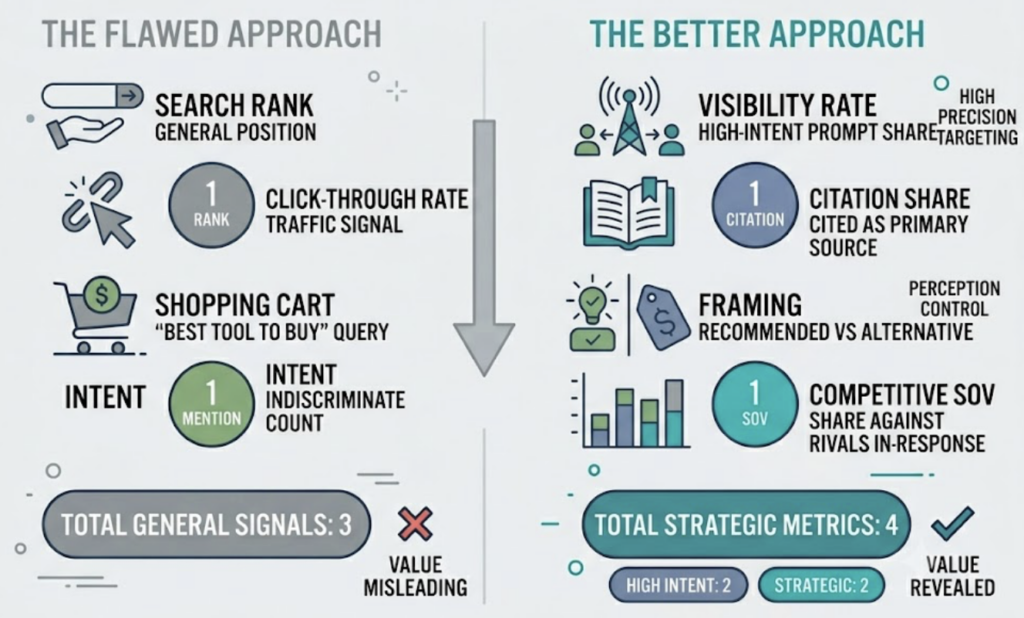
Rank tells you where your page sits. Visibility analytics tells you whether the AI bothered to mention you at all.
Why Brand Visibility Analytics for GPT and Claude Needs Its Own Layer
Here’s the thing most dashboards miss: AI visibility isn’t platform-agnostic. A brand can dominate one engine and stay invisible in another. Recent 2026 research calls this “visibility fragmentation.”
The cause is that each engine reasons differently about what counts as a credible source.
| Engine | What it weights | Acts like |
|---|---|---|
| ChatGPT | Community-validated content, Reddit, forums, broad web discussion | A socially informed synthesizer |
| Claude | Authoritative depth, white papers, structured documentation | An academic researcher |
| Perplexity / Gemini | Real-time news, fresh web signals, ecosystem data | A current-events reporter |
This is why brand visibility analytics for GPT and Claude can’t share a single number. Optimizing only for ChatGPT’s discussion-driven logic can leave you absent from Claude’s citation-heavy answers, where structured documentation tends to win.
Visibility in one engine is not visibility everywhere.
How AI Visibility Analytics Tools Track Brand Mentions
So how do ai visibility analytics tools track brand mentions in the first place? The mechanism is a continuous loop, not a one-time scan.
It starts with brand-neutral prompts. Tools generate category queries like “best CRM for enterprise” without naming any brand, which tests whether you get discovered organically rather than only when prompted by name.
Those prompts run concurrently across engines. Because AI outputs are non-deterministic, the same question can surface your brand once and skip it the next time, so tools rely on statistical sampling over time to smooth out that drift.
Then a language model parses each response as an auditor. It separates a passing mention from a real citation (a specific URL offered as proof), and it reads the surrounding context to judge whether the framing is positive, neutral, or negative.
The detail that matters: this runs at the prompt level. You don’t just learn that your mention rate dropped, you learn which specific queries stopped surfacing you.
Turning AI Visibility Data Into Search Optimization
Tracking is only half the value. The point of the best ai visibility analytics for search optimization is to feed the data back into what you actually publish.
The most actionable signal is source analysis. When you’re missing from a key comparison, the data shows which competitor source the AI cited instead. That lets you reverse-engineer the citation and find the exact documentation or data point that earned the reference.
From there the work gets structural. Models tend to favor extractable content: short, declarative answers backed by schema and clean text, rather than long narrative pages that bury the point.
In practice the loop runs four ways. Monitor presence across platforms. Analyze where competitors outperform you. Optimize content into an answer-first structure. Then re-run the prompt set to validate whether the model updated what it knows about your brand.
That last step is what separates a report from a result.
Where Topify Fits
Most tools stop at the dashboard. The harder part is connecting cross-engine mentions, competitive position, and citation sources in one place, so a drop in visibility turns into a clear fix.
Topify is built around that connection. It tracks Visibility and brand Mentions across ChatGPT, Claude, Perplexity, and Google AI Overviews, so visibility fragmentation shows up as one comparable view instead of four separate exports. When your mention rate slips on Claude but holds on ChatGPT, you can see it side by side and trace it back to the structured documentation Claude tends to reward, then act on it without leaving the same screen.
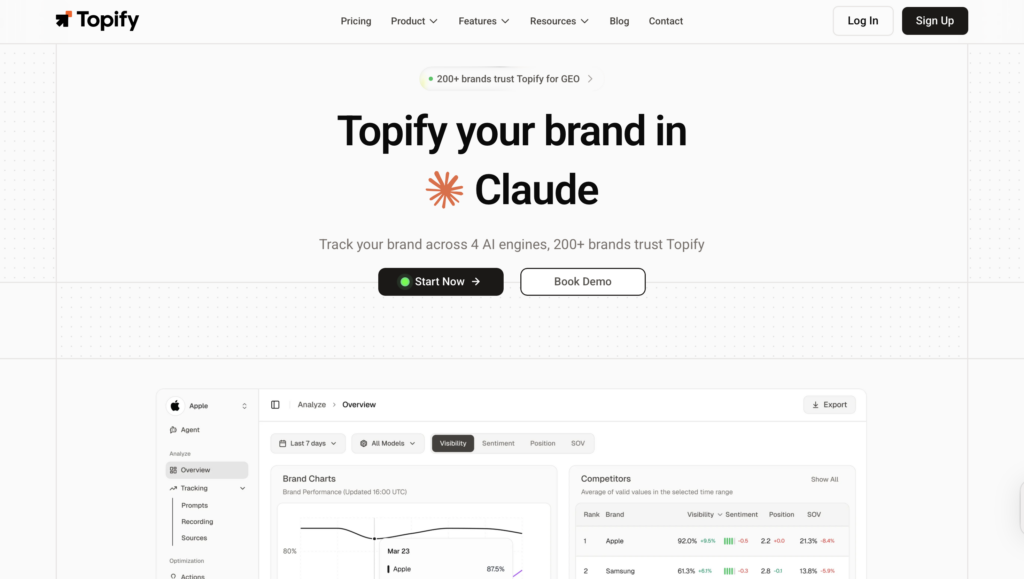
Its Competitor Monitoring tracks share of voice against rivals inside the same answers, and Source Analysis reverse-engineers the exact domains and URLs the engines cite. That’s the piece that converts a visibility gap into a concrete content task.
For teams that want the full picture, Topify’s Comprehensive GEO Analytics rolls seven metrics (visibility, mentions, position, sentiment, volume, intent, and CVR) into a single layer rather than leaving you to stitch them together.
You can get started with one project and a core prompt set, then expand coverage as the value becomes clear.
How to Start Measuring AI Search Visibility
You don’t need a hundred prompts to begin. Start with the ten to twenty questions a real buyer would ask in your category, phrased without your brand name.
Run them across GPT and Claude to set a baseline mention rate, note where competitors appear and you don’t, and check which sources each engine cites for those answers.
Then fix the gaps and re-test. Monitor, optimize, validate.
Conclusion
Your rank tracker isn’t wrong. It’s just answering a question buyers have stopped asking. The brands that show up in AI answers are the ones measuring what those answers actually say, across every engine that matters, then closing the citation gaps one prompt at a time. Start with a small prompt set, baseline your AI search visibility across GPT and Claude, and let the data tell you where your content needs to be clearer.
FAQ
Q: What does AI visibility analytics measure?
A: It measures how often and how well your brand appears inside AI-generated answers, using signals like visibility rate (the share of prompts where you appear), citation share, framing or sentiment, and competitive share of voice. Unlike SEO analytics, it tracks how a model represents your brand rather than where a URL ranks.
Q: How do you track brand mentions in ChatGPT and Claude?
A: Tools run brand-neutral category prompts across both engines, sample the responses repeatedly to account for non-deterministic output, and use a language model to parse each answer for mentions versus citations and for context. Because the two models weight sources differently, you track them separately and compare.
Q: How is AI visibility analytics different from traditional SEO analytics?
A: Traditional SEO analytics tracks URL position, clicks, and impressions on a results page. AI visibility analytics tracks whether and how an AI synthesizes your brand into its answer. The unit of measurement is the answer, not the link.
Q: How do you use AI visibility data for search optimization?
A: Start with source analysis to see which competitor pages the AI cites when you’re absent, reverse-engineer what earned that citation, restructure your content into extractable answer-first formats, then re-run the prompt set to confirm the model updated its view of your brand.

