

Your analytics dashboard can tell you how many people hit your pricing page last Tuesday and which campaign sent them. It can’t tell you whether ChatGPT named your brand or your competitor when a buyer asked for the best option in your category. That second conversation is where more purchase research now starts, and it happens somewhere your traffic reports never reach. So you keep optimizing the part of the funnel you can see, while the part that increasingly decides the outcome stays dark. AI visibility analytics monitoring exists to turn that dark space into something you can actually read.
What AI Visibility Analytics Monitoring Actually Means
AI visibility analytics monitoring is the practice of measuring how often, how prominently, and how favorably your brand shows up inside AI-generated answers. It’s not the same thing as web analytics, and treating it like it is causes most of the confusion.
Traditional SEO chases position one to win a click. AI search works differently. Discovery is shifting toward conversational interfaces like ChatGPT, Perplexity, Claude, and Google AI Overviews, where the goal is to be part of the answer, not just a blue link below it.
Here’s the shift in one line: you’re moving from rankings to citations.
In many AI sessions the user never leaves the chat. That’s the zero-click reality, where the authority you gain comes from being recommended inside the response, even when nobody clicks through. AI systems also weigh entity authority, how well they understand and trust your brand across the web, over the keyword density that older playbooks obsessed over.
How AI Visibility Analytics Monitoring Works Under the Hood
The mechanics are simpler than they sound. Effective monitoring is multi-platform and prompt-based, and it runs on a loop rather than a one-time check.
It starts with a prompt library. Teams build a golden set of prompts that mirror real buyer intent, things like “best enterprise software for X” or “compare Y and Z.” These prompts are the questions your customers actually ask AI.
Then comes automated sampling. The tool runs those prompts across multiple LLMs on a schedule and collects every response, because the same question returns a different answer on ChatGPT than it does on Perplexity or Claude.
The last step is parsing. Using natural language processing, the system scans each answer for four things: whether your brand is mentioned at all, where it sits in the list, whether the AI describes it positively or negatively, and whether it links back to your site as a source. Those four signals are the raw material for every metric that follows.
The Metrics That Make AI Visibility Measurable
If you’ve wondered how to measure AI visibility analytics monitoring, the answer is a different KPI set than organic traffic. Clicks alone won’t tell the story.
A few metrics do most of the work:
- Brand mention rate: the share of tested prompts where your brand appears at all.
- Citation rate: the share of mentions that include a real link back to you.
- Share of voice: your presence against direct competitors in the same category prompts.
- Sentiment score: how the AI characterizes you, positive, neutral, or negative.
- Visibility score: a composite that rolls mention frequency, sentiment, and recommendation quality into one number.
- LLM referral traffic: the final-mile metric for visitors who did click through from an AI interface.
The trap is reading these in isolation. A 60% mention rate sounds healthy until you learn a competitor sits at 90% on the same prompts. Column Five makes a related point: measurement only matters when it’s tied to competitive context and a clear optimization loop.
This is where a dedicated platform earns its place. Topify tracks brand performance across major AI engines through seven metrics in one view: visibility, sentiment, position, volume, mentions, intent, and CVR. In practice, that means you can watch your mention rate drop on ChatGPT and trace it to a specific source that stopped citing you, without exporting data into three separate tools.
Free Rank Tracking Across ChatGPT, Perplexity, Claude, and Other LLMs
You don’t need a contract to start. The fastest way to learn where you stand is to run a free baseline, and several no-cost options exist for exactly this.
For a single snapshot, a free GEO score check tells you how an AI engine currently reads your site, with no signup required. For ongoing ChatGPT rank tracking free of charge, Perplexity rank tracking free, Claude rank tracking free, and broader LLM rank tracking free, you can lean on a set of purpose-built tools. Topify maintains a free tools reference that points to each one.
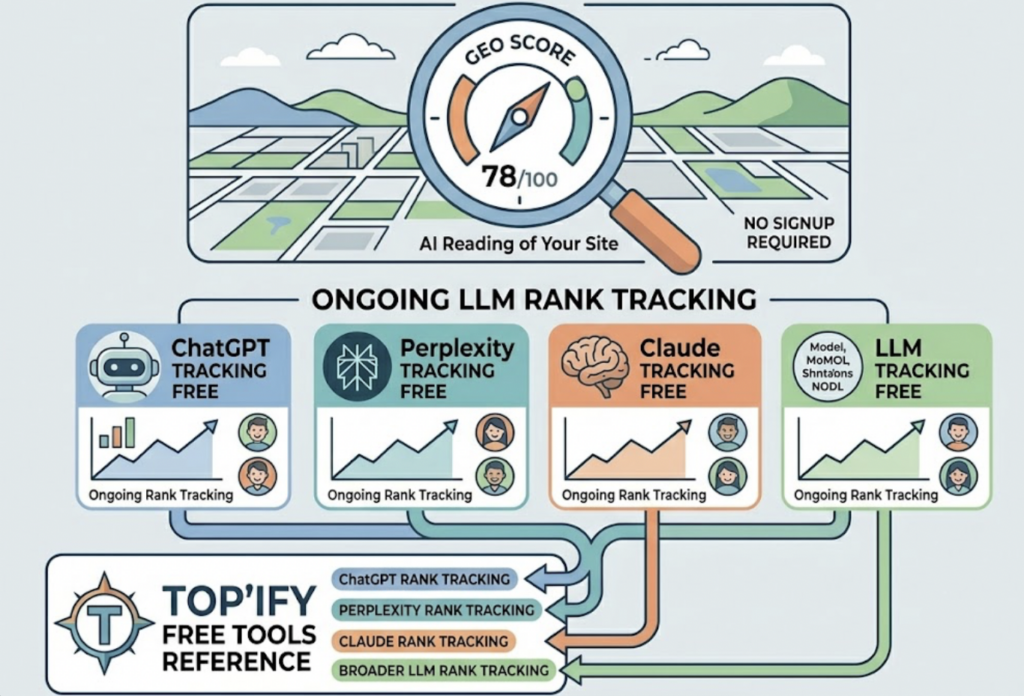
Here’s an example of what a first check looks like in practice. You pick five prompts your buyers actually use, run them across ChatGPT, Perplexity, and Claude, and record whether your brand shows up and where. Do it once and you have a snapshot. Do it weekly and you have a trend, which is the part that matters.
Free tools answer the “am I visible at all” question. They’re a starting line, not a finish line.
Best Tools for AI Visibility Analytics Monitoring
When you compare tools for AI visibility analytics monitoring, four dimensions separate the useful from the decorative. Most buyers fixate on platform count and skip the rest.
| Dimension | Why it matters | What to ask |
|---|---|---|
| Engine coverage | One platform is a blind spot | Does it track ChatGPT, Perplexity, Claude, and AI Overviews? |
| Explanation | A number with no cause is noise | Does it tell you why a metric moved? |
| Citation layer | Mentions without sources hide weak spots | Does it show which domains the AI cites? |
| Price to start | Pilots shouldn’t need procurement | Is there a low-cost or free entry point? |
On coverage, the tools worth a look run prompts across several engines rather than one. On explanation, the stronger ones connect a drop in visibility to a specific cause, like a competitor’s blog that the AI started citing instead of yours.
Topify is built around those four dimensions. It covers ChatGPT, Gemini, Perplexity, DeepSeek, and others, benchmarks you against competitors in real time, and reverse-engineers the exact URLs AI platforms cite so you can see whether you or a rival owns those references.
On pricing, plans start at $99 a month on the Basic tier, which includes a 30-day trial, tracking across ChatGPT, Perplexity, and AI Overviews, and 100 prompts. Pro runs $199 a month for larger prompt sets, and Enterprise starts at $499. The structure is usage-based on purpose: you start small and expand once the data proves its worth.
Common Mistakes in AI Visibility Analytics Monitoring
Most teams stumble by bringing a legacy SEO mindset into an environment that doesn’t reward it.
The first mistake is single-engine bias. Watching only Google AI Overviews ignores the reach of Perplexity, ChatGPT, and Claude, and the answers across those engines rarely match.
The second is treating no-click as failure. As The Optimist notes, the recommendation itself carries brand value even when nobody clicks, so judging AI visibility purely on referral traffic undercounts what it’s doing.
The third is snapshotting instead of trending. Running one prompt once a month is close to meaningless, because LLM outputs are volatile and a single result tells you almost nothing.
The fourth is ignoring source attribution. If you never track which pages the AI uses to validate your brand, you’ll miss the signal that a competitor’s content, not yours, is teaching the model what to say.
A Strategy and Checklist to Improve AI Visibility
Improving AI visibility analytics monitoring is less about a single fix and more about a repeatable loop. Here’s a checklist that turns the metrics above into action.
- Establish a baseline. Run your core category prompts across ChatGPT, Perplexity, and Claude to define your current mention rate.
- Optimize for extraction. Use clear schema markup for organization, product, and FAQ, and format content answer-first so models can lift it cleanly.
- Strengthen entity authority. Keep your brand details consistent across social, review sites, and PR so the AI builds a knowledge graph it can trust.
- Monitor competitor sources. Find the third-party domains the AI already trusts and work to get your brand mentioned there.
- Audit monthly. Re-test your prompt library on a schedule to catch content drift before it hardens into a wrong answer.
Run it once and you have direction. Run it every month and you build a moat. When you’re ready to automate the loop instead of doing it by hand, you can get started with Topify and let its agent handle the monitoring and benchmarking.
Conclusion
The conversation that decides whether a buyer considers you is increasingly happening inside an AI answer, and your traffic dashboard can’t see it. AI visibility analytics monitoring closes that gap by measuring mentions, position, sentiment, and citations across every engine your audience uses. Start with a free baseline this week, pick five prompts that matter, and track them across ChatGPT, Perplexity, and Claude. Once you can see where you stand, improving it stops being guesswork.
FAQ
Q: What is AI visibility analytics monitoring?
A: It’s the practice of measuring how often, how prominently, and how favorably your brand appears inside AI-generated answers across engines like ChatGPT, Perplexity, Claude, and Google AI Overviews. It tracks mentions and citations rather than page rankings and clicks.
Q: How do you measure AI visibility?
A: Through a different KPI set than organic traffic: brand mention rate, citation rate, share of voice against competitors, sentiment score, a composite visibility score, and LLM referral traffic. These come from running a prompt library across multiple engines and parsing the responses.
Q: Is there free rank tracking for ChatGPT, Perplexity, and Claude?
A: Yes. A free GEO score check gives you a no-signup snapshot, and a set of free tools supports ongoing ChatGPT, Perplexity, Claude, and broader LLM rank tracking free of charge. They’re enough to establish a baseline before you invest in a paid platform.
Q: What does AI visibility analytics monitoring cost?
A: Free tools cover basic checks. Paid platforms like Topify start at $99 a month on the Basic plan with a 30-day trial, scale to $199 on Pro, and begin at $499 for Enterprise, so you can start small and expand as the data proves out.

