

Your domain authority is solid. Your keyword rankings sit on page one. Then a buyer opens Perplexity, asks for the best option in your category, and reads a confident three-paragraph answer that never names you. Nothing in your SEO stack explains why. The metrics you’ve trusted for a decade measure where your link sits on a results page, not whether an AI decided to write your brand into its answer at all. That blind spot is exactly what an AI visibility analytics system is built to close.
What an AI Visibility Analytics System Is
An AI visibility analytics system isn’t a dashboard you glance at once a week. It’s a continuous, closed-loop observation system: it collects large-scale AI responses to intent-driven prompts, parses how your brand shows up using natural language processing, and turns that into comparable metrics over time.
The distinction from rank tracking matters. A traditional tool monitors your SERP rank, a static link-based position on a results page. An AI visibility system measures something else entirely: your recommendation rate, your citation frequency, and the framing AI uses to describe you.
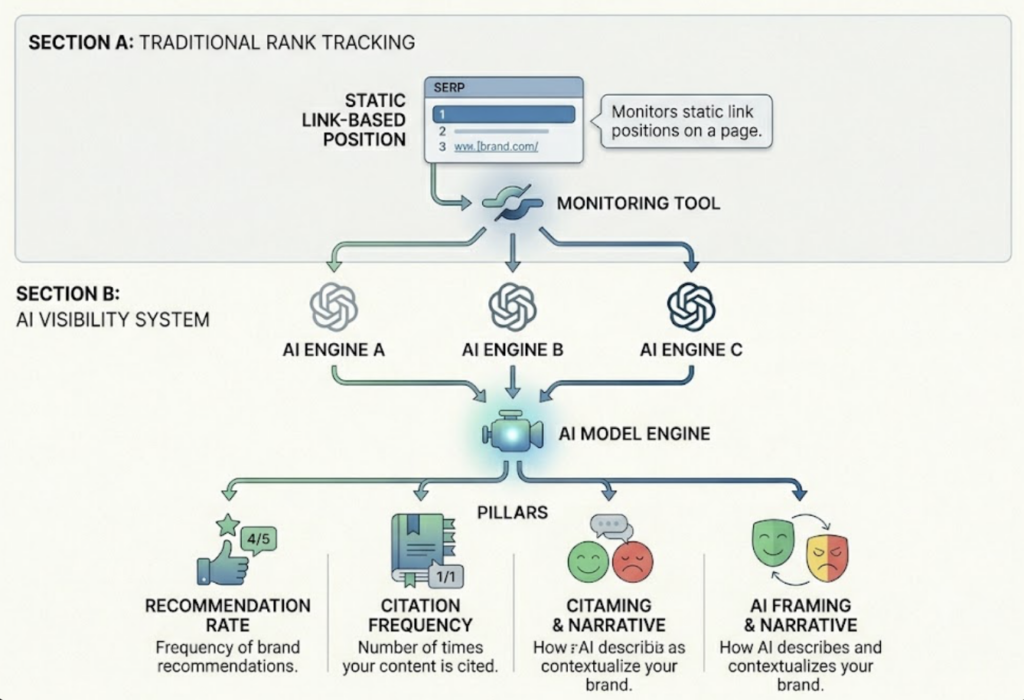
Here’s the deeper shift. Classic SEO optimizes for distribution, getting your link onto a page a user might click. AI visibility optimizes for synthesis, becoming part of the model’s preferred solution set when it writes an answer from scratch.
That’s a different game with different rules.
So when someone searches “what is an AI visibility analytics tool,” the honest answer is this: it’s the instrumentation layer for a channel where the old instruments don’t reach.
How an AI Visibility Analytics System Works
The hard part is that large language models are non-deterministic. Ask the same question twice and the wording, the brands named, even the order can change. A single screenshot tells you almost nothing.
These systems get around that with sampling at scale. The mechanism runs in four stages.
First, prompt engineering and sampling. The system generates hundreds of high-intent prompts that mirror how people actually ask, things like “what’s the best CRM for small business?” or “compare Brand A vs Brand B,” not bare keyword strings.
Second, concurrency across platforms. Those prompts fire at ChatGPT, Perplexity, Gemini, and Google AI Overviews at the same time. Because answers drift with conversation history and model temperature, the system repeats queries to capture the variance instead of trusting one run.
Third, NLP analysis. The raw text gets parsed for two things a rank tracker never sees: sentiment and framing (are you the “top choice,” a “budget alternative,” or a “risky” option?) and citation source (which exact URLs did the model credit?).
Fourth, aggregation into time-series data. That’s what lets a team watch for drift, a slow slide in how often or how favorably AI names them.
Perplexity vs Google SERP Tracking: Why the Old Metrics Miss the Point
This is where most teams get stuck, and it’s worth being precise about the perplexity vs google serp tracking gap rather than hand-waving at it.
Traditional SEO runs on the ten-blue-links model. You earn a position, the user clicks, traffic shows up in analytics. The whole measurement stack assumes a click eventually happens.
AI-native search breaks that assumption in three places.
Zero-click is the default, not the exception. An LLM can name you as the best solution and fully satisfy the user inside the answer. Intent met, no click, nothing in your referral logs.
AI characterizes, it doesn’t just list. You can hold a strong Google position and still be described as “expensive” or “outdated” inside a Perplexity answer. The rank looks fine. The narrative quietly kills the conversion.
And citation authority works nothing like backlinks. Backlinks get scored by something close to PageRank. AI citations get chosen by topical fit, freshness, and authority as the model weighs sources during retrieval. A page that never ranked well can still get cited if it’s the cleanest answer to a specific question.
That’s the gap most SEO reports still can’t see.
It’s also why a Perplexity ranking tracker answers a question your Search Console never will. The two aren’t redundant. They measure different layers of the same funnel.
How to Measure AI Visibility
Once you accept that clicks aren’t the unit of measure, the question becomes what to count instead. A workable framework tracks five things.
| Metric | What it measures | Why it matters |
|---|---|---|
| Visibility rate | Share of prompts that mention your brand | Baseline signal of whether AI is even aware of you |
| Citation share | Mentions backed by a direct URL credit | Confirms the model treats your site as an authoritative source |
| Sentiment score | Positive, neutral, or negative framing in the answer | Shows whether AI positions you as a preferred choice |
| Competitive share of voice | Your presence relative to top competitors | Reveals your standing inside the AI’s consideration set |
| Drift / volatility | Stability of your presence over time | Flags whether recent model or content changes are helping or hurting |
Treat this as your starting checklist. If your current setup reports total mentions and nothing else, you’re measuring volume while ignoring quality, position, and trust.
Common Mistakes That Quietly Break AI Visibility Tracking
Most failed AI visibility programs don’t fail on effort. They fail on a few predictable assumptions carried over from SEO.
Single-platform bias. Tracking only Google AI Overviews feels safe because it’s closest to search. But a large share of category research now happens inside ChatGPT and Perplexity, and those audiences are invisible to an AIO-only setup.
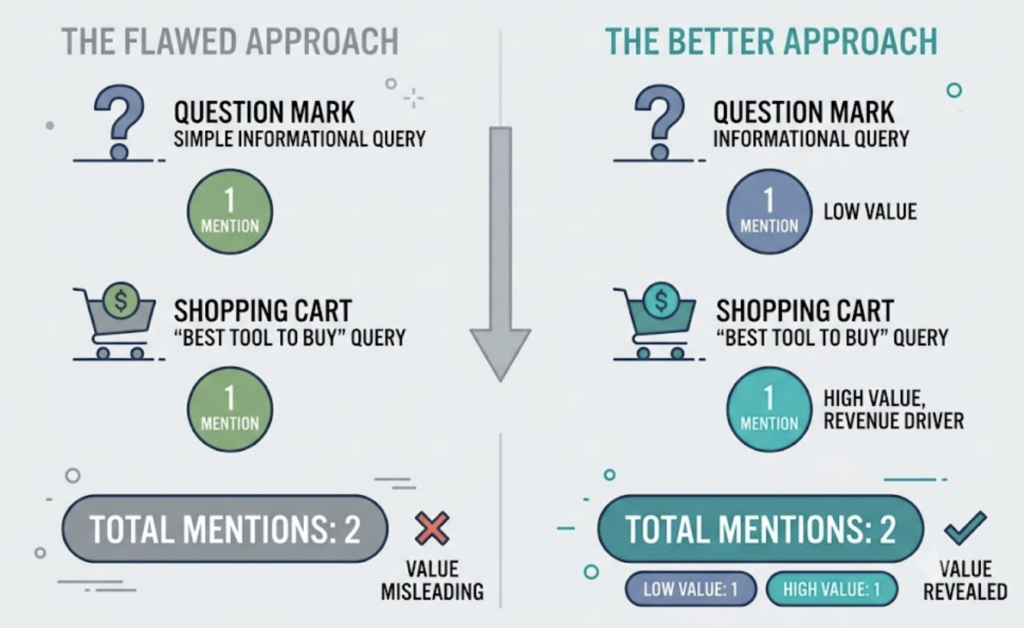
Dashboard vanity. Counting total mentions without segmenting by prompt intent. A mention in an informational answer and a mention in a “best tool to buy” answer are worth very different amounts, and lumping them together hides the ones that actually drive revenue.
The static-snapshot error. Treating AI visibility like a fixed rank you check monthly. Model updates and content changes shift answers week to week, so a snapshot can be stale before you’ve finished reading it.
Ignoring entity positioning. If your brand’s identity is fuzzy across the web, the model can’t confidently tie you to a high-intent category, so it leaves you out of the answer entirely.
How to Improve AI Visibility: A Strategy, Not a One-Off Audit
Improving AI visibility follows a loop, not a launch: monitor, identify gaps, optimize, re-measure, then repeat.
Start by establishing a baseline. Run a manual audit of roughly 20 high-intent category prompts across the major LLMs and record where you actually stand. You can’t improve drift you’ve never measured.
Then prioritize citations over raw mentions. Earning citations from third-party editorial sources the models already trust tends to carry more weight than a passing brand mention, because those sources feed directly into how the model assembles its answer.
Finally, don’t wall GEO off from SEO. Your technical foundation, crawlability and structured data, is the input data LLMs use to build answers. Weak fundamentals starve the model of clean material to cite.
The work is continuous because the target moves.
Choosing an AI Visibility Analytics System
By the time you’re comparing tools, the useful question isn’t which one has the prettiest dashboard. It’s which one closes the loop. Four criteria separate a real system from a passive monitor:
- Platform coverage: does it track ChatGPT, Perplexity, Gemini, and AIO, or just one?
- Citation-layer depth: does it surface the exact URLs the model cites, or stop at mention counts?
- Explanation: does it tell you why a number moved, or only that it moved?
- Action: can it turn findings into next steps, or does interpretation land back on you?
Topify is a useful reference point for what the full version looks like. Rather than stopping at a visibility score, it offers comprehensive GEO analytics across seven dimensions of brand authority, including recognition, recommendation rate, and trust signals, instead of one headline number.
On coverage, it monitors ChatGPT, Perplexity, Gemini, and Google AI Overviews in a single view, which is the practical answer to the perplexity vs google serp tracking split: you stop maintaining separate mental models for each engine and read them side by side.
Where a system like this earns its place is the action layer. When a citation slips, it points at the likely cause, a missing schema, an authority gap, a source that stopped referencing you, so the next move is obvious instead of a guess. In practice that means you can trace a drop in Perplexity mentions back to a specific URL that lost its citation, all inside the same dashboard.
On cost, professional platforms in this category typically start around $99/month, aimed at teams ready to move from passive monitoring to active GEO work. If you want to see your own baseline before committing to a process, you can get started with a category audit and work outward from there.
Conclusion
The uncomfortable truth from the opening still stands: your Google rankings can be excellent while AI quietly recommends someone else. An AI visibility analytics system exists to make that invisible gap measurable, by sampling real AI answers at scale, scoring how you show up, and tracking it over time.
Start small and concrete. Measure a baseline across 20 prompts, watch the citation layer instead of vanity mentions, and keep your technical SEO clean so the models have something trustworthy to cite. Visibility in AI search isn’t a rank you win once. It’s a position you hold by watching it.
FAQ
Q: What is an AI visibility analytics system?
A: It’s a continuous, closed-loop system that collects AI responses to intent-driven prompts, uses NLP to analyze how your brand is mentioned, cited, and framed, then turns that into time-series metrics. Unlike a rank tracker, it measures recommendation and citation, not link position.
Q: Can you give examples of what these tools actually measure?
A: Common metrics include visibility rate (share of prompts that mention you), citation share (mentions backed by a real URL credit), sentiment score, competitive share of voice, and drift over time. Together they tell you not just whether AI names you, but how favorably and how reliably.
Q: How is this different from Google SERP rank tracking?
A: SERP tracking measures where your link sits and assumes a click. AI search is largely zero-click and describes you in prose, so a strong SERP rank can coexist with a weak or negative AI description. The perplexity vs google serp tracking distinction is the core reason the two need separate measurement.
Q: How much does an AI visibility analytics tool cost?
A: Professional platforms generally start around $99/month. Topify’s Basic plan begins there with ChatGPT, Perplexity, and AI Overviews tracking, with Pro and Enterprise tiers for teams running more prompts and projects.

