

Your marketing team spent the last quarter optimizing landing pages, earning backlinks, and climbing Google rankings. Then someone asked ChatGPT, “What’s the best tool in your category?” and got five recommendations. Your brand wasn’t one of them. You wouldn’t have known if you hadn’t checked manually, and by the time you did, the algorithm had already moved on.
That’s the gap between checking and monitoring. One gives you a snapshot that’s already stale. The other gives you a system that catches shifts before they cost you pipeline.
Most Brands Check ChatGPT Once and Call It Monitoring
Here’s the thing about manual spot-checks: they feel productive but produce almost nothing usable. A marketing director runs a prompt in ChatGPT, screenshots the result, drops it in a Slack thread, and moves on. That’s not monitoring. That’s a one-time observation with zero statistical value.
LLMs don’t stay still. Researchers from Stanford and Berkeley found that over just three months, an LLM’s response accuracy on standardized tasks dropped from 85% to 50%. In brand visibility terms, tracking data across 2,500 prompts on Google AI Mode and ChatGPT showed that 40% to 60% of cited sources change on a month-to-month basis. The answer your brand appeared in last Tuesday might not include you by Friday.
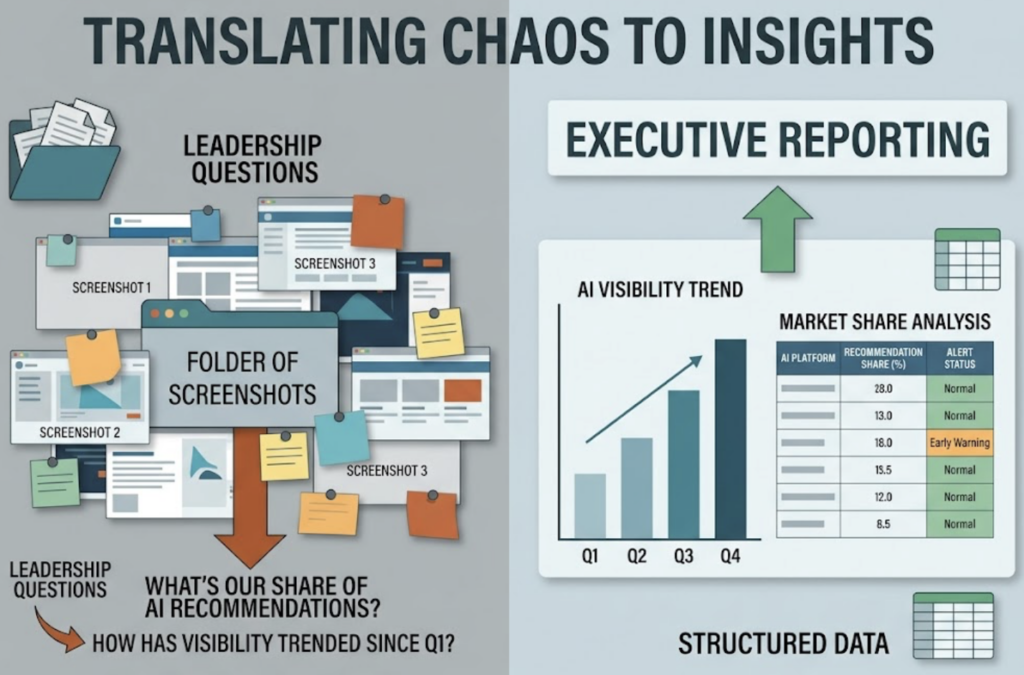
The real damage shows up in executive reporting. When leadership asks “What’s our share of AI recommendations?” or “How has visibility trended since Q1?”, a folder of screenshots can’t answer that. You can’t calculate market share from disorganized images, and you can’t detect early warning signs of algorithmic exclusion across thousands of potential prompts.
This isn’t hypothetical. In one documented case, a brand called “AcmeCloud” vanished entirely from Perplexity’s recommendations, replaced by smaller competitors who had stronger structured data on third-party review networks. No alert. No warning. Just gone.
What an AI Search Monitoring System Actually Tracks
A functioning AI search monitoring system isn’t a single tracker for keyword placement. It’s a multidimensional intelligence layer designed to reverse-engineer how Retrieval-Augmented Generation (RAG) pipelines decide which brands to mention.
When you track brand visibility in ChatGPT, you’re not measuring one thing. You’re measuring at least seven interconnected variables that collectively define whether your brand exists in AI-generated answers.
| Metric | What It Measures | Why It Matters |
|---|---|---|
| Visibility Score | % of tracked prompts where the brand appears | Executive-level benchmark, replaces traditional impression share |
| Position Rank | Ordinal placement within the generated response | In zero-click interfaces, first mention carries exponentially more weight |
| Sentiment Score | Algorithmic evaluation (0-100) of how the model frames the brand | Early warning for reputational drift in AI narratives |
| Citation Source | Specific URLs the LLM retrieved to build its answer | Reverse-engineers which third-party sites influence the algorithm |
| AI Search Volume | Estimated monthly frequency of a specific prompt across AI platforms | Prioritizes high-traffic, high-intent queries |
| Brand Mentions | Raw count of brand name appearances across all tracked responses | Measures footprint expansion regardless of prompt alignment |
| CVR | Estimated probability that a generated response drives brand conversion | Bridges visibility and revenue attribution in zero-click environments |
Why Visibility Score and Position Rank Are the Foundation
Traditional SERPs offer a gradient. Ranking on page two still provides peripheral exposure. LLMs don’t work that way. When someone queries ChatGPT, there’s no page two. Your brand either exists within the generated narrative, or it’s invisible.
Visibility Score quantifies how often you show up. Position Rank determines how prominently. On Perplexity, this matters even more: 86% of recommended brand mentions land in position five or earlier. That’s an incredibly tight shortlist with almost no room for late entries.
AI Sentiment Isn’t Social Media Sentiment
Many teams confuse these two, but they serve fundamentally different purposes. Social media sentiment analyzes human emotional output after someone uses a product. It’s reactive. AI sentiment evaluates how the model itself frames your brand during the discovery phase. It’s proactive. It shapes prospect perceptions before they ever become customers.
Current data shows LLMs generally default to positive framing: Gemini runs roughly 96% positive sentiment with only 0.3% negative, and ChatGPT sits at 94% positive. Perplexity holds the highest neutral share at 11%, reflecting a more journalistic posture. Any undetected degradation in these scores is an immediate red flag for underlying data drift.
How to Track Brand Visibility in ChatGPT, Step by Step
Moving from concept to execution requires a strict three-step rollout. Here’s how to build a monitoring system that actually produces usable data, using the capabilities of a unified platform like Topify.
Step 1: Define your prompt matrix.
Forget traditional keyword lists. AI engines synthesize complex conversational inputs, not exact-match keyword strings. Your monitoring scope needs to be built around prompt-level architecture.
Instead of tracking “CRM software,” you need to discover and ingest thousands of long-tail variations like “What is the most cost-effective CRM for a remote marketing team of 50 people integrating with HubSpot?” Topify’s High-Value Prompt Discovery algorithm continuously surfaces these high-intent prompts as AI recommendations evolve.
You also need to define your competitive perimeter. Track not just your own mentions, but which brands appear when yours doesn’t. This establishes “Share of Model,” the metric that tells you how often your brand dominates a response relative to industry rivals.
Step 2: Establish your baseline.
With your prompt matrix set, the system runs an initial crawl across target platforms to produce your first quantified AI Visibility Score. During this phase, the monitoring system executes prompts via API, parses the output using semantic analysis, detects your brand name, maps surrounding context, evaluates ordinal position, and computes initial sentiment scores.
Simultaneously, run a GEO technical audit on your own digital assets. This covers four pillars: Technical GEO (can AI bots find your content?), Content GEO (can AI extract it?), Entity GEO (does AI know who you are?), and Brand Authority GEO (does AI trust you?). Check E-E-A-T signals, JSON-LD schema markup, crawlability, and entity definitions. Topify’s free GEO tools can help you run this initial audit before committing to a full platform.
Step 3: Configure high-frequency polling and alerts.
Monthly monitoring is inadequate. AI models undergo silent updates, continuous data integration, and real-time retrieval adjustments. Data decays fast.
Set your system to execute tracking loops weekly at minimum, daily for highly competitive sectors. Topify tracks all seven metrics automatically and logs variance across cycles. The standard alert threshold: trigger a notification when any visibility metric drops more than 10% week-over-week. When a critical prompt drops 15% in visibility, your team gets notified, logs in, isolates the platform where degradation occurred, and traces the shift back to specific citation changes.
Why Single-Platform Tracking Gives You a False Picture
Limiting your monitoring to ChatGPT alone is one of the most common architectural mistakes teams make. ChatGPT processes over 800 million weekly users, but it’s not a universal proxy for all AI search behavior.
Different LLMs have distinct structural foundations, divergent training data, and fundamentally different “editorial personas.” They recommend different brands for the exact same query.
The numbers make this concrete. BrightEdge’s AI Catalyst research shows Gemini operates with an authority-to-UGC ratio of 130 to 1, drawing heavily from .gov domains (13% of sources) and .org domains (23%). Its top 10 most-cited domains account for 26.3% of all references. It’s an institutional recommender.
ChatGPT operates differently. Its top 10 domains represent only 18.5% of total citations, reflecting a much flatter, more diverse source distribution. Brands with widespread mentions across mid-tier industry journals often find significantly higher visibility in ChatGPT than in Gemini.
Perplexity is another story entirely. It concentrates roughly 30% of its citations across academic, medical, encyclopedic, and government domains, with the highest share of .edu citations (3.2%) in the market.
A cross-engine test for “best Spanish sneaker brands” produced 12 different brand recommendations across four engines’ top-three lists, with zero overlap.
Even within the same parent company, engines diverge. Google Gemini shares 39% citation overlap with ChatGPT, but only 27% overlap with Google’s own AI Mode. If your dashboard shows a top-tier ranking in ChatGPT but you’re being excluded from Google AI Overviews, which currently intercepts at least 16% of all traditional search traffic, you’ve got a massive blind spot.
Topify differentiates here by providing global engine coverage across ChatGPT, Google Gemini, Perplexity, Google AI Overviews, DeepSeek, Doubao, and Qwen. That’s where most Western-centric tools fall short.
Turning AI Search Monitoring Data into Action
A dashboard full of metrics is useless without an execution pathway. The real value of an AI search monitoring system is its ability to drive direct strategic action when the data signals a problem.
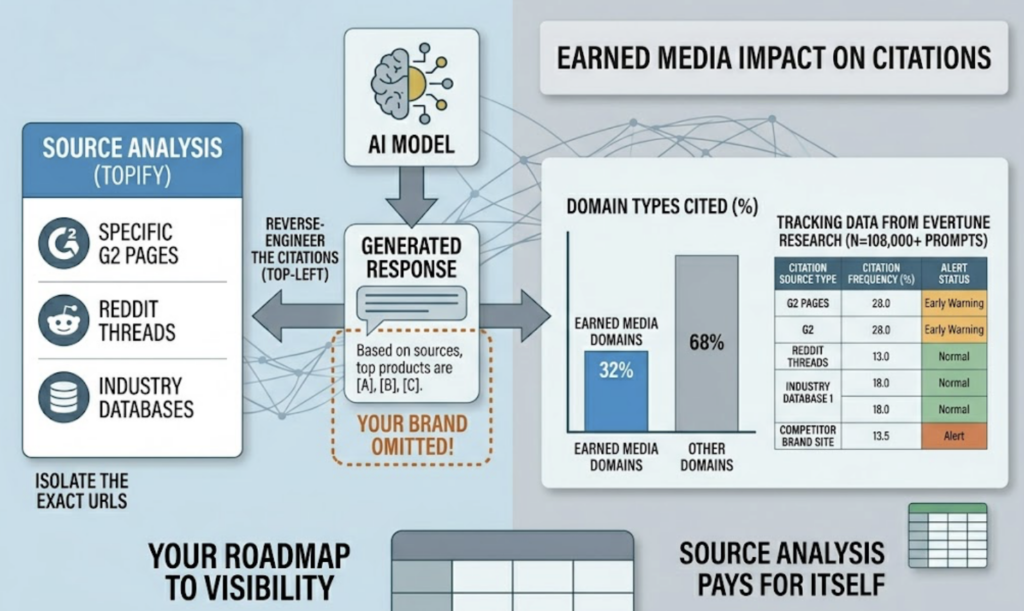
Reverse-engineer the citations. When your brand is omitted from an AI response, Topify’s Source Analysis lets you isolate the exact URLs the model used to build the answer that excluded you. If the AI repeatedly cites specific G2 pages, Reddit threads, or industry databases, you now have a definitive roadmap. Tracking data from Evertune Research analyzing over 108,000 unique product prompts shows that earned media domains account for approximately 32% of all domains cited by AI models. Knowing which earned media domains trigger citations is where Source Analysis pays for itself.
Benchmark against competitors. Track Share of Model across platforms to understand where you stand dynamically. If a competitor is gaining ground in Gemini while you’re stagnant, audit their recent PR or structured data deployments. Topify’s Competitor Monitoring spots emerging rivals in real time and shows exactly what’s driving their gains.
Structure content for machine synthesis. Academic research from Princeton University and Georgia Tech demonstrated that integrating specific structural elements, like statistics, authoritative citations, and data-driven formatting, can boost AI citation visibility by 30% to 40%. The monitoring system closes the loop: you apply optimizations, then track subsequent polling cycles to see if the model adjusts its weights.
Execute without friction. Topify’s One-Click Agent bridges the gap between insight and action. When the system identifies a content gap or a dropping visibility score, the agent parses high-performing competitor citations, drafts structurally optimized content strategies tailored to LLM recommendation algorithms, and lets your team deploy with a single click. Define goals in plain English, review the strategy, approve. No spreadsheet handoffs. Get started with Topifyto see this workflow in action.
Tools to Track Brand Visibility in ChatGPT and Beyond
The AI monitoring vendor landscape is expanding fast. Enterprise AI tool usage has grown nearly 600%, exceeding 3.1 billion monthly transactions in cloud environments. Here’s how the current options stack up.
| Tool | AI Engines Covered | Core Strength | Starting Price |
|---|---|---|---|
| Topify | ChatGPT, Gemini, Perplexity, Google AIO, DeepSeek, Doubao, Qwen | Full-stack telemetry, citation mapping, one-click execution | $99/mo |
| Nightwatch | ChatGPT, Perplexity, Google AIO | Traditional SERP + LLM sentiment integration | ~$99/mo |
| Lebesgue | ChatGPT, Perplexity, Google AIO | Zero-click attribution via first-party pixel tracking | ~$59/mo |
| Semrush AI Toolkit | Google AIO, ChatGPT (limited) | Bolted-on AI metrics within legacy SEO suite | $139/mo+ |
| Ahrefs AI Visibility | Google AIO, ChatGPT (beta) | Backlink-centric model of AI citation retrieval | $129/mo+ |
Topify stands out for two reasons. First, platform coverage: it’s the only tool in this list that natively tracks non-Western engines like DeepSeek, Doubao, and Qwen. Second, execution: most tools stop at data. Topify unites monitoring, strategy, and automated content deployment into a single platform. For teams that need to track visibility in ChatGPT and actually do something about the results, that closed-loop matters.
Conclusion
The gap between manually checking ChatGPT once a month and running a real AI search monitoring system is the gap between guessing and knowing. LLMs shift cited sources 40% to 60% month over month, different engines recommend entirely different brands for the same query, and a visibility drop can happen without a single alert if you’re not set up to catch it.
The path forward is straightforward. Define your prompt universe around bottom-of-funnel conversions. Establish a multi-engine baseline. Configure weekly polling with automated alerts. Then use a unified platform like Topify to close the loop from data to action. Brands that build this infrastructure now will see the shifts coming. The ones that don’t will keep finding out from screenshots that are already three weeks old.
FAQ
Q: What’s the difference between AI search monitoring and traditional SEO tracking?
A: Traditional SEO tracking measures static domain rankings on search result pages, heavily relying on backlinks and domain authority. AI search monitoring evaluates how a brand is synthesized into conversational responses generated by LLMs. It tracks entirely different metrics designed for zero-click environments, like Share of Model visibility, algorithmic sentiment, and citation overlap, because LLMs don’t index pages. They synthesize probability-based answers using retrieval-augmented generation.
Q: How often should I check my brand’s visibility in ChatGPT?
A: At minimum, weekly. Research shows 40% to 60% of cited sources change month over month, and model accuracy can degrade rapidly due to agent drift and ongoing safety updates. Best practice is to set up automated polling with alerts triggered by any visibility drop exceeding 10% week-over-week. Manual monthly checks simply can’t keep pace with how fast these models shift.
Q: Can I track brand visibility in ChatGPT for free?
A: You can establish an initial baseline using free entry points. Topify maintains a suite of free GEO tools that let you run preliminary visibility checks, estimate AI search volume, and gauge baseline performance before committing to a paid tier. That said, sustaining long-term automated tracking across hundreds of prompts, managing historical data drift, and deploying content optimization at scale requires a paid platform.
Q: What AI platforms should an AI search monitoring system cover?
A: At minimum, ChatGPT, Google Gemini, Perplexity, and Google AI Overviews. These engines process training data differently and recommend different brands for the same query. A brand highly visible in Gemini may be entirely absent from ChatGPT. Advanced global systems like Topify also cover emerging engines like DeepSeek, Doubao, and Qwen, which is increasingly important as non-Western AI platforms gain user share.

