

You’ve narrowed your shortlist to three AI search visibility platforms, and on paper they look nearly identical. Each one promises to track how ChatGPT, Perplexity, and Gemini talk about your brand. What none of the sales decks mention is what you hand over to use them: your prompt strategy, your target keywords, your competitive intelligence, all fed into an external system that probes public AI models on your behalf. That data is your search strategy in raw form. Most buyers study the dashboard and never ask where it goes.
That gap is why two platforms with the same feature list can carry very different risk.
What AI Search Visibility Actually Means
AI search visibility measures how often your brand gets mentioned, cited, or recommended inside answers generated by AI engines like ChatGPT, Perplexity, Gemini, and Google AI Overviews.
It’s a different target than a search ranking. Traditional search returns a list of links and lets the user pick. AI search synthesizes one answer from many sources, then presents it as the answer. The thing you’re competing for shifts from a position on a page to what the research calls synthesized authority: being treated as a credible enough source to fold into the reply.
Here’s the shift that trips up most teams. Success used to be a blue-link click. Now it’s citation authority, being the source a model selects when it builds its response.
How an AI Visibility Platform Turns Raw Answers Into AI Search Analytics
An AI visibility platform sits between raw model output and something a marketing team can act on. The work happens in four stages.
First, structured probing: the platform runs a curated set of high-value prompts across multiple AI engines. Second, synthesis parsing, where it ingests each unstructured response and normalizes it into structured data. Third, an analytics layer that tracks citation frequency, position in a recommendation list, and sentiment polarity. Fourth, an intelligence layer that compares that data over time.
That last layer is where AI search analytics becomes AI search intelligence. Analytics tells you a competitor got cited four times this week. Intelligence tells you why: cleaner schema, deeper content, a data point the model found quote-worthy.
The distinction matters at selection time. A platform that only counts mentions leaves you guessing. One that explains the gap gives you something to fix.
AI SEO vs AI Search Optimization: What Changes When Answers Replace Links
These two terms get used interchangeably, and they shouldn’t be. They describe different layers of the same problem.
| Term | What it covers | Where it operates |
|---|---|---|
| AI SEO | Technical and content adjustments like schema, entity recognition, and content structure that make your information machine-readable | The page and markup level |
| AI search optimization, or GEO | Influencing how the model makes its decision: conversational intent, entity authority, and quote-worthy data points | The model’s synthesis process |
The practical takeaway is the part that surprises SEO teams. Signals like backlink counts and keyword density are drifting away from AI performance. A page with zero backlinks can still hold high entity authority for a narrow topic, which makes it a preferred AI source.
That’s why your domain authority score can look healthy while your AI brand visibility quietly drops. We’ve broken that disconnect down further in a comparison of AI search visibility versus Google rankings.
AI Search Visibility Platforms Security Features: The Question Most Buyers Skip
Here’s the part procurement usually catches too late. To track your visibility, a platform has to ingest the questions you care about, the competitors you watch, and the keywords you’re chasing. That’s not telemetry. That’s your strategy.
Treating AI search visibility platforms security features as an IT checkbox is the mistake. It belongs in the core evaluation, right next to coverage and accuracy.
Run the same framework across every vendor on your list.
| Security dimension | Why it matters for AI visibility |
|---|---|
| Data isolation | Keeps your prompt strategy from being shared or used to train models serving other tenants |
| SOC 2 Type II | Confirms security controls held up over a period, not just on audit day |
| RBAC and SSO | Stops unauthorized access to competitive intelligence dashboards |
| Audit logs | Records who queried what, and which AI interactions ran |
| Encryption in transit and at rest | Protects proprietary search data from interception |
A Practical Security Checklist for Platform Selection
On a vendor call, five questions separate a serious platform from a risky one:
- Data retention: are prompt-level queries deleted after a set period, or kept indefinitely?
- Prompt isolation: can the vendor show that your prompt sets are segregated from other clients?
- Independent testing: does the platform run annual penetration testing or third-party security audits?
- Model governance: how does it connect to AI engines, is that traffic encrypted, and does it respect each provider’s terms?
- Data residency: under GDPR or similar rules, can the vendor tell you where your visibility data lives?
A platform that answers these cleanly has thought about more than its dashboard. Data security and compliance aren’t features you bolt on after signing.
What Strong AI Brand Visibility Tracking Looks Like in Practice
Good tracking does more than report a number. It closes a loop: see where you stand, understand why, then act.
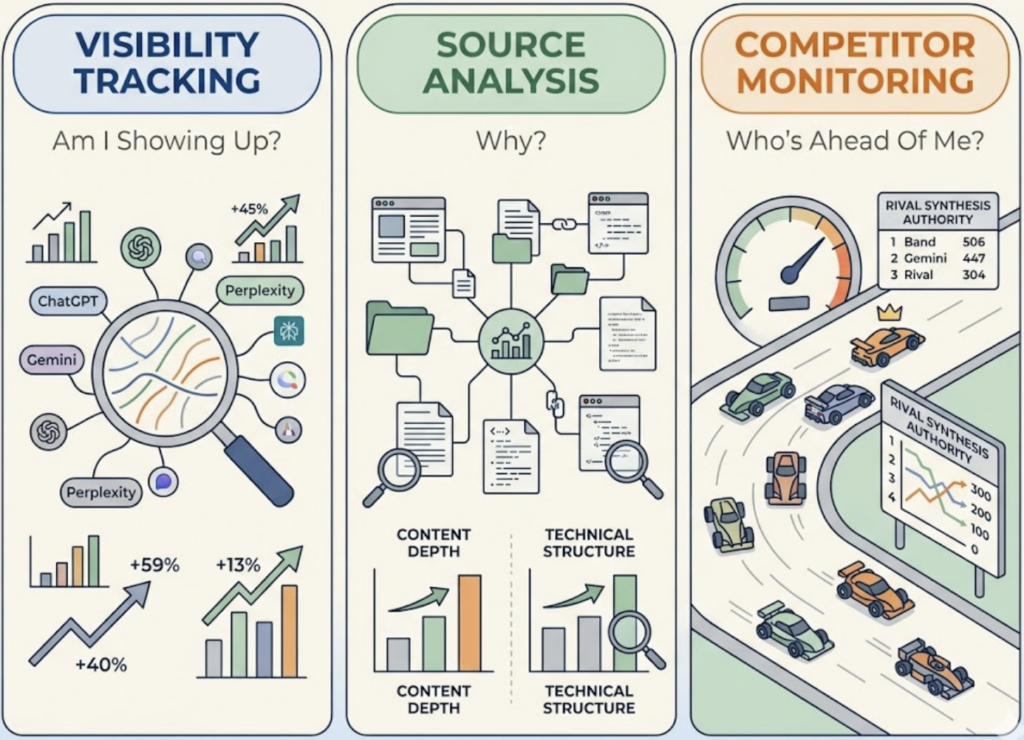
This is where Topify fits for teams measuring AI brand visibility across several engines at once. Three of its functions map directly to the questions buyers actually have.
Visibility Tracking answers “am I showing up,” monitoring how often your brand appears across ChatGPT, Gemini, Perplexity, and others. Source Analysis answers “why,” surfacing the exact domains and URLs AI engines cite so you can tell whether content depth or technical structure is winning the reference. Competitor Monitoring answers “who’s ahead of me,” tracking how rival synthesis authority moves in real time.
On the governance side, the same data isolation and access controls from the checklist above are what let a marketing team hand this to legal without a fight.
A reasonable starting path looks like this:
- Define a repository of 20 to 50 high-intent customer prompts.
- Baseline your current visibility rate by running probes across engines.
- Audit any competitor that keeps getting cited, checking their entity authority for cleaner schema or more comprehensive data.
- Iterate on your content structure, using FAQs, tables, and concise data summaries that match how models pull answers.
How to Start Measuring AI Search Visibility
You don’t need a six-month rollout to get a signal. Pick your ten highest-intent prompts, run them across the engines your buyers use, and write down who gets cited. That baseline alone usually surfaces a gap nobody on the team knew about.
From there, the platform earns its place by telling you what to change. To set up a live baseline, you can get started with Topify and probe your prompt set across engines in a few minutes.
Conclusion
The platforms on your shortlist will keep looking alike on the feature grid. The difference shows up in two places: whether the tool explains why you weren’t cited, and whether it can be trusted with the strategy data you feed it. Score both. A platform that nails coverage but can’t answer the five security questions isn’t a bargain, it’s a liability sitting next to your competitive intelligence. Define your prompts, set a baseline, and treat security as a selection criterion rather than a formality you handle after the contract is signed.
FAQ
Q: What should I look for in an AI search visibility platform?
A: Prioritize intelligence over raw analytics. The platforms worth shortlisting explain why you weren’t cited, cover multiple AI engines, and back it with verifiable security like SOC 2 and role-based access.
Q: How is AI search analytics different from traditional SEO analytics?
A: Traditional SEO measures your rank on a static page. AI search analytics measures synthesis authority, the probability that your brand gets selected and cited as a credible source inside a non-deterministic AI answer.
Q: Why do AI search visibility platforms security features matter so much?
A: These platforms ingest your core marketing and competitive strategy to do their job. Weak data isolation or open-ended retention can expose your search intent, which is exactly what you’d least want a competitor to see. Data security and compliance belong in the evaluation, not after it.
Q: Can I track AI brand visibility across multiple engines at once?
A: Yes. Look for structured probing that accounts for the different query fan-out logic each model uses, so your numbers stay comparable across ChatGPT, Perplexity, Gemini, and others.

