

Your SEO dashboard says everything’s on track. Domain authority is climbing. Keywords are ranking. Then your CMO asks, “Are we showing up when someone asks ChatGPT for a recommendation?” and you realize none of your existing tools can answer that question.
That gap is getting expensive. AI-driven search now accounts for 30% of all digital interactions, and roughly 60% to 69% of Google queries end without a single click to an external site. The brands winning in 2026 aren’t just ranking on page one. They’re being synthesized into AI answers across ChatGPT, Gemini, Perplexity, and a growing list of regional models.
Most AI Visibility Platforms Only Track One Engine. That’s a Blind Spot.
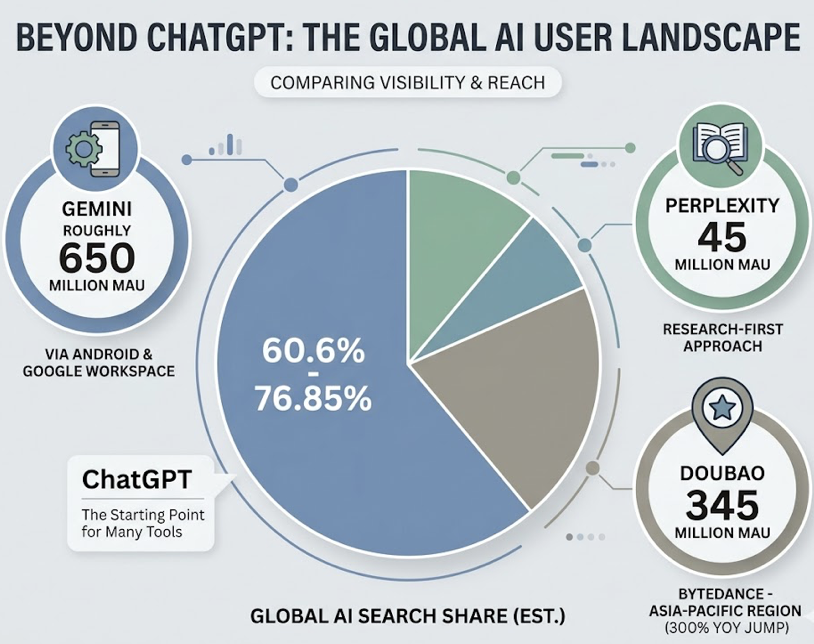
Here’s the thing most comparison lists won’t tell you: the majority of AI visibility tools still treat ChatGPT as the entire market. ChatGPT holds between 60.6% and 76.85% of global AI search share, so it makes sense as a starting point. But Gemini reaches roughly 650 million monthly active users through Android and Google Workspace. Perplexity has carved out 45 million MAU with its research-first approach. And in the Asia-Pacific region, ByteDance’s Doubao has hit 345 million MAU, a 300% year-over-year jump.
Tracking one engine and calling it “AI search visibility” is like monitoring your Google rankings and ignoring Bing, YouTube, and social search combined.
The real risk isn’t just incomplete data. Research shows that only 11% of businesses mentioned by one AI platform typically appear on a second platform for the same query. Your brand could rank first in ChatGPT answers and be completely absent from Gemini. Without multi-engine AI visibility metrics, you’d never know.
When evaluating any platform, four dimensions matter most: the number of AI engines tracked, the depth and accuracy of metrics, whether the platform covers Gemini and regional models, and whether data translates into action (not just dashboards).
5 AI Search Visibility Metrics Platforms, Ranked
Before diving into each platform, here’s a quick comparison across the dimensions that matter for AI search visibility tracking in 2026.
| Feature | Topify | Profound | Peec AI | Otterly AI | Alhena |
|---|---|---|---|---|---|
| Engines Tracked | 7+ (incl. Doubao, Qwen) | 10 | 9 | 6 | 4+ |
| Core Strength | One-Click GEO Execution | Query Fanout / Compliance | Gemini / Looker Studio | Lightweight GEO Audits | SKU Attribution |
| Gemini Support | Yes | Yes | Deep (specialized) | Yes | Limited |
| Entry Price | $99/mo | $99/mo | $199/mo | $29/mo | ~$295/mo |
| Best For | Growth / Global Brands | Enterprises / Agencies | Google-centric SEOs | SMBs | E-commerce |
Now let’s break down what each platform actually does, starting with the one that covers the most ground.
#1 Topify: Full-Spectrum AI Visibility Metrics Across Every Major Engine
Topify was built specifically for the post-SEO era, where brand visibility is a composite signal spread across multiple AI engines rather than a single ranking on a search results page.
What sets it apart is a seven-metric framework that goes well beyond simple mention tracking. Most platforms stop at “were you mentioned?” Topify measures how you were mentioned, where you were positioned, and what business valuethat mention carries.
The Seven Metrics That Define AI Search Visibility
Topify’s framework tracks visibility score (a normalized 0 to 100 index), mention frequency, recommendation position, sentiment analysis (scored from -100 to +100), volume/demand estimates, citation share, and conversion visibility rate (CVR). The CVR metric is particularly useful for marketing teams: it estimates ROI based on prompt intent, and high-intent commercial prompts convert at 4.4x to 23x the rate of traditional organic results.
That’s not a dashboard full of numbers for the sake of numbers. It’s a system designed to answer: “Is AI helping or hurting our brand, and where should we act first?”
AI Visibility Metrics on Gemini, Doubao, and Beyond
For teams that need ai visibility metrics across Gemini and other non-ChatGPT engines, Topify covers ChatGPT, Gemini, Perplexity, DeepSeek, Doubao, and Qwen from a single dashboard. This matters for global brands especially. Alibaba’s Qwen has recorded over 700 million cumulative model downloads worldwide, and Doubao dominates the Chinese market with 345 million MAU. Topify’s own research confirms that ChatGPT visibility is not a reliable proxy for Chinese model visibility.
From Data to Action: One-Click GEO Execution
Most AI visibility platforms stop at diagnostics. Topify adds an execution layer. When the system detects a “Visibility Gap,” where a competitor is being cited for a high-value prompt and your brand isn’t, it reverse-engineers the competitor’s citation source and generates a content strategy to close that gap. You define goals in plain English, review the proposed strategy, and deploy with a single click.
Pricing starts at $99/month for the Basic plan, which includes ChatGPT, Perplexity, and AI Overviews tracking with 100 prompts and 9,000 AI answer analyses. The Pro plan at $199/month scales to 250 prompts and 22,500 analyses. For teams ready to get started, there’s a 30-day trial on the Basic plan.
#2 to #5: Other AI Visibility Metrics Platforms Worth Considering
Profound
Profound targets enterprise teams in regulated industries. It tracks 10 AI engines and uses “Query Fanout Analysis” to simulate the recursive reasoning paths engines take before generating answers. SOC 2 Type II and HIPAA certifications make it a fit for fintech and healthcare brands. The Agency Growth plan starts at $99/month, with full Client Workspaces at $399/month. The trade-off: Profound focuses heavily on diagnostics but doesn’t offer an automated execution layer.
Peec AI
Peec AI is built for Google-centric SEO teams. It specializes in Gemini and Google AI Overviews tracking, with “quadrant views” for competitive benchmarking and native Looker Studio integration. If your team’s primary concern is ai visibility metrics on Gemini specifically, Peec offers deep coverage of the Google ecosystem. Starter plans begin at $199/month, with Pro tiers reaching $499/month.
Otterly AI
Otterly AI is the lightest option on this list, and that’s its strength. For mid-market teams that need prompt monitoring without enterprise complexity, it offers GEO audits focused on technical blockers (missing schema, crawlability issues) and a clean dashboard tracking brand coverage over 14-day intervals across six platforms. The Lite tier starts at $29/month, making it the most accessible entry point for small teams testing the waters.
Alhena
Alhena serves a specific niche: e-commerce brands that need SKU-level attribution. Instead of tracking brand mentions broadly, it connects AI visibility data to actual shopping assistant conversions. It tracks whether product cards in AI answers display pricing, ratings, and images, or just a text mention. Estimated pricing starts around $295/month. If your priority is AI shopping conversations rather than general brand visibility, Alhena is purpose-built for that.
What the Most Accurate AI Visibility Metrics Software Actually Measures
Not all AI visibility data is created equal. The non-deterministic nature of LLMs means the same prompt can produce different citations on consecutive runs. Research shows that even ChatGPT and Gemini vary their citations by 60% to 87% between repeated queries. A single-snapshot audit, in other words, is noise.
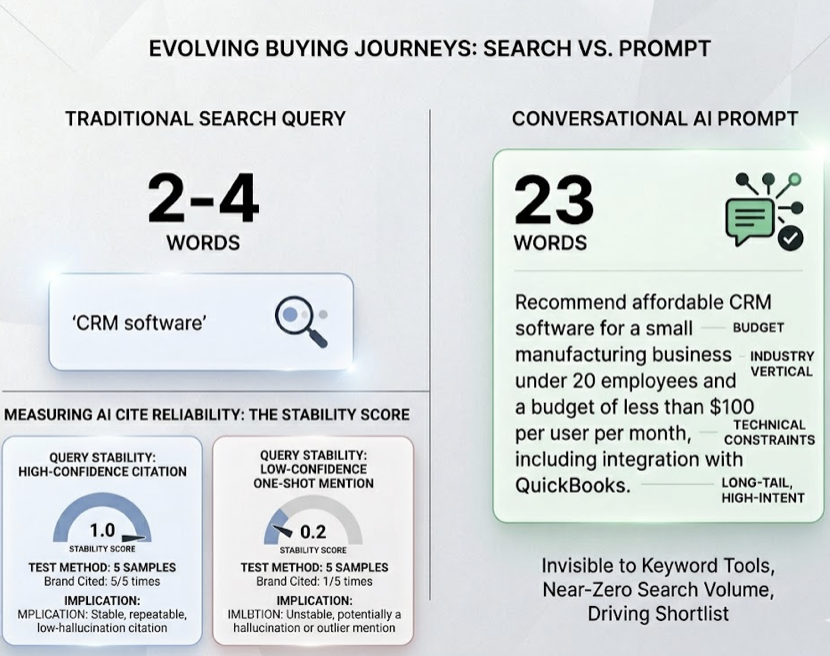
The most accurate ai visibility metrics software addresses this through what the industry calls a “Stability Score.” This metric is derived from running the same query multiple times (typically 3 to 5 samples) against each engine. A stability value of 1.0 means your brand is cited every time. A 0.2 score suggests a one-shot mention that could be a hallucination.
Geographic bias adds another layer. US-based queries generate citation rates roughly three times higher than non-US markets. Each platform also has distinct preferences: ChatGPT favors editorial sources like Wikipedia and Forbes, Perplexity leans toward community content like Reddit and G2, and Gemini prioritizes YouTube and Google-indexed sources. Any platform claiming “accurate” metrics without accounting for these biases is giving you an incomplete picture.
Then there’s Semantic Drift. Hallucination rates across major models still range from 15% to 52%. That means an AI might describe your premium product as a “budget alternative” or fabricate features you don’t offer. Researchers measure this using Embedding Similarity Scores, where a drop below 0.95 similarity between your official positioning and the AI’s synthesis signals a reputation risk. The best platforms for ai visibility metrics flag this automatically rather than leaving you to discover it manually.
How to Evaluate the Best Platform for AI Visibility Metrics
Choosing the best platform for ai visibility metrics comes down to five practical steps.
Start with a Prompt Matrix. Build a bank of 30 to 50 prompts that reflect how your buyers actually interact with AI. Cover three layers: informational queries (“What’s the best way to optimize for X?”), comparative queries (“How does Brand A compare to Brand B?”), and evaluation queries (“Is Tool X worth it for a team of 50?”).
Measure Share of Model, not just mentions. The Share of Model (SoM) framework divides your brand’s citations by total citations in the model’s response set, then multiplies by 100. This gives you a relative measure of influence rather than an absolute number that’s hard to benchmark.
Prioritize platforms that test for stability. If a tool runs a prompt once and reports the result as fact, that’s a red flag. Look for repeated sampling (3 to 5 runs minimum) and transparency about variance.
Check multi-engine and regional coverage. Your audience isn’t using one AI engine. The leading ai visibility metrics platform should cover ChatGPT, Gemini, Perplexity, and at minimum one regional model if you operate globally.
Look for action, not just dashboards. Data without a path to optimization is expensive trivia. Topify’s One-Click Execution approach, where diagnostics feed directly into a GEO content strategy, is one example of what “actionable” looks like. Content that includes inline citations to authoritative sources can boost AI visibility by up to 40%, adding precise statistics lifts it by 37%, and including expert quotes adds another 30%. The platform you choose should help you execute those tactics, not just report on the gap.
Conclusion
The question isn’t whether AI search visibility matters. It’s whether you’re measuring it accurately, across the right engines, with metrics that translate into decisions. Single-platform tracking and one-shot audits don’t cut it in a world where citation behavior varies by 60% to 87% between runs and 89% of brands visible on one AI engine are invisible on another.
The platforms on this list approach the problem from different angles. Topify covers the widest range of engines (including Gemini, Doubao, and Qwen) and pairs its seven-metric framework with automated GEO execution. Profound goes deepest on enterprise compliance. Peec AI specializes in the Google ecosystem. Otterly AI keeps it simple and affordable. Alhena zeroes in on e-commerce SKU attribution.
Pick the one that matches where your audience actually searches, not where you assume they do.
FAQ
Q: What are AI search visibility metrics?
A: AI search visibility metrics measure how often, where, and in what context your brand appears in AI-generated answers across platforms like ChatGPT, Gemini, and Perplexity. Core metrics typically include visibility score, mention frequency, recommendation position, sentiment, citation share, and conversion visibility rate. They’re distinct from traditional SEO metrics because AI answers are synthesized, not ranked.
Q: Which AI visibility metrics platform supports Gemini?
A: Most leading platforms now offer some level of Gemini tracking. Peec AI specializes in the Google ecosystem and offers deep Gemini coverage. Topify tracks Gemini alongside ChatGPT, Perplexity, DeepSeek, Doubao, and Qwen in a single dashboard. Profound and Otterly AI also include Gemini in their engine coverage, though with varying levels of depth.
Q: What’s the most accurate AI visibility metrics software for marketing teams?
A: Accuracy in AI visibility depends on how the platform handles the non-deterministic nature of LLMs. The most accurate ai visibility metrics software runs multiple samples per query (3 to 5 minimum) to establish a Stability Score, accounts for geographic and platform-specific citation biases, and flags Semantic Drift where the AI’s description diverges from your actual brand positioning. Topify and Profound both emphasize statistical baselines and repeated sampling in their methodology.
Q: How much do AI visibility metrics platforms cost?
A: Entry-level pricing ranges from $29/month (Otterly AI Lite) to approximately $295/month (Alhena). Topify starts at $99/month with a 30-day trial, and Profound’s Agency Growth plan also begins at $99/month. Peec AI starts at $199/month. Enterprise tiers across all platforms typically run $499/month and up, with custom pricing for large-scale deployments.

