

Your team spent months building domain authority, earning backlinks, and climbing Google’s first page. Then a prospect typed a 23-word question into ChatGPT, asking which tool fits their budget, their team size, and their compliance requirements. The AI returned five recommendations. Your brand wasn’t one of them.
Traditional SEO dashboards can’t explain why, because they weren’t built to measure what AI chooses to say. With zero-click search rates hitting 58.5% in the U.S. and AI-generated answer requests now reaching nearly 88% of human organic search volume, the gap between search rankings and actual brand discovery is widening fast. AI prompt tracking software exists to close that gap.
What AI Prompt Tracking Software Actually Measures
Most marketing teams think of AI visibility as a yes-or-no question: “Does ChatGPT mention us?” That’s the wrong frame. A mention is a signal of brand familiarity. A citation, where the AI links to your domain as an authoritative source, is what actually drives conversion.
AI prompt tracking software monitors how Retrieval-Augmented Generation (RAG) systems handle your brand at the prompt level. Unlike traditional search tools that map keywords to URLs, RAG-based engines break a user’s conversational prompt into semantic vectors, retrieve relevant text chunks from across the web, and synthesize a unique response. The output is probabilistic, not deterministic. Run the same prompt 100 times, and your brand might appear in 5% or 95% of those responses.
That’s why modern AI prompt tracking platforms measure a multidimensional matrix, not a single rank. The standard framework includes seven parallel metrics:
| Metric | What It Measures | Why It Matters |
|---|---|---|
| Mention Frequency | How often your brand appears in AI responses | Baseline awareness and entity recognition |
| Citation Share | How often the AI links to your URL as a source | Directly tied to high-intent referral traffic |
| Recommendation Position | Where your brand ranks in the AI’s list | First-position mentions capture outsized trust |
| Sentiment Quotient | How the AI describes your brand (positive, neutral, negative) | Catches mischaracterizations before they spread |
| Entity Confidence | How much third-party consensus backs your brand | Higher confidence = consistent shortlist inclusion |
| Intent Alignment | Whether the AI matches your brand to the right buyer persona | Ensures visibility drives revenue, not just impressions |
| CVR | Predicted likelihood a mention drives a transaction | Translates visibility into language the C-suite understands |
Here’s the number that makes this concrete: AI-referred visitors arrive pre-qualified by the conversational interface, with conversion rates up to 23 times higher than traditional organic search traffic. Tracking mentions without tracking citation quality is like counting impressions without tracking clicks.
Why Keyword Rankings Don’t Tell You What AI Says About Your Brand
A brand ranking #1 for “CRM software” on Google can be completely absent from a ChatGPT response to: “Which CRM is best for a remote sales team of 50 that needs deep Slack integration and HIPAA compliance?”
That’s not a bug. It’s how AI search works.
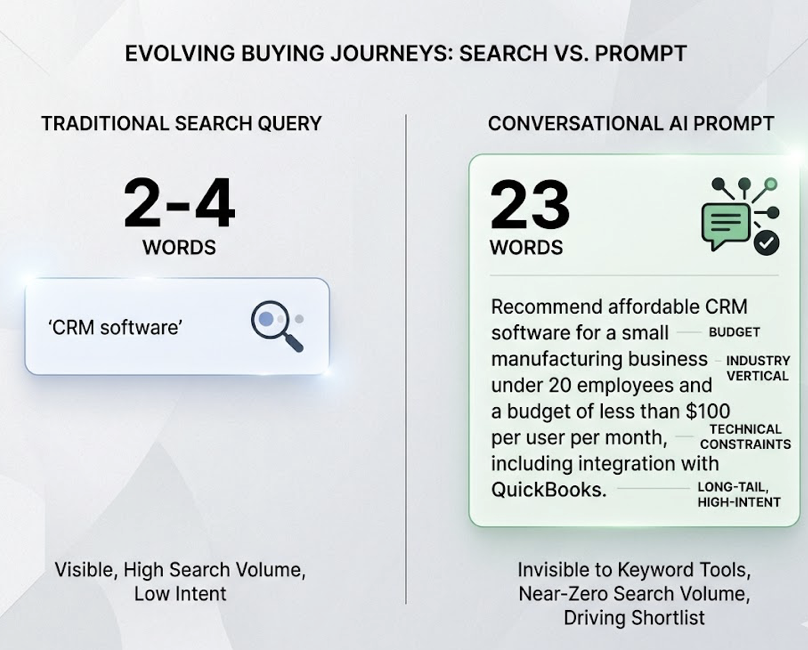
Traditional search queries average 2-4 words. Conversational AI prompts average 23 words, packed with qualifiers like budget, industry vertical, and technical constraints. These long-tail, high-intent prompts are largely invisible to traditional keyword tools because they have near-zero search volume on Google. Yet they’re driving the shortlist phase of B2B and D2C buying journeys.
The structural differences run deeper than query length:
| Dimension | Traditional SEO | AI Search (GEO) |
|---|---|---|
| Primary Unit | 2-4 word exact-match phrases | 15-30 word conversational prompts |
| Ranking Logic | Backlink authority, page speed | Extraction clarity, entity verification |
| Visibility Outcome | 10 blue links | A single synthesized recommendation |
| Source Authority | Domain-level link equity | Passage-level semantic accuracy and citations |
And there’s a platform fragmentation problem. The citation overlap between Google AI Overviews and ChatGPT is just 13.7%. A brand that’s visible in one AI engine may be completely absent from another. Without an AI prompt tracking tool that covers multiple platforms simultaneously, you’re seeing a fraction of the picture.
5 Features That Separate Useful AI Prompt Tracking Dashboards from Vanity Metrics
Not every AI prompt tracking dashboard delivers actionable data. Some just count mentions and call it a day. Here’s what actually moves the needle.
1. Multi-Platform Coverage
ChatGPT commands roughly 79% of conversational search traffic, but it’s not the only engine that matters. Google Gemini and AI Overviews capture users within the traditional search infrastructure. Perplexity dominates among researchers and analysts. Regional engines like DeepSeek, Doubao, and Qwen are critical for brands with global footprints. Any AI prompt tracking solution that covers only one platform is leaving blind spots.
2. Prompt-Level Granularity
Brand-level summaries hide the details that matter. You need to know which specific prompts trigger your brand, which ones trigger competitors, and how those patterns shift week to week. The most valuable AI prompt tracking systems surface the exact 23-word queries real buyers are using, not aggregated brand scores.
3. Citation Source Analysis
Here’s a stat that changes how you think about content strategy: 95% of AI citations come from third-party sources, not a brand’s own website. That means Reddit threads, G2 reviews, and niche industry publications are often driving your AI visibility more than your homepage. An AI prompt tracking analytics layer that reverse-engineers these citation sources tells you exactly where to focus your digital PR.
4. Sentiment and Hallucination Monitoring
Hallucination rates in major models range from 15% to 52% depending on query complexity. Your brand could be mentioned frequently but described inaccurately. High-end dashboards score brand descriptions on a 0-100 scale. A drop in embedding similarity signals “Semantic Drift,” where the AI begins misrepresenting your brand based on outdated or conflicting data.
5. Insight-to-Action Execution
Data without action is just a dashboard you stare at. The strongest platforms close the loop: identify the visibility gap, prioritize the fix, deploy the optimization. One-click execution that pushes content updates directly reduces the time between spotting a problem and solving it.
How Topify Tracks Prompts Across ChatGPT, Perplexity, and Beyond
Topify was built natively for the LLM era, not retrofitted from a legacy search engine tracker. Its founding team includes researchers from the forefront of AI and champion Google SEO practitioners, which shows in how the platform approaches prompt-level tracking.
The core philosophy centers on a three-stage Execution Loop: identify the visibility gap, prioritize the fix, deploy the optimization. That’s particularly relevant for SaaS teams, where buyers are 3x more likely to use AI for vendor research than in other sectors.
Here’s what the workflow looks like in practice.
High-Value Prompt Discovery continuously surfaces the exact prompts driving buyer decisions in your category. Not generic brand mentions, but queries like “best project management tool with SOC 2 compliance for healthcare” or “CRM with native Slack integration under $50/seat.” These are the prompts where visibility directly converts to pipeline.
Seven-Metric Tracking applies the full framework (visibility, sentiment, position, volume, mentions, intent, CVR) at the individual prompt level across ChatGPT, Perplexity, Gemini, DeepSeek, and other major AI platforms. You don’t just know whether you’re mentioned. You know how you’re described, where you rank, and which sources the AI is citing.
Real-Time Browser Rendering captures the live state of AI responses, not static API caches that can be days old. This matters because citation patterns in AI Overviews and ChatGPT can shift by more than 50% within a single month. Marketing teams using Topify react to what the machine is saying now, not what it said last week.
The results speak in specifics. One e-signature SaaS platform used a joint SEO and GEO strategy through the platform and achieved a 35% visibility uplift within 48 hours, eventually sustaining an average Top-3 recommendation position of over 81%.
Topify’s pricing starts at $99/month for the Basic plan (100 prompts, ChatGPT/Perplexity/AI Overviews tracking, 4 projects) and scales to $199/month for Pro (250 prompts, 10 seats). Enterprise plans start at $499/month with a dedicated account manager. Full details are on the Topify pricing page.
Mistakes That Quietly Wreck Your AI Prompt Tracking Strategy
Having the software isn’t enough. Teams still find ways to sabotage their own AI visibility.
Tracking only brand-name prompts. If you’re only monitoring “What is [your brand]?” you’re missing the 90% of high-intent queries where buyers ask about your category, not your name. “Best analytics platform for e-commerce under $200/month” is the kind of prompt that decides shortlists, and most brands aren’t tracking it.
Covering one AI platform and calling it done. With citation overlap between Google AIO and ChatGPT at just 13.7%, single-platform tracking gives you a false picture. A brand visible on ChatGPT might be invisible on Perplexity, where your analyst audience actually does their research.
Blocking AI crawlers. Some teams have updated their robots.txt to block GPTBot and PerplexityBot, fearing traffic cannibalization. That’s the equivalent of blocking customers. AI agents now drive requests at a scale nearly matching human search. Inaccessible content gets excluded from the AI’s entity confidence checks entirely.
Counting mentions without weighting quality. Here’s the uncomfortable truth: 85% of the sources ChatGPT retrieves never get cited in the final response. A raw mention count creates a false sense of security while competitors win the high-intent “Featured Citation” positions. Always track recommendation position and citation share alongside mention frequency.
Ignoring Information Gain. AI systems gravitate toward content that provides unique data points, original research, or specific case studies. If your content just restates what ten other pages already say, the AI has no reason to cite you. It’ll cite the primary source instead.
How to Get Started with AI Prompt Tracking Software
You don’t need to overhaul your entire marketing stack on day one. A phased approach keeps the transition manageable and the ROI visible early.
Phase 1: Establish your AI visibility baseline. Select 30-50 prompts that mirror real buyer intent in your category. Run each priority query 10-20 times across ChatGPT, Gemini, and Perplexity to build a statistically significant visibility score. Record which brands the AI currently favors, where your brand is absent, and which sources the AI pulls from.
Phase 2: Restructure content for AI extraction. Shift from “content creation” to “content architecture.” Add concise 40-60 word summaries at the top of each section (Atomic Knowledge Blocks). Convert features, pricing, and specifications into HTML tables, which are the strongest signals for comparison queries. Lead pages with clear, declarative answers in the first two sentences.
Phase 3: Build off-page authority across the AI’s source ecosystem. Since 95% of AI citations come from third-party sources, your presence on G2, Reddit, Capterra, and industry publications directly impacts your AI visibility. Use schema markup (FAQPage, Organization) and llms.txt files to give AI agents a structured map of your brand’s entities.
Technical foundations typically show impact within 4-8 weeks. Broader content architecture and off-page authority strategies generally require 3-6 months to shift an AI’s citation behavior.
Ready to see where your brand stands? Get started with Topify and run your first prompt audit in minutes.
Conclusion
The shift from ranked links to synthesized answers isn’t a future trend. It’s happening now, with AI answer requests at 88% of human search volume and zero-click rates above 58%.
AI prompt tracking software is how marketing teams adapt. It replaces guesswork with prompt-level data across every major AI platform, showing not just whether your brand gets mentioned but how it’s described, where it ranks, and which sources the AI trusts. Start with 30-50 high-intent prompts, establish your baseline visibility score, and build from there. The brands that track this now will be the ones AI recommends next quarter.
FAQ
Q: What is AI prompt tracking software?
A: AI prompt tracking software monitors how your brand appears in AI-generated responses across platforms like ChatGPT, Perplexity, and Google Gemini. It tracks metrics like mention frequency, citation share, sentiment, recommendation position, and conversion visibility at the individual prompt level, giving you a data-driven view of your brand’s AI search presence.
Q: How does AI prompt tracking software work?
A: It runs your target prompts across multiple AI engines repeatedly, collects the responses, and analyzes them for brand mentions, citations, sentiment, and position. Because AI outputs are probabilistic (the same prompt can produce different answers each time), the software runs hundreds of queries to build a statistically reliable visibility score rather than relying on a single snapshot.
Q: What’s the difference between AI prompt tracking and traditional SEO tracking?
A: Traditional SEO tracking measures keyword rankings and click-through rates on search engine results pages. AI prompt tracking measures whether your brand is included, cited, and positively described in AI-generated answers to conversational prompts. The two often don’t correlate: a brand ranking #1 on Google can be completely absent from ChatGPT’s recommendations.
Q: How much does AI prompt tracking software cost?
A: Pricing varies by platform and scope. Entry-level monitoring tools start around $29-52/month. Mid-market platforms like Topify start at $99/month for 100 prompts with multi-platform tracking. Enterprise plans with dedicated support and custom configurations typically start at $499/month and scale from there.

