

Your SEO dashboard says everything’s fine. Domain authority is climbing. Keyword rankings are stable. Then your CMO asks, “Are we showing up in Perplexity?” and you realize none of those numbers answer that question. Perplexity processed over 435 million monthly search queries by the end of 2025, grew to 45 million monthly active users, and is targeting one billion weekly queries by the end of 2026. That’s high-intent search traffic your current tools can’t see.
The gap isn’t just a missing platform. It’s a missing measurement layer: AI citation tracking, the practice of identifying which URLs and domains generative engines actually reference when they build an answer.
Most Perplexity Rank Trackers Only Show Half the Picture
There’s a structural problem with how most “AI-ready” tracking tools work. They’ll tell you whether your brand was mentioned first, second, or third in a generated response. That’s position tracking. What they don’t reveal is which source the AI read, trusted, and cited to produce that response in the first place.
That distinction matters more than it sounds.
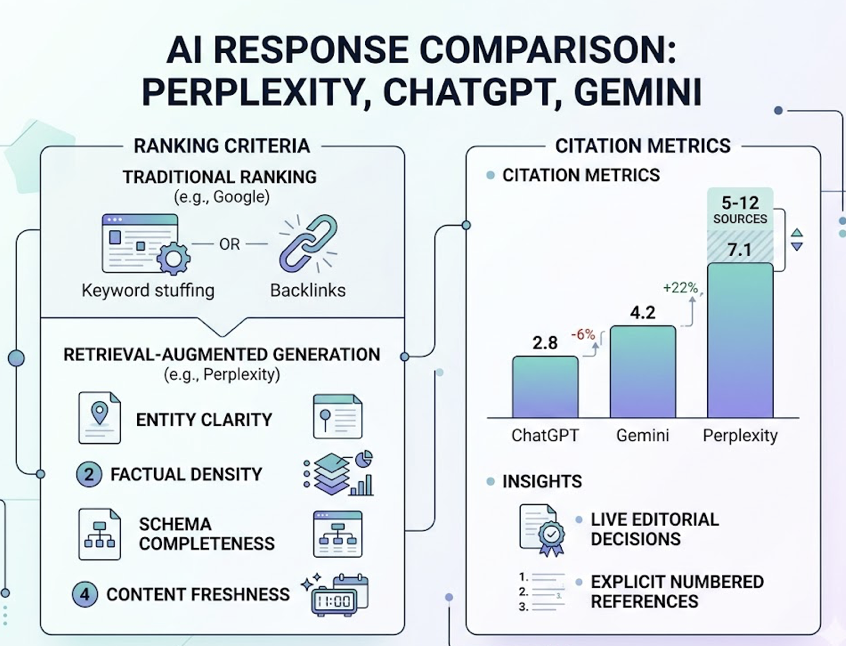
Perplexity doesn’t rank pages the way Google does. It runs a real-time retrieval-augmented generation system that bypasses traditional ranking signals in favor of entity clarity, factual density, schema completeness, and content freshness. Perplexity averages 7.1 citations per answer, pulling from 5 to 12 sources with explicit numbered references. Compare that to ChatGPT’s 2.8 and Gemini’s 4.2. Every answer is a live editorial decision, and the sources it selects are the ones that shape brand perception.
Here’s where it gets urgent: content decay on Perplexity is aggressive. Content updated within the last two hours gets cited 38% more often than similar content published a month earlier. For time-sensitive queries, visible decay begins within just two to three days.
If your tracking tool only confirms that your brand was mentioned but can’t tell you which URL earned that mention, you’re flying blind. You won’t know if the AI cited your product page, a competitor’s comparison article, or a three-year-old forum thread.
Tools that only monitor Perplexity also miss the broader picture. ChatGPT, Gemini, DeepSeek, and Qwen all have different citation behaviors. A complete AI citation tracking protocol needs to bridge all of them.
7 Best Perplexity Rank Tracking Tools for AI Citation Tracking
Not all tracking platforms are built equally. Some cover a single model. Others reverse-engineer the full citation graph across multiple generative engines. Here’s a quick comparison of the leading perplexity rank tracking tools on the market.
| Tool Name | AI Platform Coverage | Citation Tracking | Position Tracking | Starting Price |
|---|---|---|---|---|
| Topify | Perplexity, ChatGPT, Gemini, DeepSeek, Doubao, Qwen, AI Overviews | Yes | Yes | $99/mo |
| Omnia | Perplexity, ChatGPT, Google AI Overviews, Google AI Mode | Yes | Yes | €79/mo |
| Scrunch AI | 8 Major Platforms including Perplexity, Claude, ChatGPT | Yes | Yes | $250/mo |
| Peec AI | Perplexity, ChatGPT, Gemini, DeepSeek (115+ languages) | Yes | Yes | $95/mo |
| Rankability | Perplexity | Yes | Yes | $199/mo |
| Keyword.com | 10+ Models including Perplexity and Mistral | Yes | Yes | $24.50/mo |
| Semrush (Add-on) | Perplexity + 5 other platforms | Yes | Yes | $99/mo add-on |
#1 Topify
Topify is built specifically to reverse-engineer how large language models select, trust, and cite sources. It natively tracks Western models (ChatGPT, Gemini, Perplexity, Google AI Overviews) and Chinese models (DeepSeek, Doubao, Qwen), giving global brands a single pane of glass across the entire generative search ecosystem.
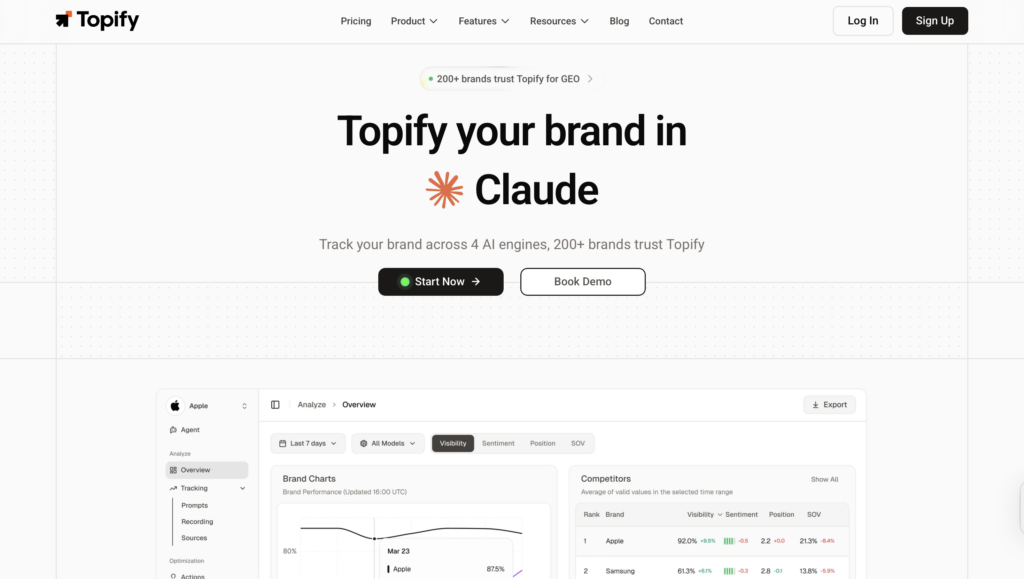
The platform’s core advantage is its Source Analysis Engine. When a generative platform builds a response, Topify decomposes the citations to show which structural elements satisfied the model’s retrieval threshold: embedded comparison tables, hyper-specific data points, or semantic paragraph structures that matched the query. This goes well beyond checking whether a brand name appeared in the output.
Topify organizes this data into a 7-Dimension Metric System: Visibility Score (mention frequency per 1,000 queries), Sentiment Quotient (brand framing on a 0 to 100 scale), Relative Positioning, Generative Search Volume, Mention Density, Intent Alignment, and Attributed Conversion Rate. You don’t just know if you’re mentioned. You know whether the AI positioned you as a top recommendation or a footnote alternative.
On the action side, Topify’s Competitor Monitoring flags instances where rival brands are cited and yours isn’t, generating a quantified Visibility Gap score. Its One-Click Execution Layer proposes content improvements based on that gap data, so teams can move from insight to action without manual spreadsheet workflows.
Pricing starts at $99 per month for 100 prompts across 9,000 AI answer analyses. For teams that need both the diagnostic depth and the execution layer, it’s the most comprehensive option on this list.
#2 Omnia
Omnia focuses on fast-growing startups and active content teams, starting at €79 per month. It tracks Perplexity, ChatGPT, and Google AI Overviews on a daily schedule with unlimited country and language support. Its standout feature is a strategic action layer that converts raw citation data into prioritized content tasks, bridging the gap between tracking and execution.
#3 Scrunch AI
Built for enterprise-grade security, Scrunch AI starts at $250 per month and holds SOC 2 Type II compliance with a zero data retention architecture. It monitors eight generative platforms using browser automation and APIs. Its unique Agent Traffic tracking correlates autonomous crawler activity (like PerplexityBot visits) on your site with subsequent citation shifts, offering diagnostic insight into how your content structure directly affects recommendations.
#4 Peec AI
Peec AI serves global brands needing multilingual coverage, executing daily synthetic prompts across more than 115 languages for $95 per month. It mechanically separates mere brand mentions from direct source citations, distinguishing between content that “informed” a model’s output and content that secured a clickable URL link. Native Google Looker Studio integration makes it agency-friendly for client reporting.
#5 Rankability
At $199 per month, Rankability targets SEO agencies looking to connect traditional metrics with generative visibility. Its Perplexity Analyzer logs citation lists and runs Citation Gap Analysis to highlight pages referencing competitors but omitting your brand. It bundles tracking with built-in content execution tools, including an autonomous writer and content optimizer.
#6 Keyword.com
Keyword.com offers the lowest entry point at $24.50 per month on a credit-based system. It monitors over ten models simultaneously, including Mistral alongside Perplexity. Its key differentiator is timestamped full-response snapshots, providing verifiable proof of when citations appeared and how surrounding sentiment shifted over time.
#7 Semrush AI Visibility Toolkit
For teams already using Semrush for traditional SEO, the AI Visibility Toolkit adds generative tracking as a $99 per month add-on. It monitors Perplexity alongside five other platforms and leverages Semrush’s 261-million prompt database for competitive benchmarking. It also includes a site audit feature designed to ensure your robots.txt and server configurations aren’t accidentally blocking AI retrieval crawlers.
What Perplexity Rank Tracking Software Actually Measures
Traditional SEO tools evaluate a linear output: where does a URL sit in a static list of blue links? Generative tracking measures something different: a probabilistic process that synthesizes sources in real time. Here are the four core dimensions the best perplexity rank tracker software captures.
Position Rank tracks the exact order in which a brand appears within a synthesized response. Users overwhelmingly trust the first recommendation an AI provides. A brand buried under “other options” at the end of a paragraph is functionally invisible.
Citation Share measures how often a generative model links to your specific domain or URL as a factual source. The distribution is steep: research into Google AI Overviews found that the top 1% of cited domains capture 47% of all citations. Pages using structured schema markup (FAQ, Article, HowTo) achieve a 2.3x higher citation inclusion rate than unstructured content.
Visibility Score quantifies your brand’s total presence across a defined set of prompts. Benchmarking data tracked by Topify shows the average B2B software brand holds a visibility score of just 2.1%, while top performers reach 11.8%. Financial services brands average 14.1%. Healthcare sits at a low 1.2% due to algorithmic caution around medical claims.
Sentiment Score evaluates whether the AI frames your brand positively, neutrally, or negatively on a 0 to 100 scale. High visibility with low sentiment (the model references your product but cites complaints or controversies) is arguably worse than low visibility.
The Economic Case for AI Citation Tracking
These metrics aren’t vanity numbers. Generative referral traffic converts at drastically higher rates than traditional organic search.
An Ahrefs internal analysis found that generative visitors accounted for 0.5% of total sessions but drove 12.1% of signups, a 23x conversion rate. The Opollo 2026 Benchmark, covering 312 tech firms, reported generative referrals converting at 14.2% versus traditional search’s 2.8%. Microsoft Clarity data shows Copilot referrals convert B2B subscriptions at 17x the direct traffic baseline, while Perplexity drives 7x higher sign-up conversion. These visitors are 33% less likely to bounce and spend 45% more time on site.
That’s why precise AI citation tracking is a revenue protection strategy, not a reporting exercise.
How to Track Your Brand’s Perplexity Rankings in 3 Steps
Step 1: Map Your Core Prompts
Generative search runs on conversational queries, not two-word keyword fragments. The first step is identifying the exact prompts your target audience types into Perplexity and other AI platforms.
Tools like Topify’s High-Value Prompt Discovery feature surface these prompts and score them using an Opportunity Score weighted by estimated query volume (30%), visibility gaps (25%), commercial intent signals (25%), and existing content readiness (20%). The goal is building a prompt matrix that covers every stage of the buyer’s journey, from “What is generative engine optimization?” to “Topify vs Semrush for AI search tracking.”
Step 2: Establish a Baseline and Map Citation Gaps
Once your prompt targets are set, run a diagnostic sweep to establish your current Visibility Score, Sentiment Quotient, and Citation Share across Perplexity and other models.
The most valuable output here is the Citation Gap Analysis: identifying high-value commercial queries where competitors are cited but your brand is completely absent. Research shows that 52% of generative citations come from listicles, review articles, and structured product pages. If your brand is missing from a major industry roundup that AI models trust, that gap will show up clearly in the baseline data.
Step 3: Monitor Continuously and Benchmark Competitors
Static reports are useless in generative search. Roughly 80% of all citations come from content published within the last two to three years, and Perplexity’s algorithmic decay for time-sensitive topics kicks in within 72 hours.
Configure your tracking tool for daily or weekly automated prompt execution. Platforms like Topify automate this loop, alerting your team if a competitor displaces your brand in a citation slot. If their frequency spikes, continuous monitoring lets you trace whether the cause was new schema data, fresh backlinks, or a press campaign, so you respond strategically instead of reactively.
Why AI Citation Tracking Matters More Than Perplexity Rankings Alone
Position rank tells you where you appeared. Citation tracking tells you why.
When a user submits a prompt to Perplexity, the system doesn’t pull from a pre-indexed list. It decomposes the query into sub-intents, sweeps its real-time index, reads and reranks retrieved content, then synthesizes an answer with a citation attached to every verifiable claim. If a competitor’s content has better factual density, fresher timestamps, or stronger structural markup, the algorithm cites them instead. Your brand gets displaced regardless of traditional keyword rankings.
The data backs this up. An Ahrefs analysis of 4 million URLs found that only 38% of URLs cited in AI Overviews also appeared in the top 10 organic results for the same query. BrightEdge reported an even lower overlap of roughly 17%. Domains with a Domain Authority of 60 or higher get cited four times more frequently, but even high-authority sites get skipped if their content lacks the entity clarity and structured data that models need for extraction.
That’s the core argument for citation tracking over rank tracking. A rank tracker tells you that your brand disappeared from a response. A citation tracker tells you that the model replaced your outdated whitepaper with a competitor’s freshly published, schema-optimized data study. One observation is passive. The other is actionable.
Conclusion
The shift from static search rankings to AI-generated answers is the largest structural change in digital discovery in two decades. Traditional rank trackers can’t identify the source URLs, sentiment framing, or content decay cycles that define how Perplexity and its peers construct answers.
To stay visible, adopt a full AI citation tracking protocol. Measure citation share. Monitor sentiment. Map prompt visibility gaps. Start with Perplexity, but don’t stop there. Platforms like Topify provide cross-platform coverage spanning ChatGPT, Gemini, DeepSeek, and beyond, so your brand earns the citations that keep it visible.
FAQ
Q: What is the best free perplexity rank tracker tool?
A: Enterprise-grade AI citation tracking typically requires paid infrastructure for large-scale synthetic prompt execution. That said, accessible starting points exist. Omnia offers a 14-day free trial on its Growth plan (no credit card required) plus a free AI Visibility Checker that runs 40 prompts across four generative engines. Topify provides a free real-time AI Visibility Checker that returns mention frequencies and sentiment breakdowns without upfront cost. For budget-conscious teams, Keyword.com starts at $24.50 per month on a credit-based model.
Q: How often should I check my Perplexity rankings?
A: At minimum, daily. Perplexity heavily rewards content recency, with visible algorithmic decay for time-sensitive queries starting within two to three days. Content updated within the last two hours is cited 38% more often than similar content published a month prior. Brands in competitive or fast-moving sectors should configure automated daily monitoring to catch citation shifts before visibility collapses.
Q: Can traditional SEO tools track Perplexity rankings?
A: Some can, with limitations. Semrush offers an AI Visibility Toolkit ($99/mo add-on) and Ahrefs has a Brand Radar feature ($199/mo). But these are built on databases designed for traditional SERP scraping and often rely on proxy metrics to estimate LLM behavior. For URL-level citation analysis, sentiment tracking, and autonomous optimization, purpose-built perplexity rank tracking tools deliver more actionable data.
Q: What’s the difference between AI citation tracking and rank tracking?
A: Rank tracking measures the ordinal position of a brand in a generated response (listed first, third, or fifth). AI citation tracking traces the specific source material the model used to generate that response: the exact URL, domain, or data point it referenced. A site can hold the number one organic ranking but have zero citation share if the model prefers a competitor’s structured, extractable content.

