

Your SEO dashboard says everything’s fine. Domain authority is climbing. Keyword rankings are stable. Then your CMO asks, “Are we showing up when someone asks ChatGPT for a recommendation in our category?” and nobody on the team has an answer. The uncomfortable truth is that traditional search metrics weren’t built to measure what generative AI chooses to say about your brand. And by the time you notice the gap, your competitors have already filled it.
The tools designed to close that gap are multiplying fast. But most of them measure fundamentally different things under the same label, which makes picking the right one harder than it should be.
Most AI Search Optimization Tools Only Track One Platform. That’s the First Red Flag.
The single biggest structural flaw in the current AI search optimization market is single-platform telemetry. The majority of first-generation tools were built exclusively around the OpenAI API. That means the “AI Visibility Score” on their dashboards is really just a ChatGPT Visibility Score.
In 2026, that’s not enough.
ChatGPT still dominates, processing roughly 250 to 500 million weekly queries and holding between 60.7% and 76.85% of the global AI chatbot market. But its share has entered a multi-month contraction. Google Gemini has surged to as high as 15% of the AI search market, driven less by standalone app adoption and more by deep integration into Android, Workspace, Gmail, and Chrome. Microsoft Copilot controls approximately 13.2% through its entrenchment in Windows and Office 365. Perplexity holds 4.2% to 7.73%, concentrated among researchers, financial analysts, and enterprise developers. Claude captures around 2.66% to 4.1% of long-context queries.
| Generative Search Platform | Estimated Market Share (Mid-2026) | Core User Demographic |
|---|---|---|
| ChatGPT | 60.7% – 76.85% | General Consumer / Prosumer |
| Google Gemini | 9.0% – 15.0% | Enterprise / Daily Consumer |
| Microsoft Copilot | 3.76% – 13.2% | Enterprise / B2B Users |
| Perplexity | 4.2% – 7.73% | Researchers, Developers, Analysts |
| Claude | 2.66% – 4.1% | Long-context Document Analysts |
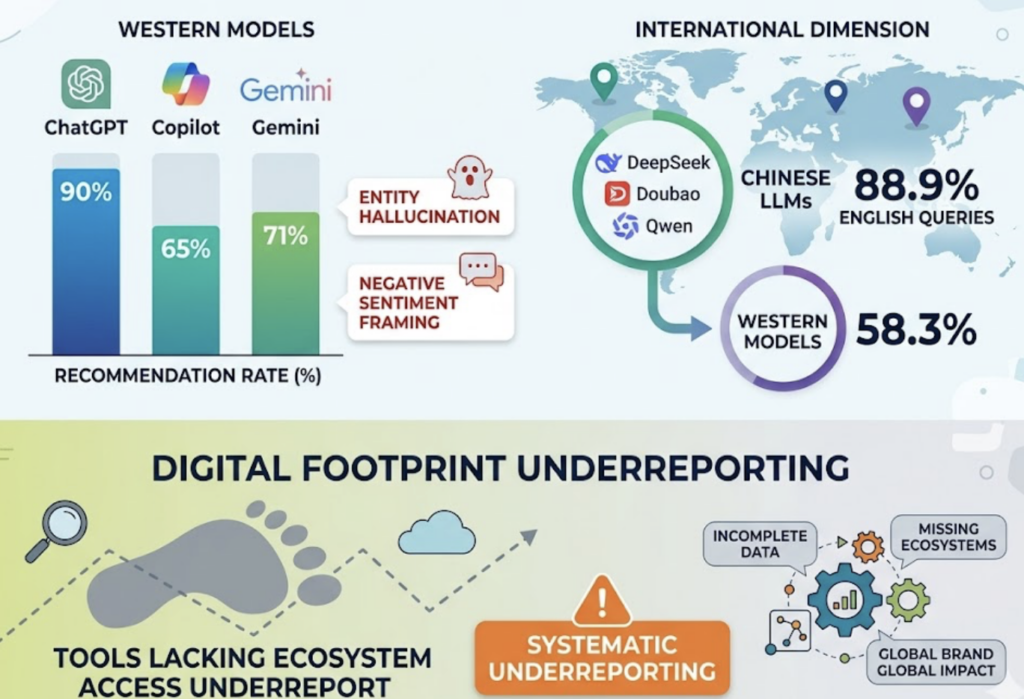
Different models hallucinate, retrieve, and synthesize data differently. A SaaS brand might enjoy a 90% recommendation rate on ChatGPT while suffering from entity hallucination or negative sentiment framing on Copilot or Gemini. The international dimension compounds the problem: Chinese LLMs like DeepSeek, Doubao, and Qwen mention brands at an 88.9% rate for English queries, compared to only 58.3% in standard Western models. Tools that can’t access this ecosystem systematically underreport a global brand’s digital footprint.
Before evaluating any platform, marketing teams should filter through five non-negotiable dimensions:
- Platform Coverage: Does the tool natively track Western models and high-influence international models?
- Metrics Depth: Does it go beyond binary mention rates to evaluate positioning, sentiment, volume, and conversion visibility?
- Competitor Tracking: Can it automatically detect narrative drift and share-of-voice shifts?
- Citation Analysis: Does it reverse-engineer the exact source URLs that inform model outputs?
- Pricing and Sampling Mechanics: Does at-scale prompt sampling (querying up to 100 times per prompt for statistical significance) fit within the budget?
These five standards separate superficial dashboards from real AI search optimization infrastructure.
AI Search Optimization Tools Worth Testing in 2026
When filtered through those five dimensions, the viable pool contracts fast. The market splits into two camps: native generative engine optimization platforms built for the probabilistic web, and legacy SEO tools that have bolted on AI tracking modules.
Here’s how the leading platforms compare:
| Rank | Platform | AI Platform Coverage | Competitor Tracking | Citation Analysis | Starting Price |
|---|---|---|---|---|---|
| #1 | Topify | ChatGPT, Gemini, Perplexity, DeepSeek, Qwen, Doubao | Dynamic Share of Voice mapping | Deep Source Reverse Engineering | $99/mo |
| #2 | Profound | 10+ models (incl. Grok, Claude, Meta AI) | Static competitive benchmarking | Bot-level indexation tracking | $99/mo (Lite) |
| #3 | ZipTie | ChatGPT, Perplexity, Google AI Overviews | URL-level extraction comparison | Diagnostic indexing verification | $69/mo |
| #4 | SE Ranking | Google AI Mode, Google AI Overviews, ChatGPT | Traditional organic vs. AI presence | “Not Cited” diagnostic flagging | $119/mo |
| #5 | Scrunch AI | ChatGPT, Perplexity, Gemini | Multi-brand narrative control | Persona-driven strategic insights | $250/mo |
| #6 | Semrush | Google AI Overviews, ChatGPT | Broad market share reporting | Content gap identification | $139.95 + $99 (AI) |
| #7 | Evertune AI | 8+ LLMs via direct API | Automated category tracking | Topic & Brand Relevance scoring | Custom Pricing |
One critical factor separates the top performers from the rest: probabilistic sampling. AI models generate different answers every time. Tools that don’t run a query dozens of times to establish statistical significance deliver fundamentally inaccurate data. The ranking above penalizes platforms that fail to account for this variance.
Why Topify Tracks What Other AI Search Optimization Tools Miss
Topify’s differentiation comes down to philosophy. Instead of treating generative search engines as black boxes that occasionally return URLs, Topify models them as probabilistic knowledge graphs that need to be audited, influenced, and continuously simulated. That architecture enables the industry’s widest model coverage: ChatGPT, Gemini, Perplexity, plus the Chinese ecosystem of DeepSeek, Qwen, and Doubao.
Four technical subsystems turn that philosophy into daily marketing decisions.
Visibility Tracking with Persona Simulation. Standard rank tracking is deterministic: you’re either in position three on Google or you’re not. Generative visibility is volatile. Research shows that only 30% of brands maintain consistent visibility across identical prompts from one query to the next. To counter this, Topify runs at-scale persona simulations. Instead of querying a generic keyword like “best office chair,” the system simulates a query from a “six-foot-tall user seeking an ergonomic chair for lower back pain during ten-hour shifts.” This forces the model to produce contextually specific outputs, letting marketing teams measure visibility across the exact long-tail prompts real users type.
Dynamic Competitor Monitoring. AI responses typically mention only three to five brands per query. The top-ranked brand captures an average of 62% of the total AI Share of Voice, and the gap between the first and third positions is typically five-to-one. Anything outside the top three risks total exclusion. Topify automatically detects a brand’s competitive set based on vector proximity within the LLM’s latent space and alerts teams to “Narrative Drifts” before a competing entity overtakes them in the recommendation hierarchy.
Source Analysis. In retrieval-augmented generation (RAG), AI doesn’t inherently know facts. It retrieves them from trusted external nodes. Topify reverse-engineers the exact publisher domains, forum threads, and technical documentation that influence platforms like Perplexity or Gemini to recommend a specific product. Marketing teams can then target digital PR and link-building efforts with precision.
One-Click Execution. Most ai search optimization tools present raw data and leave implementation to the marketing team. Topify’s integrated AI agent framework continuously analyzes incoming data, generates prioritized action feeds, formulates schema-rich content blocks, and prepares updates. A marketing manager reviews the draft, applies strategic judgment, and publishes with a single click to WordPress, Shopify, or Framer. Deployment cycles drop from weeks to minutes. Teams can get started here.
How Topify’s Metrics Connect to Real Decisions
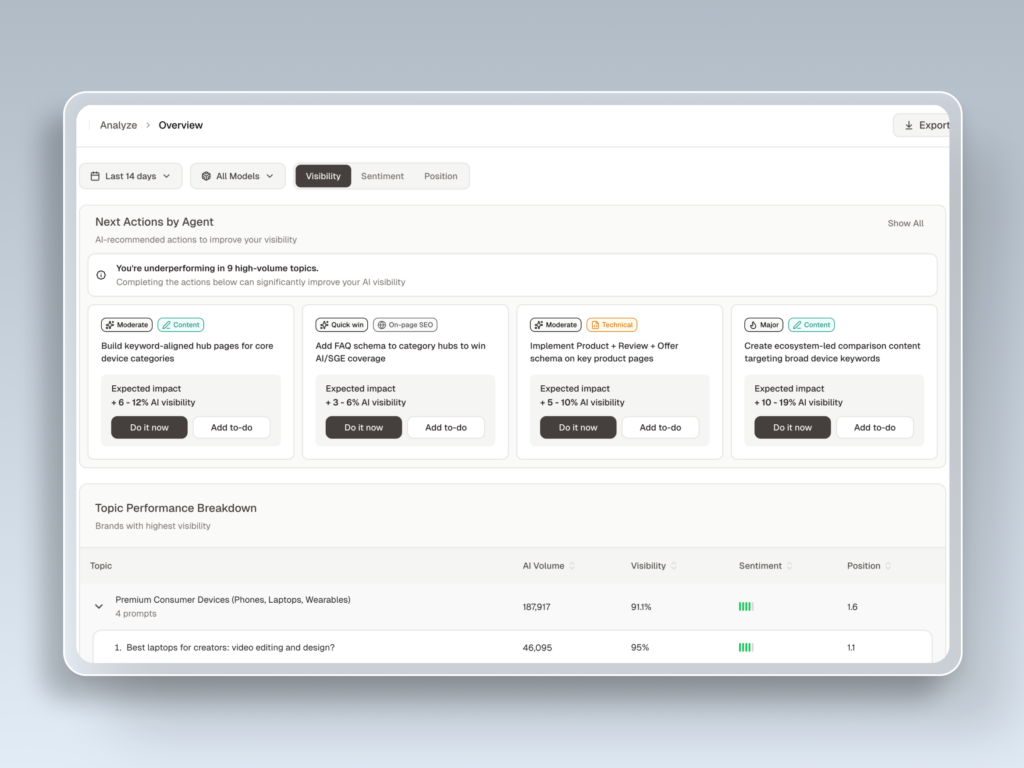
Topify organizes its telemetry into a seven-dimension metric system: Visibility, Sentiment, Position, Volume, Mentions, Intent, and Conversion Visibility Rate (CVR). Each metric maps directly to a specific marketing action.
Visibility Score quantifies the percentage of category-level generative queries that include the target brand. If you query ChatGPT with 100 prompt variations and appear in 48 responses, your score is 48%. A declining score signals an entity recognition failure. The fix: run an Entity Audit across your About Us page, Wikipedia, Crunchbase, and LinkedIn to eliminate conflicting data.
Sentiment Score measures how the model characterizes your brand on a 0-to-100 scale. Being described as “reliable but expensive” determines whether you appear in “best” or “affordable” category prompts. High visibility paired with low sentiment means the AI is actively warning users away. The fix: deploy structured, machine-readable “Direct Answer” content that explicitly counteracts negative framing.
Position Rank tracks ordinal placement in comparative AI lists. The first-mentioned brand in an AI output captures a 33.07% citation probability. A brand in the tenth position captures just 13.04%. If you’re mentioned but stuck in fourth or fifth place, the fix is source infiltration: identify the publications citing the top-ranked competitor and deploy digital PR to secure placements in those same knowledge graphs.
The metric that connects directly to the boardroom is CVR (Conversion Visibility Rate). It integrates with Google Analytics 4 and Shopify to attribute on-site revenue to AI citations. The numbers are striking: visitors from generative platforms like Perplexity convert at approximately 14.2%, and in specialized technical queries, up to 27%. Traditional organic search converts at 2.1% to 2.8%. When CVR proves that generative referrals drive outsized revenue, marketing leadership can justify reallocating budget from legacy PPC into generative engine optimization.
Other AI Search Optimization Tools: What Each Does Well
Profound operates at the apex of technical governance. Starting at $99/month but scaling past $499/month for full functionality, it specializes in log-level crawler analytics, monitoring exactly how bots like GPTBot or PerplexityBot interact with a brand’s server infrastructure. Its “Conversation Explorer” shows the exact language real users employ when querying AI engines. It’s the top pick for enterprise legal, compliance, and cybersecurity teams.
ZipTie serves a highly specific diagnostic function at $69/month. It captures real-time screenshots of ChatGPT carousels and Google AI Overviews, providing agencies with concrete visual proof of visibility. Its indexation audits diagnose whether AI systems are failing to extract content due to JavaScript rendering issues or malformed schema markup.
SE Ranking ($119/month) merges traditional keyword tracking with AI overview citations. It flags “Not Cited” errors: instances where a brand ranks well in organic search but is omitted from the generative summary above it. It’s the transition tool for SEO teams that want unified reporting.
Scrunch AI ($250/month) focuses on rendering websites mathematically readable for AI bots through its Agent Experience Platform (AXP). It restructures web pages into AI-friendly formats so crawling agents can extract brand entities without parsing unnecessary frontend code.
Semrush offers generative tracking as a $99/month bolt-on to its $139.95 base subscription. It synthesizes classical keyword tracking alongside Google AI Overviews and ChatGPT citations. It’s built for teams that want one dashboard for both traditional and AI metrics.
Evertune AI (custom pricing) approaches the problem through consumer psychology. Its “EverPanel” data pool of nearly 25 million users reveals the semantic attributes that AI models associate with entire market categories. It’s suited for CMOs aligning high-level brand positioning with probabilistic consumer language trends.
How to Compare AI Search Optimization Tools Without Getting Lost in Dashboards
Platform selection shouldn’t start with feature lists. It should start with your team’s constraints.
Lean B2B or mid-market brands should prioritize actionability. With limited headcount, you can’t dedicate 40 hours a week to deciphering probabilistic data. Reject platforms that offer passive, read-only monitoring. Look for CVR tracking, analytics integrations, and autonomous execution layers that connect insights directly to content deployment. A tool with an AI agent layer turns a single marketing manager into a full generative optimization unit.
Enterprise marketing teams across regulated global markets face different pressures: brand safety, compliance, and international scale. A multinational can’t optimize for ChatGPT while ignoring that its Asian market share is shaped by DeepSeek, Qwen, and Doubao. Enterprise procurement should focus on deep platform coverage, log-level crawler analytics, and the ability to simulate enterprise buyer personas across multiple language models.
Digital agencies need speed and proof. The operational bottleneck is proving ROI to clients who may not understand RAG theory or probabilistic variance. Prioritize unmetered team seats, visual screenshot evidence, and the ability to merge traditional SEO reporting with generative citations. Platforms with integrated content generation can automate technical restructuring of client assets, removing hundreds of manual hours from the workflow.
Conclusion
The utility of an AI search optimization tool isn’t defined by how much data it visualizes. It’s defined by what it actually measures and whether it connects those measurements to revenue.
A platform that confirms your brand was mentioned by a single LLM offers zero strategic advantage. True optimization requires global platform coverage, sentiment analysis, ordinal positioning, and direct revenue attribution. Start by baselining your brand’s presence across at least two to three distinct generative ecosystems, covering both consumer and enterprise applications. Then select infrastructure that connects semantic data to actionable deployment, so your team can systematically move from observation to execution.
FAQ
Q: What is AI search optimization and how is it different from SEO?
A: Traditional SEO focuses on improving algorithmic rankings to capture clicks on a search engine results page. AI search optimization, often called Generative Engine Optimization (GEO), focuses on ensuring a brand is recognized as an entity, favorably characterized, and explicitly recommended within the conversational outputs of large language models. SEO competes for a hyperlink. GEO competes for placement within the synthesized answer itself.
Q: How to compare AI search optimization tools for your team?
A: Evaluate beyond dashboards across five dimensions: breadth of AI platform coverage (including international models), depth of metrics (sentiment, ordinal position, not just mention rates), dynamic competitor tracking, source citation analysis to reverse-engineer AI trust nodes, and autonomous execution capabilities that connect insights to content workflows.
Q: What metrics matter most in AI search optimization?
A: Beyond basic visibility, the most actionable metrics are Sentiment Score (how favorably AI describes your brand), Position Rank (ordinal placement in comparative lists, where the top position captures 33% citation probability vs. 13% for position ten), and Conversion Visibility Rate (CVR), which links AI citations directly to on-site revenue.
Q: How much do AI search optimization tools typically cost?
A: Entry-level diagnostic tools range from $69 to $119 per month. Comprehensive mid-market platforms with multi-model tracking and execution capabilities typically run $99 to $399 per month. Enterprise solutions with log-level analytics and custom panel data start around $499 per month and scale upward based on query volume and governance requirements.

