

Your keyword rankings look solid. Your domain authority is climbing. But organic traffic from high-intent comparison queries dropped 30% last quarter, and your rank tracker can’t explain why. The gap isn’t in your SEO execution. It’s in what your tools are measuring. Google’s AI Overviews now intercept the click before users reach the blue links, and most tracking software reports the world as if that layer doesn’t exist. The brands capturing traffic in 2026 aren’t just ranking. They’re getting cited.
Google’s AI Overview Now Controls the Click. Here’s What Your Rank Tracker Misses.
As of March 2026, Google AI Overviews appear on roughly 48% of all search queries globally. That’s a 58% surge in prevalence since December 2025. The distribution isn’t random. Informational queries trigger an AI Overview about 36% of the time. Question-based queries hit 86%. And mid-funnel comparison queries, the exact searches that drive software evaluations and vendor shortlists, trigger an AI Overview 95% of the time.
The click impact is severe. Seer Interactive analyzed 2.43 billion impressions across 5.47 million queries and 53 enterprise brands. When an AI Overview is present, organic CTR for traditional results drops by 61% to 89%.
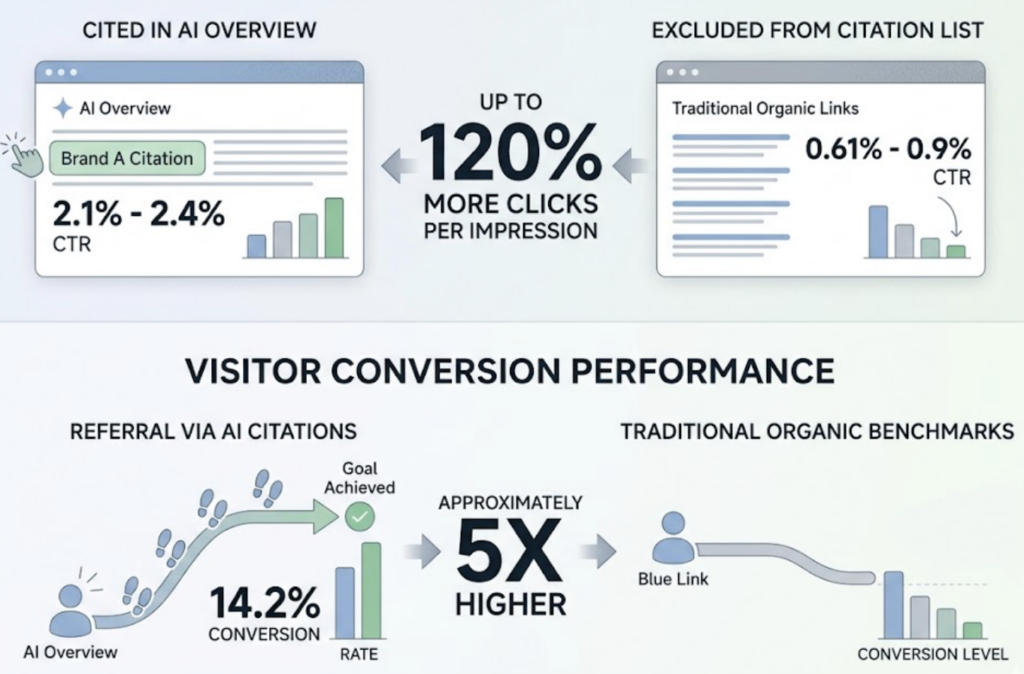
Here’s where it gets specific. When a brand is cited inside the AI Overview, CTR lands between 2.1% and 2.4%. When excluded from the citation list, CTR collapses to 0.61% to 0.9%. Being cited generates up to 120% more clicks per impression compared to uncited blue links. Visitors referred via AI citations convert at rates up to 14.2%, roughly five times higher than traditional organic benchmarks.
The overlap between top-10 organic results and AI Overview citations has deteriorated from 76.10% in mid-2025 to between 17% and 38% by early 2026. Roughly 62% of sources the AI cites don’t appear on the first page. The breakdown: 38% from the top 10, 31% from positions 11 through 100, and 31% from deep index pages beyond position 100.
A page at position 40 with dense, structured data is more likely to earn an AI citation than a vaguely written page at position one. That makes ai overview seo rank tracking the only methodology that reflects true search visibility in 2026.
What an AI Citation Tracking System Actually Measures
Not every “AI visibility tool” is an AI citation tracking system. The difference matters.
When an LLM generates a response, it references brands in two fundamentally different ways. Parametric mentions rely on pre-trained neural weights to output a brand name without executing a live search. Retrieval-based citations occur when the RAG infrastructure actively queries the live index, reads specific URLs, extracts verifiable data, and links those URLs as interactive footnotes. Traditional visibility scores blur these two together, which is why they’re unreliable as a standalone metric.
A true AI citation tracking system measures the RAG layer across three dimensions.
Source Domain Extraction. The system identifies the exact destination URL the AI relied on, not just the brand name. This granularity drives real optimization. AI models return to specific first-party content URLs at 4.31 times the rate they cite aggregated directory listings. Knowing the AI extracted the third paragraph of a technical whitepaper lets your team reverse-engineer the success and replicate it.
Citation Frequency and Share of Voice. This tracks how broadly an AI engine trusts a specific domain relative to competitors. Analysis of 1,000 AI Overviews found that citation share is hyper-concentrated: the top 1% of cited domains capture 47% of all available citations. The average AI Overview cites 4.2 domains per response. Capturing a dominant share of those limited slots is the primary KPI for modern SEO.
Position Rank within the generated response. AI position tracking measures the ordinal placement of a brand inside the synthesized answer. Whether a brand appears as the primary recommendation, a secondary supporting source, or a hidden reference carousel changes commercial impact dramatically. A system that evaluates both position and sentiment polarity, where the AI might cite a product but pair it with negative framing, is the only way to get the full picture.
Citation patterns also vary by model. Claude relies on user-generated content at two to four times the rate of competing models, while Google AI Overview distributions skew toward Reddit (2.2%), YouTube (1.9%), and Quora (1.5%). Independent brand websites remain the primary target for commercial extraction, which is why URL-level tracking across platforms is non-negotiable.
Best AI Overview Rank Tracking Tools in 2026
The enterprise SEO software market has split into two camps: legacy suites that bolted on generative tracking features, and native AI citation platforms built from the ground up for deep source extraction. Evaluating the best ai overview rank tracking software means looking at platform coverage, citation depth, and pricing viability.
Topify: Source-Level Citation Extraction
Topify is architected entirely around a proprietary Source Analysis engine. Where competing tools detect whether a brand name appears somewhere in AI-generated text, Topify’s engine extracts the specific destination URLs and embedded footnotes the AI used to synthesize its answer. Content teams can map exactly which pages are earning citations, identify the sub-topics the AI deems authoritative, and reverse-engineer competitor citation success at the URL level.
The platform unifies cross-platform tracking across ChatGPT, Gemini, Perplexity, DeepSeek, and Google AI Overviews within a single dashboard. It monitors seven metrics: AI Answer Inclusion Rate, Citation Rate, AI Share of Voice, Sentiment Polarity, Position Tracking, Information Gain Gap, and Referring Domain Baseline. Position Tracking detects ordinal sorting volatility in real-time.
Pricing starts at $99/month for the Basic plan (100 prompts tracked daily, 9,000 AI answer analyses, 4 projects). The Pro plan scales to $199/month with 250 daily prompts and 22,500 analyses. Enterprise plans start from $499/month with dedicated account management.
Semrush: Database Benchmarking Add-On
Semrush’s AI Visibility Toolkit costs an additional $99/month on top of standard subscriptions. It monitors Perplexity and five other platforms using a 261-million prompt database for competitive benchmarking. The trade-off: it relies on proxy metrics rather than automated URL extraction, and its single-domain restriction and limited custom prompts make it more of a macro visibility layer than a tactical ai overview rank tracking tool.
Ahrefs: Macro Brand Research
Ahrefs’ Brand Radar taps into 271 million organic prompts for broad citation and mention tracking. It’s strong for macro-level visibility auditing, but at $199/month on top of core plans (starting at $129/month), total costs exceed $328/month. Strict quota limits on custom prompt tracking position it as a historical research database rather than a daily optimization tool.
Frase: Content-to-Citation Loop
Frase takes a content optimization angle, starting at $49/month. It tracks visibility across up to eight AI platforms and features a proprietary “Content-to-Citation closed loop” that identifies AI visibility gaps and generates content briefs to close them. For small teams focused on content production, it’s a practical entry point.
SE Ranking: Unified SEO Dashboard
SE Ranking integrates AI tracking into its core SEO suite, sharing one interface for traditional keyword positions and AI Overview citations. Its “Source Intelligence” feature identifies frequently cited domains across a keyword set. Adding the AI module to the $129/month base pushes costs past $270/month at high prompt volumes.
| Tracking System | Platform Coverage | Core Tracking Dimension | URL-Level Depth | Starting Price |
|---|---|---|---|---|
| Topify | ChatGPT, Gemini, Perplexity, DeepSeek, Google AIO | Source Analysis + Position Tracking | Exact URLs and Footnotes | $99/mo |
| Semrush | Perplexity + 5 others | Database Benchmarking | Visibility focused | ~$238/mo |
| Ahrefs | Google AIO, ChatGPT, Perplexity, etc. | Macro Brand Research | Database driven | ~$328/mo |
| Frase | 8 platforms incl. ChatGPT, Google AIO | Content Gap Diagnosis | Brief Generation | $49/mo |
| SE Ranking | Google AIO, Gemini, ChatGPT, Perplexity | Unified SEO Dashboard | Source Intelligence | ~$270/mo |
Free AI Overview Rank Tracking Options Worth Testing
For teams without immediate enterprise budgets, several free ai overview rank tracking tools provide foundational data.
Topify’s free tier connects to Google Search Console and processes up to 50,000 rows of data per day. It delivers Pages reports, Clicks reports, Position reports, and CTR reports alongside basic Brand Tracking. Automated multi-platform prompt extraction is reserved for paid tiers, but as a starting point for spotting organic traffic degradation, it’s the fastest path to baseline data.
SEO PowerSuite’s free desktop Rank Tracker uses your own IP to scrape SERP features, simulating human browsing to capture hyper-local visibility. The free edition supports unlimited keyword tracking and records SERP snapshots so you can manually verify which domains are cited in AI Overviews.
The limitations of ai overview rank tracking free options are predictable: manual verification doesn’t scale, local scraping risks IP throttling, and most free tools only cover Google AI Overviews. For single-campaign baselines, they’re valuable. For ongoing competitive intelligence, paid platforms close the gap.
How to Build Your AI Citation Tracking System Step by Step
Deploying an AI citation tracking system isn’t just buying software. It’s building a continuous intelligence loop that governs content strategy.
Step 1: Define tracking scope and keyword architecture. AI Overviews aren’t deployed uniformly. Transactional queries trigger them about 5% of the time. Comparison queries trigger them 95% of the time. Your tracking scope should prioritize mid-funnel, informational, and comparison queries where the AI actively synthesizes vendor data. Specify which platforms matter for your audience. A B2C publisher may focus on Google AI Overviews and Gemini. A B2B SaaS team may depend entirely on Perplexity and ChatGPT. Using Topify’s centralized dashboard, teams configure tracking parameters across these distinct engines simultaneously.
Step 2: Establish your analytical baseline. Before optimizing, document current state. Record the percentage of target queries triggering AI Overviews, your citation inclusion rate, and your competitor map. The top 1% of cited domains capture 47% of all AI citations, so identifying who holds that dominance is the first priority. Join this data with Search Console telemetry to quantify revenue risk from uncited queries.
Step 3: Configure continuous monitoring. LLMs are non-deterministic. A baseline from Monday is stale by Friday. Daily tracking for high-value commercial queries and weekly monitoring for informational clusters is the standard. Topify’s Position Tracking module calculates moving averages to smooth daily noise. The system should also archive evidence: generative answers are ephemeral, and an archived trail of exact text, layout, and footnotes on a specific date is required for performance attribution.
Step 4: Close the optimization loop with Source Analysis. When citation visibility drops, deploy Source Analysis to answer the real question: which competitor URL did the AI choose instead, and what advantages does it have? Maybe they added a novel statistic, better JSON-LD schema, or structured specs in a machine-readable table. Author a content brief designed for AI extraction, deploy the update, and let continuous monitoring measure the citation lift. That’s the ai overview seo rank tracking workflow that turns data into pipeline.
What Changes When You Track AI Citations at the Source Level
Source-level tracking changes how a team thinks about content. It moves the conversation from “where do we rank” to “why does the AI cite that page and not ours.” That’s a different kind of optimization entirely.
The data backs this up. Pages with structured schema markup get cited 2.3 times more frequently than unstructured equivalents. Long-form pages exceeding 2,500 words with dense, named sources earn a 2.1x citation lift. And recency is heavily discounted for non-news queries: the median age of a cited page is 14 months. AI models prioritize established entity authority over freshness.
Princeton, Georgia Tech, and IIT Delhi formalized these patterns into Generative Engine Optimization (GEO). Their research isolated “Semantic Completeness” as the strongest predictor of AI citation (0.87 correlation). Injecting authoritative external citations yields a 115% lift in AI visibility. Specific statistics increase visibility by 37%. Promotional language triggers a 26% penalty.
The underlying principle is Information Gain. Content that merely restates consensus gets absorbed without attribution. Content that contradicts consensus gets flagged as a hallucination risk and ignored. The sweet spot: establish consensus, then provide something novel, a proprietary statistic, original research, or analysis the LLM needs to build a complete answer.
Teams that operationalize these principles see measurable results. A B2B SaaS company restructured core pages based on AI visibility data, improving citation rates from 8% to 24% within 90 days, generating 47 pipeline leads and $64,000 in closed revenue (288% ROI). A Webflow agency pivoted content architecture toward ChatGPT and Perplexity optimization, driving 10% of total organic traffic from AI citations, with 27% of that traffic converting into sales-qualified leads.
Those aren’t theoretical projections. They’re what happens when tracking data at the source level becomes the input for content strategy.
Conclusion
Traditional rank tracking still matters. But it no longer tells the complete story. AI Overviews intercept up to 61% of potential clicks on high-value queries, and the sources they cite often don’t match top-10 organic results.
The fix isn’t a single tool. It’s a system: scope your keywords, baseline your citations, monitor continuously, and close the loop with source-level analysis. Pick one high-value commercial keyword, deploy an AI citation tracking system to track its generative behavior, and start optimizing for the layer that’s controlling the click. Get started with Topify to see where your brand stands in AI search today.
FAQ
Q: What’s the best ai overview rank tracking software for small teams?
A: Topify’s $99/month Basic plan delivers URL-level Source Analysis and cross-platform tracking without enterprise overhead. Frase at $49/month is a strong alternative for content-focused teams. Legacy tools like Ahrefs and Semrush are powerful but often push total spend past $300/month with required add-ons.
Q: Can free ai overview rank tracking tools provide accurate data?
A: Yes, within narrow limits. Desktop tools like SEO PowerSuite’s free tier capture accurate SERP snapshots of Google AI Overviews. But manual verification doesn’t work across thousands of queries, local scraping risks IP throttling, and free tools generally can’t track Perplexity, Gemini, and ChatGPT simultaneously. They’re useful for single-campaign baselines, not ongoing intelligence.
Q: How often should I check my AI overview SEO rank tracking data?
A: LLMs are non-deterministic, so generative answers fluctuate with every index refresh. High-value commercial and comparison queries should be monitored daily to catch micro-shifts in citation share. Broader informational keyword clusters can typically run on a weekly cadence to track long-term entity authority development.
Q: What’s the difference between AI citation tracking and traditional rank tracking?
A: Traditional rank tracking measures the ordinal position of a URL within standard blue-link results, such as ranking third on Google. AI citation tracking measures whether an LLM actively retrieved, read, and cited a brand’s specific URL as a footnote or reference inside a dynamically generated response. One monitors the links below the AI answer. The other monitors the sources inside it.

